It's the first time in the history of the world.
On August 30, 2026, the Master of Probability, Hugo Duminil-Copin, winner of the 2022 Fields Prize, wrote with sadness:
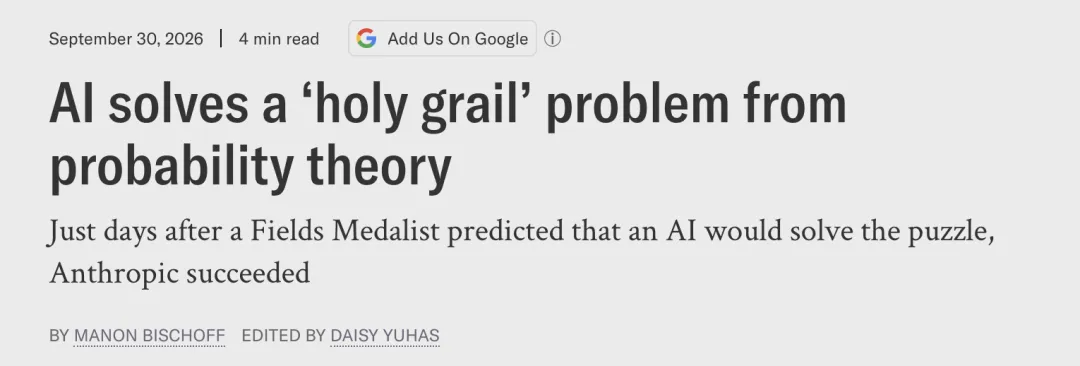
It's probably only a matter of time before the most famous speculation in our field falls under the hype of AI.
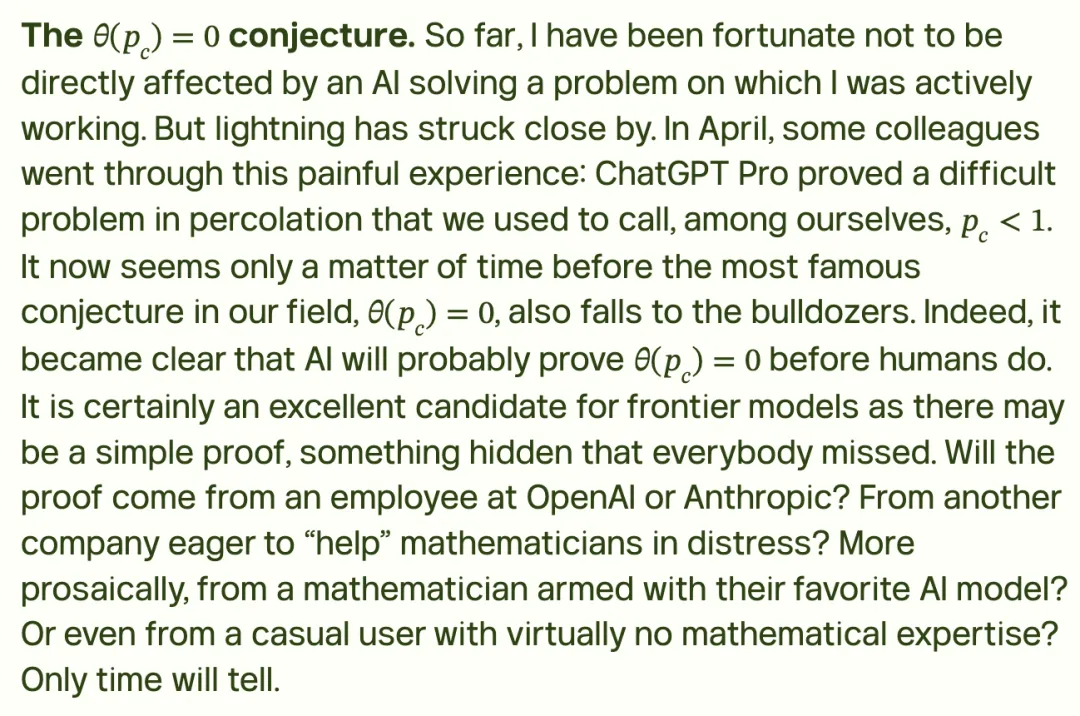
He talks about the half-century-old problem of probability in mathematics, the "Holy Grail".In the theory of flow, there is a continuous shift in conjecture: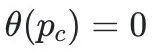 Guess what?。
For this issue, the winner of the Fields Award has spent years shedding blood and losing battles.
But what was unexpected to everyone was:The real drama is more magical than the prophecies.
Almost as soon as his article was published, colleagues suddenly discovered a code repository that Anthropic engineers had just submitted on GitHub.
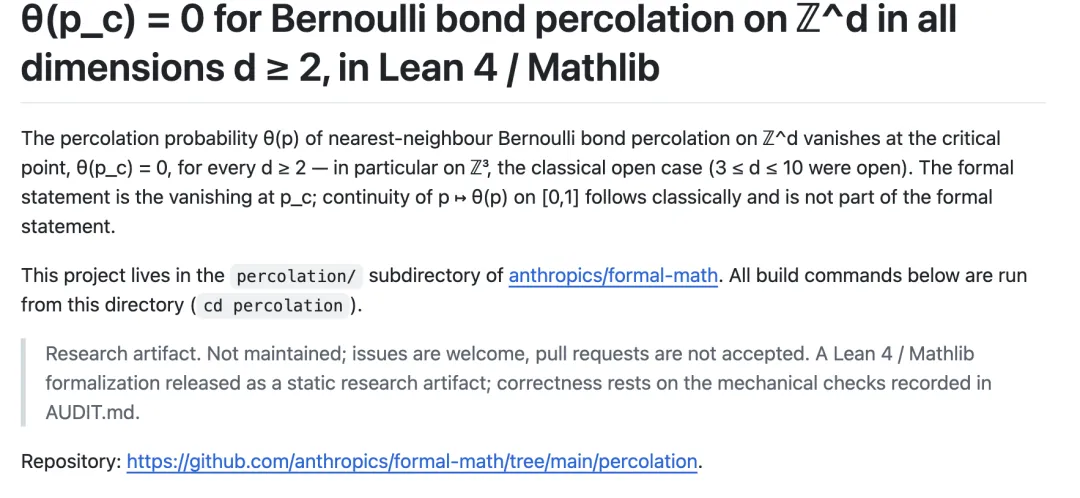
There were no press conferences, no internet hype, and no official blog posts.
It's a complete code set, automatically generated by the big language model Claude and rigorously verified by mathematical formalization to prove the language Lean.The idea that the Davy Fields Prize winner hadn't been able to cope with for years has been proven by AI.
It was reported that the global mathematical community exploded instantly.
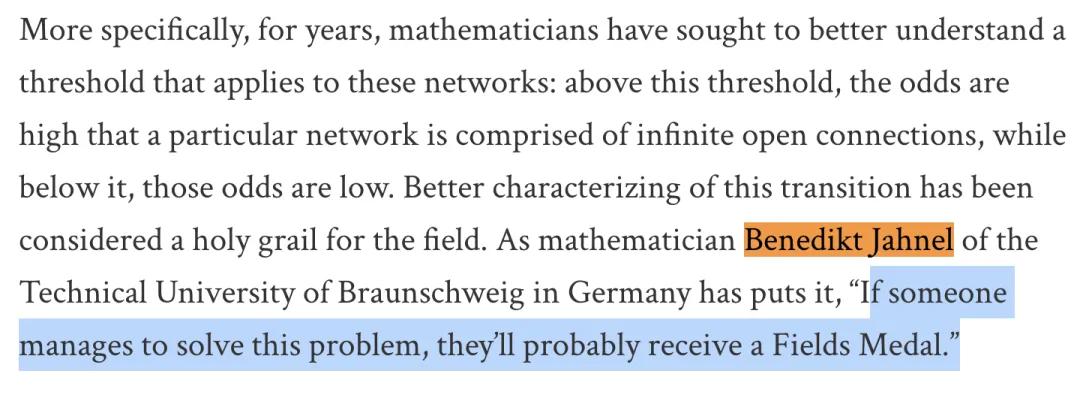
Benedikt Jahnel, a German mathematician at the Industrial University of Brunswick, said in an interview:
If humans proved this, he would probably win the Nafields Award. But now, AI has crossed the finish line.
AI has already thrown the proof of the machine on the table.
Mathematician Gil Kalai said: "If verified, it would be an extraordinary breakthrough".
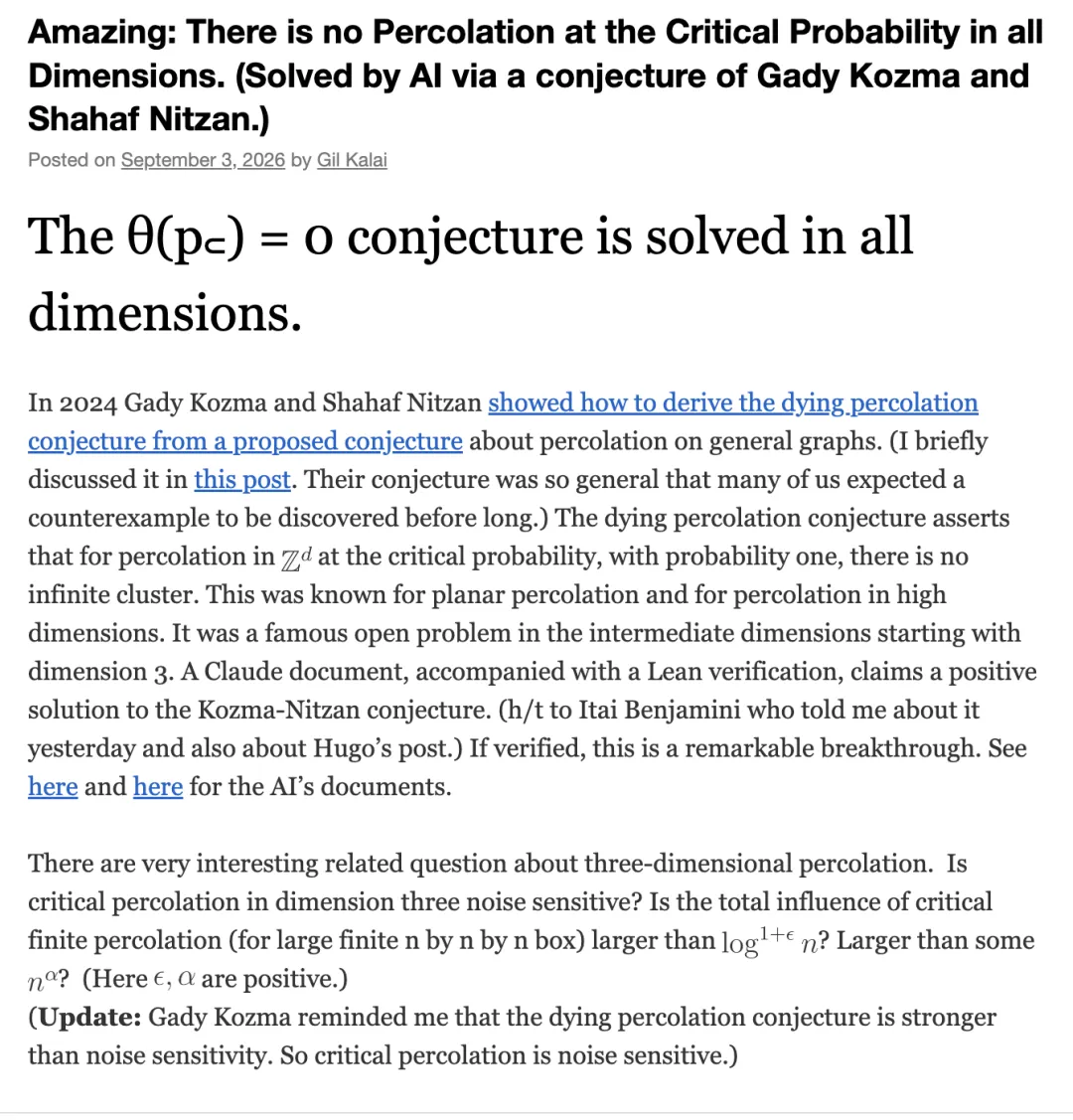
Continuous fluctuations in speculation in fluid theory are known as the "holy grail" of probability theory.
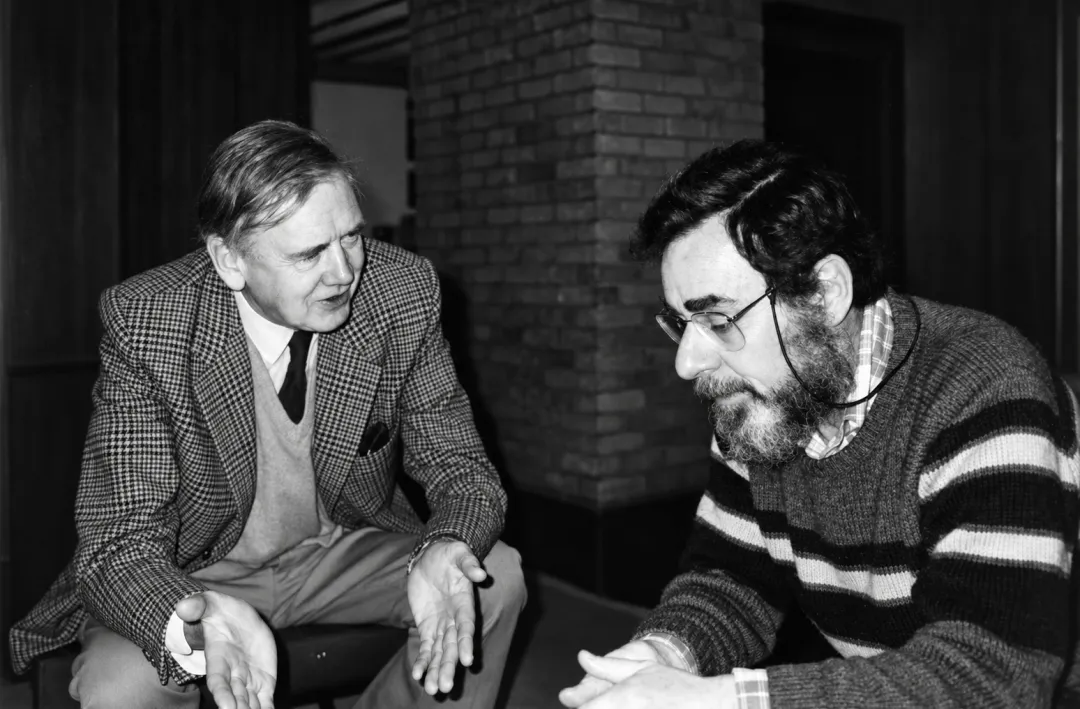
In 1957, mathematicians Simon Broadbent and John Hammersley were thinking about an unusually profound physical phenomenon:How does the fluid pass through a perforated sponge?
You can think of it as a coffee bubble, or oil leaking through a hole in the ground:
Suppose there is a huge spatial grid, with tiny pipes connected between each intersection. There is a certain probability that each pipeline p is crossed, and there is also a probability that 1-p is blocked.
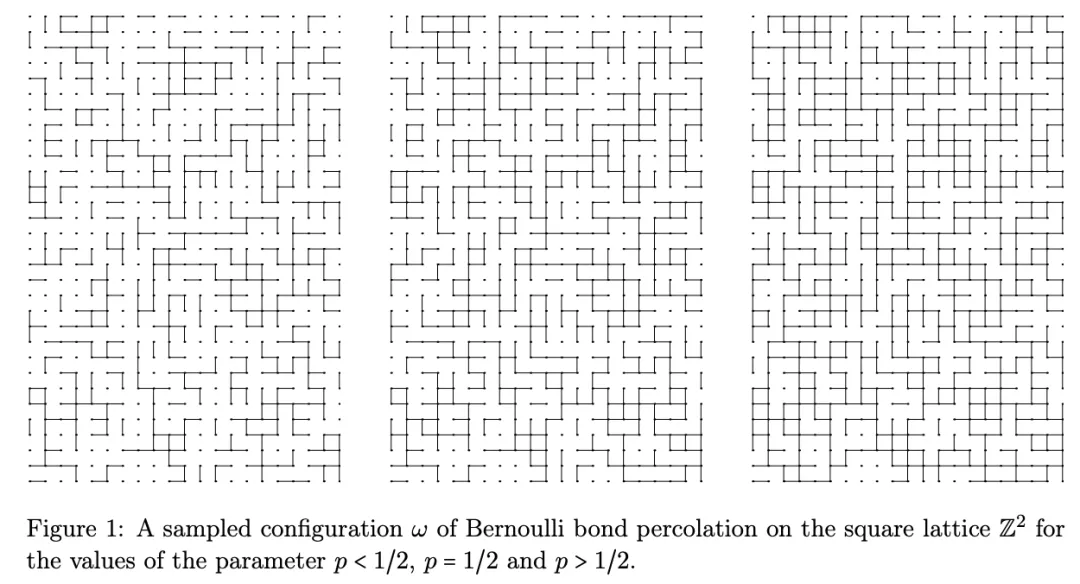
If p is very small, such as only 0.1, then most of the pipes are blocked, and the water droplets will stop as soon as they enter, and it will never be possible to penetrate the entire sponge; if p is very large, such as 0.9, the pipes will flow as fast as bamboo, forming a continuous stream in an infinitely extended network.
In mathematics, the magic dividing line that jumps from a "local water drop" to an "infinite network of connections" is known as the "water drop".Critical probability。
This is a change, as if water freezes when the standard atmospheric pressure drops to 0°C.
Below the critical point, the probability of forming an infinite mass-connected water flow is absolute 0; above the critical point, it is greater than 0.
So a "Question of the Century" was born that has been a nightmare for all probability scientists:
It's exactly the same as the critical point.In other words, is it possible to create an infinite network of connections within a system that is not equal to zero?
If 0 means that this change is extremely smooth, continuous, like the morning fog gradually becoming fine rain; if it is greater than 0, it means that the system will mutate instantly at the critical point, blowing up an infinite flow of water through the universe in space.
This seemingly simple conjecture is the "holy grail" conjecture in probability theory.
For more than half a century, mathematicians have been trying to solve this puzzle.
In 1980, mathematician Harry Kesten proved that the critical probability in a two-dimensional square network is exactly 1/2, and = 0.
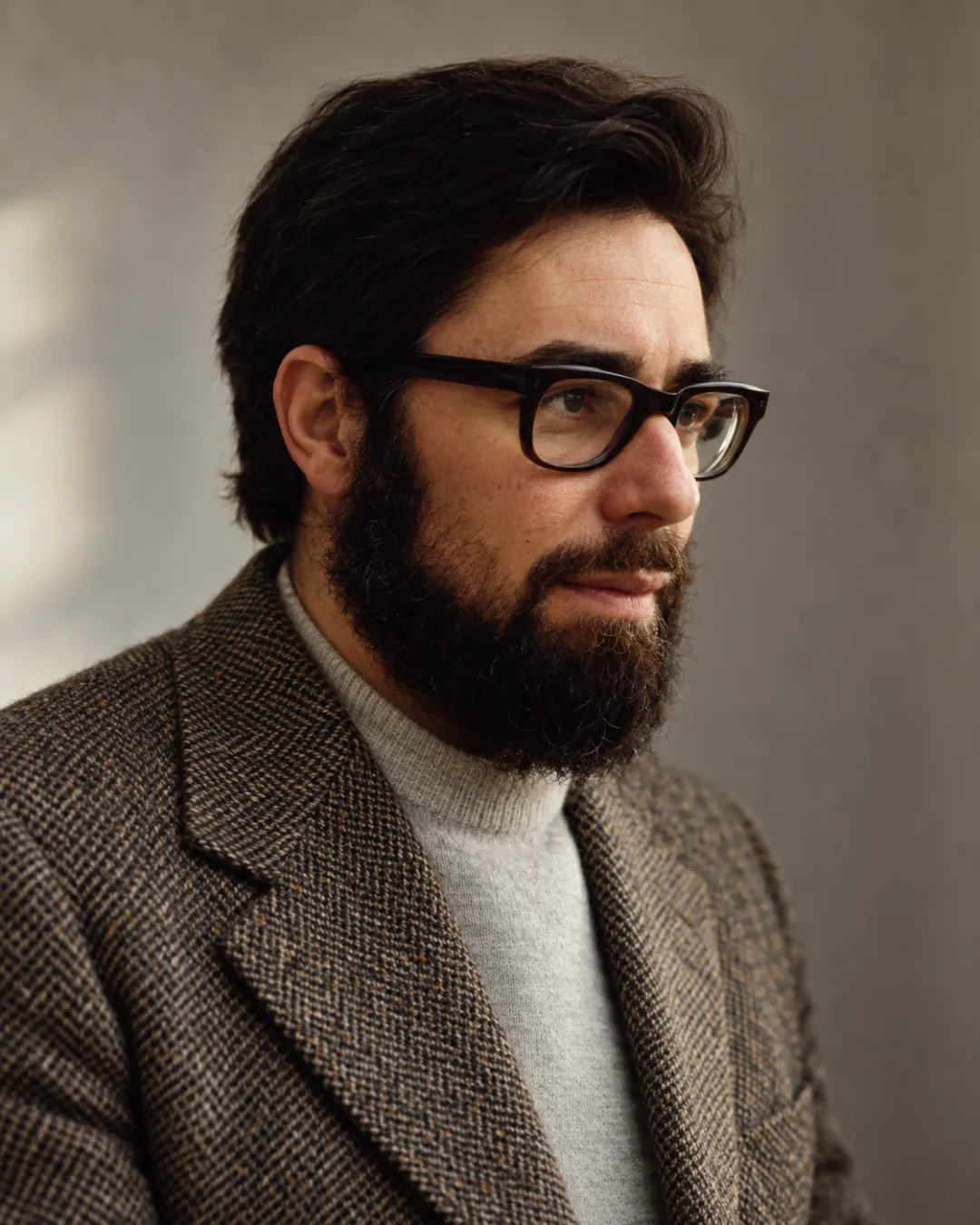
This directly established his status as a monk in the history of mathematics.
In ultra-high dimensions (11D and above)Where each node has a large number of neighbors, mathematicians can use statistical averages and theories to simplify the problem.
Many years ago, scholars demonstrated that evolution is continuous in 11 dimensional spaces and beyond.
However, the real nightmare lies in the middle of nowhere.3D to 10D space grids。
There is no special geometric symmetry of the two-dimensional plane, and it is impossible to use high-dimensional statistical smoothing tools, and the topological entanglement between dimensions and dimensions is extremely complex chaos.
The three-dimensional is the real universe in which we live, the four-dimensional is the space-time of relativity, and these core dimensions have become the "wall of sighs" that human mathematicians have not been able to overcome for decades.
Over the decades, countless top scholars have exhausted their youth to the point of leaving only one sigh on draft paper.
Poetic wanderer who encounters a cold pusherHugo Duminil-Copin, winner of the Fields Prize, is one of the most famous of these "wallbreakers".
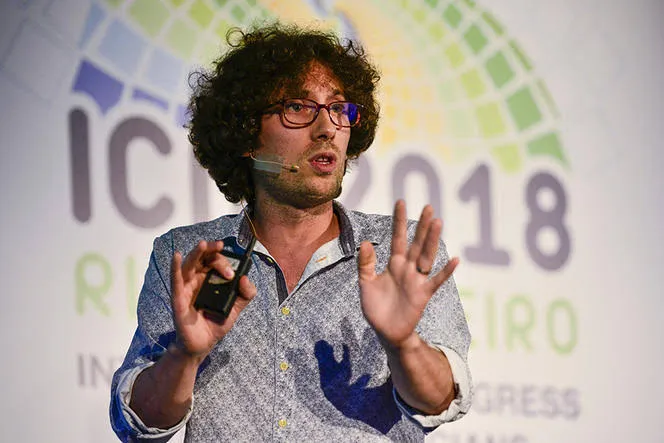
In 2022, Duminil-Copin won the most prestigious Fields Prize in mathematics for his disruptive work in the field of statistical physics of transformation, and his academic career has been almost intertwined with flow theory.
He loved the idea so much that he was almost obsessed with it.
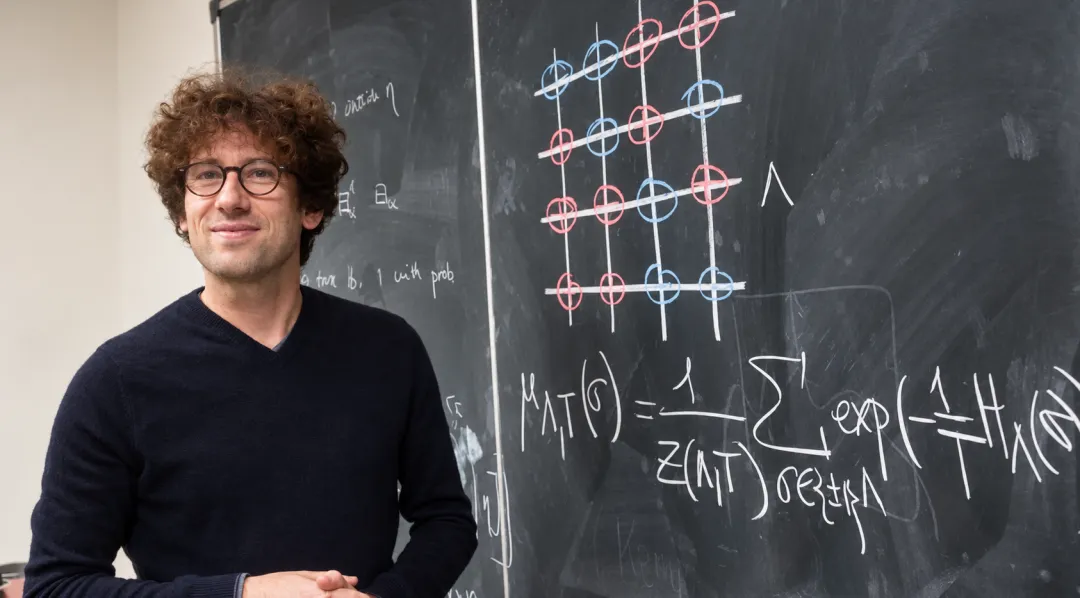
In a blog post dated August 30, Duminil-Copin wrote in an extremely beautiful prose pencil:
A mathematical problem is by no means just a theory waiting to be proven. It is not just a lighthouse in the dark, but a guide to the soul.
Unraveling it may not immediately open up a whole new field of mathematics, but its own depth and beauty is enough to upend the soul of a generation.
Duminil-Copin shared with enthusiasm that despite his repeated attempts to conquer the 3rd to 10th dimensional continuum, the seemingly unsuccessful drafts have spawned dozens of unexpected sparks of inspiration in a long struggle and climb.
He subsequently won the Fields Prize for his work as a "by-product" of the failure of the main line mission.
In the traditional narrative of human mathematicians,The process is far more sacred than the outcomeOn the way to the summit, there is a cliff of Lemah, a despair of mountains, and a night after day of beauty. This struggle with the unknown is considered the highest symbol of human intellectual dignity.
However, the entrance of Anthropic completely shattered this romantic lens.
Justin Leder, who submitted the proof, was not a mathematical tycoon and was not even well known in the field of fluid theory. He relied on the super-precursor Claude model, which had not yet been published publicly within Anthropic.
AI is neither lost nor knows what aesthetics is.
In the face of this 70-year-old dilemma that has plagued humanity, AI is like a pushing machine, pushing the past with rigorous to almost suffocating symbol logic and formalized language.
In an interview with the media, mathematician Benedikt Jahnel confessed:
This resulted in extremely complex emotions for me.
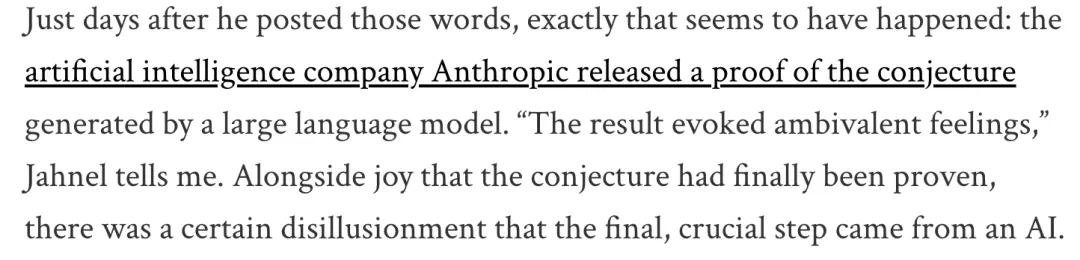
On the one hand, the conjecture was finally proven to be a genuine joy for him as a mathematician; on the other hand, there was a huge loss and disillusionment in his mind, because it was AI that opened the final door.
For more than half a century, mankind waited patiently for the doors of the synagogue to be opened by AI with an omnipotent key.
How does AI break down? It's not just "violent computing".Many unconsciously would think: Is AI using mass-calculation to kill a blind cat and use violence to try out all the possibilities?
The answer is: Absolutely not. If it were just a mishap, the destruction of the universe would not prove an infinite-dimensional continuity hypothesis.
What this AI demonstrates is an almost terrifying blend of high-dimensional logic and cross-domain reasoning.
This closed door can be opened only if it is not far from the last block laid by anthropologists in the past.
Back in 2024, Gady Kozma of the Pitzmann Institute of Science in Israel and Shahaf Nitzan of the Georgia Institute of Technology published a groundbreaking paper.
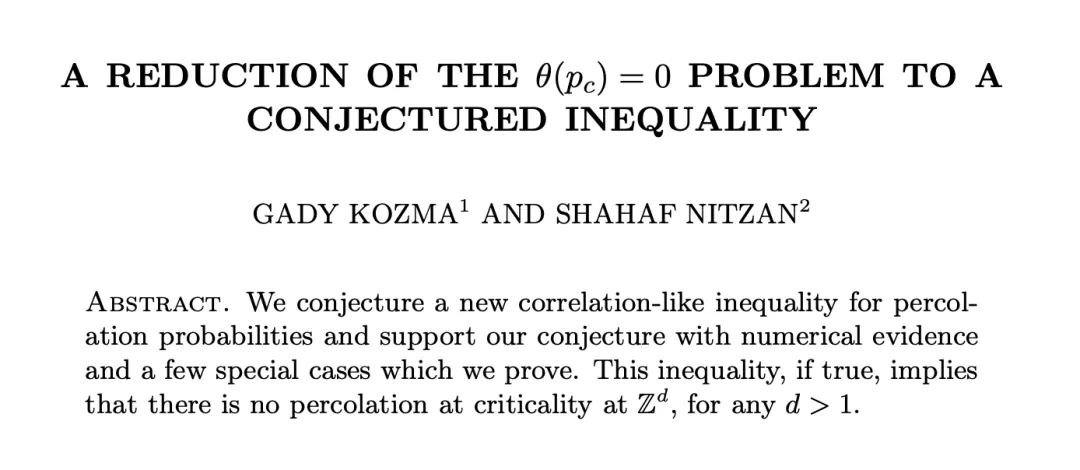
Two mathematiciansProve that as long as a relatively simple algebraic inequality of a particular form can be proved, then 3D to 10DGuess it's on its own!
The paper instantly gave the academic community a glimpse of the victory.
The finish line has been drawn nearer and nearer than this last step in begging for proof of that damned inequality.
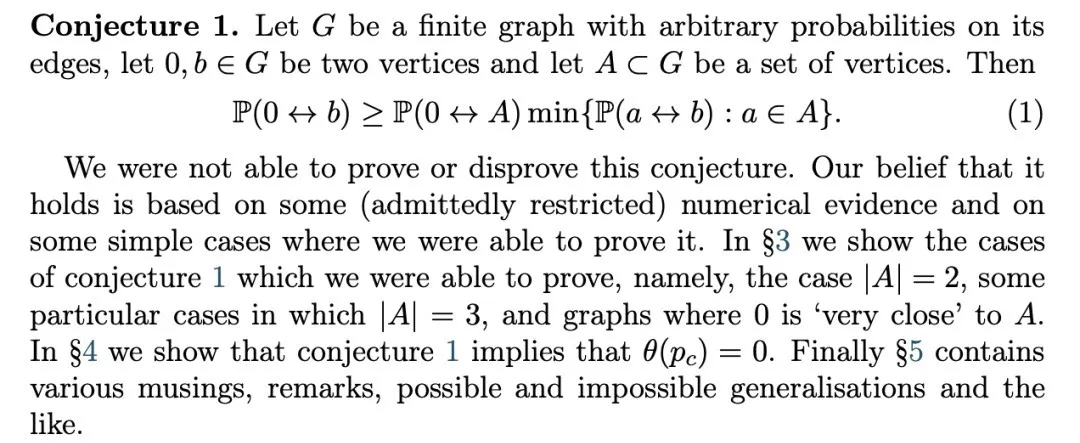
However, this final step turned out to be a failure.
Mathematicians try to construct an auxiliary function to find the bottom line, but this inequality is like a slippery slope of mud, always causing a peculiar collapse at the critical nodes of the derivation.
This is where Anthropic's model completed a deadly blow.
It doesn't have another stove, but rather grabs the leaps that Gady Kozma and Shahahaf Nitzan built in 2024 with extreme agility.
Under the rigorous constraints of Lean's assistant, the large model, using a large number of analytical tools and unequal techniques known to man, constructed a closed loop of thousands of lines of reasoning at the bottom of the formalized code in an ingenious way that human mathematicians had never imagined.
Mathematician Ahmed Bou-Rabee of the University of Pennsylvania announces that Anthropic has proven this Feltz Award-winning conjecture.
But what shocked Ahmed Bou-Rabee was the speed of progress that followed.
Ahmed Bou-Rabee, with the help of a large model, only paid for it.Time of dayAnthropic's proof code has been generalized and modified.
"AI has made me do things I never thought I would do", says Ahmed Bou-Rabee, "some of the research projects I've worked hard on for eight years, with almost no progress, but with the help of AI, I'm just one step away from solving them completely".
But at the same time, the original author, Professor Kozma, appears to be exceptionally restrained and even cold.
In the face of questioning from all sides, he said calmly:
I have not commented on their claims for the time being.
We're still waiting for Anthropic to release a "human-readable version" and explain how they do it.
End and Dawn: When Humanity No longer Rules the TruthWhen the steam engine was invented, drivers thought the art of driving was over; when the camera was born, real-life painters were mourning the death of art; when Deep Blue beat Kasparov, AlphaGo swept Kochi, the whole world was crying for the game.
But is the game dead?
Although human chess players are no longer able to defeat AI, thanks to AI's perspective, they have seen a whole new format that has never been imagined for thousands of years, the dimensions of the chessboard being infinitely expanded.
The same is true of mathematics. As Duminil-Copin shared in his reflection:The proof of the theorem is never all of mathematics.
Throughout the history of human mathematics, the charm of conjecture has often been not in the "proving results" themselves, but in the whole set of tools conceived in the conquest of conjecture.
In order to prove Fermat's theorem, humans pioneered magnificent maps of algebraic geometry; in an attempt to prove Liman's conjecture, the big bang of parsimonial mathematics was raised.
Duminil-Copin himself struggled for years with the failure of the flow theory, but as he put it:Those failed attempts spawned dozens of new ideas, and I used them in other fields, bringing about many of the major discoveries I never imagined.」
Future mathematicians may no longer need to devote their primary energy to decades of complex algebra. They will choose the most valuable trajectory of exploration, command thousands of rational intelligences to launch a surge into the unknown, and explain to the human world the pieces of intelligence brought back by machines, or they will be the new mission of a new generation of scientists.
Einstein once said:
The most wonderful and profound emotion that humanity can experience is the perception of the mystery. It is the source of all true art and science.
From the simple speculation about sponge water in 1957 to the 2026 sword-slamming AI on GitHub, humans have demonstrated their greatness over 70 years and witnessed the interconnection of intelligent forms.