Just this morning, the AI circle and the mathematics circle really exploded, with many researchers and netizens sitting in their chairs, shocked by the intelligent explosion.
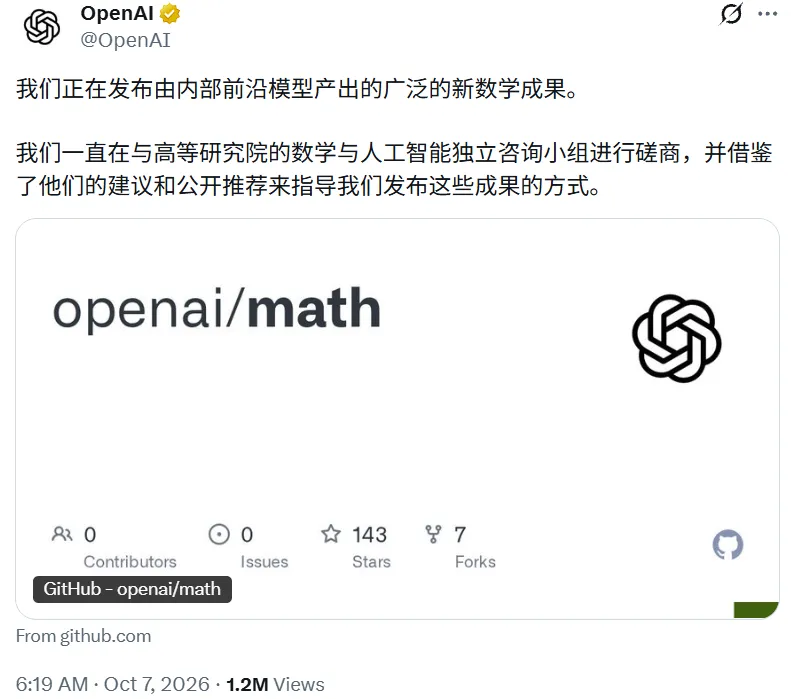
It's hard to imagine that this Github repository is not a two-weight mathematical result, but 722!
This is a list of mathematical papers: 722 manuscripts belonging to 372 families of results, all produced by an unpublished internal front-end model.
The names on the list are enough for anyone who has ever read a graduate math program to pause for a moment: the Freeman conjecture, the four-dimensional valley conjecture, the only game conjecture, the free group factor synthesis problem, the Hilbert 10 problem in rational numbers, C.M. Abelson's Hodgkin conjecture, the Maller conjecture... Some of these problems have been suspended for more than half a century, and some have been an extension of the Fields Award-winning work.
Sam Altman says we are entering a new era of great discovery.
An explosive release
According to OpenAI, these results come from an assessment of the mathematical abilities of the internal models.
Since the model's performance in existing mathematical evaluations was consistent, the team extended the evaluation to open research problems, with some of the results built on the results previously produced by the model. Throughout the evaluation process, the model was tossed around 4,000 research questions; the output was classified according to relevance into the outcomes, and then the "important enough" threshold was selected, leaving the current 372 families, 722 manuscripts.
According to OpenAI's own discipline labels, these 372 groups cover 17 disciplines, the most numerous being theoretical computer science (40), combinatorial mathematics (37), algebra and repeating geometry (36) and numerology (31), followed by probability and statistical mechanics, differential geometry, mathematical physics and algebra; and mathematical logic (6).
In terms of computing, OpenAI says that the vast majority of the results come from the same set of fixed processes, each of which consumes about 3 hours of ChatGPT Pro's thinking.
Another noteworthy detail is that the manuscript folders are dated and almost all are concentrated between 23 September and 5 October, with nearly 200 items on each of the two days on 23 and 24 September. In other words, the subject of this list appears to have been mass-produced in less than two weeks.
Along with the paper, there are three categories of "proof tools": Lean formalized proofs, a concise summary of 10 model reasoning processes, and statistics on computational quantities and the number of attempted problems. According to our statistics for the warehouse catalog, 235 of the 372 families were accompanied by Lean formalized pages, accounting for about 63%.
But OpenAI also admits that not all of the manuscripts have completed the formalized, unformalised result "may be a problem", and the team will correct and continue to supplement it as soon as possible.
Currently, the project's star count is on the rise, and in just three hours, it has surpassed 2k.
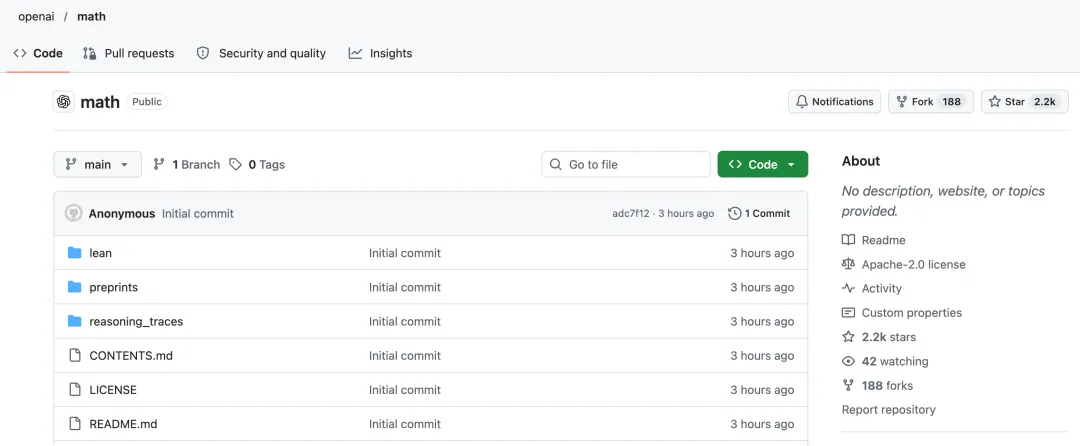
Address of the warehouse:
Lyman and the Hanging Valley
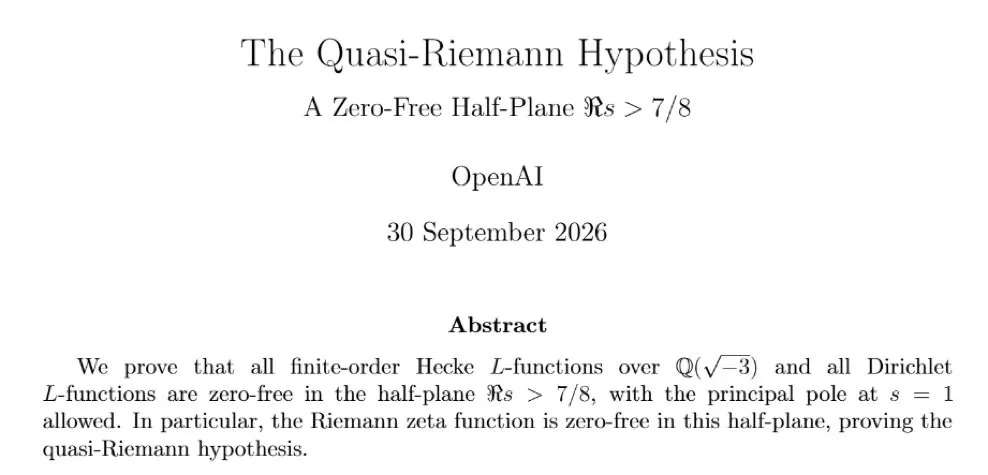
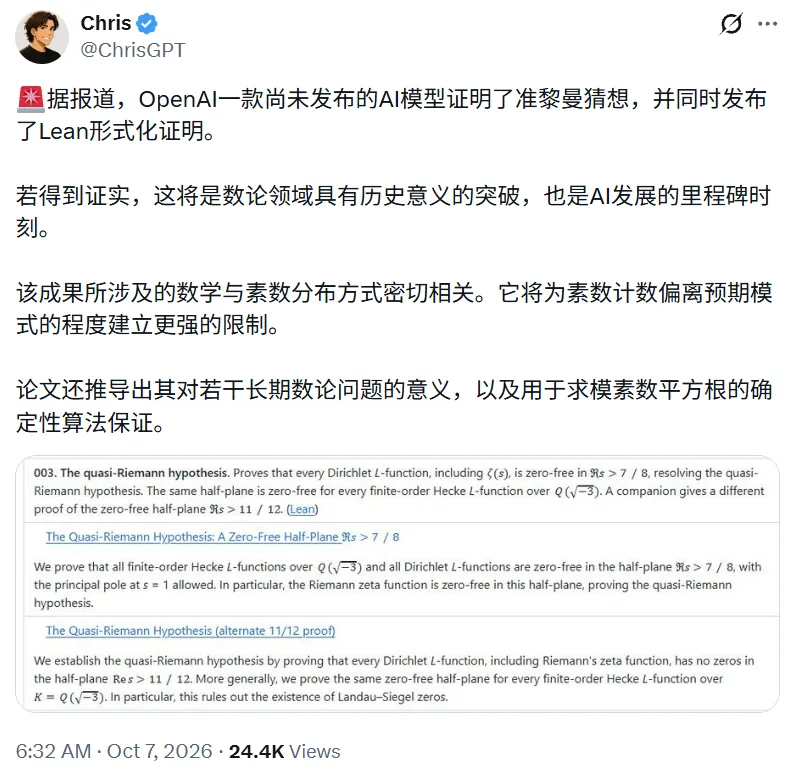
Of the 722 manuscripts, the first to be displayed on social media was the number 003: Pre-Rhyman's Guess.
Liman's conjecture asserts that all unusual zeros of the Liman zeta function lie on a straight line of 1/2. This goal is too far off, and mathematicians backtrack and propose the "pre-Liman conjecture": even if it proves that there is a constant θ less than 1, there are no zeros in the whole half-plane of θ that is greater than θ, it is a huge advance.
For more than a hundred years, it has been possible to prove that the free zone of zero points will grow closer and closer to the real line 1 as the void increases, never being able to "pull" out a fixed-width linear band. OpenAI concludes that θ = 7/8, which is consistent with the zeta function and all Dickray L functions, and has been formalized by Lean. The paper supports a consistent exclusion of zero points by Landau and Siegel.
Another hotly debated issue is issue number 074: Hanging Valley.
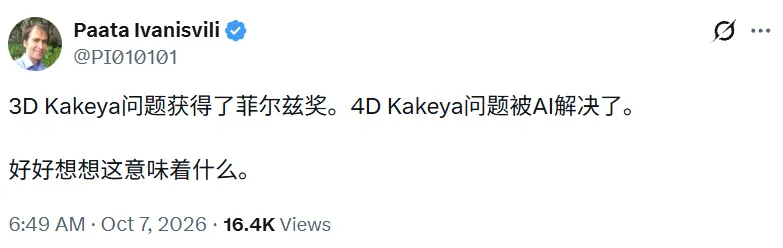
On July 23 this year, she became the third female mathematician in history to receive the Fields Prize for her three-dimensional hanging valley assumptions with Joshua Zahl, completed in 2025.
This family on the OpenAI list simultaneously claims to solve the three-dimensional "extreme function" conjecture and the four-dimensional Hausdorf dimension conjecture.
The results of the weight class are far more than these two.
In theoretical computer science direction, number 102 claims to prove the only game conjecture proposed by Subhash Khot in 2002 and thus gives the best approximate difficulty threshold for classical problems such as Max-Cut, top coverage;
Algebraic geometry direction, number 032 claiming that all repeated CM Abellian proofs of Rhijko's conjecture;
In numerical theory, the combination of the numbers 002 and 006 gives the complete BSD formula for a density of one on each rational elliptical curve of the second twisted triangle; the number 004 gives a negative answer to Hilbert's tenth question on the rational domain.
All three of them deal with the Millennium Grand Prix puzzle or the iconic issues of the twentieth century.
The algebraic direction of the arithmetic, number 287, claims to solve the free group factor homology problem, concluding that the free group factors of different orders are homologous to each other, with the accompanying Lean formalization.
In addition, the list also shows that the irrational measurement of π is exactly 2, that the Catalan constant is irrational, that Malle's conjecture is true in all dimensions, that the plane cannot be chromatized in five colors, and that there are counter-examples of Kaplansky's zero-factor conjecture and Hadwiger's conjecture.
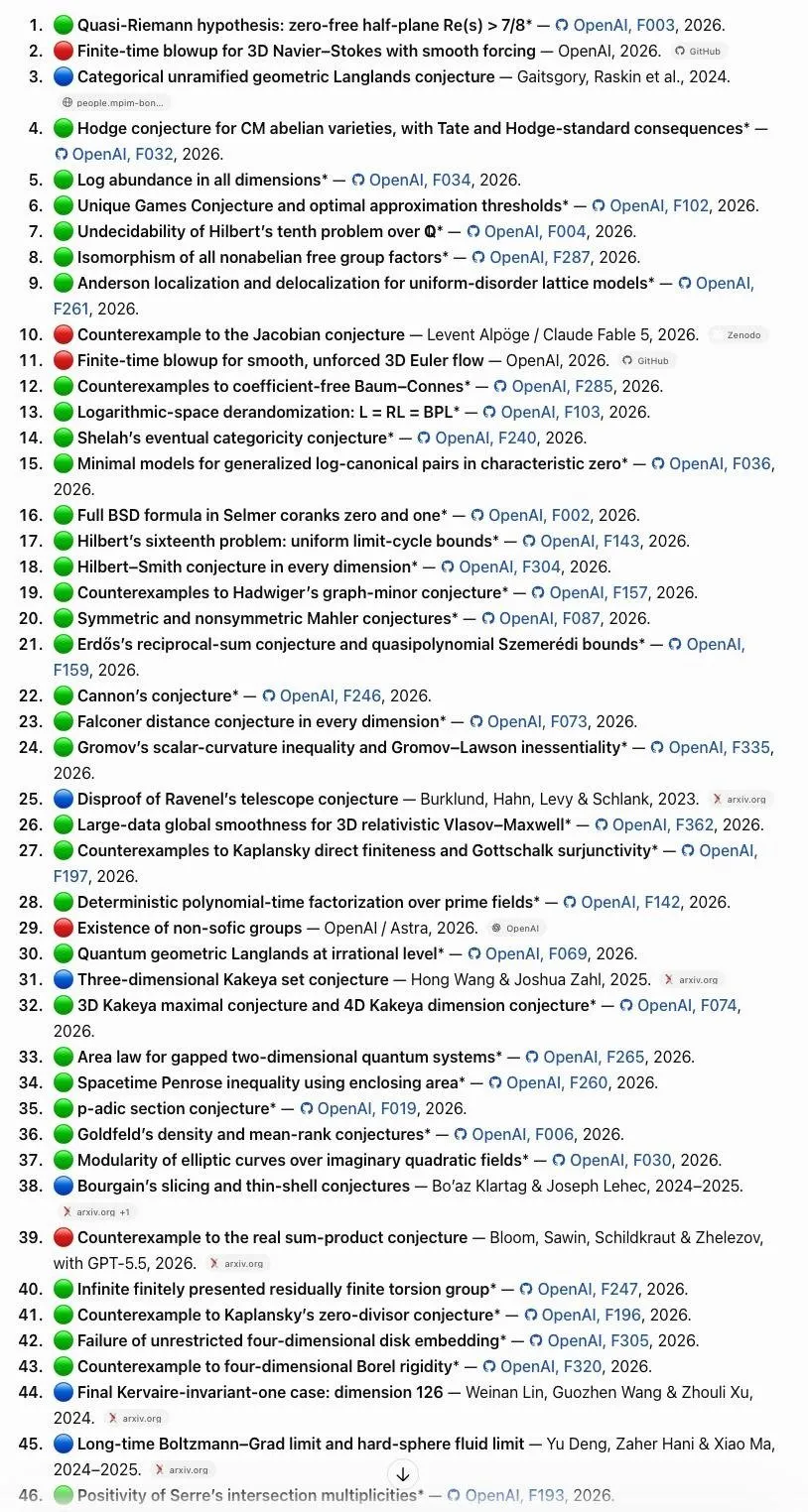
In addition, former OpenAI researcher Will Depue used GPT 6 Pro and Fable 5.1 to rank all of the discoveries in the past three years. Blue represents human findings, red represents AI findings (before October 6) and green represents AI findings from OpenAI/math repo. Shockingly, 81% of them were released today.
A mysterious inner model
OpenAI has not disclosed its name, calling it an "internal front-end model" in its blog and saying it is promoting its "responsible release".
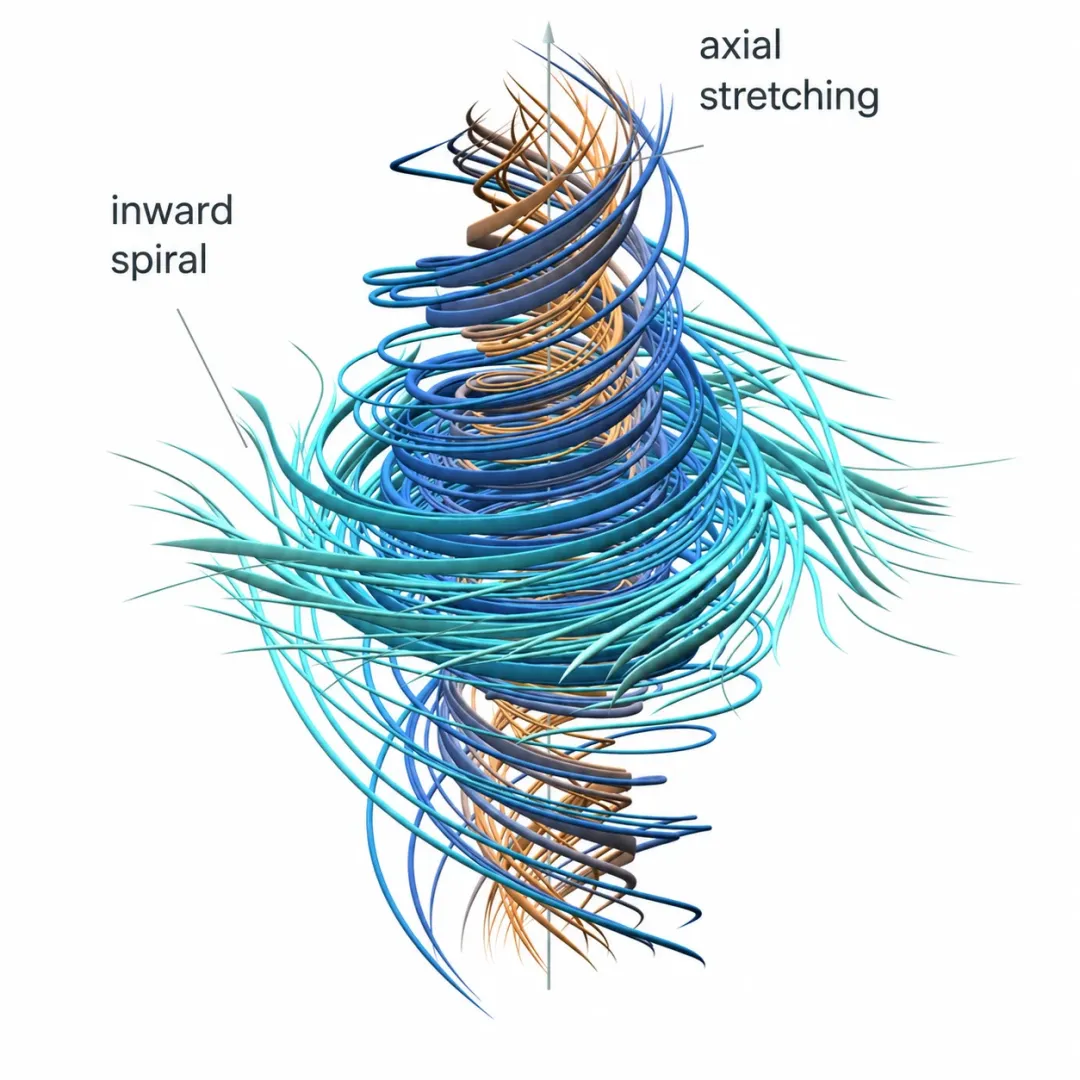
On September 8, OpenAI released the Navier-Stokes announcement. The announcement said that an "significantly stronger than the GPT-6 Astra" internal model, which began training on August 28 and is still being trained, with about 10,000 parallel intelligences and 88 hours of work, demonstrated that 3D uncompressed fluids can emerge from a static state under the influence of smooth external forces, generate odd points in a limited amount of time, and that it took an additional 17 hours to complete Lean formatting with the GPT-6 Astra.
The following is a link to the article:
On the eve of its release, an OpenAI spokesperson confirmed that the new internal model had solved more than 100 long-standing problems in "most areas of mathematics".
Mathematicians are thrilled
Over the past two months, friction between AI labs and mathematicians has skyrocketed.
On August 1, OpenAI released the next-generation model Astra in 10 advances in mathematics and theoretical computer science. Only a few days later, mathematicians noted that in one of the counter-examples of falsifying Connes' rigidity speculation, a group did not meet the required conditions. On August 11, Anthropic also disclosed that its unpublished model had made progress in the direction related to Lyman's speculation.
In August, OpenAI privately convened about 40 mathematicians to discuss what to do if AI is mathematically superior to humans.
Participants said at the time that OpenAI implied that its model had solved hundreds of long-term problems and how to issue a request for comment; some participants said the company had promised not to release it all at once, but an OpenAI spokesperson said they "didn't know" that such a commitment had been made.
Mathematicians at Northwestern University recalled that the emotions of the participants were intertwined with excitement and fear, and it was suggested that they should no longer just blog and tweet like the August 10 questions, but write a paper so that mathematicians can digest and use these results.
OpenAI is reported to have mobilized thousands of intelligence entities for the offensive after hearing "rumors" that someone is about to solve the problem. New York University's Tristan Buckmaster accused OpenAI of hijacking his private collaboration with Levent Alpöge, an Anthropic employee who has not yet published the results but has been using OpenAI's toolkit to support research.
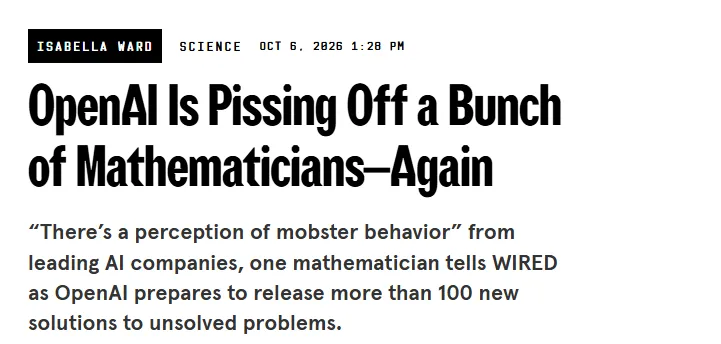
The following is a link to the article:
According to the mathematicians, "People think that these top AI companies are gang-like".
On September 11, the Joint Statement of the 25 Fields Award winners, including Tao Te Ching. The statement argues that the title of the attack was a tool and a proxy indicator for promoting conceptual understanding, and that a hasty announcement without time to write papers and make citations would lead to serious signing and copying issues.
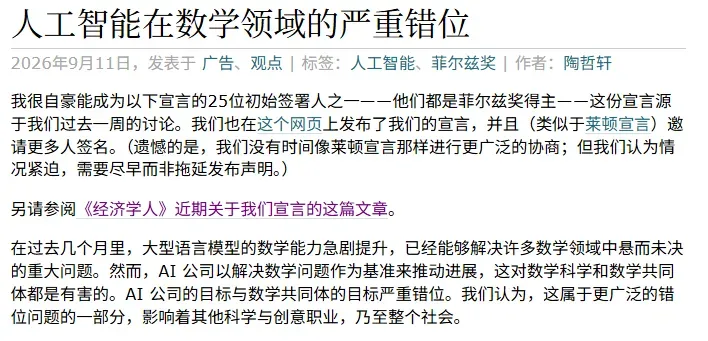
The following is a link to the article:
Prior to this, Bryna Kra was one of the drafters of the Clayton Manifesto, which was joined by more than 4,000 mathematicians and required AI companies to comply with the standards of the mathematical community, including disclosure of AI use, peer review, references to former people's work and keeping open access.
On September 29, the Independent Advisory Group on Mathematics and Artificial Intelligence of the Institute of Advanced Study (IAS) released a recommendation for the release of AI-generated mathematical results after gathering more than 600 community surveys. This is exactly what OpenAI cited in its tweets and blogs.
The IAS recommendations are divided into two steps.
The first step is "first release": the laboratory should retrieve and cite relevant work already done, write the proof as it is in accordance with the conventional mathematical paper practice; disclose model names, pronouns, mind-chain summaries, time-consuming and computational cost estimates; be formalized as much as possible; be stored in a neutral warehouse that "is not controlled by any AI laboratory"; and maintain identification and modification records; and report failures on comparable problems.
The second step is "supporting understanding": grant conferences, workshops and explanatory writing, and providing a broad, equitable model access to the global mathematical community.
In contrast to this list, OpenAI's answer can be "selectively and qualitatively". Open reasoning summaries, computational estimates and number of attempted questions, pledges to fund a series of seminars and conferences around AI's major achievements, pledges to leave traces of versions, revisions to new versions, releases and formalizes more than 60 percent.
There are also many places that do not meet the recommendations. In particular, the model names are not disclosed. The warehouse is under OpenAI's own GitHub organization, and OpenAI says it is still exploring alternatives to community hosting. OpenAI also acknowledges in the blog that future conferences will continue to improve in terms of citation, mathematical explanation and presentation.
The bottleneck is shifting from "proving" to "understanding".
If the Navier-Stokes announcement in September proved one of the most difficult questions AI can solve, this release proves something else: on a fairly wide mathematical frontier, new verifiable results have been produced that can be run at a batch rate of "several hours per question".
This makes Taoge's judgment in September more acute: the real conflict is not between human reasoning and machine reasoning, but rather the mismatch between the proven output and the scarcity of expert attention.
Of the 372 outcome families, 235 families had Lean proofs, which did greatly reduce the cost of verifying "proving correctness"; but Connes's rigid conjecture insert has reminded everyone that formalization can guarantee that reasoning is correct, but cannot automatically guarantee that the proven proposition is the proposition that mathematicians have in mind. OpenAI's Lean explanatory pages for each family specify "where formalization covers, where it does not".
As for the most weighted but not yet formalized results, such as the four-dimensional hanging valley, the Hodge conjecture of C.M. Abelson, the rational Hilbert tenth problem in the mathematical field, it is only in the next few months that the actual results will be published.
A more pertinent question is: How will the mathematical community redistribute its most precious resources - the time it takes to read them - when the supply of new theorems is no longer scarce?
Sam Altman says we're entering a new era of discovery. The first half of this sentence has 722 pieces of evidence available today; the second half of "discovery" requires humans to read, grasp, and pass on the results.
Reference links