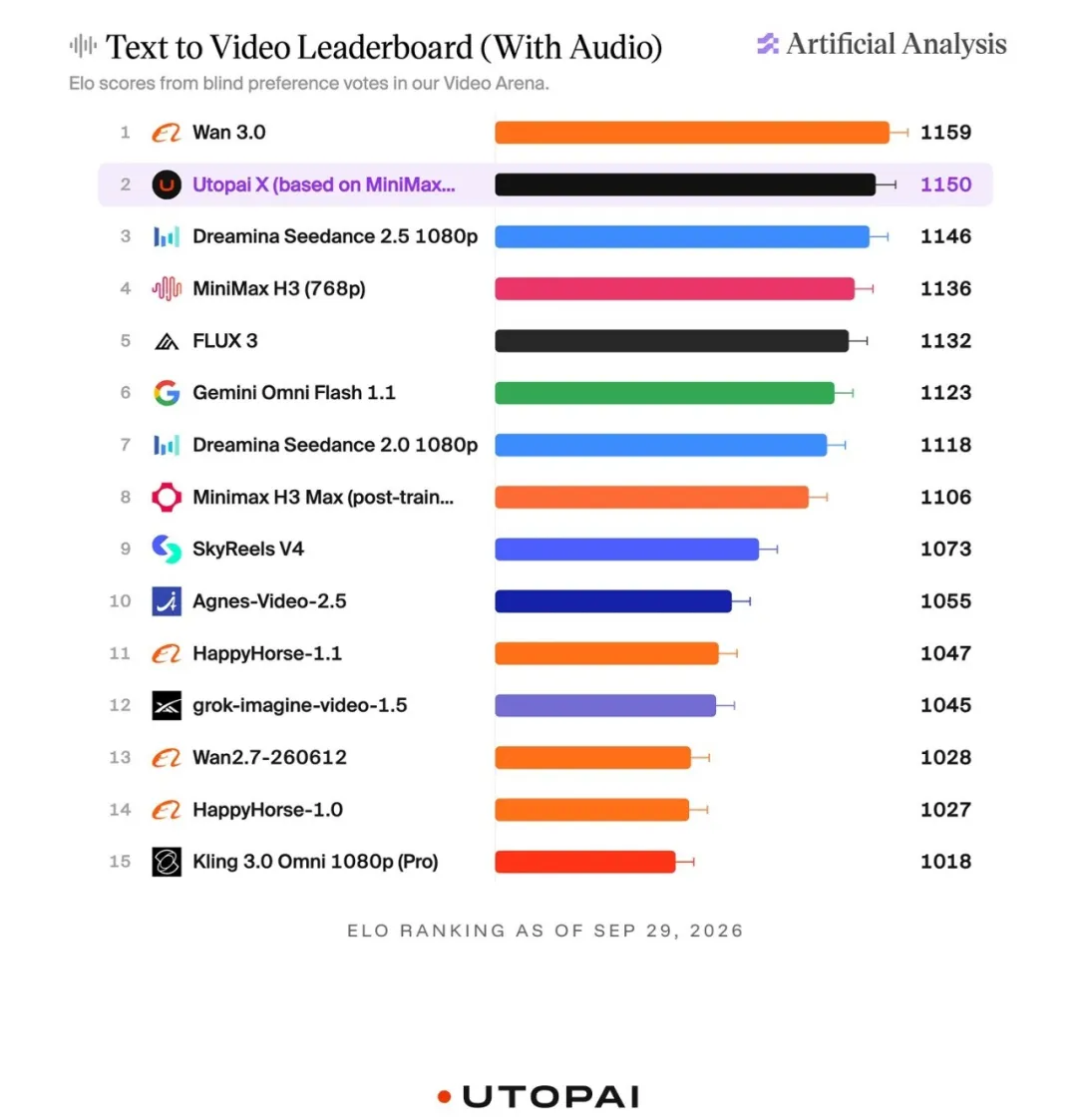
At the end of September, Utopai X was ranked second in the world and first in the United States with an Elo rating of 1150, according to the World Video Arena ranking published by the authoritative independent rating agency Artificial Analysis.
It is also worth noting that Utopai X's parent company, Utopai Studios (abbreviated as Utopai), is not a tech team in the traditional sense, but a television company, which has been called "the world's largest independent AI television company" by Variety Entertainment.
Over the past two years, competition in the field of video has largely revolved around model companies and AI factories, ranging from model capabilities, parametric scale, to generating quality, user experience, and round after round of video models.
Artificial Analysis is one of the most highly regarded independent AI video rating agencies in the industry today, with its Video Arena adopting an extremely rigorous double-blind mechanism (Blind Preference Votes): All test videos are deleted from brand watermarks and source labels and are voted for by independent audiences around the world, under the premise that they don't know the model name at all, for exactly the same complex hint word output results.
In other words, without looking at the parametric level the model claims, without looking at the computational consumption behind it, and without looking at the public relations volume of the brand, the only basis for the final ranking is the visual and visual quality of the finished film.
This is the first time that a video company's customized model has made it to the top of the list since Video Arena's blind review mechanism.
It's not uncommon to wonder: Why would a TV company win in the video world dominated by model companies or AI giants?
Perhaps the answer is not in the parameters of the model, but in the way it solves industrial production problems...
The film industry needs more than just a big model to generate video.
In order to understand Utopai's technical path, we first need to understand the real difficulty of making long films.
Currently, almost any mainstream video generation model is capable of generating surprisingly few seconds or even tens of seconds of video, a character, an action, a set of scenes can be generated quickly by simple hints, but if the target is shifted to a standard 90-minute cinema-length film, this single-point generation logic will collapse instantly, because filmmaking is quite another thing.
A 90-minute film capable of appearing on the big screen often requires hundreds or even thousands of footage to work in close collaboration. In a long story arc, the characters must always be consistent, the scenes must be continuous, the visual style must be unified, the language of the footage must be consistent with the director's intentions, and the entire production process must be repeatedly revised and teamed together.
However, the biggest pain in today's general video models is that they can produce cool clips but can't go into continuous production, the characters are negligible, the background space is distorted, the direction of light is distorted as the camera moves, and the laws of gravity and collision often violate intuition.
This means that the real challenge of AI filmmaking is no longer "being able to produce a refined image" but "being able to understand or even handle a complete industrial production process".
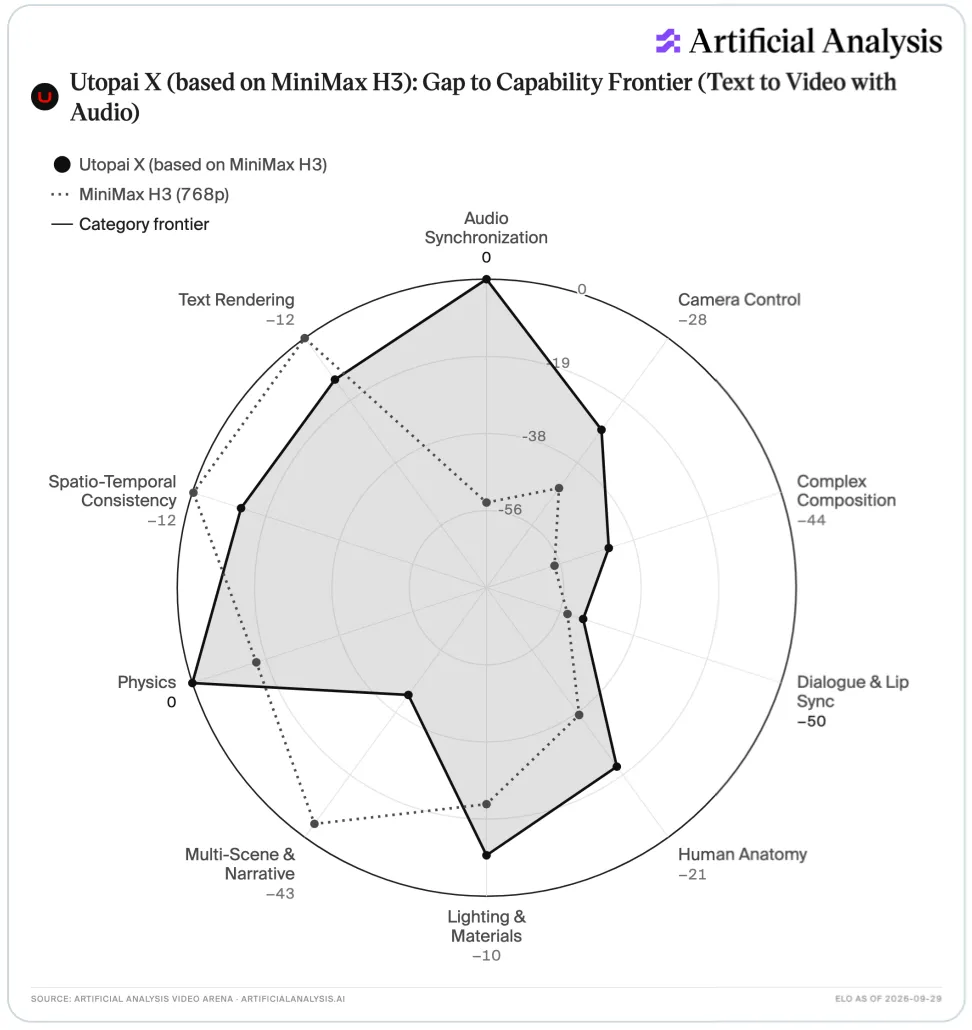
Based on the results of Artificial Analysis, the Utopai X stands out in the difficulty areas of generative video systems such as reflection, spotlight, spatial understanding, high consistency: first in the direction of Audio Synchronization (audio synchronization), Physics (physical laws) and second in the direction of Lighting & Materials (lighting and materials), Camera Control (lens control).
These capabilities correspond to the key elements of video production:
Laws of Physics: The focus is on whether the model really understands the real world, covering gravitational factors, fluid flows, fluid refraction, and so on, whether it's a wooden boat pushed into shallow water or a toy rolled down by gravity, which completely gets rid of the traditional "floating sensation" and "floating texture" of video production;
Audio Synchronization (Audio Synchronization): solves the problem of matching sound and images, achieving motion and environmental sound effects, in contrast to the white rhythm of native sound;
Lighting & Materials: determines the authenticity of the image, accurately restoring complex high-light reflections, fluorescent spots, and color temperature transitions in continuous light shadows;
Camera Control: Complies with professional video language, supports 360-degree lens flipping, fast oscillating and complex long-lens motion, and meets the position adjustment requirements of professional video and audio language.
It is worth noting that the bottom of the Utopai X is a deep customization post-training based on the MiniMax H3 architecture, and in the 10 segmentation capabilities covered by the evaluation, it significantly exceeds the original base model by 7 points, especially in physical simulation, sound synchronization and position control.
This result undoubtedly breaks with the notion that "it is necessary to win from zero weight training base": basic models are like untrained talent, while specialized post-training in the film industry is "directional training" for models using real visual language and industry standards.
But for the film industry, modeling capabilities are just the foundation, and it's really how AI enters industrial production that determines how models integrate into the entire workflow. A true understanding of the film industry's processes, a "production layer" that can absorb long-term production knowledge, is the key to building barriers.
As a result, Utopai does not provide a model API in isolation, but deeply integrates the customized video model Utopai X into its self-developed AI native video production infrastructure.
PAI: Turn AI from a generating tool into a producing intelligence
If Utopai X represents model capability, PAI is responsible for the role of the production system.
Utopai's positioning for PAI is a complete AI native video production system for professional creators and film companies. Although the underlying video generation model is based on basic models such as MiniMax, the core of its technological research and development is always on "how to organize, schedule and control underlying production capabilities, serving serious long narrative" rather than just producing a few short videos in isolation.
PAI's goal is to transform creator's creative intentions into professional narrative content by understanding the process of production, preserving production knowledge, and continuing to learn from each project.
Production intelligence is the driving force behind this vision.
In the technical philosophy of the Utopai team, the evolution of AI tools must go beyond the elementary stages of single cue words. The built-in Agent on the PAI platform should not just respond to instructions, but evolve into a "production assistant" that truly understands the process of filmmaking and creators' needs: learning past decisions, understanding creative preferences, using the right tools to complete tasks, and judging whether output meets creative goals.
As more and more projects accumulated, Agent's understanding of the production process grew, gradually forming a continuously evolving layer of intelligence that became a key competitive barrier to PAI's long-term development.
It addresses the three core issues facing current AI tools as they enter the real-world production scene:
AI does not understand the overall state of production and cannot plan for the next step: isolated tools lack a sense of context, never know what the front footage is shooting, which assets have been approved by the director, which processes need to be matched for the next step, completely losing engineering planning ability;
AI does not understand creators: each director's creative preferences, styles and decision-making methods are constantly lost between projects, forcing creators to repeatedly explain themselves;
Technological complexity pushes creators to diversify: Models and workflows change every day, and creators are forced to become AI experts, wasting their valuable energy on learning how to "destroy AI tools" rather than focusing on creating, and vice versa.
To address these industrial pain points, PAI focuses on three core engineering directions in order to achieve manufacturing intelligence:
Agent Platform & Skills: enables agents to use the right context, tools, models and skills to plan, execute and complete the entire production process for production tasks, thus transforming general model intelligence into a reliable production workflow, allowing creators to focus on creative intentions without the need to understand and operate complex AI tools.
For example, the AI Agent acts as a "production assistant", structuring the entire script into scenes and footage, binding scenes, roles and prop assets, assisting filmmakers in planning footage and generating multiple versions, while ultimate decision-making is entirely in the hands of the creators.
Personalization & Memory: Addressing the traditional tool "single session statusless" pain points, continuously building an understanding of creators, teams, and related production history, systematically adhering to the aesthetic preferences of directors, style swapping with team decision history, reducing the repetitive communication of creators in each interaction, and allowing the Agent to work more closely with each creator and team over time.
Evaluation & Learning: Establishing an automated evaluation framework for professional video assignments, dynamically measuring Agent's decisions, the true intent of the creator to express whether skills and output fit tightly, effectively serving the production process, thus improving reliability, guiding model and skill selection, avoiding capacity degradation, and forming a continuously optimised feedback loop.
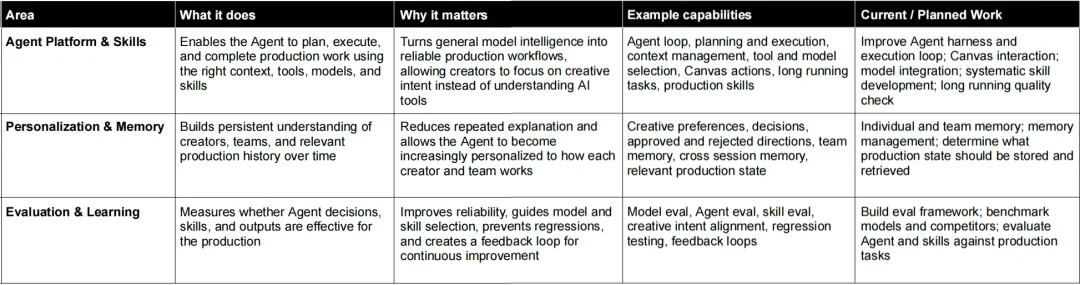
These three pillars of engineering clearly illustrate the triple leap from mere "production tools" to mature "production partners" in the film industry: from mechanical execution, to deep understanding, to autonomous evolution.
It is also worth noting that the Utopai X model is deeply integrated within the PAI and can be connected to professional late-stage tools such as Premiere, DaVinci Resolve, etc. This also means that the production material can be directly accessed through industry-level coloring and cutting processes, achieving a complete, coherent workflow from creation, generation to cutting and delivery.
Real Data Flight: Another Fortress of AI
If modeling ability determines the starting point for AI video, real production data determines long-term competitiveness.
For most model companies, model training typically relies on public datasets and standardization tasks, but Utopai is unique in that it is itself a film production company that is currently developing and producing over 20 film projects.
This means that the technical team and the video creators are not two separate systems, they collaborate in the same studio environment, and the artists constantly raise real production needs; the director and production team constantly provide feedback: what kind of footage works, what kind of expression fits the story, which production results need to be adjusted... These feedback then goes into the model and the Agent system, driving the next round of optimization, ultimately forming the "real project, the real data, the feedback of the experts, the feedback of the real data, the feedback of the digital systems".
This is also an important difference between AI video and ordinary video generation tools: model capabilities can be tracked, but the understanding of production processes accumulates with real projects.
More importantly, this "data flyer" is not a hollow concept on PPT, but a real work. Data shows that Utopai is promoting the development and production of more than 20 video feature films. Especially in the 2027 blockbuster line-up, several works across different themes and aesthetic dimensions are being intensively promoted under the support of the PAI system:
MSF: The Most Serious Fart: The Project is adapted from the New York Times best-selling children's book of 2023, written by Mike Bender, the original author.
The film brings together the leading "All-Star" matrix of Hollywood superstars: veteran animation producer Russell Hollander, who was involved in the production of Super IPs such as The God Who Steals Grandpa and Grandpa; Golden Globe-nominated screenwriter Joe Stillman, who won the Academy Award for Best Adapted Screenplay for the classic animated monster Slack; veteran cinematographer Andy Brooks, who was nominated for the Annie Award for Best Animated Feature Film; senior director Andy Brooks, who worked on the animated feature The Knife Pictures and the animated adaptation of Raiders of the Lost Ark of the Clock; and top director John Lee, who was nominated for the Academy Award for Best Animated Feature for Disney's Ice Cream Movie Crazy Animal City; and Scott Muller.
The top artists in the decades-long Hollywood industry are involved in providing feedback on PAI's character design, asset continuity and animation movement rhythms, and continuously inputting what is truly a "theater-level animation standard" into system sources.

Half Moon Moon: directed by Berlin Film Festival Silver Bear winner Hyo-joo Yang, and co-produced by Germany's In Good Company and South Korea's Paper Barn. The film is described within the industry as a love letter to an aunt from a Korean version, telling of the details of misunderstanding, silence, distance and intergenerational reconciliation within a multicultural family living in Germany.
For this work, where stories and human emotions always prevail over mere technical visuals, the film abandons the grandiose stack of bizarre moments of life and focuses on micro-expressions of life's subtle moments with real-life family footage, it reflects the PAI platform's precise control of capturing human subtle emotions, the authenticity of long-focus footage and the control of visual listening language.

The film, directed by Oscar-nominated screenwriter Nicholas Kazan, focuses on the clash between 16th-century Spain and the Aztec civilization. In the traditional Hollywood filmmaking system, the subject matter involves sensitive civilization conflicts and the need to reconstruct extremely complex ancient urban communities and battle scenes, and the vast real-world landscapes and visual budget often make it difficult for traditional filmmakers to get approval.
The PAI system demonstrates a whole new possibility: it reduces human needs to a much lesser extent than traditional films through AI native production systems, rewriting the economic model of film production, and allowing complex historical storytelling to take shape on screen.
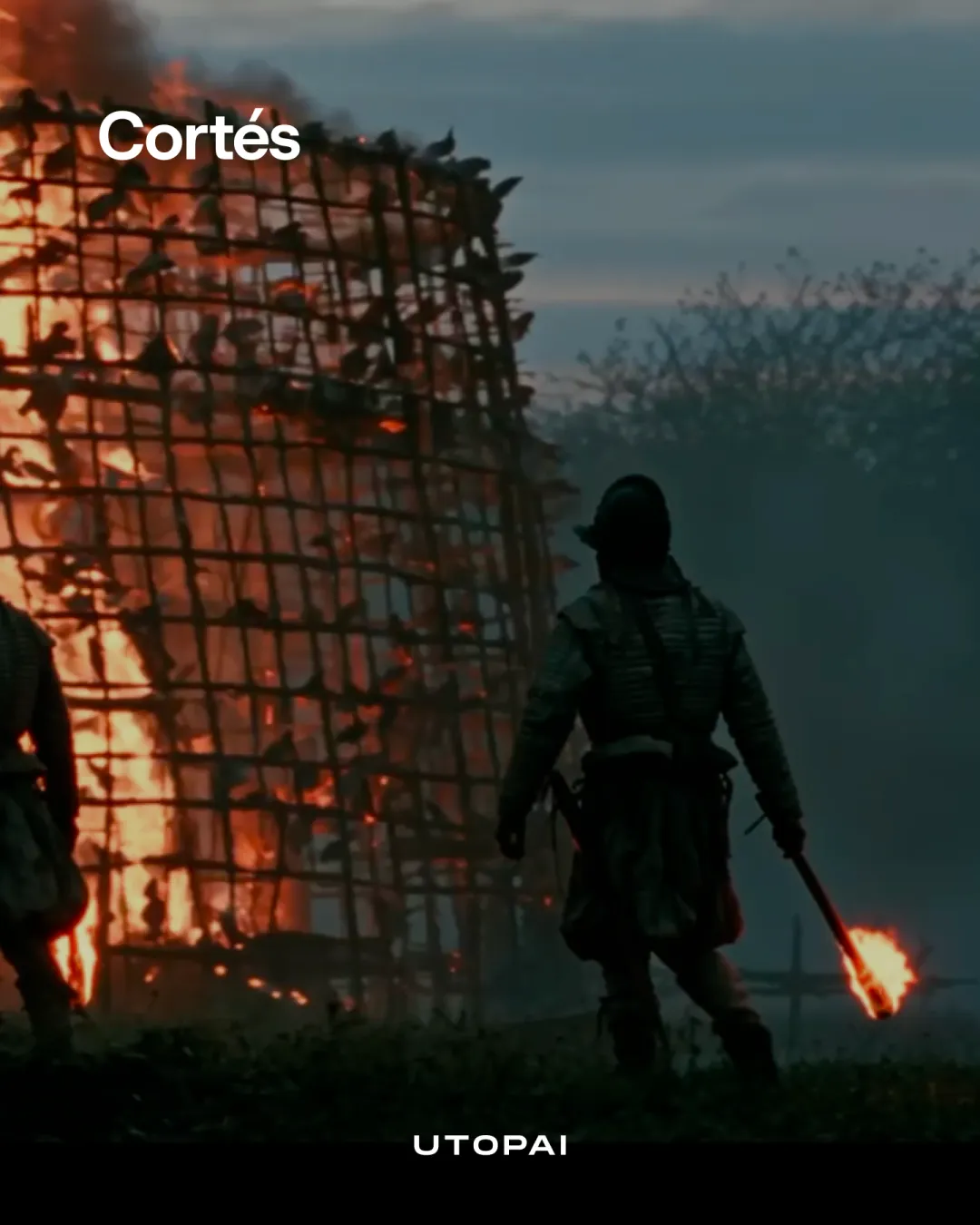
From this point of view, PAI's purpose is never simply to reduce costs and improve efficiency, but to enable creators to re-touch the grand themes of the past, which have been enclosed by high industrial barriers, at a controllable scale and cost.
In addition, it is worth noting that behind the long advances, Utopai has cross-domained the most core institutional resistance in the industry.
From a technical point of view, making AI a lens is no longer the biggest challenge, and the real challenge is getting AI into a 100-year-old film industry system. In recent years, much of the heated debate about the Hollywood trade union's strong opposition to AI has essentially pointed to the same question: who has creative control when machines start to engage in content production?
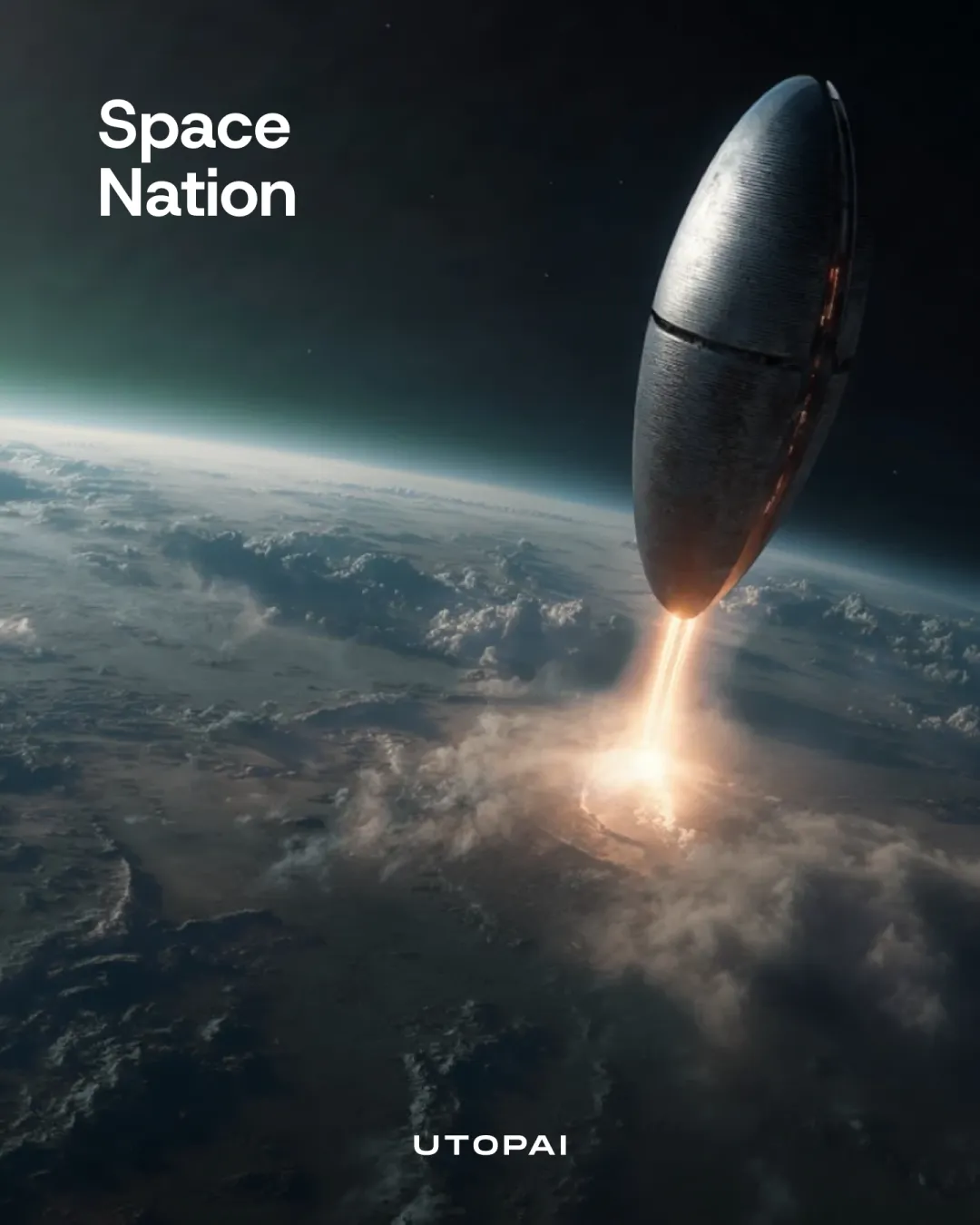
It is understood that in the process of promoting the film Curtain of Cortés and the science fiction series Space Nation, the Utopai team went through extremely difficult communication with the Hollywood trade union system, dialogues and multiple rounds of gambling, eventually reaching a deep consensus to become the industry's first successful AI film company to join the Hollywood Writers Guild (WGA) and the Actors Guild (SAG).
This rare loophole on this level stems directly from Utopai's respect for and adherence to the creator's sovereignty. In Utopai's view, the ultimate decision about the content is always in the hands of the filmmaker: deciding what to do, what to leave, where to change, it's up to the creator, and AI is responsible for expanding the possibilities.
As Utopai's chief scientist Zijian He says, "Technology should expand the canvas of filmmakers, and the creative vision still comes from the people who make movies". Zijian He is the longtime head of the multi-modal generation team at Meta Super Intelligence Laboratory (FAIR) who not only has deeply dominated the core research and development of Meta Llama 4, but is also the core leader of Meta's flagship video model MovieGen.
In fact, apart from Hollywood, the commercialization of the PAI system has taken place globally.
In September this year, Utopai announced a strategic partnership with Japanese mobile gaming and general entertainment giant DeNA for AI-assisted animation. DeNA has been involved in the development of multiple Pokémon series handheld games. Under the collaborative arrangement, Utopai's AI production experts will work side by side with DeNA's creative team to integrate PAI into its animation production process, while the ultimate decision on story, visual style, and performance remains in the hands of DeNA's artists. This is the first time PAI has entered the Japanese animation industry system, and one of the landmark exports of this set of smart platforms for film production.
In China, the company has also incorporated PAI into its long-running content production process, which will be used for the two-part collaborative animated series Yosemite: 500 Years of Disappearance.
In terms of sports and entertainment, Utopai is equally active: in addition to acquiring Paramount, former president Tom Ryan, and the personal investments of Hollywood's top sci-fi disaster film director Roland Emmerich, the company also announced massive cross-border financing in May this year: acquiring the strategic investment of NBA Hall of Fame legend Anthony Carmelo Anthony under Creative 7, and working with NBA superstar James Harden to co-produce cross-border AI animated short films, accelerating their penetration into mainstream sports and youth culture.
From animated feature films, literary plays, historical epics to comics and cross-border sports, AI technology has never been a harsh alternative but has given creators unprecedented visual control and tolerance to express themselves.
Written at the end
Finally, what I would like to say is that the world's second-biggest surprise on the list is that the outside world is looking at the iceberg corner of Utopai.
According to Forbes magazine's May 2026 estimate, the Mountain View, California-based film company, founded in 2022, has a market value of about $1 billion.
Within the film system, it has also been certified gold and silver: Bedford Park won the U.S. Dramatic Special Jury Award for Debut Feature at the Sundance Film Festival, and was acquired worldwide distribution rights by Sony Pictures Classics; Space Nation became the first AI series to collaborate with traditional copyright buyers, and was acquired by Brazilian Globoplay and German TV for the market price of non-AI content.
This time, Utopai took the "blind review second", which meant a whole new sample for the industry: when the model's evolution was driven by real video production, when the generation capabilities were seamlessly embedded into the complete workflow from creation to delivery, AI entered the path of making feature films, saying goodbye to the "doing a few dozen-second demo trick" phase, the first time there was an independently verified sample.
In the future, the core of AI video competition may be not just the parametric size of a single video model, having a stronger video generation model, but building an intelligent production system that understands how stories are generated, how creators make decisions, how production processes progress, and continually learning to evolve.
When AI moves from "production tools" to "production intelligence", the film industry or a new restructuring...