It's the first time in the history of the world.
In the words of ChatGPT, we're going to start using the word "buried cryptography!"
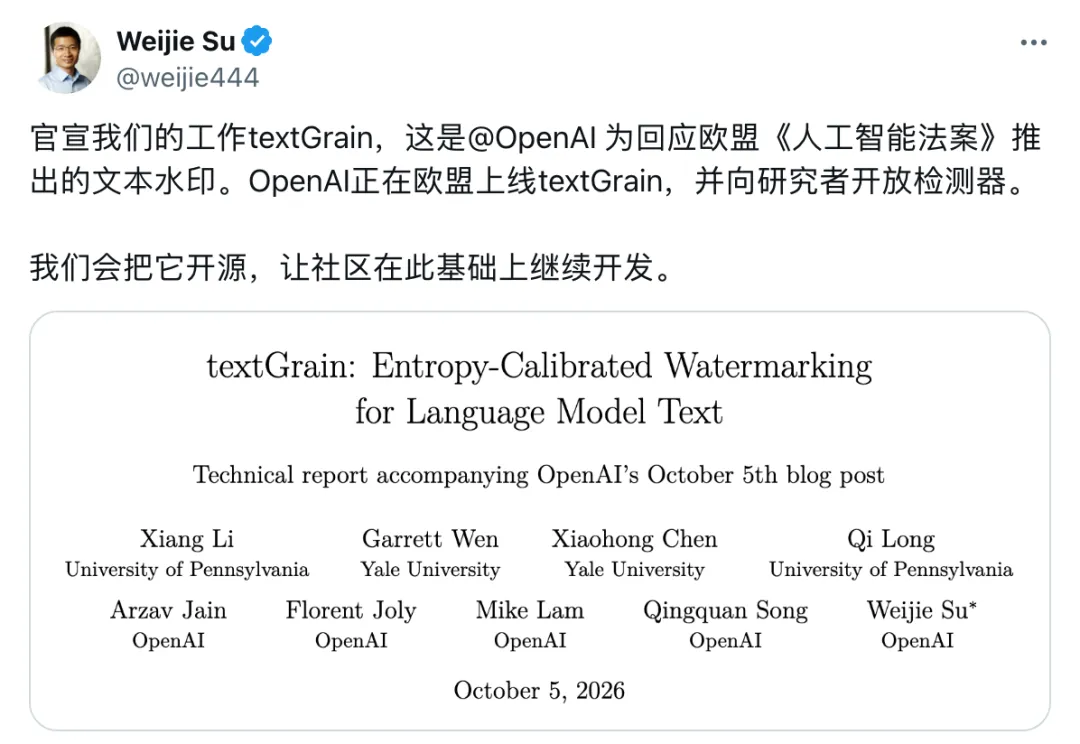
This watermark is called TextGrain. Each time the model picks up a word, it inserts a key that only OpenAI knows.
The eye can't see any traces, it reads the same as it did before, and the detector can scan it and instantly recognize if the passage is from a model of OpenAI.
From now on, you letAIRewrite assignments, résumés, weekly newspapers, as long as the original copy of the stickers can be recognized on the spot.
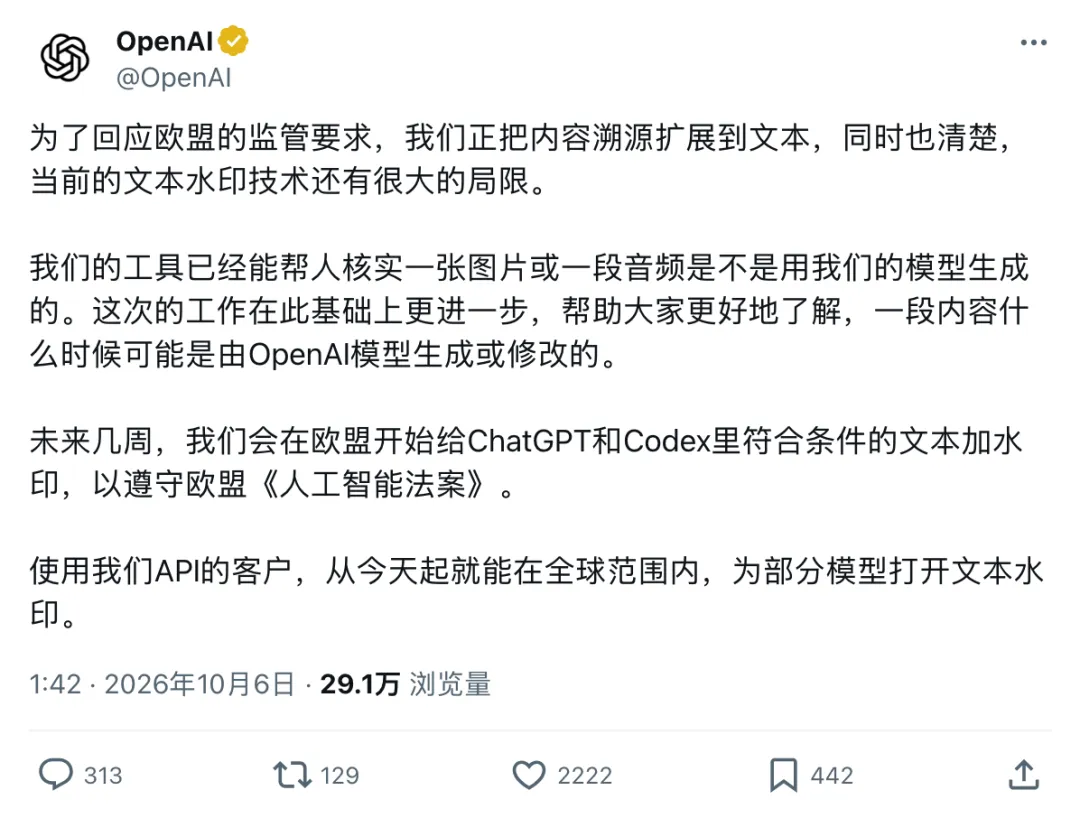
It is important to emphasize that the four most critical articles in this release are:
1. Effective immediatelyGlobal API customers will be able to launch their own waterproofing today, and ChatGPT and Codex will be available in the coming weeks.
2. High detection rateWhen the error rate is controlled at 1%, a psychology class response of 400 tokens can be detected by more than 90 percent. OpenAI also releases chatter that is equivalent to or even superior to Google's SynthID.
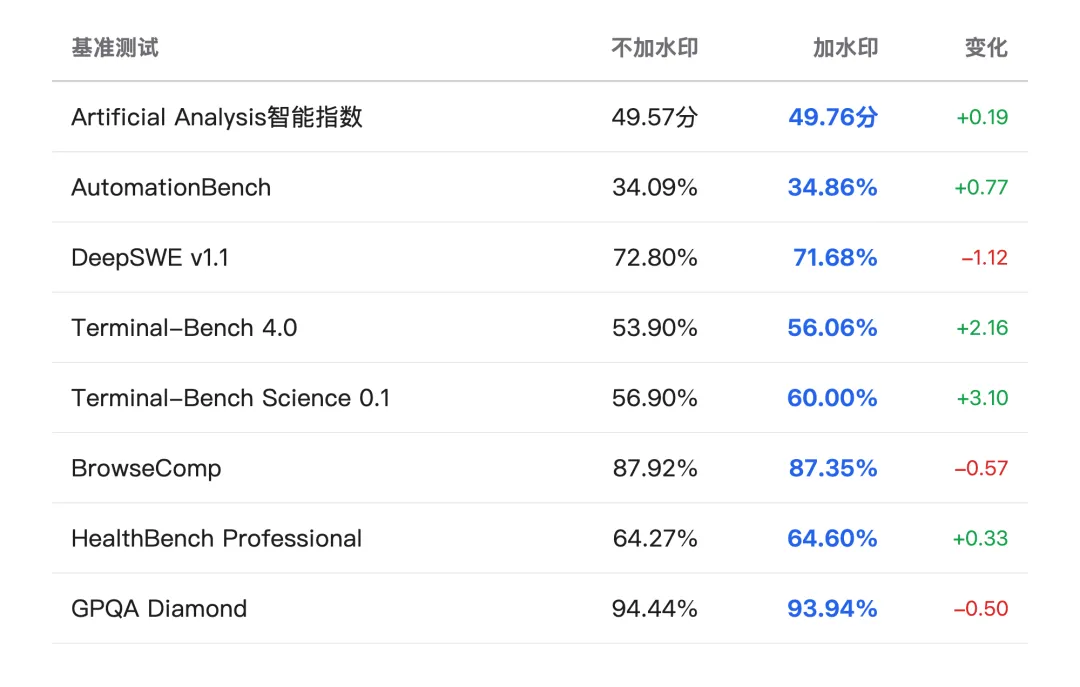
3. Almost intact performanceThe flagship model GPT-6 Astra is waterproofed with eight core runs that are essentially flat and five are even slightly slender.
4. Controlled testing rightsThe detector is not open to the public for the time being; it is sent only to researchers and professional institutions that have passed the audit, while the textGrain itself is open source.
The "real name era" of AI writing is officially underway.
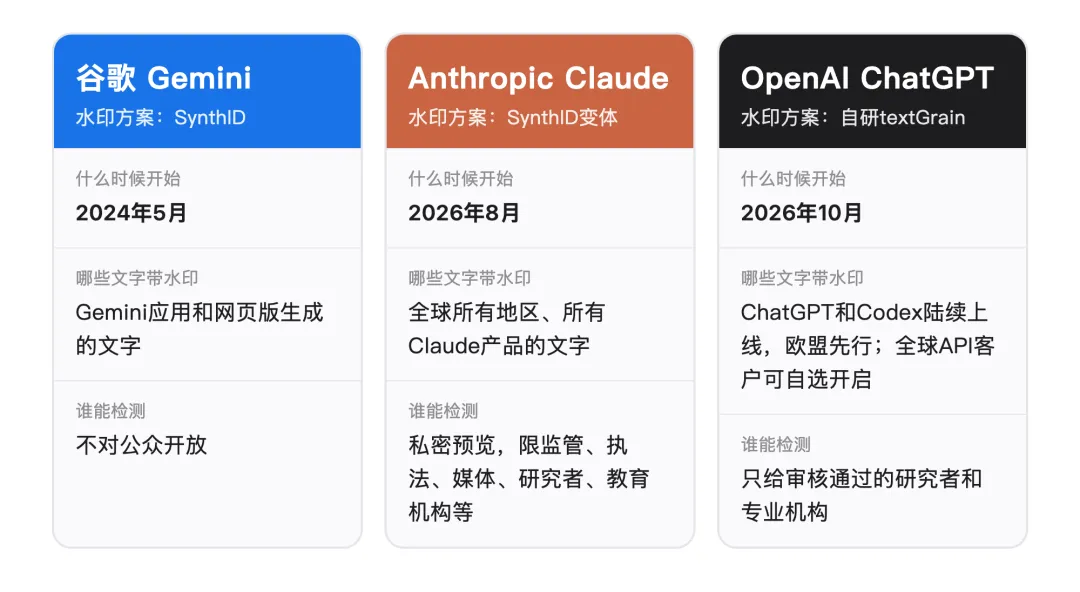 In the meantime, Google, Anthropic, and OpenAI, the three giants, have all written to AI in the form of "IDs".
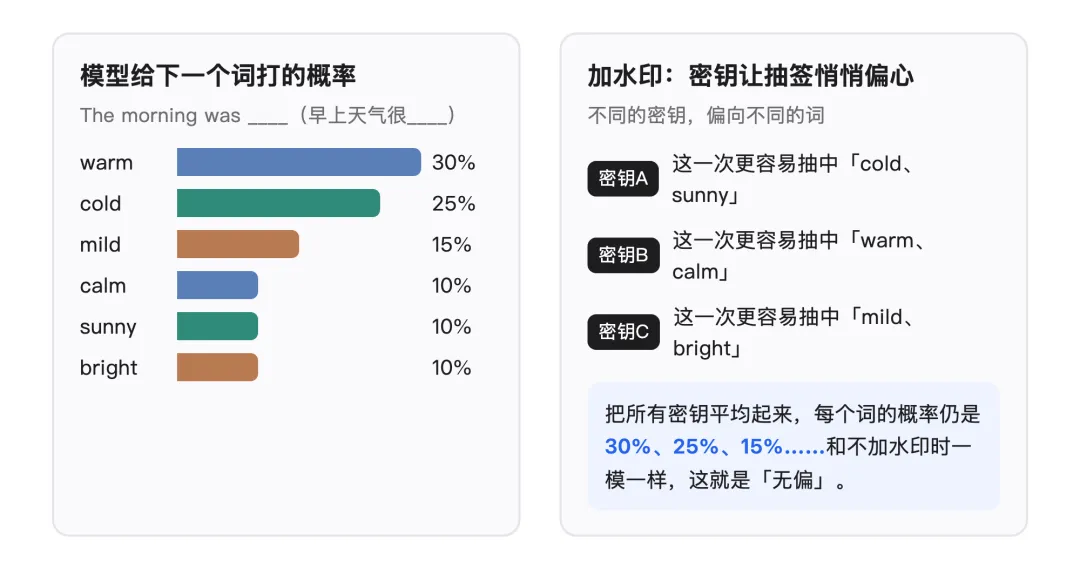
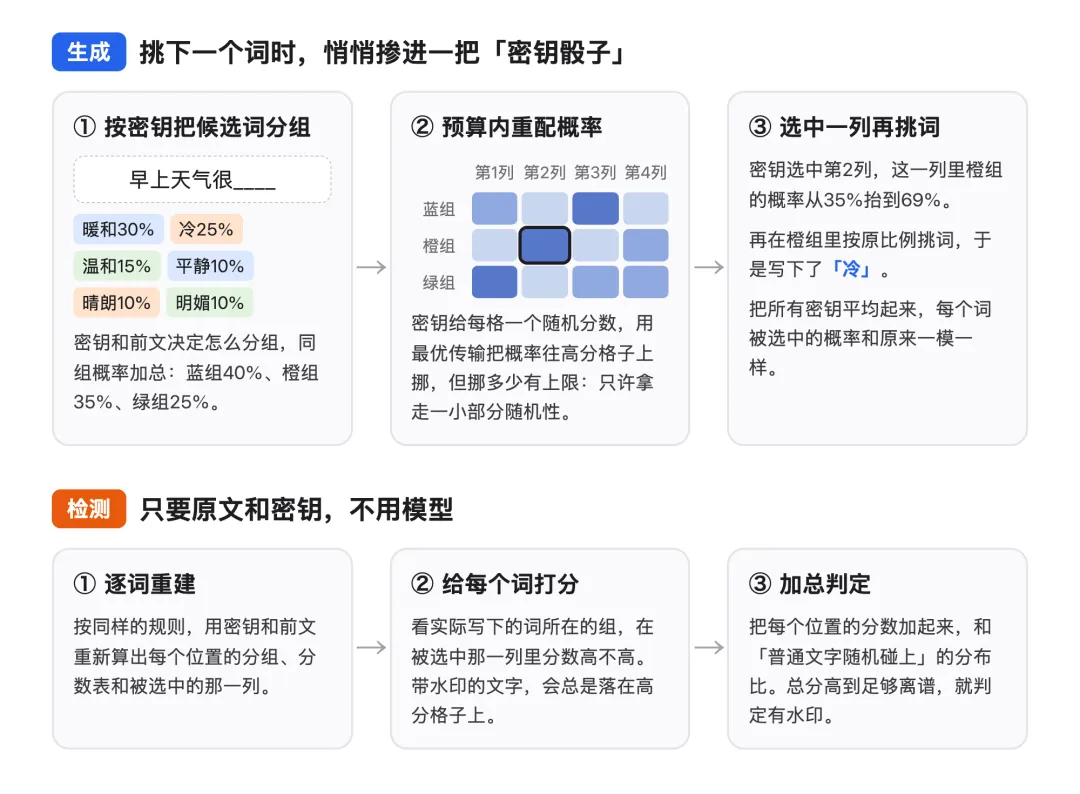
In 1781 he was transferred to the ChatGPT.The big model writes out one word each time. Before spitting out, it gives all the candidates a probability and then draws one out according to the probability.
For example, after "The morning was ___" (the morning was very _____), "warm" is 30%, "cold" is 25%, and the rest of the words are divided.
The only thing that the watermark has to do is let the key be heard in this draw.
But there is an iron law that can't be broken, called "unbiased". Averaging all possible keys, the probability of each word being drawn must be the same as before.
In this way, the people who don't know the key see perfectly normal random words, and the words the model wants to say have not changed at all.
Scott Aaronson's first watercolor print at OpenAI that year was met with impartiality, but left a trail of flaws.
The same question, the same key, the model chooses the same word every step of the way, the same question is asked ten times, and the answer is probably one word.
TextGrain's solution comes from a mathematical problem that dates back nearly 250 years.
It really started with "Moving the Earth".
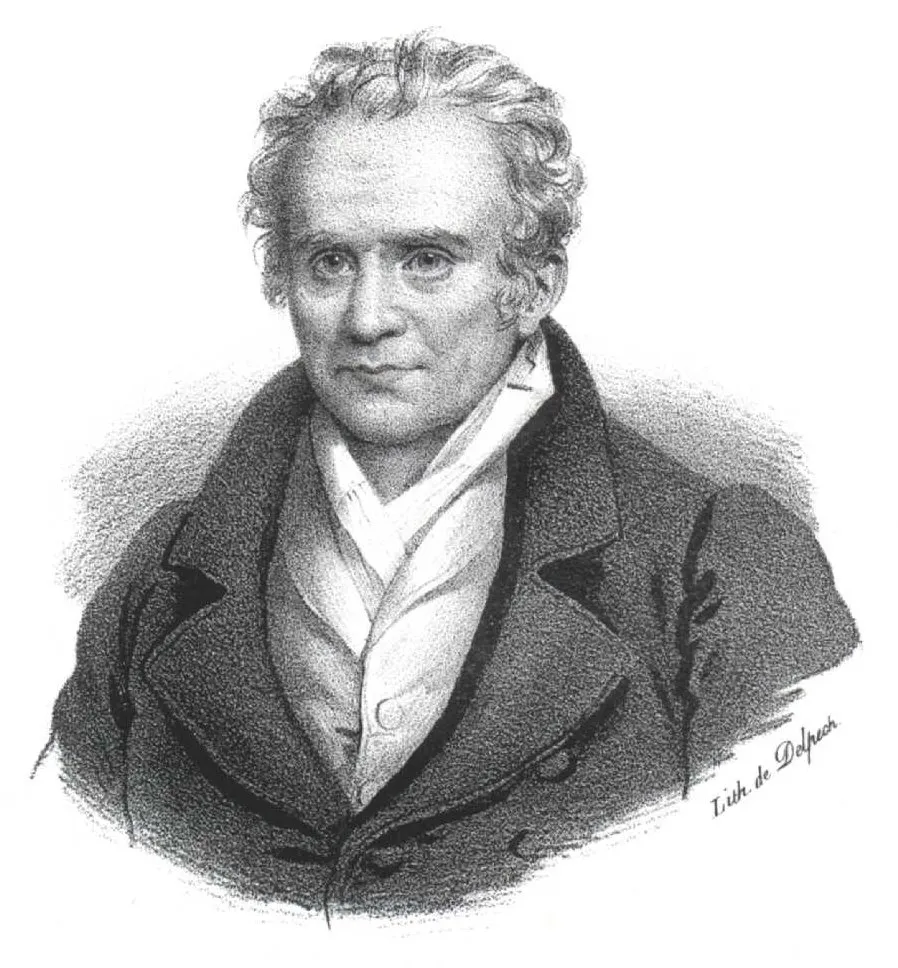
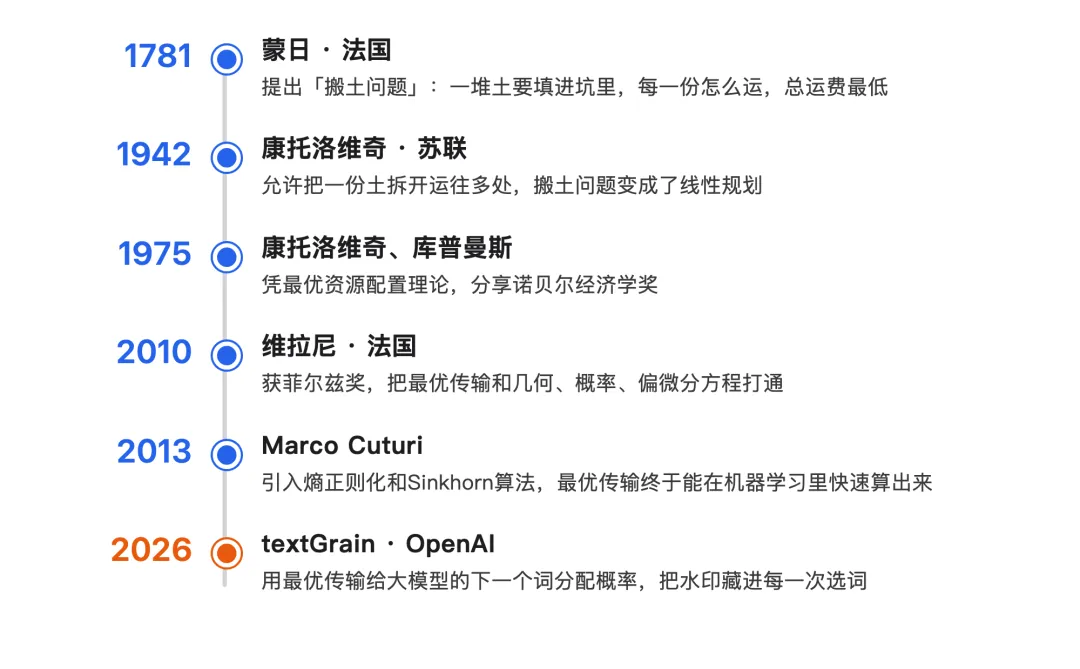
In 1781, the French mathematician Jean Monnet solved a very specific problem: a pile of soil must be filled in another crater, where each soil is transported, and the total transport costs are the lowest.
By the 1940s, the Soviet mathematician Kantorovich had loosened the problem so that a soil could be disassembled and transported as long as the sum of the two ends was equal.
Kantolowicz later shared the 1975 Nobel Prize in Economics with Kupman for his best resource allocation theory.
Coopmans is an economist at Yale, and one of the authors of the technical report, the Yale economist Chen Xiaodong, is currently sitting in a chair named after him.
Back in 2010, the winner of the 2010 Fields Award, Villanueva opened the best transmission and geometry, probability, and partial differential equations.
In 2013, Marco Cuturi introduced Silicon Normatization and the Synchhorn algorithm, which greatly accelerated the costly computation and optimized transmission that became a common tool in machine learning.
More than two centuries later, TextGrain moved the mathematical chain into the larger model. Only this time, the move was replaced by the probability of the next word.
The core idea behind textGrain is to print a "random budget" for water.
The paper demonstrates a constant equation. The resulting association of watermarks with keywords coincides with the average loss of randomness of the model, with the two sides being the same quantity.
WatermarkThe number of statistical correlations to be obtained, the amount of randomness to be paid, is no different.
Thus, OpenAI can set a ratio in advance, determining the maximum amount of original randomness that a watermark spends. For example, 0.2, on average, it retains at least 80% randomness, leaving it to the diversity of responses.
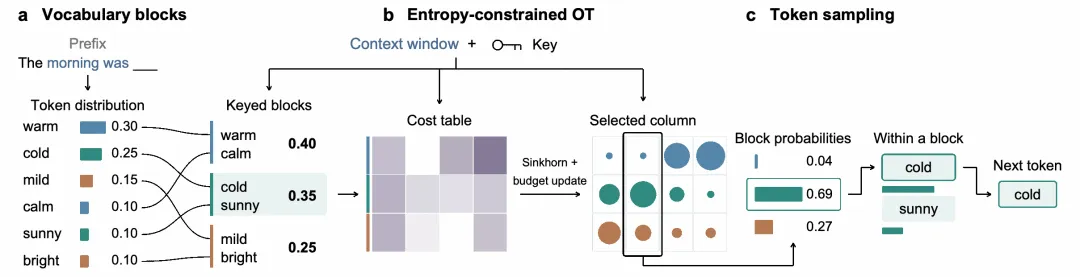
The specific process is divided into three steps.
The first step, along with the key and preface, is to randomly divide the candidate words into groups, adding the probabilities of each group together.
The six words are divided into three groups: warm, calm, 0.40, cold, sunny, 0.35, and mild, bright, 0.25.
In the second step, OpenAI is equivalent to preparing four sets of "biased" schemes, the four rows of which are these four schemes.
The key generates a random number for each of the "group x schemes" and then optimizes the transmission of the string constraint using the Synchhorn algorithm to modify the alignment over and over again, moving the probability as far as possible to the higher grades and moving the budget until it is used.
Each set of schemes favoured a different group, with four sets averaging downwards, and the probability of each group remaining 0.40, 0.35, 0.25, and none favoured.
The third step is to select one of the sets of keys in the second row, where the "cold, sunny" group is mentioned from 0.35 to 0.69.
In the group, the word "cold" is written in the original 25 to 10 ratio.
Those who don't know the key see a normal draw; those who hold the key know which group of steps to take.
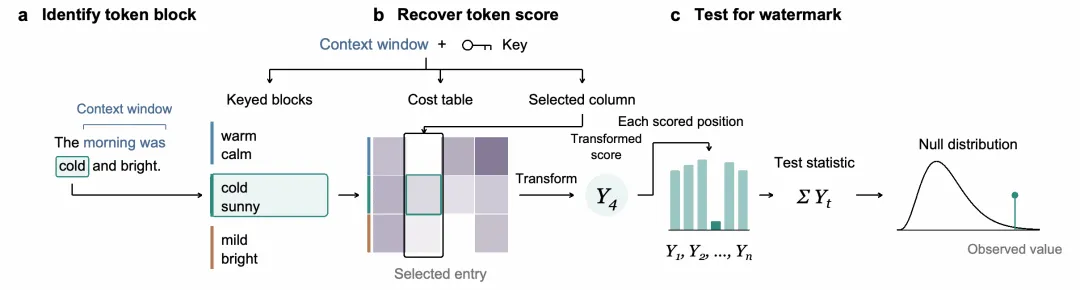
When testing, there is only one question to be answered, which is whether the word "accidentally" is always preferred when pressing the key.
The words and keys written by ordinary people are irrelevant, the scores of each location are purely random and can be calculated accurately using a finite probability distribution.
The text with the watermark will be stamped on high scores, so the total score will also be high.
The entire detection requires only the original and key, neither requiring a model, nor knowing how much of the budget was set at the time of generation.
It is worth noting that this watermark did not alter the model.
Of the eight benchmarks of the GPT-6 Astra, five were slightly watermarked, dropping only a maximum of 1.12 points; tests in ChatGPT also showed little change in the user's "point-to-point rate".
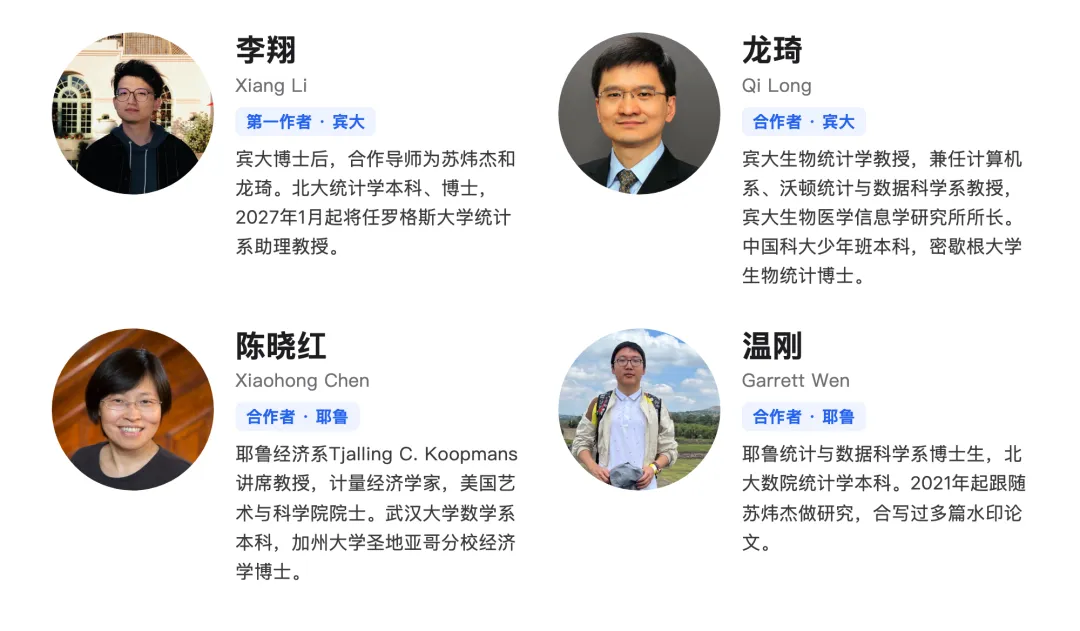
Students from Northeastern University are invited to participate in OpenAIIn this 20-page technical report, the authors are four university academics and nine authors from different backgrounds across statistics, economics, optimization and machine learning.
The first author, Li Xiang, who completed his undergraduate and doctoral studies in statistics at Northeastern University and was mentored by Zhang Zihua, specializes in large model text printing and large model assessment in recent years, will be an assistant professor in the Department of Statistics at Rutgers University in January next year.
Pineda Long is a biostatisticist from the Chinese Academy of Sciences and is currently the director of the Biomedical Informatics Institute of Pineda.
At Yale, Chen Xiaoxun is a Fellow of the American Academy of Arts and Sciences, who won the Chinese Economics Prize in 2017 together with Liu Xiaobo.
Weng is a fifth-year PhD student in the Department of Statistics and Data Science at Yale, an undergraduate at the Northwestern Institute of Mathematics, majoring in high-dimensional probability and randomization matrix.
Among the authors on the OpenAI side, Qingquan Song comes from the baseline model team and is one of the authors of the open-source tool Auto-Keras; Arzav Jain and Florent Joly were both involved in the research and development of the ChatGPT search.
One of the people who put this team together was the communications author Suzie.
He joined OpenAI in May of this year and is still a professor in the Department of Statistics and Data Science at Binghamton Business School.
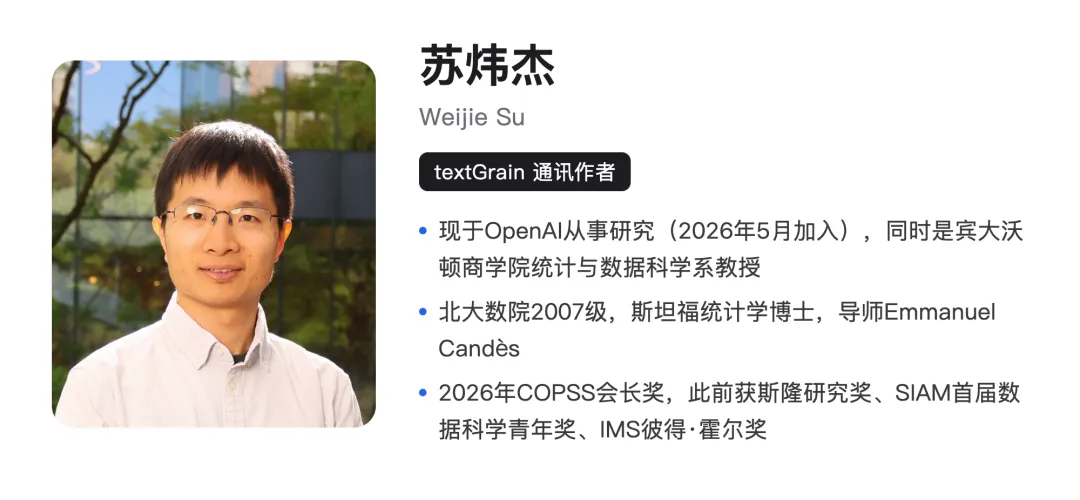
Suzuki is a 7th grader at the North Central Mathematical Institute, first in his senior year at the North Central Mathematical Institute, and a first-time All-American gold medalist at the University of Michigan Mathematical Competition. He then went to Stanford for his Ph.D. in statistics from Emmanuel Candès.
His research spans statistical machine learning, high-dimensional inference, optimization, and privacy protection, and ICML 2023 specifically uses his proposed "security mechanism" to allow authors to sort their posts to calibrate review scores.
When he won the COPSS Chairman's Award in February this year, the first words he wrote were the statistical basis for generated AI, which includes research on water printing.
"This is what I wrote", and it needs to be proven.
The principle is that when you talk about what you're most concerned about, what you've written with AI will not be detected.
It's dangerous to duplicate it. A few hundred words together is enough to make the detector recognize it.
However, in the eyes of those who can see it, it is not your teacher or your HR.
According to the official announcement, OpenAI's detectors are only open to researchers who have passed the audit, and Anthropic's are only open to regulators, the media, researchers and educational institutions.
The door is not yet open, but the direction is clear.
ChatGPT is used by 1.2 billion people each week, with more and more words coming from models, and Google, Anthropic, and OpenAI all taking the same path to write the output directly into the text itself.
More than two hundred years ago, the mathematics used to calculate transportation costs for earthworks is now used to characterize words written to machines.
Waterproofing can only prove that a word is from AI and not a word from you.
Later, the phrase "this is what I wrote" may have to be used as evidence.
RoboInd editorial channelResearch, robotics companies and market intelligence for cross-border sourcing.Explore the channel ↗
Share this
End of editorialExplore more from Global Robotics News ↗