
It's the first time in the history of the world.
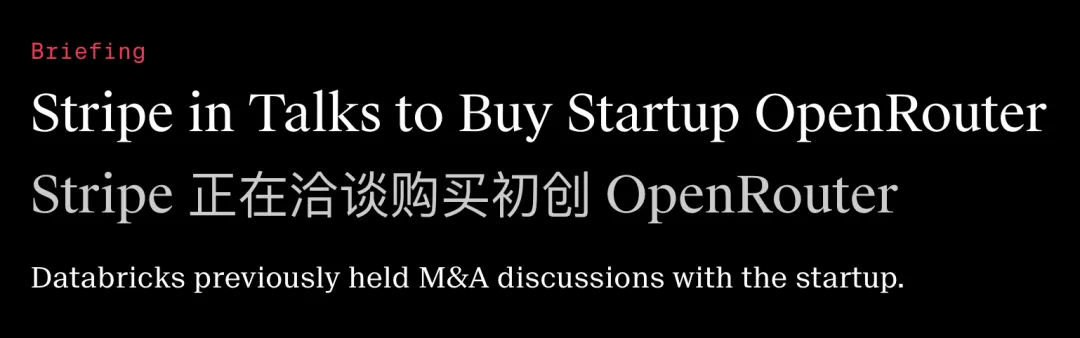
Stripe is in talks to acquire OpenRouter.
According to The Wall Street Journal and The Information, the price of the transaction could be close to US$10 billion (approximately RMB68 billion).
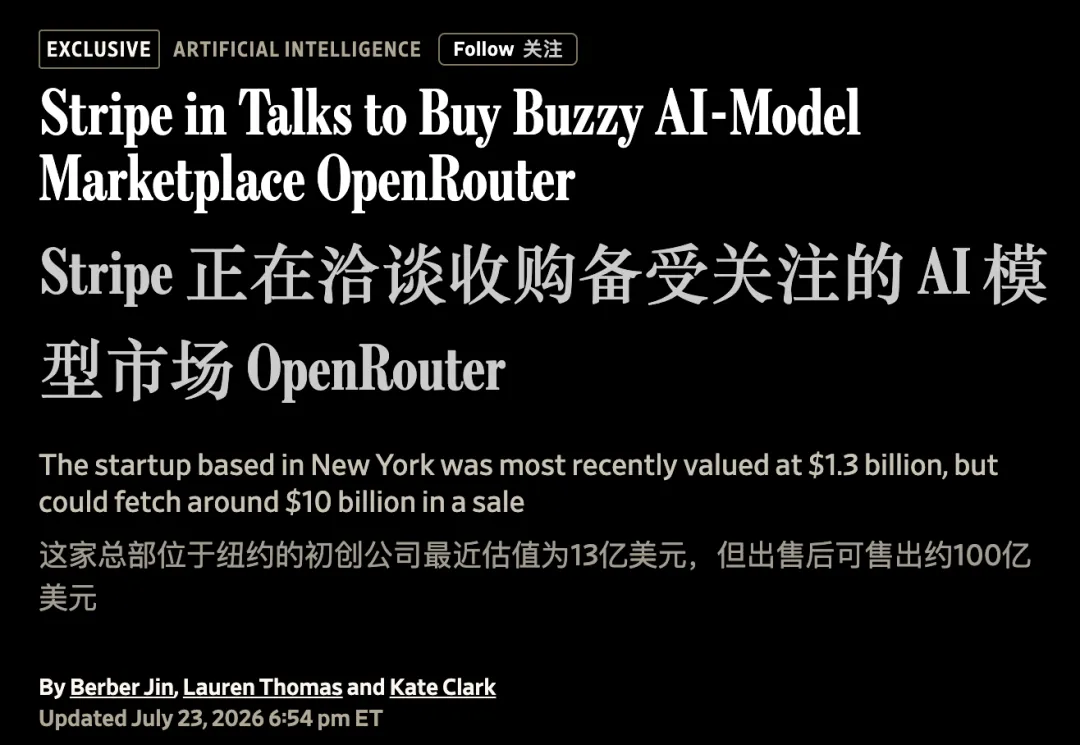
Two months ago, OpenRouter was valued at just $1.3 billion (approximately RMB 8.8 billion), with a premium of almost 700 times.
The deal could be announced within a month, but it could also be advertised.
According to The Information, Databricks has previously discussed the acquisition with OpenRouter, and further progress is unknown.
A Stripe spokesman called the Wall Street Journal "no comment on rumors and speculation".
The name OpenRouter may not be familiar to most people, but what it does is relevant to every AI user.
AI applications that you useThere's a comparison engine behind it.
Open an AI translation tool, type in a sentence, and get results in seconds.
What you don't see is that this was sent to GPT, Claude, or a much cheaper open-source model.
The decision of "which model to choose" is increasingly made by the middle class, such as OpenRouter.
A simple analogy: If an AI model is a flight, where does OpenRouter go?
Through its API, developers access more than 400 large models that are automatically matched by task complexity, cost, and response speed.
To sum up, a daily email doesn't need to be run on the most expensive front-end model, and a legal contract is handled by one that is more capable.
The user experience has not changed, but the bills behind it are several times worse.
It also explains one thing: why so many AI products remain low-priced or even free.
OpenRouter was founded in 2023 by Alex Atallah and Louis Vichy.

Alex Atallah

Louis Vichy
Atallah's previous venture was NFT trading platform OpenSea, which was valued at US$13.3 billion at its peak.
Following the decline of NFT, he left in 2022 to turn to AI infrastructure.
In an interview, he said:
Reasoning is the fastest-growing cost of an enterprise, and often comes from more than four different models.
Growth data confirms this judgment.
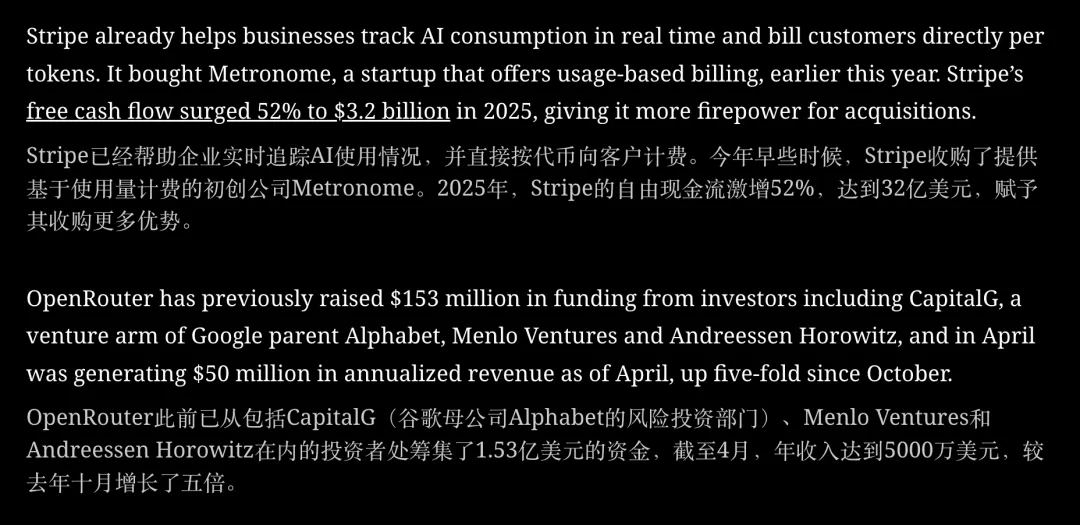
According to The Information, as of April this year, OpenRouter's annual revenue reached $50 million, five-fold in six months.
The platform has over 400 large models and over 1 million developer users.
Investors include CapitalG, Alphabet's Growth Fund, Menlo Ventures and a16z, which have raised a total of $153 million.
Stripe is an AI economy.Banking and Scheduling Centres
Stripe is the world's largest Internet payment processor, helping millions of businesses complete online payments.
Over the past year, the company has expanded its business extensively to AI infrastructure.
In December 2025, Stripe spent about $1 billion to acquire the usage-based billing platform Metronome.
Metronome charges AI companies for Token usage, and OpenAI and Anthropic are its customers.
Stripe CEO Patrick Collison said at the time:
Quantitative pricing is a business model born in the era of AI.
In addition to OpenRouter, Stripe's intentions have come to the surface: model selection, billing, receipts, a full link.
If you compare AI to a restaurant, then Stripe is also a food service provider (to help you choose a model), a water meter (to charge by quantity) and a cash register (to pay).
For enterprise customers, one supplier can handle all AI usage and bills.
Stripe has ammunition to do this.
According to The Information, Stripe's free cash flow in 2025 was $3.2 billion, an increase of 52% compared to the previous year's total revenue of about $6.8 billion.
In February, employee stock transfers pushed the valuation to $159 billion.
During the same period, Stripe also partnered with private equity fund Advent International to issue a purchase order for about $53 billion to PayPal, which is allegedly priced too low and negotiations are ongoing.
$10 billion to buy a company that earns 50 million a year seems like a great deal.
However, OpenRouter's revenue doubled five-fold in the first half of the year.
More importantly, the location: when an enterprise switches from tying a single AI model to a multi-model blend, the people controlling the routing layer have the power to allocate traffic.
It is at this level that it is decided which model is recommended as a priority and which is ranked in the back.
For ordinary users, the change is not tomorrow, but the direction is already visible.
Stripe acquired Metronome, took "how to make money" and took OpenRouter and took "who's model".
Every AI product you use in the future, its cost and the model choice behind it, is sinking from the hands of application developers to this layer of infrastructure.