It's the first time in the history of the world.
Last month, OpenAI and Anthropic began a series of extreme introspections. They just announced that they had conquered a hundred-year-old mathematical conjecture, and they were breaking the news of solving a millennia-old puzzle.
And social media is also caught up in a traffic frenzy.
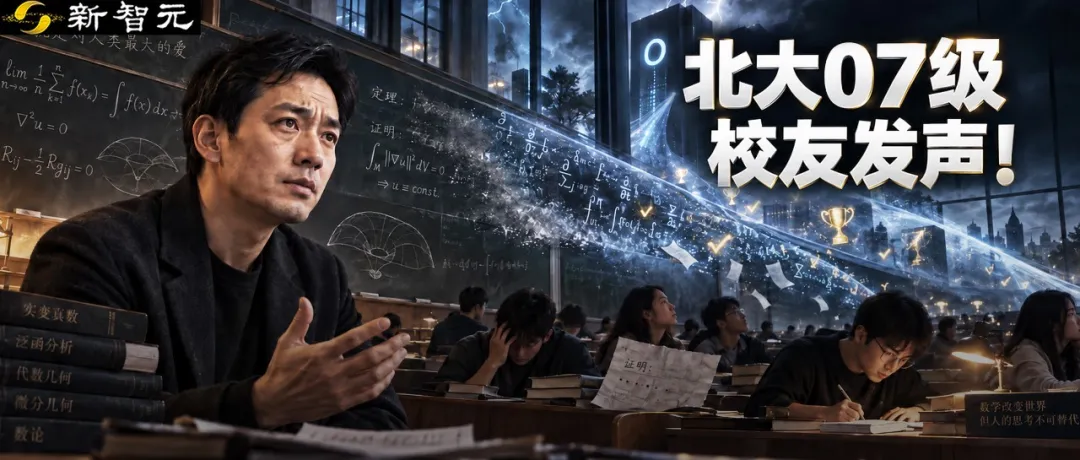
As a technology media outlet, we also kept up to date with the latest developments and gained a lot of enthusiasm. However, shortly after the release of the next Millennium Challenge, an alumnus of the North Mathematics Department expressed his thoughts.
That afternoon, we had a conversation that lasted about 30 minutes.
His voice was filled with deep concern and helplessness about the practices of these Silicon Valley factories.
He told us how their crude practices hurt the mathematical academic community as a whole and how they destroyed the young people who had just burned their passion for mathematics.
As a result, as if it were a historical omen, the day after we ended this in-depth conversation, the 25 winners of the FIPRES, including Tao Te Ching, issued an open letter in their names, aiming to start a conversation with us.
The following is an in-depth review of this conversation.
The problem is to explore.It's not a "brush list" award for Silicon Valley.Ordinary people might think that the ultimate guess and puzzle is the ultimate boss, and now AI has overthrown the boss for a second, so AI has won.
But in the eyes of real mathematicians, this logic is absurd and deadly.
"Solving these assumptions is actually just a few trophies. These trophies are now being taken over by AI, which is not a good thing for the mathematical community".
In the mathematical world, he said, the ultimate goal is not to reach a conclusion on the gravestone, but to train a generation of human mathematicians on this long journey.
"We all have this goal of working hard, of course, and it's very good. But it's done well, it's not done well, the relationship isn't that big.
He pointed to the most recent PR tools of O and A.
Rumor has it that OpenAI solves mysterious puzzles such as the Hodge conjecture and the BSD conjecture.
According to the criteria of the Clay Mathematical Institute, the answer given by AI may hardly be a "solution" of some dimension, but this solution is extremely fractured for human civilization.
"It's actually a 'solved, but not completely understood' situation. If it were solved by a human mathematician, he would have produced enough, rich enough, theoretical insights in the long proof process. But the problem now is that whether AI finds a counter-example or gives a result, humans don't digest it at all".
What's more terrible than violent puzzle solving is the propaganda carried out in collaboration with Silicon Valley. This PR, which is conveying the wrong ideas to the public, makes the world no longer need human mathematicians.
"This propaganda will not only frighten young people who want to study mathematics, but also mislead those who make financial decisions".
"The mathematical community needs living people, or it needs to support living mathematicians with the same intensity. The way mathematics is done can change, and the criteria for judging people can change. But if this false prosperity is not criticized, it is actually helping to propel a bad future".
And they have drained the genius of mankind, and destroyed the genius of mankind.And how many of the "miracles" of AI are genuine originals?
In the interview, he revealed to us the truth about what just happened around him.
A researcher who spent a very long time working on a cold mathematical guess.
In the course of his research, he routinely used a large model (GPT-5.x, an early version of intuition) as an aid, exploring AI and developing his own ideas.
However, something dreadful happened.
On the same day of the interview, someone posted a paper on arXiv. The core ideas and content of the paper are almost the same as the draft in the post-PhD computer!
The paper was published by a physicist who works mainly as a researcher.
For the physicist, publishing this cross-border paper was not at all part of his main research. To him, it was more like a playful "draft" where he used AI to run a bunch of seemingly rigorous results, which he found interesting, and then signed directly and hung out.
"It's like you can happily do some research and let the AI write you a draft, and it's a blank slate".
Finally, it was discovered early, and the two sides negotiated more amicably, to conclude in a "joint signature" manner, but this revealed a terrifying truth.
The unpublished drafts that human mathematicians explore with big models are being ruthlessly taken by AI companies as "training feed" and then thrown out in the form of "AI self-discovery" or "external sweepstakes".
Previously, AI's breakthrough in solving the Navi-Stokes equation was widely questioned in academia, as it was the data from a conversation with a model prior to being stolen from a professor at New York University.
He sadly concluded: "You have absorbed the genius of human wisdom, but you are destroying the genius of this community".
So, does AI have the ability to discover new evidence independently?
We talked about the previous episode of "Consistent Physicians Solving Matrix Problems", where a doctor with absolutely no professional background in mathematics could just throw out a whole new proof of AI through an excellent prompt.
He replied, "The raw materials needed to prove it are already there. That guess probably hasn't been proven in years. But he tried, and now that AI is smart enough, its trick is to put all the previous clues in the literature together and get it right".
Even he had the same experience two days ago: a man who spent half a year thinking hard about himself, 20 years of speculation in mathematics, and he went to ask an AI question, and it came out!
And the way AI is used is the same old way that one of the few people who came up with the idea that year had used.
In other words, these issues are already a state of "everything is ready, only the east wind".
The theory is there, the direction is there, and there is only one machine that can instantly retrieve all human memories and perform violent actions.
This is not about AI demonstrating anything beyond human independence, it's just a harvest of human knowledge.
Why feed a bunch of people?So now there's a cruel question before the academic community: Who should be credited for these academic achievements?
Is it the mathematician who spent a decade thinking about the underlying system, or is it the "winner" who just taped a few hints and pressed the back button?
"We're meeting today, and we're still discussing this hotly". He told us, "First of all, you don't recognize the mathematical results of AI itself?
"As a community of mathematicians, we need to figure out who to give credit to. Who can get a teaching position? Who can get a National Natural Science Fund? We don't think that awards should be given to people who just press the button. You have to input your own mathematical understanding and contribute to understanding in order to be honored".
It also raises a bigger question: Why does human society have to feed so many scholars?
In terms of utility, the vast majority of basic mathematical research is of no concrete use in the real world today. They are only a theoretical alternative to what might be "useful" in the coming decades or even hundreds of years when a technological breakthrough occurs.
And now, it's hard to tell, they've all become "training feed" for AI.
However, it would be suicide to stop supporting human mathematicians.
"In order to maintain a 'mathematical understanding' of human society for a long time, we must maintain an extremely high tree of mathematical knowledge and maintain a large group of human mathematicians".
"You can't say that once I've learned something from a textbook, I'm going to pass it on to the next generation. It's a dead end. In the process, in order to really understand the underlying logic of mathematics, you have to understand mathematics at a higher level, that is, you have to study mathematics yourself".
Why don't we focus our limited money on developing mathematics that is "really useful, instantly transformative"?
The answer is this: because you have to feed this bunch of people, you have to allow them to do a lot of "useless" things. You can't just think about the tip of the pyramid.
Now, even with AI, these human brains need to be trained.
What is the mathematician's way out?So where is the path for theoretical mathematicians?
He said that even if one day all the mathematics done by AI were better than humans, humans would have to work hard to train their brains to ensure that there are still generations of people "who know mathematics" in the world instead of happily surrendering all the research mechanisms to AI.
In addition, today's large model is essentially a sequence combination within a known framework. If it is required to break through from zero in deep water, the cost is still high.
AI broke the Navi-Stokes equation and may have spent nearly 20 million knives burning Token. What is the $20 million concept? Enough to hire 100 top human mathematicians for a year!
"If you really hired 100 mathematicians for a year, you might actually be able to construct that counter-example. You let AI find a theory that's really up-to-date, and it's likely to cost more than the existing token".
In the long run, the human brain will remain the most efficient and disruptive "carbon-based computing cluster" in the universe. Thus, human society still deserves to be heavily sponsored by mathematicians who are innovative enough.
Research is still a work in progress.
Recently, Vibe Coding has gained popularity, while Vibe Math has a deadly crisis.
Today's Vibe Coder, the vast majority of whom have written hundreds of thousands of lines of code themselves that year, are programmers who have a deep understanding of the underlying code. But what about the next generation?
In the end, he told a darkly humorous passage.
"I was joking with one of my collaborators the other day, and I really want to thank him for writing our paper so well over the last couple of years, so AI hasn't learned our direction yet, and we still have a meal to eat".
It's a joke that's exactly what's killing AI right now.
Existing AI is mostly trained on the basis of text symbols on paper. However, there are many areas in mathematics that rely heavily on human intuition.
"There are a lot of disciplines, like geometry or topology, where mathematicians describe spatial things like they describe a picture. You can't just write your argument on paper. People who write think of a picture and read the same picture. This is a mathematical discipline that relies heavily on spatial intuition, and AI isn't very good at it right now".
Fortunately, as long as the human brain uses deep intuitions that AI can't easily penetrate, mathematicians have a final stand.
What are humans doing?Mathematicians have different views on AI.
Some people are very positive, very anti-traditional and believe that AI should be fully embraced.
Some have started defending AI, firmly refusing to release unfinished drafts online.
The mathematical universe, which AI now occupies, is just the tip of the iceberg.
If one day AI really reaches all-knowingness and solves the problems of countless dimensions, then humanity will not have to panic. We can leave home with dignity and embrace emotion, literature and art.
After the interview ended, our minds could not be calm for long.
In the mathematical-dominated steel forest, we still need the group of living mathematicians who seem "plain-faced" and do "useless things" on the blackboard every day.
They are the ones who built human civilization for human dignity.