On September 30, a decision model was officially released, quickly generating huge attention: in a 38-point benchmark test of Decision Index 0.2.1, it outperformed the current hottest Jev by 31 points, scoring a combined score of 63.88 to 57.91, nearly 6 points ahead of the public list; and it is fully open source.
In a chess match with Jev, the game's response rate was not comparable to that of its opponent, but it won 35 of 36 innings.
The company that produced this model is now the hot-tempered Shanghai AI star startup StartLux. The company, which was founded less than five months ago, is already the second company to produce an industry shock: the last time, the local model of the StartLux-27B surpassed 284B in the DeepSeek-V4-Flash test at the China Communications Institute at the Ministry of Industry and Communication; and basically leveled the DeepSeek-V4-Pro by about 1/60 of the parameters. This time, the fully open-source StartLux-Decision model is already the world's most powerful decision-making model in terms of overall public evaluation results.
More than Jev
This time around, the Decision model of StartLux launched versions 0.8B, 2B, 4B, 9B and 27B in five grades and provided quantitative models supporting local deployments.
It's a bit of a mystery.
A collection of Hugging Face models can be downloaded:https://huggingface.co/collections/startlux-models/startlux-decision-6abba92b301b573fa154d493
What's the power? Let's see a chess piece first.
The opponents were the recently-concerned Jev 1.13.[7] Both sides saw the same state of the board, with no additional searches, and each step was directly selected by the model.[8]
In the end, StartLux-Decision-27B finished dead. In this match, its average losses, best-of-five hits and number of mistakes also performed better. In such a game, StartLux won 35 of 36 innings.
Let's take a closer look at the specific test situation. First, the overall results of StartLux-Decision, without much ado, look directly at the numbers.
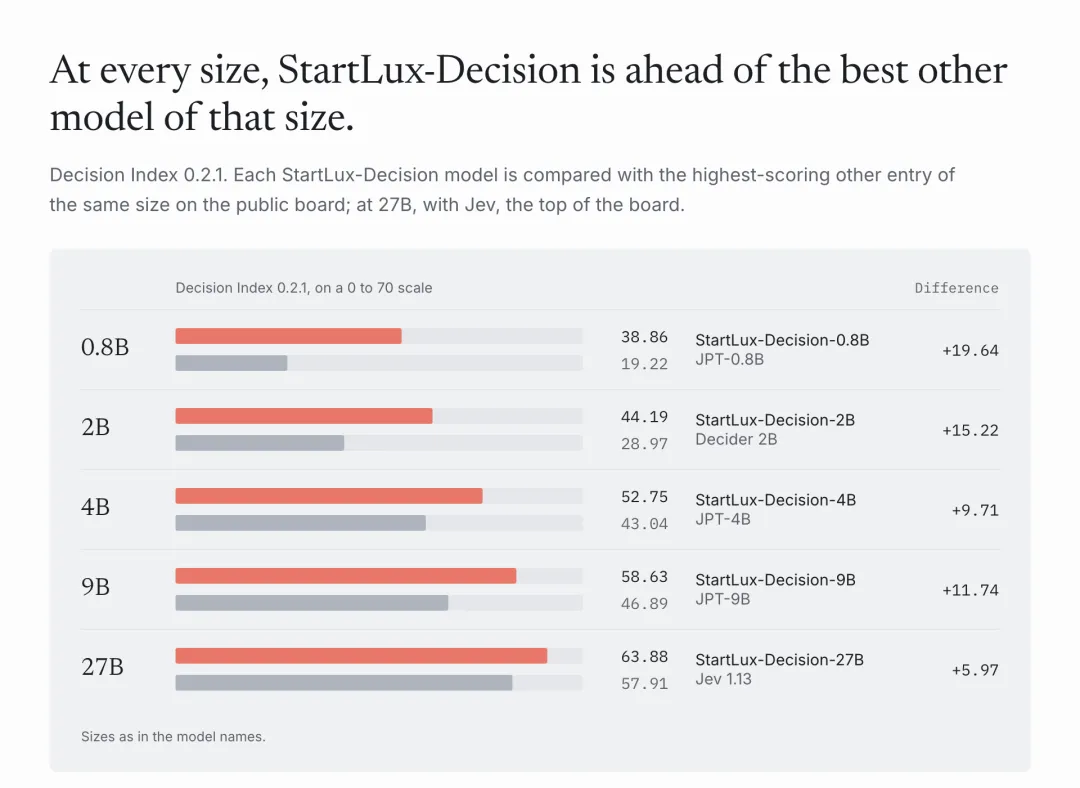
So let's go back to the score of version 27B.
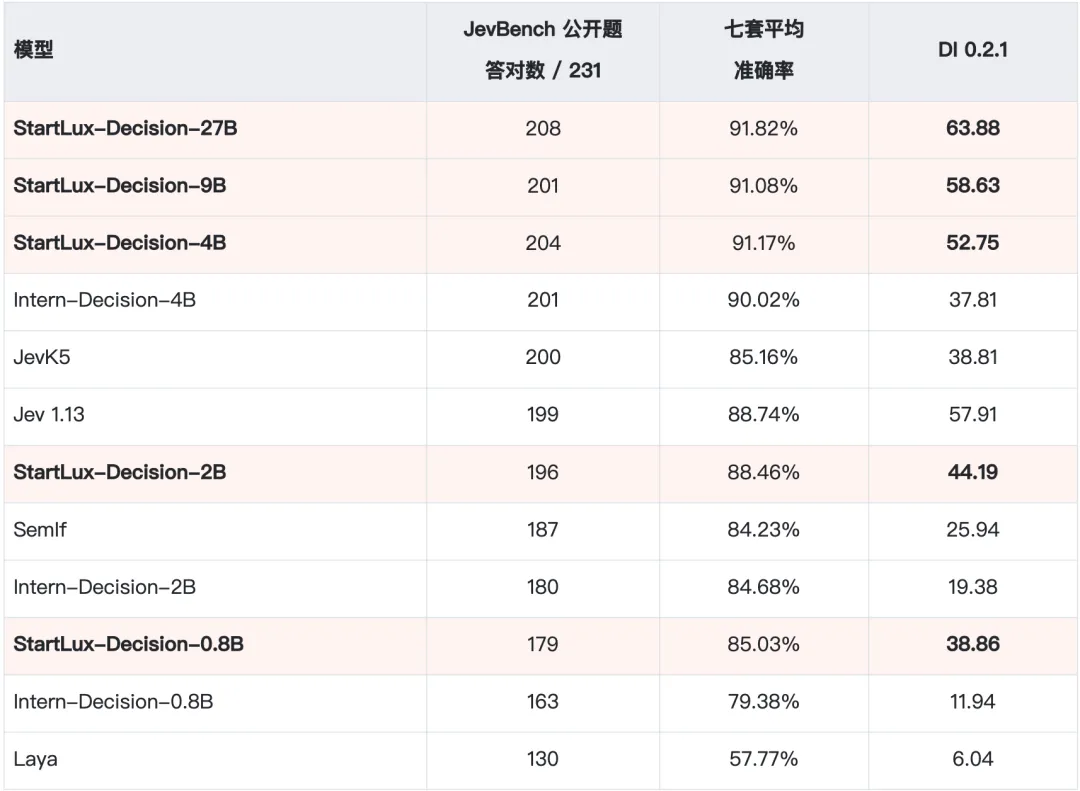
In the Independent Decision Index 0.2.1. version 27B of the StartLux-Decision scored 63.88,38 points higher than the latest Jev version Jev 1.13 in the benchmark; in another set of seven tests, the average accuracy of the StartLux-Decision-27B was 91.82%. It should be noted that the above results for the StartLux team were based on the public assessment tool Decision Index published on 28 September 2026.
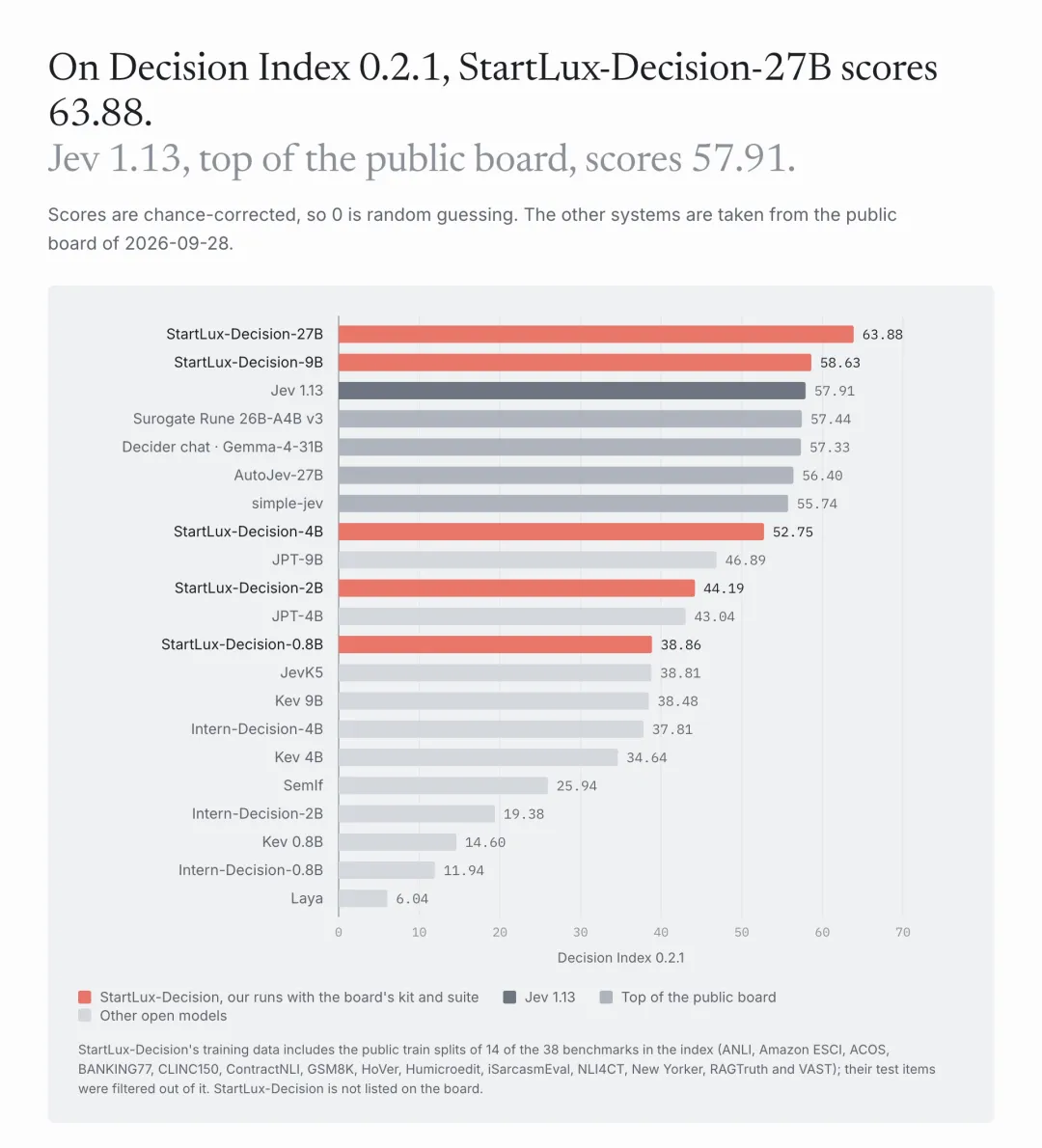
Why does Agent need it?
A model specifically responsible for "judging"?
The decision model has recently seen a surge in popularity. So why would an Agent need a decision model to be specifically responsible for judging?
Let's see what StartLux-Decision is actually doing.
In a customer service demo displayed on StartLux, the system received a message: "Orders have been repaid twice, but the system still shows unpaid".
Traditional generated AI typically understands the problem first and generates an analysis, while StartLux-Decision can make three clear judgments simultaneously in a single request: distributed flow teams, processing time-efficiency, and severity ratings.
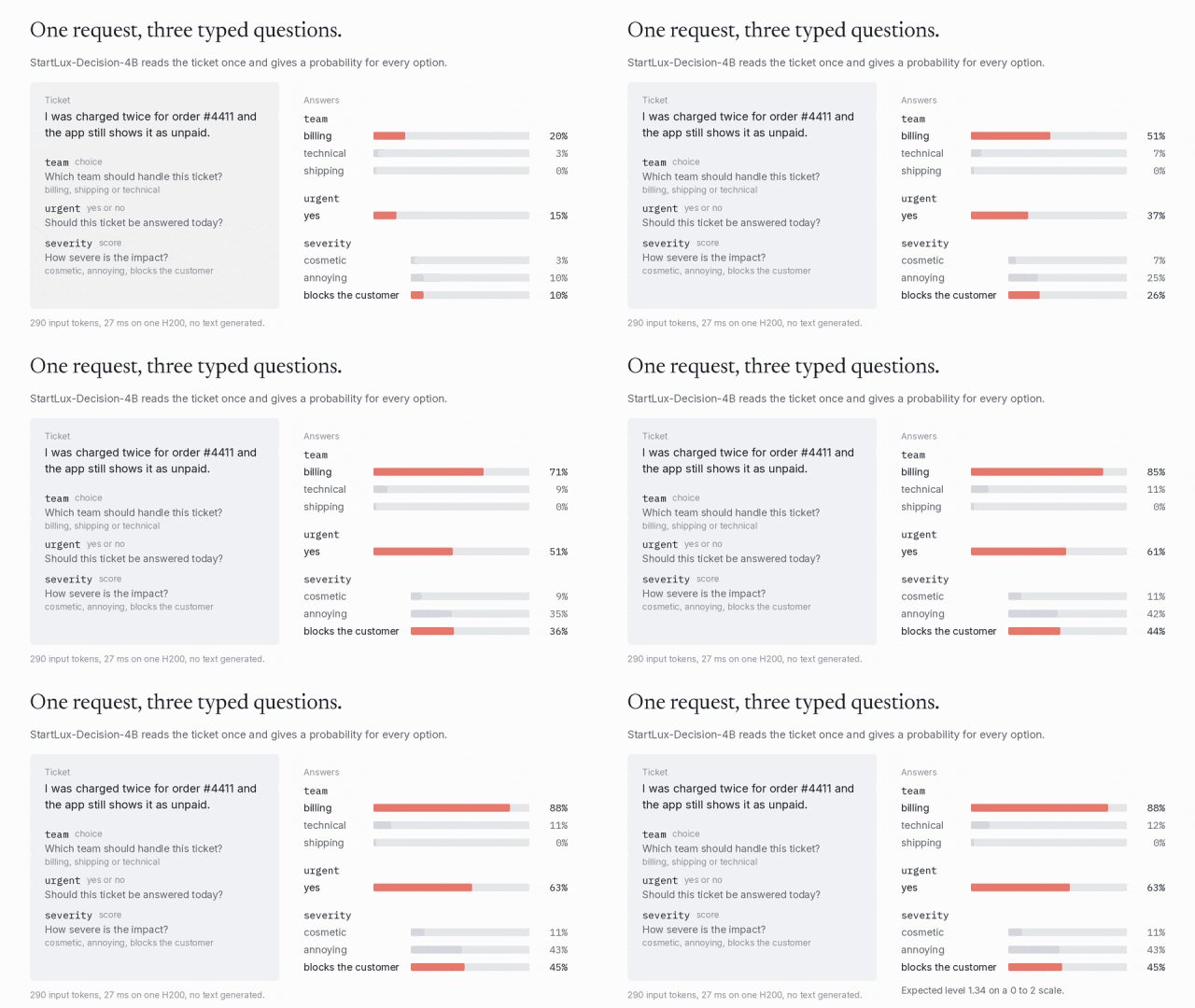
Customer service demo: one request to complete team allocation, urgency judgement and serious grade judgement.
This reflects the most intuitive difference between the Decision Model and the ordinary generating model: it does not require a master to be written in natural language and then analyzed by the program, but instead selects, non-judges or grades directly for the candidates offered by the developer.
These capabilities will become more apparent once they are put into the Agent.
For example, the following shopping demo. The user's request to Agent is to purchase "the cheapest, free-to-ship 8-bit AA batteries and send them to the home address".
System comprehensive consideration of model, quantity, price and delivery conditions. Each round is judged by StartLux-Decision based on the current page status to determine whether the next operation and task has been completed; after the operation is performed, update the page status and continue to judge until the order is completed and the task conditions are checked.
Shopping Demo: Select items that meet AA, 8 packages, free shipping and minimum prices, and complete the order.
A similar pattern appears in the Office Collaboration Demo. The task is to invite the designated member to the Design team and set it to Editor. The model needs to select teams, members, and roles successively, and then determine whether the invitation process has been completed.
Team Demo: Select a Design team, invite members to designate, and set Editor permissions.
What these demos have in common is that the answer space is relatively clear. Browser controls, customer service departments, and tool lists are all predefined. Unlike LLM, which is good at generating open content (such as writing emails, planning), the need for a large number of Agent steps is very small (such as Yes/No, three-point, five-point, or tool selection).
If you dial backwards in time, you'll see a very interesting cycle happening here.
In the traditional software era, engineers break down business into a lot of rules. How much money goes into which processes, what actions are triggered by a certain state, and which authorization branches different users enter. The system is fine, but a lot of logic needs to be written down in advance.
With the advent of the LLM, much of this explicit logic was absorbed by the model. Developers began to directly assign natural language and environmental states to larger models, allowing the same model to understand, classify, judge, plan and generate. The system became more general and flexible.
At the Agent stage, AI re-started the process of allocating precision to code, searching to Embedding, complex planning to Reasoning Model, and high frequency selection to specific models such as Decision Model.
Calculative power is also distributed more precisely as it begins.
StartLux published a set of speed tests. Under single-card H200, BF16, local HTTP and short-request conditions, StartLux-Decision-4B takes an average of 26 milliseconds to answer three questions; 0.8B and 2B are 12.2 milliseconds and 15.5 milliseconds respectively.
The team also used CUDA Graph, a rapid linear attention calculator, and combined multiple problems into one forward computation to reduce the cost of repeat computation and calling.
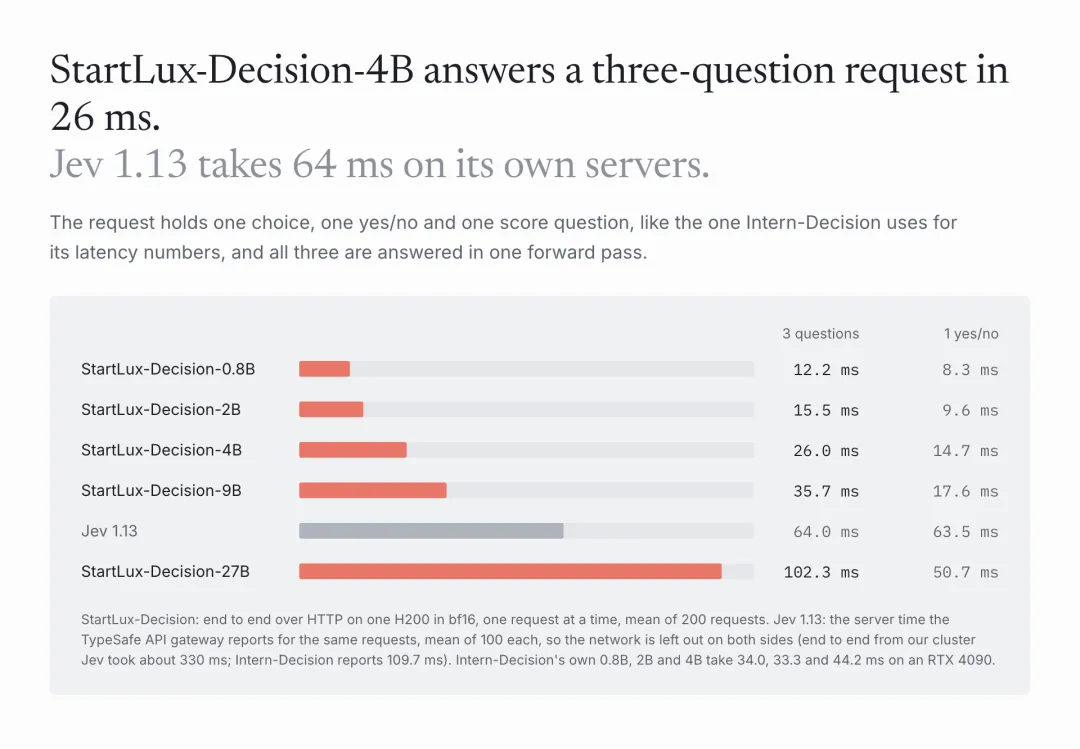
When an Agent task consists of dozens of judging nodes, the exact amount of computation required for each step will soon affect the response speed and running costs of the entire Agent.
This also explains why the Decision Model will warm up quickly in a short period of time. Many of the things it deals with look small: selecting a tool, judging whether a task is over, checking which process information should be entered into, deciding where to click next on the page. Once the Agent starts to run for a long time, these "small judgments" may become the most frequent layer of calls throughout the system.
StartLux's local intelligence is starting to come apart
In September of this year, Machine Heart had a conversation with StartLux co-founder and CTO Guo Quang about "local x RSI". We talked to the StartLux CTO.
Guo's boundaries are broad: including models, quantification, reasoning systems, hardware adaptations, and upper-level Agent Harness, tools, search and continuous learning. The team's goal is to deploy these capabilities as much as possible on user-local devices.
This is in essence different from simply running an offline model locally. A long-running local agent must face a number of system-level challenges: storage and memory constraints, model accuracy selection, scheduling between different tasks in 4B/9B/27B, long-term context management, step-by-step recovery mechanisms, access strategies for memory, and the balance of costs for high-level judgment.
StartLux-Decision is the component introduced to fill specific levels.
In the system division of StartLux, the StartLux-27B takes over the general capability layer, the Decision Model focuses on high frequency decision-making, the upper layer deploys Agent and Memory, and the lower layer is supported by quantification, reasoning systems and hardware adaptation.
This architectural design began with a realistic computational constraint: the hardware resources of personal computers had clear boundaries.
Unlike cloud models that can be scaled by GPU clusters, local systems must run on limited storage, memory, bandwidth, and power over a long period of time. Thus, "how to efficiently allocate unit computing" becomes a central issue.
Previous post-training experiments with StartLux on the 27B model have demonstrated this logic. Guo Weiwei described the model parameters as a high-dimensional space, which determines the capacity, while training is the capacity distribution in the reconstructed capacity. The experiment showed that after training for Agent capabilities, GPQA increased from 83.33 to 90.40, DeepSearchQA increased from 47.04 to 59.39, and Tau3-Banking also increased; but at the same time, GAIA decreased from 57.57 to 45.70, IFEval also saw a decrease.
This phenomenon suggests that under fixed parameters, resources are redistributed between different capabilities. The training process is essentially about determining which tasks the parameters tend to handle more.
The Decision Model goes even further: it deals with frequently called and targeted specific tasks and is handled by dedicated lightweight models.
This is the reason why StartLux has introduced five specifications of 0.8B, 2B, 4B, 9B, 27B to cover different devices and scenarios. At the same time, it offers three GGUF quantified files: BF16, Q8_0 and Q4_K_M.
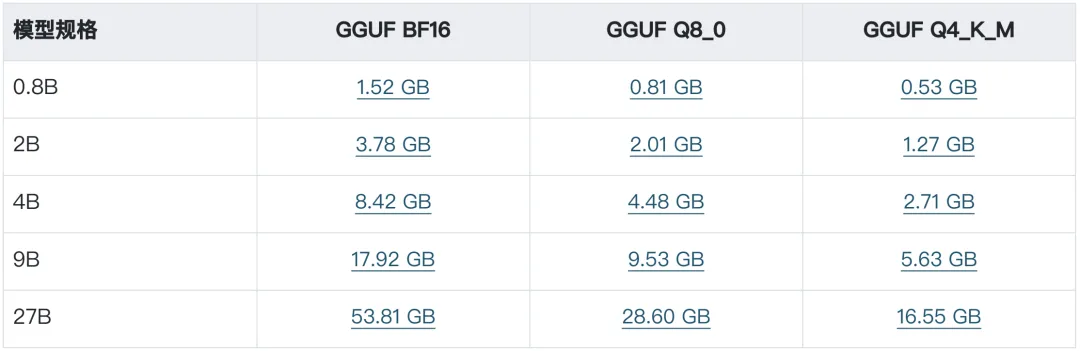
For example, in the 4B specification, the Q8_0 file is about 4.48GB. In the 231 publicly released JevBench quantitative replications published by the team, its decision consistency with the original weight was 100% and the answer was 204 questions; after the Q4_K_M version, which was compressed to about 2.71GB, the decision consistency was 98.3% and the answer was 201 questions.
In actual local Agent systems, this specification has a clear engineering meaning.
A long-running personal AI system may simultaneously schedule multiple models: low-latency discretion is accomplished by a small Decision Model, complex reasoning delivers large models, retrieval is carried out by professional modules, long-term memory relies on Memory, and cross-application operations are coordinated by Agent Harness. The models are gradually transforming into different processing units in computing systems.
In addition, probability output is also a key feature. The probability distribution of candidates that can be output by the StartLux-Decision enables the system to establish routing and distribution strategies. If the model reaches a confidence mark on a known task, the system directly executes follow-up logic; if the probability of multiple candidates approaches, information can be added, a stronger model can be transferred, or artificial confirmation can be triggered.
However, the probability itself still needs to be combined with the calibration of specific business scenarios. For high-risk operations such as payment, deletion, authorization modification, the original authorization confirmation mechanism is essential.
This signals that local intelligence is evolving from a mere "model transformation" into a comprehensive "system engineering".
StartLux has set a clear goal: to make users willing to hand over documents, research, and office tasks to local AI over a long period of time, ensuring continuous hours of system work and maintaining high task success rates.
Guo Chen pointed out that the current model, quantization and local reasoning systems are advancing rapidly, and the real difficulty lies in long-term task stability, abnormal recovery, context management and overall experience. Decision Model solved specific links in this link, providing a higher pricing form for high frequency, candidate clear judgments.
Three days of Auto Research.
We'll talk about this remarkable figure again: 3 days. According to the team's announcement, it took about 3 days to complete the first round of model research, development and validation, from determining the direction of the Decision Model.
This is due to the long-standing Auto Research R&D system built by StartLux under RSI thinking: AI has entered the research and development sphere of data construction, training, evaluation and failure analysis, as demonstrated in two recent model R&D at StartLux.
In a previous interview with Heart of Machines, Guoqiang explained that "70% of experiments are performed with AI participation": if only statistical configuration generation, training start-up, Eval operation, and result sorting were used, automation rates would exceed 95%; while 70% indicated the proportion of AI models involved in core research and decision-making.
The technical difficulties between the two differ substantially. Automated startup training is relatively mature, but the difficulty lies in the analysis and decision-making after the training: why the model fails? what data should be added? questions arise in the algorithm or in the order of reasoning? what variables will need to be adjusted in the next experiment?
StartLux defines this high-level decision-making process as Auto Research.
Guo Feng once cited an example of a financial task. When a system discovers that a model is computed directly without reviewing the raw data, a failed sample is sent to the research system. Multiple AI models co-analyze the reasons and propose hypotheses (such as insufficient data coverage, reasoning chain defects or lack of corresponding behavior reinforcement), the system then evaluates the value of the program, automatically constructs the data, starts training, runs Eval and detects deteriorating capabilities, ultimately returning the new results to the next round of turnaround.
In the process, AI has begun to take on the role of "research decision-making" in the traditional sense.
StartLux-Decision is a landing practice for the pipeline in a new model category. Once the decision model is established, the team needs to define its interface specifications and build a data set and evaluation system around the capabilities of action selection, constraint understanding, structured output.
In the context of a rapidly changing base model, the shortening of lead cycles for single-copyloads has made the R&D system's migration capability more critical. Guo Feng said that in the practice of StartLux, when switching from the same base model series, the accumulated data and most of the training experience can be directly replicated, while the migration rates of Pipeline, Eval and fail analysis systems are higher.
Therefore, the team defines long-term accumulated core assets as: the effectiveness of data recognition, the processing mechanisms for failed samples, the experimental evaluation system, and the automated generation capabilities for the next round of experiments.
On this basis, StartLux further proposed a five-tier classification of Recursive Self-Improvement (RSI):
Level 0 is Self-correction, where the model detects errors and then tries again; Level 1 starts accumulating Memory and Experience; Level 2 is Automated Training, where AI can generate data, write code, start training and run Eval; Level 3 is Auto Research, where AI fails to analyze the previous round of experiments, makes new assumptions, and participates in deciding the direction of the next study; Level 4 only enters the full RSI in his definition: improved AI along with "the ability to improve AI" itself continues to grow and form recursive feedback.
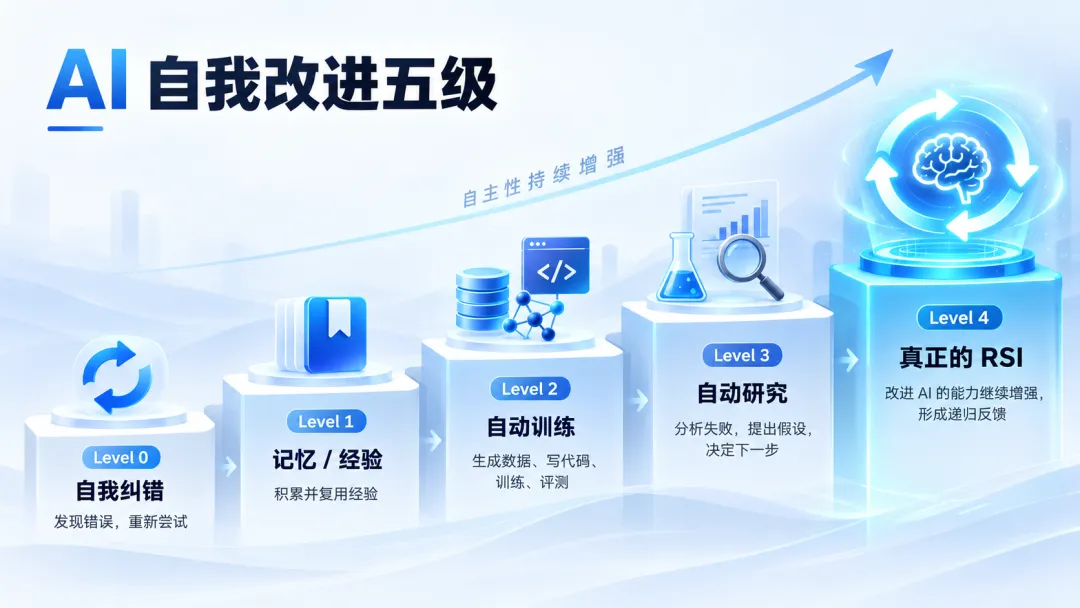
Currently, StartLux is positioning itself at Level 3.
StartLux-Decision is both a result of the accelerated output of the Auto Research pipeline and a key component of the pipeline for future calls. Because automation research itself involves a large number of discrete decisions: which failures are worth analyzing in depth? what tools to call next? how to prioritize multiple experimental programs? under what circumstances to terminate the current route?
For these candidate clusters, it is a reasonable assumption that participation in the Decision Model is a clear task, and its specific benefits still need to be verified in the subsequent process of actual research.
This is consistent with StartLux's judgement of the overall architecture of Auto Research: the research system uses a multi-modal isomorphic collaboration model. Different parameters, training paradigms, and function models (prediction, determination, algorithms, etc.) collaborate separately in the process, ultimately combining Verifier and algorithms to determine the storage of experiments.
AI research and development itself has begun to undergo similar changes to Agent: the question has gradually shifted from "which model to call the strongest" to "how to build heterogeneous model systems to allow them to collaborate in their respective locations".
Synopsis: The next step is to integrate systems into a single model
Just over two weeks after the launch of Jev in mid-September, OpenAI launched the Decisions API on Developer's Day, Cloudflare released the open-source decision model Clef, along with the earlier red-hot Laya and the constantly warming Personal Agent, the industry has reached a consensus at a rare pace: the most frequent calls to smart body systems are those high-frequency, candidate-specific little judgments that make them worth a layer of dedicated, low-cost, millimeter-responsive smart to load, without having to use a full-sized model every time.
According to co-founder and CTO Guo Guoqiang, who previously revealed in an interview with Machine Heart, "local" was never meant to be "a relatively small, downloadable model on a computer", but "a whole set of individual AI systems: the bottom layer is model, quantization and reasoning systems, and the middle one is geared toward the environment".
The StartLux team introduced the Decision model in just three days. The "three-day" figure should also be understood in this coordinate system. It is not about speed competition, but about verifying the team's ability to migrate their Auto Research R&D system under RSI thinking: when data construction, evaluation and failure analysis systems can be cross-category replicated, a new model class will be systematically compressed from the logical to the first-category verification cycle.
Of course, the value of a system doesn't end up in the architecture, but in the long term, the ability to accomplish real tasks, the stability of tasks, the failure to recover and the overall experience, which is precisely part of what Dr. Guo Chen said was "much more difficult than simply running a model". According to the plan, based on the progress of the submission, the first public-facing local smart experience version of StartLux is expected to be launched within the year, when the concept will be fully tested for the first time.