
“ The human figureMachinesRobots are new materials.
A humanoid robot has not yet entered thousands of households, and the material on it has already worked.
On September 24, Berkeley analyst Katie Richards threw out a number by gambling: By 2030, one million humanoid robots will generate about 10,000 tonnes of new demand for PEEK, the equivalent of about 10 kilograms consumed per robot.
But just a week ago, Kim Jong-il's general manager of technology in the robotics industry, Liu Fei, had a cold shower in a public speech: Liu's current application to PEEK in the field of physical intelligence is largely a sham.
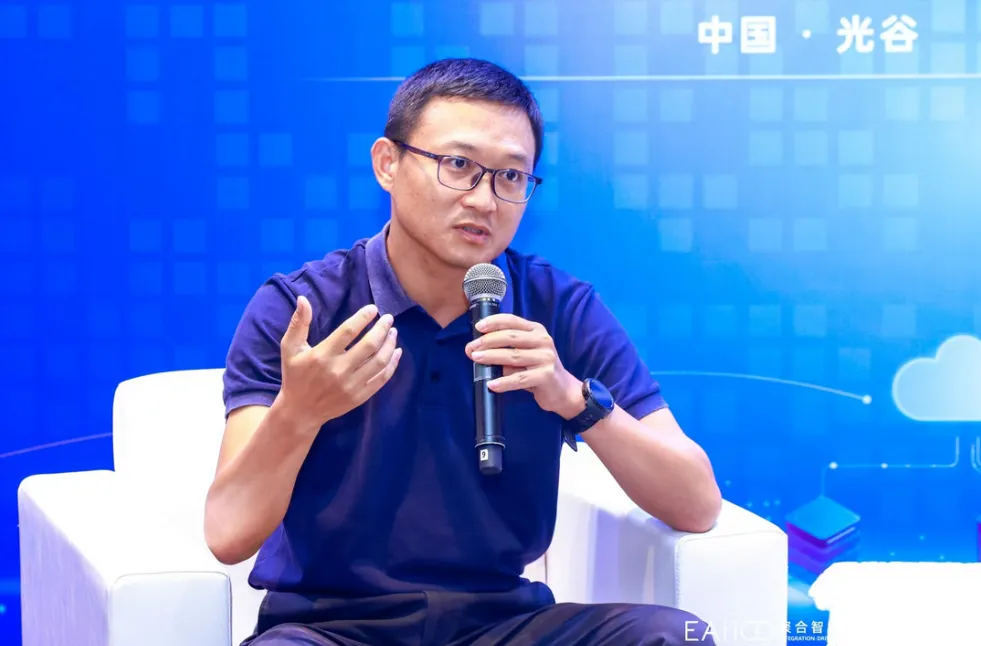
One said 10kg, and one said the majority of it was a hoax; one from a Wall Street top-notch bidder, and one from the robotics business head of one of the world's largest transformed plastics companies. But this group of opposers, not a simple multi-empty disagreement, but another trend worth dismantling in the current man-made robot new material narrative, is that the expectations of the capital market are already far ahead of the industrial landscape.
01.
How did you come up with 10,000 tonnes?
Katie Richards says about 10,000 tonnes of new PEEK demand in 2030, so how did that come about?
When we put the two sets of data back into their respective contexts, we find that they are not directly contradictory.
Barclay's 10,000-ton demand is essentially a market cap overlaid by the triple-optimistic assumption, rather than a neutral expectation of industry consensus. The difference between the two is primarily due to different settings of the core premise.
1. Export assumption: the extreme value of the most optimistic range
The global shipment of humanoid robots in 2030 is the basic premise for all measurements, with prediction results from different agencies varying up to a quantitative level.
Barclay's 1 million shipments are in the most optimistic range of current industry forecasts. U.S. banks of the same ranking predict 1.2 million shipments in 2030, and Goldman Sachs, updated in August 2026, predicts 890,000 shipments. Neutral agencies generally predict between 250,000 and 350,000 shipments: Counterpoint predicts 256,000 shipments, and Morgan Stanley predicts 262,000 shipments for the Chinese market.
The assumption that only the volume of shipments, the optimum and neutral scenarios, have a gap of about 3 times, directly determines the baseline difference in demand measurement.
2. Single unit use: Total plastic quantity differs from pure PEEK
The second major difference lies in the statistical quality of lithium.
Barclay's 10 kilograms for a single machine, which means that in a million-scale mass production scenario, the total use of all PEEK material parts for a single robot is the maximum value under ideal conditions.
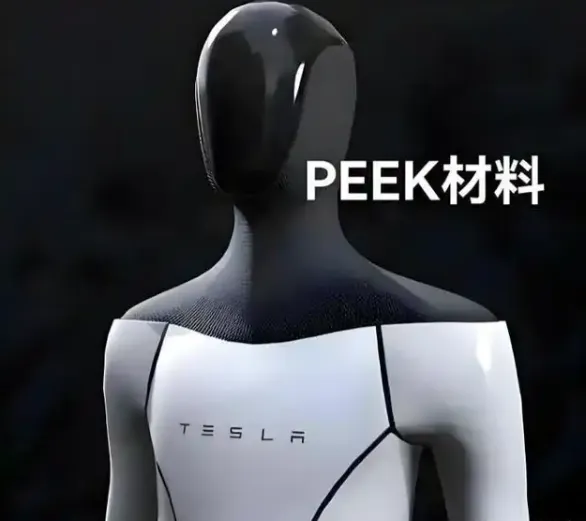
Based on the actual industry situation, Tesla Optimus Gen3 public information shows that the PEEK use of a single unit is about 6.6-8 kg, which is already the highest in-industry usage according to verifiable. The vast majority of robotic manufacturers in the country are still in the prototype verification phase, the PEEK use of a single unit is common in 1-2 kg, mainly concentrated in the small joints such as the fingers, wrists and hands.
According to industry data estimates, the average single unit PEEK used for domestic mass-produced models in 2025 was about 2.3 kg, only 23% of the Barclay assumption value. According to the neutral scenario measurement: 350,000 units were shipped globally in 2030 × 4 kg of single units on average ((volume production increased after maturity), corresponding to the total demand for PEEK of about 1400 tons, only 14% of the forecast for Barclay of 10,000 tons.
In addition, the Barclays report did not specify whether 10,000 tonnes was the annual increase in demand for 2030 or the cumulative total demand for 2025-2030. If measured on a cumulative scale, the average annual increase in demand would be only about 1700 tonnes, further narrowing the gap with industry judgments.
In essence, the bidding process is how big the market will be if a million units are produced in the future, and the enterprise side is saying how many units of aluminum PEEK actually uses in a prototype of aluminum. The gap between the two is the entire industrial cycle from a thousand-ton prototype to a million units produced, estimated to be at least 5-10 years between the two, according to the actual situation.
02.
Why is PEEK being framed?
Objectively, this wave of PEEK heat is not a vacuum. It just stepped on the core pain point of human robots: weight loss.
Human robots' self-weight is a dead cycle: the more joints, the greater the load, the higher the self-weight; the higher the self-weight, the shorter the lifespan, and the lower the load capacity.
PEEK is known as a nickel plastic gold alloy precisely because its performance perfectly matches this scenario: the density is only half that of nickel alloy, but twice the strength of nickel alloy. As the benchmark for the most commonly used 30% carbon fiber reinforced PEEK (CF30) in the robotics field, we can list the core parameters of traditional metal materials as follows:
Materials | density (g/cm3) | Resistance to resistance (MPa) | KN/m/kg | Curve of fatigue limits (MPa, 107 cycles) | Continuous use temperature (°C) |
Carbon fiber increases PEEK by 30% | 1.41 | 201 | 143 | 70-90 | 250 |
6061-T6 Aluminium alloy | 2.70 | 310 | 115 | 90-110 | 150 |
304 stainless steel | 8.00 | 505 | 63 | 220-250 | 870 |
Ti-6Al-4V aluminum alloy | 4.43 | 950 | 214 | 400-450 | 315 |
From the data, it can be seen that PEEK's strength is indeed superior to that of 6061 aluminium alloy, which is the core source of its lightweight value; it also has properties such as self-lubricating, wear-resistant, corrosion-resistant properties, and is suitable for high-frequency and repetitive motion transmission scenarios.
Based on performance parameters, PEEK's range of applications on humanoid robots can clearly be divided into three categories:
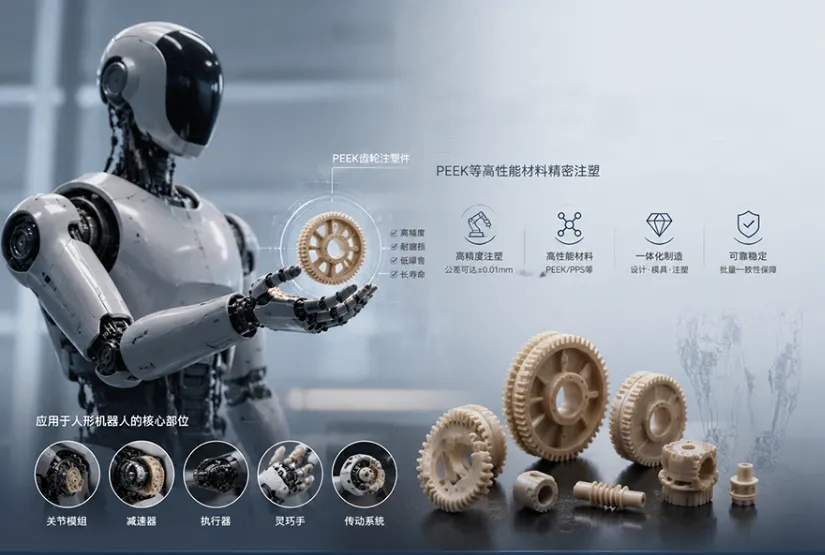
Core application scenarios: medium-low load actuators for arm, wrist, finger sections, including shock wave reducer gear, silk screw, small gear, bearing holding rack, etc. These sections are low load, high frequency of movement, significant weight loss gains, and PEEK's lightening + self-lubrication + wear resistance combinations match the highest.
Limited use scenarios: Large arm, small leg, secondary structural parts that are only considered for use under extreme lightweight requirements and require additional structural reinforcement design.
Non-applicable scenarios: main force joints such as the waist, ankle, knee joints, carrying total body weight and movement shock loads, must use metal materials, which cannot be replaced with PEEK.
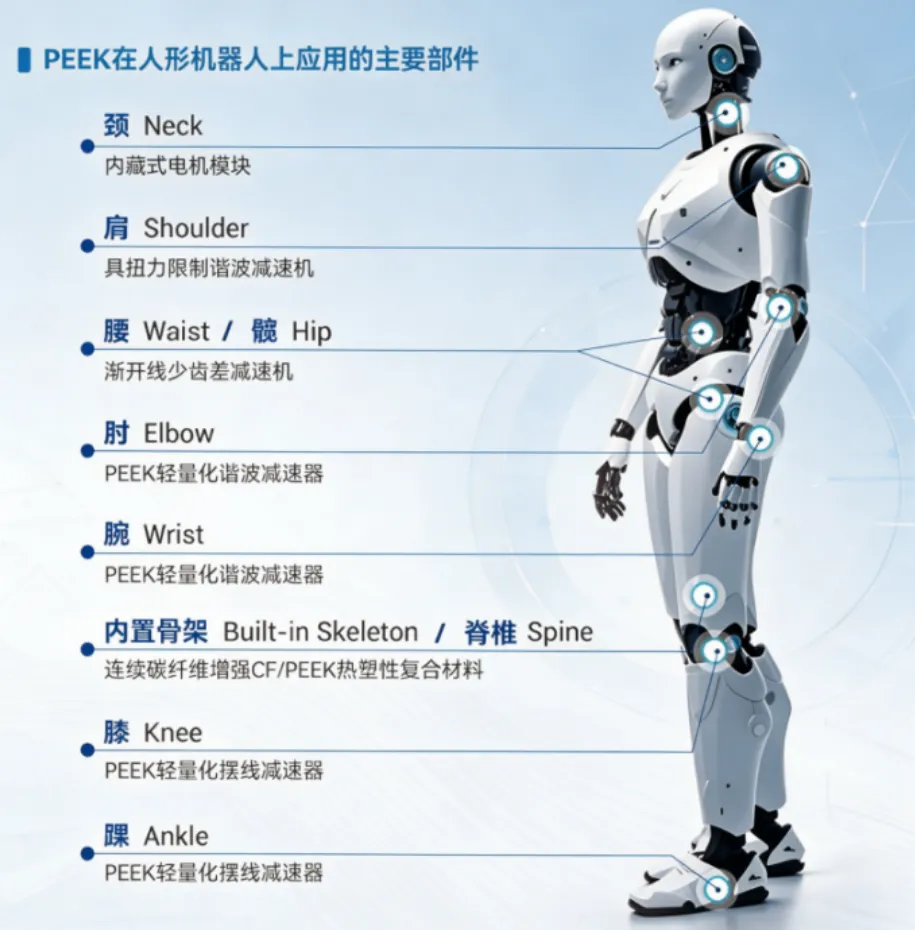
According to the actual scheme of the current mainstream model, PEEK parts weigh less than 15% of the total weight of the overall structure. Boston Power Atlas, Tesla Optimus' main power structures still use aluminium alloy and aluminium alloy schemes, and there is no tendency to replace large-scale plastics.
Chinese securities use Optimus as a reference measure, with a single-piece robot PEEK consuming about 6.6 kg and a single-piece material value of about 3500 yuan, corresponding to a PEEK market of about 3.5 billion yuan per million robots.
03.
Saying, "It is not a bad thing to hear".
But heat to heat, back to industrial reality, PEEK has at least three ways to achieve a scale-down.
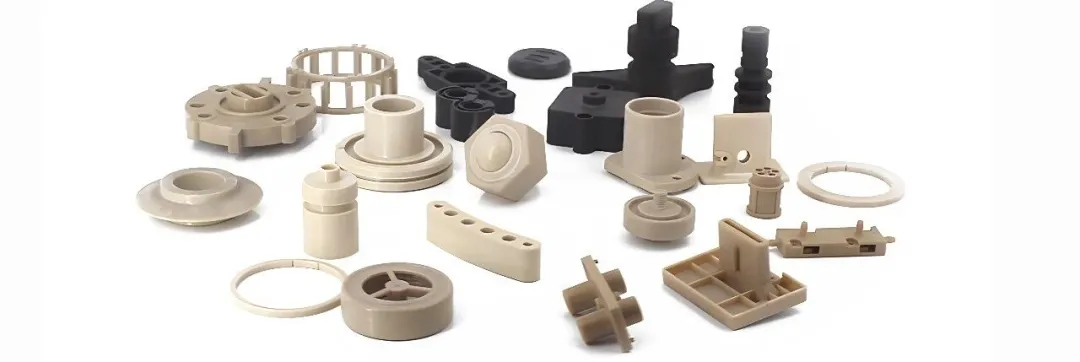
The first can is a processing barrier. Many people think that PEEK replacement metals are the replacement of materials, in fact, it is not the same thing. PEEK focal point is 341 ° C, the processing window is very narrow, the temperature control accuracy of the injection molding equipment, mold design, crystal control requirements are very high, and slight deviations can cause problems in parts performance.
There are many manufacturers that can make ordinary PEEK products, but companies that can make robotic-grade precision PEEK parts can be counted in the country. From materials to qualified parts, it is a very high technological threshold, not to buy a few devices, buy a few tonnes of resin.

Currently, the price of high-end PEEK pure resin is 35-40 million yuan / ton, and the modified high-end brand can even reach 1000 yuan / kg, which is several tens of times that of ordinary engineering plastics.
At the current stage of the industry, human robots are generally still in small batch trials, with tens to hundreds of orders for a single unit, and development costs are fundamentally understated. With PEEK replacing metals, the system gains brought by parts weight reduction, far outweigh the additional costs of materials and processing. For machine factories, PEEK is more like a lithium technology verification kit, far from a lithium production solution kit.
The third way can is the performance with clear boundaries. PEEK is not the main force joints, such as all-power materials, the waist of a humanoid robot, the base of the thigh, carrying the weight and motion of the entire machine, these positions must be metals, cannot be replaced with PEEK.
The more realistic problem is that the human-robot industry does not have a uniform material standard, 80%-90% of the material package is customized, and it is almost impossible to replicate between different manufacturers and models.
04.
The real battlefield: Capacity and Cost Curve
Global demand for PEEK has not yet started on a large scale and the supply end has already entered the expansion cycle, but the structural differences in output are much greater than the total differences.
Global PEEK capacity is currently typically strong: the UK Victrex has an annual capacity of around 8,000 tonnes, making up around half of the world's production capacity; Syensqo and Winstrol have approximately 2,500 tonnes and 1,800 tonnes respectively. The three have almost monopolized the global high-end PEEK market, but interestingly, the three giants have barely publicly mentioned growth opportunities in the field of robotics.
Since this year, companies such as China R&D Shares have announced successive expansions, with the newly announced PEEK capacity in the country totalling about 260,000 tonnes, which is expected to be released continuously from next year. This figure has already exceeded the total global PEEK capacity for 2034 predicted by the institution.
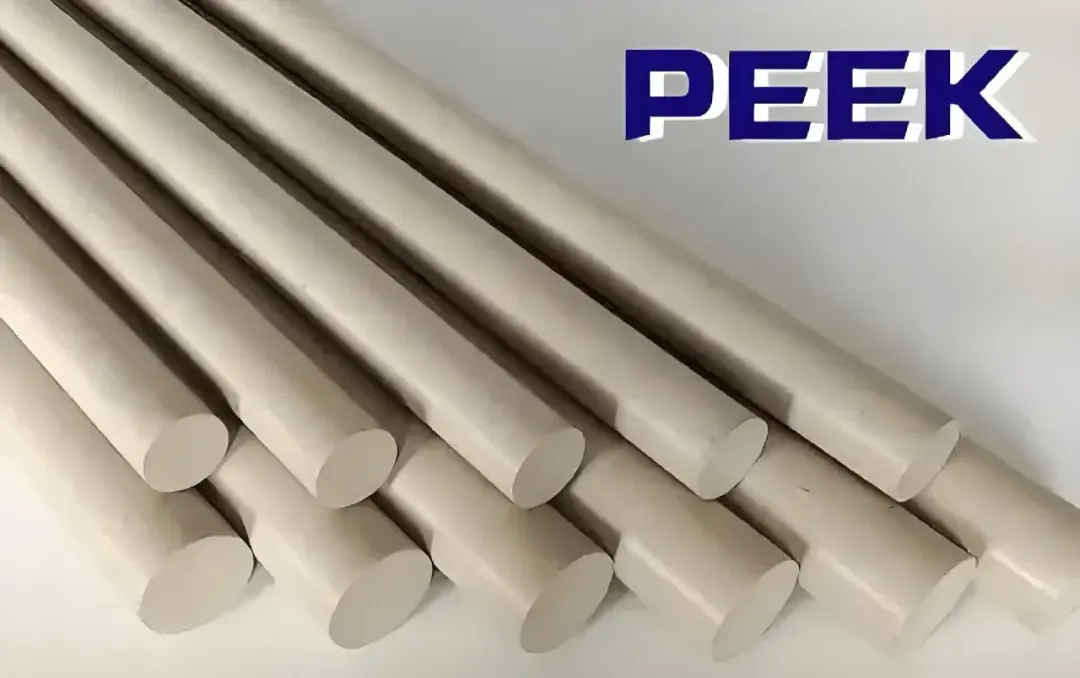
But there's a core problem behind the heat pump: most of the domestic expansion is general-purpose PEEK, while high-end robotically modified PEEK is the real cartridge link.
PEEK's performance differences, not only in raw material purity, but also in synthetic processes, modified formulations, and post-processing techniques. The three overseas giants have a high-end brand name, with a significant gap in strength, fatigue resistance, stability and domestic commodities.
China's advantages in the PEEK field are concentrated in upstream raw materials. About 80% of the world's lithium capacity is in China, where companies such as China, China, China, China, and China possess core raw material production capabilities, which can theoretically lead to a cost advantage of up to about 25%. However, there is still a significant gap between domestic materials and overseas high-end brands: basic indicators such as strength, thermal resistance have approached overseas levels, but there is still a gap of 10 to 20% in key indicators such as fatigue performance, size stability, batch consistency.
05.
What is the meaning of this verse?
PEEK's story on humanoid robots is that the direction is likely to be established. Lightweighting is the precondition for robot performance breakthroughs.
But from the formation of aluminum to the production of millions of tons of aluminum, the breakthroughs in the processing process, the lowering of the cost curve, the establishment of industry standards, and the most critical downstream assembly plants, the leap from 1000 to millions of tons of capacity.
It's worth re-reading the quote: "We'd be more willing to recommend a better-than-price solution if both the cost of the customer and the profits were not significantly increased".
In an industry where 80% to 90% of the solutions are customized, material wins not the most beautiful performance parameters, but the one that can find the best balance between performance and cost and that can quickly evolve with customers.
PEEK will not be the only answer, nor will it be the whole answer. Its real chance is to become an irreplaceable puzzle in a mixed-structure solution.