It's time to talk about AI's third polarity, social intelligence.
Currently, there are two mature versions of AI: symbolic space intelligence, represented by GPT-5.5, DeepSeek, which is good at understanding language, logical reasoning and code generation; and physical space intelligence, represented by a robotic body, which is good at perception, action and environmental control.
At WAIC 2026, Richard Sutton, winner of the 2024 Turing Award and father of reinforcement learning, declared that AI is moving from the "human data age" to the "experience age".
But the question arises: What is the origin of what Sutton says is the experience of living in a vacuum? Is it really only possible if individuals collide with the physical world?
Recently, the Knowledge Team came up with the idea that experience does not happen in a vacuum, it happens in social relationships, in a recurring belief of "I know you know I know", in the intent to read one eye, to infer an unspoken intention.
In other words, the truly complete experience is intelligence, inseparable from the social mind. The ability to understand beliefs, to infer intentions, to perceive emotions, to balance norms.
The Knowledge Team, from the National Key Laboratory for Intelligent Algorithm Security at the Institute of Computing and Technology of the Chinese Academy of Sciences, aims to complement the existing large model with the ability to understand human emotions, to make AI more compassionate, more credible, and more trustworthy in the face of complex social situations. What they really want to explore is that social intelligence cannot be defined as an engineering ability that can be continuously measured, trained, and improved just like language understanding and code generation.
To this end, they have recently released a comprehensive social mind model technology system, which includes the benchmark assessment SoMBench, a multi-parameter version of the social mind model Zing, and the Actio Intelligent Deployment Framework.
It's a bit of a mystery.https://github.com/Zhijing-AI/Zing(The follow-up to the benchmark, model weight, etc. will be open source)
Technical report:
SoMBench has established a system of capability coordinates that classifies "unintelligible people" as localizable cognitive gaps; Zing organizes adaptive training based on diagnostic outcomes that translates social reasoning from temporary behaviors that rely on prompts into stability in model parameters; Actio provides dynamic organization of skills, mental states, experience, and social knowledge to provide verifiable support for deployment.
Together, the three point to a technological path: social intelligence is no longer just a vague "customer" of models, but an engineered object with tools for evaluation, training methods and interfaces when running. This is the key step in moving the large model from a buzzword to a buzzword to a buzzword.
On five international authority social mind assessment benchmarks, the combined mean of the multi-modal model Zing-27B exceeds GPT-5.5; the text model Zing-32B is equivalent to the DeepSeek-V4-Pro level; the lightweight model Zing-8B/14B has extremely small parameters that exceed the parameters on the hierarchical belief logic benchmark HiToM for dozens of times its baseline model.
Knowledge-based social mind model technology system
SoMBench: Social psychology, health and well-being
The SoMBench builds on the three capabilities of mind representation, social interaction and standardization, covering 17 secondary dimensions and 71 finite-dimensional tasks, containing 3,481 cases reviewed by 15 experts and 87% strictly reserved. By means of multi-thematic cross-checking, option disruption, and shortcut detection, SoMBench not only gives scores but also accurately identifies the wrong patterns of the positioning model to guide further training.
Of the 20 top models tested, the strongest models had an accuracy of only 72.08%, and 17 had a sub-level dimension of no more than 90% ceiling. This means that even the most advanced models still have nearly a third of the capacity gap in systematic social mind assessment. SoMBench is the latest social mind assessment benchmark, with the current mainstream model still having much room for improvement and indicating the focus for the next step.
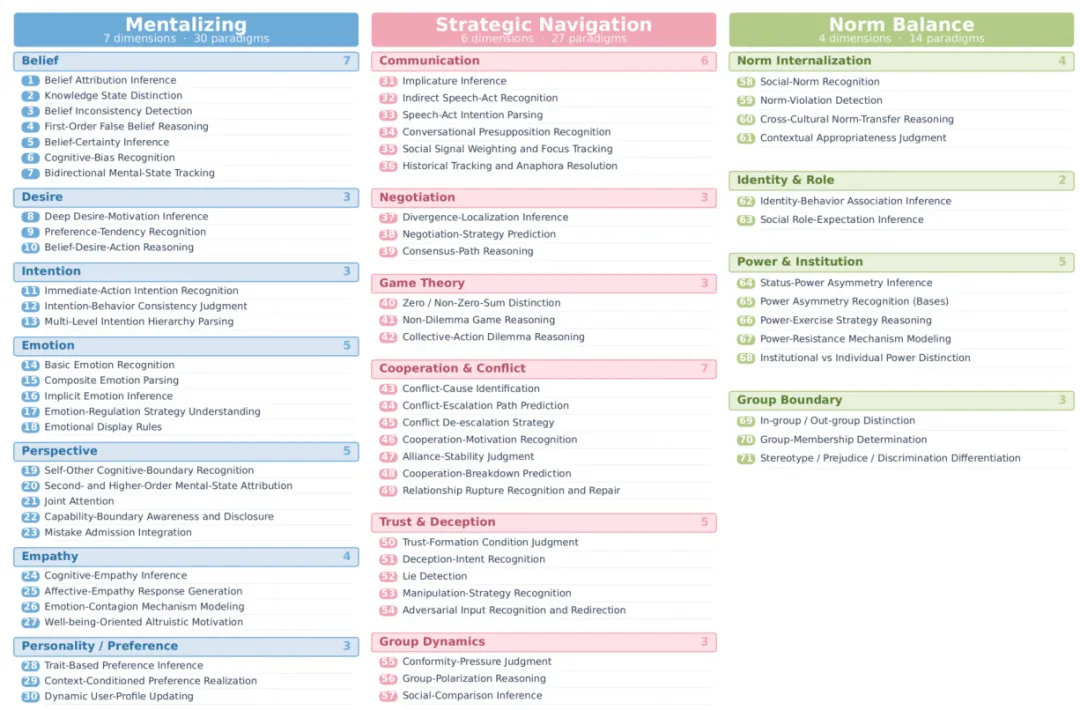
Knowledge SoMBench evaluates the system of classification of dimension indicators
Zing: Training goals evolve with ability
Zing does not use the traditional training method of the "fixed problem library, fixed loss function", but instead constructs a set of training systems that "self-evolves". When the model exposes a shortboard in the diagnostic cluster, the FLARE data flywheel is positioned to a specific cognitive dimension, and the targeted synthesis of all new training samples, semantics, scenarios, and reasoning pathways are different from the original, but target the same capability deficiencies.
The training was carried out in two phases: the first phase was to establish a common foundation for social psychology, using the Mixed-Reward GRPO reinforcement learning framework, dynamic combination process rewards and verifiable rewards; the second phase was to strengthen specialized capabilities for emotional understanding, intent inference, social norms, perspective selection.
FLARE solves "What to learn", two-phase training arrangements "When to learn", and OPD is responsible for "To whom to learn, not to forget what".
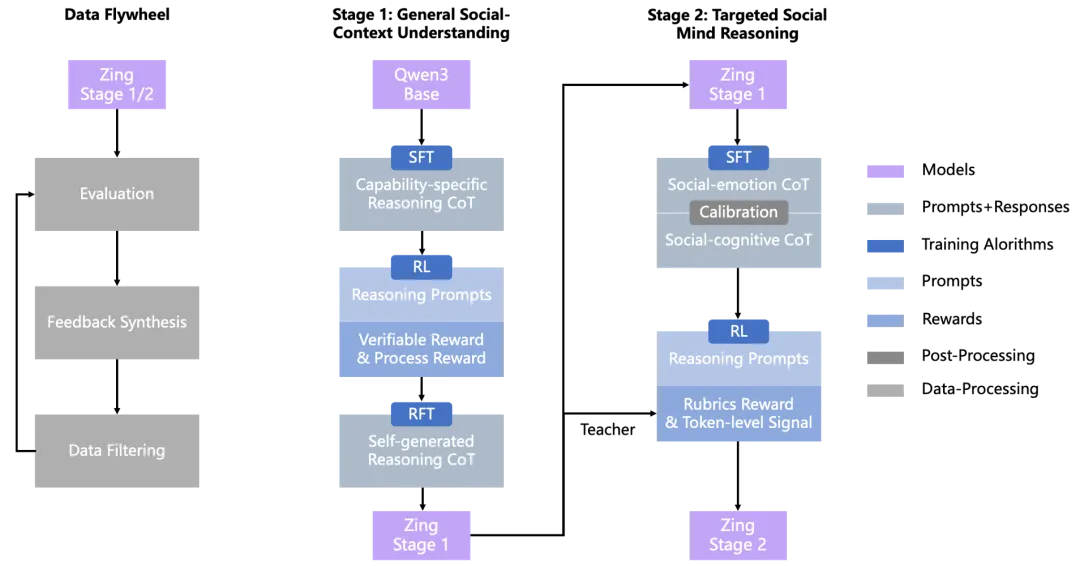
Zing's training process overview
Actio: deployment on demand
Based on Harness, Actio selectively activates four types of support modules based on task mind variables and reasoning needs: PRISM provides 76 layered psychological and social skills; Starling Memory explicitly records "who, when, what, what to believe"; SAGE embedded cross-task reusable reasoning experiences; Gateed RAG on-demand retrieval of socio-cultural knowledge.
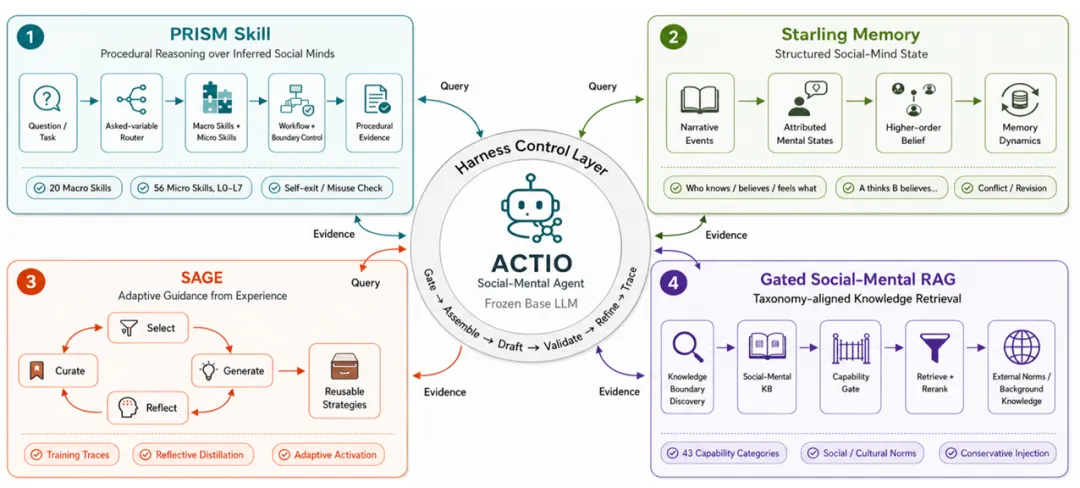
An overview of the Actio system
Assessment and verification: Zing series models exceed multi-dimensional performance
The combined mean of the Zing-27B multi-mode model exceeds GPT-5.5
On five international authority social mind assessment benchmarks, the combined mean of the multi-modal model Zing-27B was 79.80, up from 78.44 on the GPT-5.5.
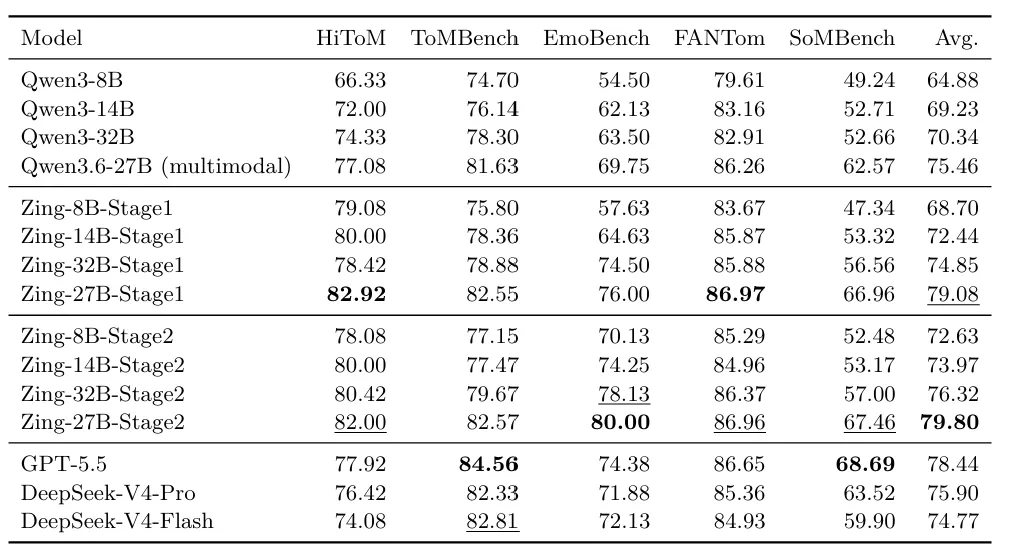
Mindfulness-Zing performance comparison in five social mental abilities assessments
Among them, HiToM rated its ability to track recursive beliefs of "I Know You Know I Know", with increasing degrees of difficulty. The Zing-27B is 77.92 out of GPT-5.5 at 82.00, making it the first open-source model to exceed GPT-5.5 on the scale of 100 billion parameters.
The Zing-32B text model is compared to the DeepSeek-V4-Pro.
The text model Zing-32B reached an overall average of 76.14 on 5 benchmarks, equivalent to the level of 75.90 for the DeepSeek-V4-Pro.
On the EmoBench emotional reasoning benchmark, the Zing-32B is 77.25 points ahead of the DeepSeek-V4-Pro at 71.88, a gap of 5.37 percentage points. This indicates that specialised social mind training in the cognitive field provides a significant advantage in terms of emotional understanding.
Zing-8B/14B is a small-scale, high-class mindset model that exceeds dozens of times the parametric scale
On the HiToM benchmark of high-level belief reasoning, the Zing-8B and Zing-14B achieved the transcendence of the dozens-fold scale baseline model with very small parameters.
Zing-8B reached 67.50% on the three-stage belief logic (baseline 45.83%), four-stage reached 65.83% (baseline 43.75%), rising by 21.67 and 22.08 percentage points, respectively.
This demonstrates that the improvement of social intelligence comes from structuring training methods rather than merely amplifying parameters.
How the social mind empowers AI
The ability of the social mind in consciousness to explore the extension of the three real worlds in the future.
Enable one: make robots move from "powerful hands" to "powerful emotions". Current robots can drink tea, but do not read the intent. Small models of 8B/14B in the know-how can be embedded on the edge, allowing the robot to infer that "the owner's eyebrows are too hot or not in a good mood".
Empowerment two: make complex decisions from "hit the head" to "take the lead". The cost of complex decisions is often not to calculate the number of errors, but to calculate the human mind. Knowledge ability can be used in the future for business decisions, team collaboration, etc.
Empowerment Three: allowing multiple intelligences to work together from "talking" to "single-channel resonance". When humans, robots, AI agents collaborate, the biggest risk is "you think I understand, I think you understand". The mindset framework could provide a unified mind-state protocol in the future that allows different intelligences to collaborate under the same social cognitive coordinates.
Related link: Knowledge: Let AI understand the mind and integrate it into the social fabric