What will happen to the world when people start outsourcing this stuff to AI?
Today, browsing payments, face brushing payments have become routine, carrying wallets out as if they were a long-standing habit. Mobile payments have become unprecedentedly convenient and make people think that spending money is easy enough.
But it's clear that we're moving into a deeper transformation. Payments are being simplified by sweepsaws, while AI is trying to compress the entire process of consumption into a single sentence. The first change is mainly payment methods, which still require people to actively select commodities, compare prices, confirm orders and complete payments; the second one is the entire chain of consumption. From understanding consumer needs, searching for comparisons, making decisions, executing transactions, payments can be gradually transferred to smart bodies.
But at the same time, a new question has begun to arise: how will the payment system evolve when the who-who-who-who-who-who-who-who-who-who-who-who-who-who-who-who-who-who-who-who-who-who-who-who-who-pays-who-who-who-who-who-who-who-who-who-who-who-who-who-who-who-who-who-who-who-who-who-who-who-who-who-who-who-who-who-who-who-who-who-who-who-who-who-who-who-who-w-who-who-w-who-w-w-w-who-w-w-w-w-w-w-w-w-w-w-w-w-w-w-w-w-w-w-w-w-w-w-w-w-w-w-w-w-w-w-w-w-w-w-w-w-w-w-w-w-w-w-w-w-w-w-w-w-w-w-w-w-w-w-w-w-w-w-w-w-w-w-w-w-w-w-w-w-w-w-w-w-w-w-w-w-w-w-w-w-w-w-w-w-w-w-w-w-w-w-w-w-w-w-w-w-w-w-w-w-w-w-w-w-w-w-w-w-w-w-w-w-w-w-w-w-w-w-w-w-w-w-w-w-w-w-w-w-w-w-w-w-w-w
Recently, this change has started to accelerate. Large payment giants and technology platforms are operating almost simultaneously, competing to pave the way for AI smart bodies to pay.
But there's no denying that, regardless of the current practice, smartphone payments are still in the very early stages, either not being able to take the final step of confirming payments to AI, or using a quantity of security and very limited capabilities. This creates an embarrassing situation: everyone clearly knows the enormous efficiency space for the smartphone to automatically execute transactions, but sooner or later does not dare to upload large-scale applications.
This is not a simple technical problem, but the existing payment infrastructure is not yet ready for the arrival of the age of smart payments, and the foundations of trust are not yet firmly established.
However, in the WAIC that just passed, we've seen some solid efforts to build a more credible and reliable payment infrastructure for future AI transactions. These different levels of efforts show the potential for real-world payments.
Four-storey building,
Silver Linings Playing Smart Payments
Around the key issues that need to be addressed by smart payments from concepts to large-scale applications, SBI is building a four-tiered layout consisting of the rule layer, the ecological layer, the scenario layer and the input layer.
Layer one: Layer one: Why are you spending money on AI?
The biggest challenge for smart entities is to get the entire payment system to believe in AI.
Traditional payment identification is people, accounts, and payment tools, and users often need to express their willingness to pay through passwords, bio-identification, or active confirmation. But when the subject of a payment transaction extends from a person to a smart entity, new questions arise: how to trust the smart entity (identity trust), how to trust the smart entity (identity trust), and how to ensure that the entire transaction process is securely controlled, verifiable, and traceable (process trust).
To address these issues, the Bank of China has launched the Smart Payment Open Protocol Framework (APOP) called the Agentic Payment Open Protocol.
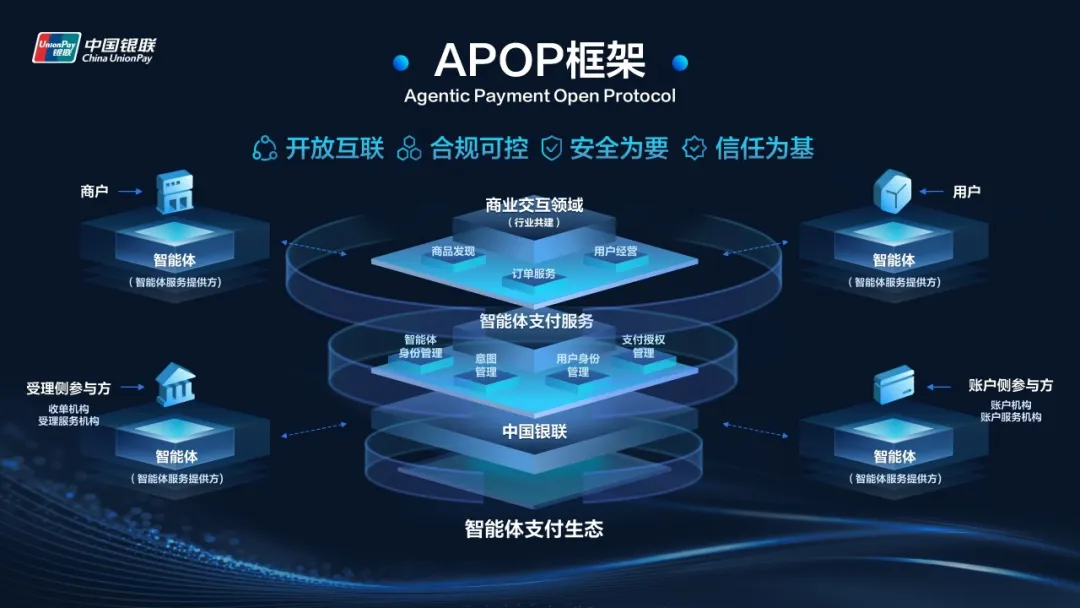
For the first time, many people think it's a long way from itself. In fact, every time the Internet develops on a massive scale, it's not possible to separate from a set of underlying protocols. For example, we hardly realize the existence of HTTP every day when we browse a web page, but it's HTTP that governs how browsers and servers exchange information, allowing different websites around the world to interact with each other, and ultimately the Internet as we know it today.
APOP wants to do exactly the same thing in the age of smart payments.
Simply put, you can think of it as the smart ID system in the world of smart entities + authorization commission books + driving record dashboard 3.1. When smart entities want to spend money on their own, APOP is responsible for answering three core questions: who is it? is it allowed to spend the money?
Specifically, APOP builds this trust mechanism through four capabilities:
The first is to give AI ID cards. Each smartphone with access to APOP has a unique digital ID, just like a driver needs a driver's license to get on the road, to ensure that the parties to the transaction can accurately identify who is operating the cards.
When you say, "Help me buy a ticket to Beijing", the smart body translates that into structured, verifiable intentional instructions, such as limiting the amount of money, specifying the date of departure, and specifying the way to pay. AI can only operate within the defined boundaries and cannot do it alone.
Third, it connects people to AI. APOP helps users to establish a credible mapping relationship between the smartphone and the payment network, ensuring that the payment system knows that the AI represents the client, not an unknown third party.
Fourth, full trace, controllable authorization. From opening payment authorizations to actual deductions to final transaction confirmation, APOP has designed a complete set of authorization and verification processes. Combined with bioidentification and payment marking technologies, it ensures that every transaction initiated by AI is backed by the will of real users and is fully traceable.
Why is this important? There is no unified protocol, every smart platform, every bank, every merchant has to tap into their own set of rules about how to make AI pay, and the result is a standard mess, a mismatch, and users are afraid to hand over their wallets to AI. With APOP, banks, AI companies, merchants, and billing agencies that can plug into the same ecosystem, the user experience is also unified.
So APOP isn't just a paper protocol in the technical documentation, it's about letting AI help you save money, from concept demonstrations to infrastructure available on a daily basis.
Layer Two: Ecological Layer: How can more institutions be brought together?
A transaction initiated by AI may involve both a smart platform, a bank, a merchant, a collection agency and a technical service provider. As long as either of them adopts different interfaces and rules, the entire link will fall back into fragmentation.
Therefore, at this level, what SIL needs to do is to transform the previous standards and technologies into a public capacity that can be accessed and reused by the entire industry.
The first is to allow different institutions' smart bodies to speak the same language. After APOP resolves identity, authorization and transaction trust, SBI further introduced the smart body value-added service protocol AVOP. The difference between the two can simply be understood as: APOP solves the problem of not being able to pay securely, AVOP solves the problem of not being able to do things together with different AI.
For example, users used to query bank sites, queue out or get benefits, often by opening the entrance to different banks separately. After accessing AVOP, users could directly submit requests to user-side smart bodies such as cloud flash, and then the bank smart body would complete the query, process and return the results. It transformed different account services and benefit services from different institutions into a unified language of interaction and a standard interface, enabling services to flow across institutions.
Secondly, it's about making smartphones pay for packaging into products that banks and merchants can directly use.
For banks, SBI has introduced a smart card solution that integrates the ability to make one-time smart payments, smart body benefits and limit payments, and fault dispute management. Banks do not have to build an entire system from scratch while maintaining differentiated customization space.

In the past, a merchant access payment often required developers to read documents, write code, and repeat calls; now, developers only need to describe the needs in natural language, and AI coding tools can generate payment codes that conform to the specification, compressing the original 5- to 7-day access cycle to a few minutes.
Why are these moves so important? Because only when access is simple enough, collaboration is smooth enough, and smart payments can truly get rid of scattered pilots and enter the stage of scale development.
The third layer: Scenario level: How do smart payments move to real commercial applications?
In the end, it remains to be seen whether a set of payment capabilities has value and whether it can enter the real world.
The path currently taken by SIB is clear: first, clear demand, complete transaction chains, high-frequency payment scenarios, linking the understanding, decision-making and payment capabilities of smart entities, and then gradually copying them to more industries.
Travel is a typical scenario. After users submit travel requests, the smart body can continue to complete information queries, program screening, order generation and payment, reducing switching between multiple pages and applications. The dining scene is more direct, the user completes meal selection, ordering and payment in natural language, allowing AI to truly participate in a complete process of consumption.
Cross-border business is another important landing route. Offshore business travel, hotel, outsourcing and corporate procurement often involve language, currency, business system and payment network at the same time.
These cases show one thing in common: in the system built by the Chinese Banking Union, smart payments are no longer a concept in PPT, but they can really synchronize and run in a real transaction closed loop.
Fourth floor: Entrance level when payments no longer only happen on mobile phones
Over the past decade, payments have largely revolved around mobile phones, and until now, mobile phones are still the main battlefield for smart phone payments. APPs at major manufacturing plants are pushing for a large-scale landing of smart phone payments, and Samsung's Cloud Flash APP is also incorporating smart phone payments into its upgrade plans, and it is expected to launch a cloud Flash AI version. But as AI begins to enter cars, smart glasses, AR and XR devices, the way users express their needs is changing. For Samsung, this means that payment capabilities are also coming together with smartphones to these new terminals.
At the moment, Silver Union has already set up a layout around vehicles, AR, XR and other entry points.
In an on-board scenario, the capabilities offered by APOP, such as intent management, intelligent body identity management and payment credentials, will go into the smart seat with the payment. After the user has ordered a meal or charged the request, the machine's intelligent body can continue to complete intent identification, service calls and payment execution; at the same time, user instructions are recorded, the identity of the intelligent body can be verified, and payment authorization is also limited by the credentials.
With AR and XR devices, payment gateways take a step further. Commodities, discounts and consumer guidelines can be displayed directly in the user's view, and smart entities can understand the purchase intent in real time, and then complete the card by voice, eye, or gesture, and offer clearance and payment confirmation. This space-based payment system also operates under the framework of APOP to support the complete transaction closure with real-time understanding of user intent and reliable triggering.
Silver Union's exploration of on-board, AR, and XR payments is actually paving the way for the next generation of payment gateways in advance: freeing payment capabilities from dependence on mobile pages, allowing them to be naturally called in new interactive terminals, and maintaining security, credibility, and traceability.
Why the Silver Union?
From this five-tier layout, it is easy to see that in this wave of change in smart payments, the role of China Banking Union is changing as well, upgrading from traditional payment network operators to builders and regulators of trusted trading networks in the era of smart payments.
So why is China Banking Union doing this?
Consider a fact that can be easily overlooked: the difficulty of smart payments is that it requires a complete link between AI capabilities and execution capabilities. The first is in the hands of the big model and the second is in the hands of the financial infrastructure, which can hold both institutions at the same time. The Fed is just one of them. At this end of payment, its network of recipients covers 183 countries and regions around the world, with more than 100 million foreign customers; AI at this end, a thousand-calendar-scale computing pool, 2TB of high-quality financial data sets, a L0+L1+L2 scenic model system, is not lacking, and has continued long before APOP was launched.
More importantly, its position in the industry. Smart payments involves banks, merchants, billing agencies, smart platforms and tech companies, and any business platform dominated can lead to new ecological rifts in the industry. As a card organization, it naturally grows amongst all parties, it is not a traffic monopoly in itself, nor does it need to lock users into a closed platform. This neutrality enables it to unite entire industry chains of business partners including commercial banks, billing agencies, smart vendors, tech companies, etc., avoiding the embarrassment of binary options, and truly achieving trans-ecological Internet connectivity.
Finally, there is a point in the history of Tibet. In 2002, the central mission of the Banking Union was to break the fragmentation of the banking card standards and establish a unified banking card cross-border transaction standard. In the era of mobile payments, it solved the problem of connectivity to banking APP swap payments by releasing the Banking Union 2D payment standard. In the case of cross-border transactions, the Banking Union is working harder to build a two-way global payment network.
New productivity is being released
On social media, many people question the value of smart payments, but it has been proven that multiple payment evolution in history has significantly reduced the difficulty and cost of transactions, enabled people to buy, sell and trade more freely, and enabled the flow of wealth throughout society to become more smooth and productivity to increase.
In addition to the interaction between humans and intelligent entities, ZTE is also working towards autonomous transactions between more cutting-edge intelligent entities, and has published on WAIC the technical pre-research results of their joint development with China Digital Corporation.
These results reveal a trend that is expected to transition from a boring payment loop to a trading loop in a boring machine economy, freeing up the ability of non-human entities to participate in the economy.
And the value of these capabilities will ultimately sink into the leap of productivity. As mentioned at the beginning, the intelligent body pays to unload transactional decisions from the cognitive load of the human mind. But unloading is not the end, the re-allocation is only. Comparison, ordering, accounting, settlement, these repetitive transactions in the past consume two of the most scarce resources of man: time and attention. When they are taken over by the intelligent body, individuals can put their energies back into creation and decision-making, from the enterprise to put human labor in the process, to the development of research, services and operations themselves.
More importantly, this time it was not just human productivity that was unleashed. When the intelligent body itself became a credible subject of transaction, collaboration between machines and machines would unfold for the first time in the form of economic activity: 7×24 hours uninterrupted, across languages and currencies, completing matches and settlements in milliseconds. Human productivity was liberated and machine productivity was activated.