Naive AI is exploring an exciting new path: allowing the current AI model to take on the R&D of the next generation of models, and allowing each generation to take on more R&D than the previous generation.
10 days ago, Anthropic released a rare set of internal data: 26% of the AI research and development work within the company has been done by Claude "Dominated".With only a high-level instruction, Claude will be able to complete most of the task on the ground, and humans will be responsible for overseeing it.In February this year, this figure was less than 1%.
And this is not an isolated incident. A few days earlier, OpenAI announced that last year's goal of "Automation Research Interns" has been achieved: according to the standard workday calculation, its research team uses about 3.1 working days for every human working day.
On September 21, OpenAI also proposed that the United States lead the way in developing cutting-edge global technology standards for AI.RSI is a recursive self-improvement.This is a list of topics.
Domestically, Intel Spectrum also disclosed on September 17 that the GLM-5.3-powered Infra Agent, on a 100,000-capacity domestic product group, started the reasoning service of GLM-5.3-Flash from scratch.

Definition of RSI in the OpenAI blog
In just over a month and a half,Let AI develop AI"It's gone from a biased theoretical topic to a quantitative indicator openly contested by the main laboratory".
But look closely, most of these numbers answer the same question:How much work can AI do to develop the next generation of big models?
And just in February of this year, when Anthropic's AI "dominance" ratio was close to zero, the start-up team at the peak of the millenniumNaive AI It's there.
From the very beginning, the startup has abandoned the traditional R&D system centered on humans.It's about writing code, running experiments, monitoring processes, analyzing results, and doing research and development.That's it. AI ModelsHuman researchers focus on three things: setting goals, setting constraints and criteria for evaluation, and making final decisions.
From the very first day, we let AI develop AI.
The new company delivers its first model.
In route selection, Naive AI focuses on training after open-source models and R&D with Agent, not from zero pre-training, but starting with open-source models, architectural transformation, incremental pre-training and post-training.
Open-source ecology is becoming the starting point for a new set of labs. Inkling, the first model launched in July by Thinking Machines Lab, founded by former OpenAI chief technology officer Mira Murati, has been trained from scratch, but the architecture follows DeepSeek-V3's mixed expert design.
Naive AI goes even further, continuing to train and modify directly based on open-source modeling. Open-source modeling is already strong enough that the competition in the new lab is shifting from "can't train a base model from scratch" to "can't train a base model from scratch".I'm not sure if I'm going to be able to change the basic model faster and better to what I want it to be.」。
Naive AI is behind the latter.R&D efficiency。
It has just been released.The first modelNaive-N0.5-FlashWith a total parameter of 309B and an activation parameter of 15.5B, it supports millions of tokens in the context of programming and AI development.
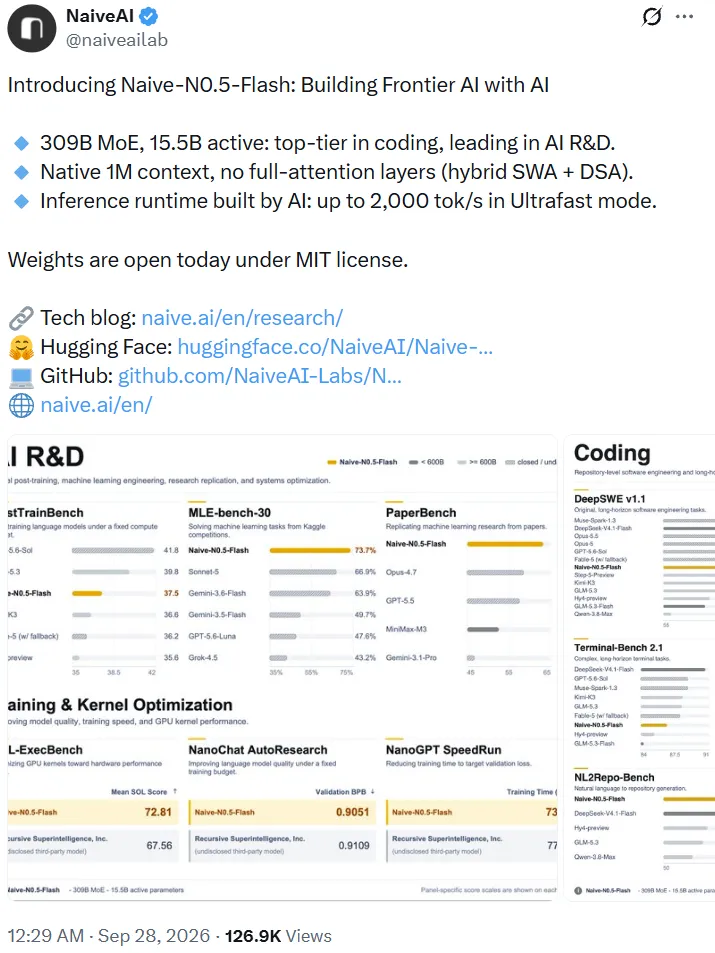
It has a dual identity:AI is involved in research and development and is specially trained to undertake AI research and development work.
The technical report shows thatAI is already involved in the exploration of attentional architectures, as well as in training, reasoning and optimizing systems for deployment.Researchers set goals, constraints and criteria for evaluating AI, implementing candidate programs, running experiments, and continuing to adjust to results; critical decisions, such as architectural choices, remain closed by researchers.
There are two official supporting cases that give this approach to R&D a concrete presentation:
I've been thinking about it for a long time.NaiveRT In the optimization, the researchers conducted 151 rounds of experiments with AI over six days, reducing the total speculative decoding time of the same system from 12.3 milliseconds to 3.4 milliseconds.
In another mission, Naive-N0.5-Flash followed the world model study with 400 hours of cumulative 15 rounds of major experiments, continuous data adjustment, training programs, and reasoning strategies.AutoWMIt is the first stage of the WorldArena.
In addition, Naive AI intern Shiqian Su, a Chinese Ph.D. student, also shared on X an example of a Jev model using Naive-N0.5-Flash training. The multi-modal Jev model obtained was very prominent in both Russian squares and Greedy Snake games, both superior to Jev and open source Laya.
Enabling the Naive N0.5 to undertake training, the trained multi-modal models are responsible for playing Russian squares and ravenous snakes. Environmental and data preparation, model and training method selection, test construction, and subsequent training, evaluation, correction and iteration are all developed by Agent itself. In the process, Agent will also adjust the program based on the evidence obtained.
Behind these cases, Naive AI is trying to put the model into further research and development to help it solve the real problems of the next generation.The ability of the model itselfQ: Can it read the paper, implement the method, and after a series of experiments, find a direction to move forward?
Around these issues, Naive AI's first technical report provides a set of results from model design, training, and R&D assessment tasks, and gives the outside world a concrete look at how the startup team is preparing to enter the big model competition.
Quit tradition and move to AI's original way of doing research and development
Giving a machine learning paper to a model is a long way from getting results that can be tested. The model needs to understand methods, complete implementations, organize experiments, and deal with the constant problems that arise in the running process.
Around these R&D missions, the Naive-N0.5-Flash delivered a very bright set of core assessments.
It's a good idea to look at the reproductive capacity of the exam papers.PaperBenchNaive-N0.5-Flash has been released.63.2 pointsIt is higher than the reported Claude Opus 4.7, GPT-5.5 and MiniMax M3.
For a model focused on AI research and development, this result provides a direct observation window: in the face of the research approaches in the paper, how much content it can implement as a concrete realization.
Machine learning engineering provides another test. On the MLE-bench-30 from the Kaggle competition mission, the Naive-N0.5-Flash was achieved.73.7%Results and tasks involve model training and experimentation around data.
Further focus on model research and training after language modeling under a fixed computational budget.PostTrainBenchUp, it got it.37.5 points。
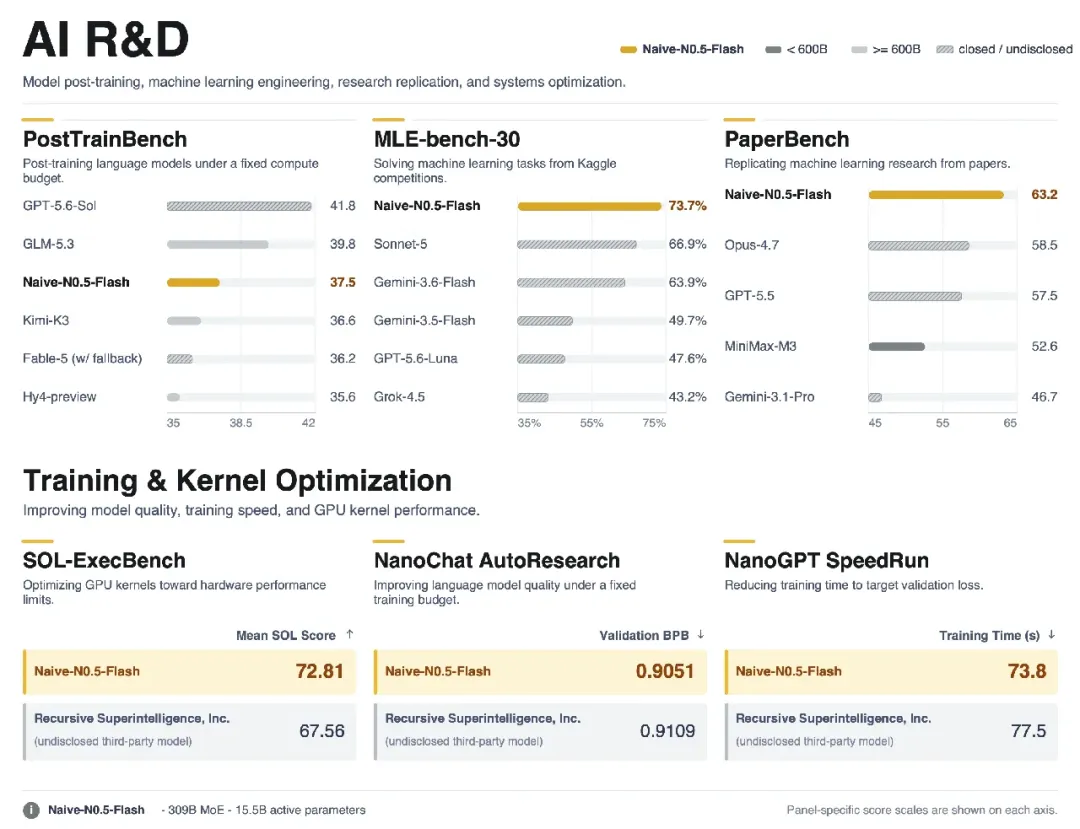
Naive-N0.5-Flash's AI research and development related to evaluation and optimization results, including post-model training, machine learning engineering, paper reproduction, training and GPU algorithm optimization.
These types of assessments cover different areas of research and development. The papers reflect the focus on the understanding and implementation of existing research, the ability of machine learning engineering researchers to solve specific tasks, and post-training tasks that require models to look for improvement solutions under resource constraints. Together, they provide a basis for judging whether models can participate in research and development.
There is also a set of controls to be noted in the chart above. In three tasks: Sol-ExecBench (GPU algorithm optimization), NanoChat AutoResearch (fixed-budget training improvement) and NanoGPT SpeedRun (training acceleration), the object of the comparison is Recursive Superintelligence. The company, co-founded by Richard Socher, is dedicated to automated AI research.
The company announced its first results in June: The community has optimized NanoGPT Speedrun, which has accumulated a record 83 human refreshments in more than two years, and has been squeezed from 79.7 seconds to 77.5 seconds by its system.73.8 seconds。
Programming skills are the foundation for accomplishing these tasks.NL2RepoOn top of that, Naive-N0.5-Flash is rated as71.9It's a bit more powerful than DeepSeek-V4.1-Flash.
I'm not sure if I'm going to be able to do that.ALE-CLIUp, it got.32.4 pointsThe GPT-6 Astra and Opus 5.5 are closest.
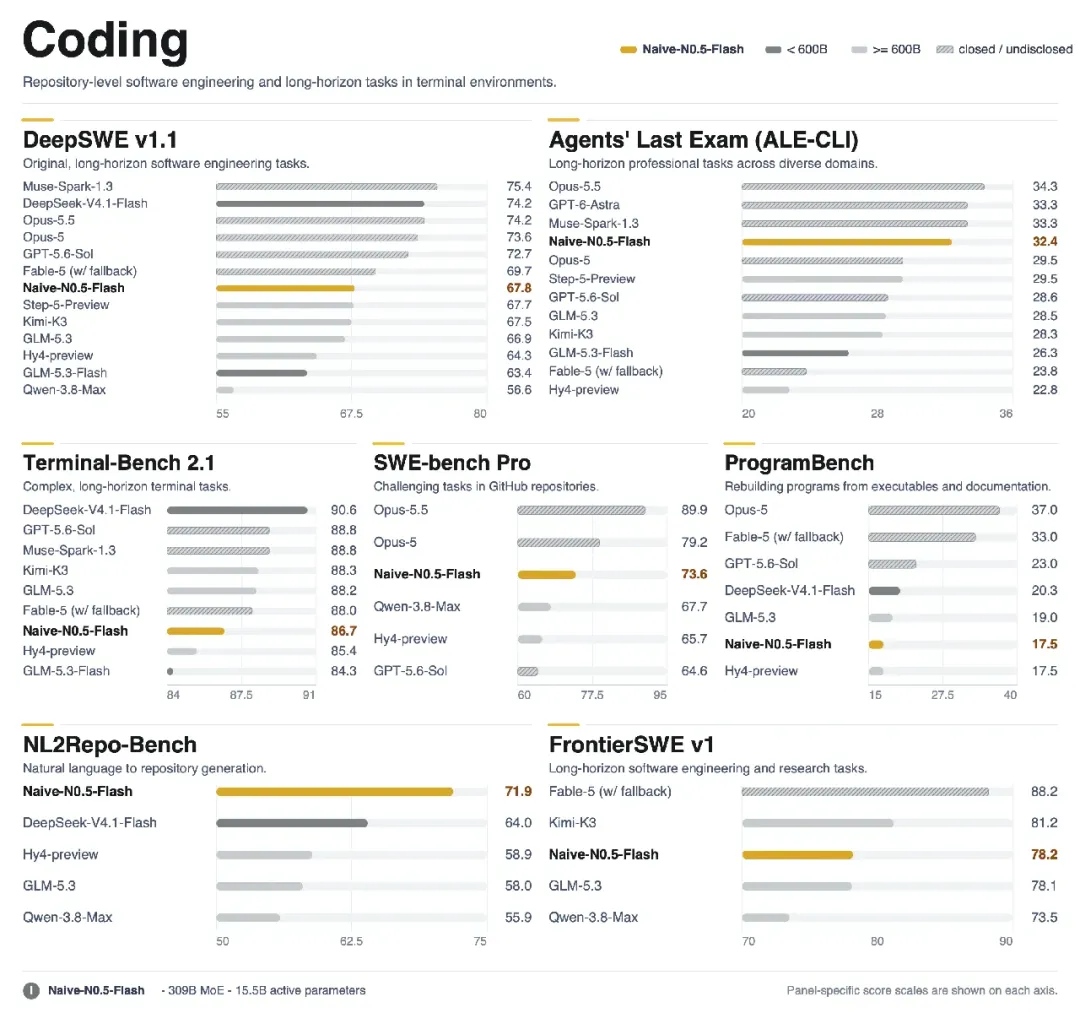
Naive-N0.5-Flash's programming and long-range task evaluation results include software engineering, code warehouse generation, and terminal operations.
Naive-N0.5-Flash appears to have shown considerable competitiveness in paper reproduction, machine learning engineering and long-range tasks.
There is also a practical feature of R&D tasks: the longer the work progresses, the more historical information that needs to be processed. Once a training error is reported, it may be necessary to combine previous code modifications to locate; the next round of experiments will require reviewing the results and their corresponding configurations when deciding the direction.
And what?1M in the backgroundTo preserve the history of these tasks, space is provided. The return of code, tools, and experimental records can be incorporated into longer interaction processes, providing support for model-related decentralized information, and continuous advancement of tasks.
The Naive-N0.5-Flash model weighs and rationalizes the code according to the report's open protocol.Licensed by MITThe price for the input, output, and caching readings will be at 1 million tokens, respectively.0.6, 2.6 and 0.07 coinsResearchers and developers can choose deployment and access accordingly.
For the model to maintain operational efficiency available in continuous interaction, attentional computing, cross-card communication, and memory management need to be followed. Naive AI's transformation of model architecture and training systems revolves around these issues.
Next, we look further into the process of the birth of the first new model, and AI also undertakes a lot of specific work.
What has AI been involved in developing N0.5?
The team developed Naive-N0.5-Flash to solve the efficiency problem of millions of tokens in the context.The open-weight MiMo-V2.5 base is the starting point.Most of the layers of this base model use sliding window attention (SWA) to focus on local information, while a few layers of global attention are responsible for retaining long-range information. These layers of global attention will contribute to a significant portion of decoding expenses after they grow to a million token level in the above context.
Naive AI will put the transformation goals on these layers.DeepSeek will replace the DSA with global attention.The DSA is based on a five-layer SWA layout with a single layer of DSA, forming a mixed scarcity attention architecture.
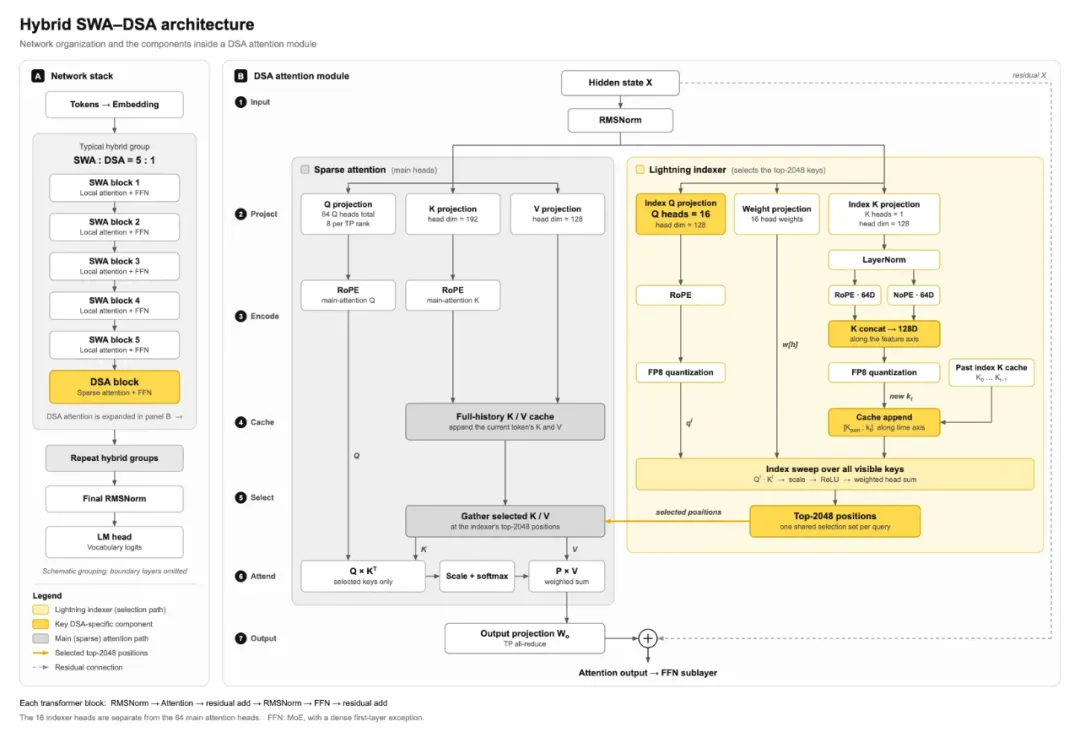
SWADSA Mixed Attention architecture
The team also adopted a GQA with four KV clusters and designed a lightweight index with 16 query heads to further adjust the cost of indexing and attention calculation. It should be noted that the index in DSA still needs to scan the complete history and the relevant layers still need to retain the complete KV cache, which largely reduces the amount of computation and visits to mainstream attention.
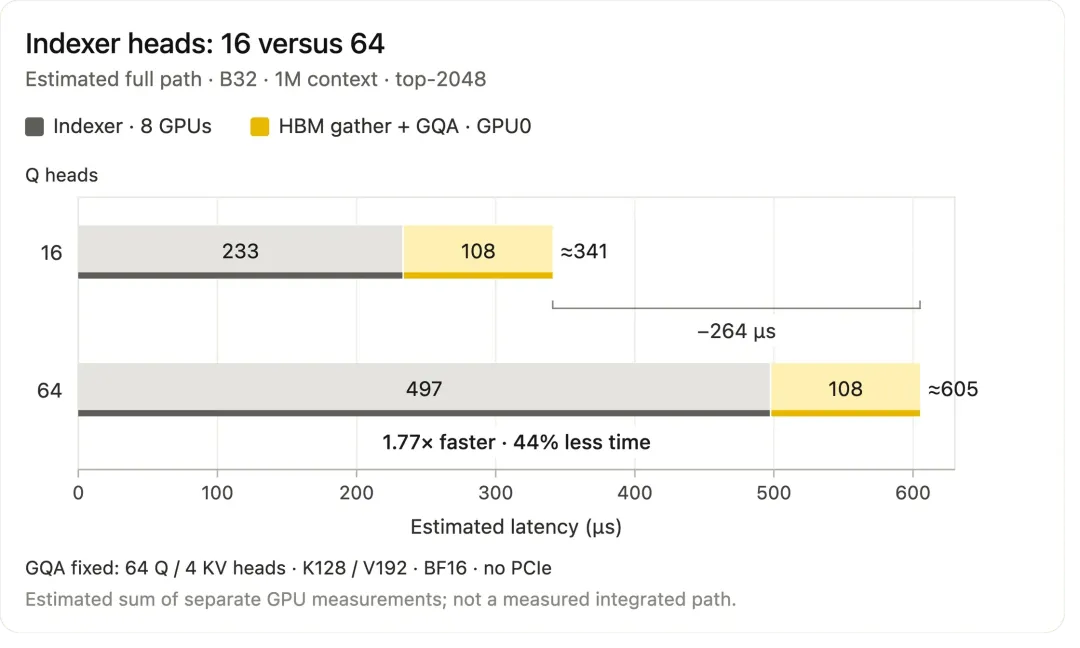
Reducing the index's query head from 64 to 16 can significantly reduce the time it takes to process context-poor attention.
The project is being explored in collaboration with researchers and AI.Researchers set goals and evaluation protocols that require maintaining model quality while improving context decoding efficiency on growth; AI is responsible for implementing candidate architecture, running dissolution experiments and summarizing results.
Changing the structure of attention, the model also needs to re-adapt the way the information is read.For this purpose, Naive-N0.5-Flash has completed multi-stage training of a cumulative 3.25T token in context configuration on 1M:
First of all, the initial 50B token was used toIndicator preheating: The remaining parameters of the frozen model allow the layer ready to switch to DSA to continue to use global attention, and then distribute its attention as a monitoring signal, through the KL dispersion loss training index.
The model then switched to scarcity of attention to perform 3T tokens.Continued Pre-TrainingIt aims at the loss of language modeling, adapting to new information choices and aggregation mechanisms, and strengthening programming and AI research and development capabilities.
Finally, we're going to do it with 200B tokens.Overseeing SFTsIt's been a long time since I've been able to do this.
In this exchange, AI undertook a verification taskIn the process, AI discovered and corrected the numerical stability problems of the top-k selection, and independently verified the correction results. The researchers determined switching time and precision thresholds, and standardized the verification standards for the training and deployment phases.
A deeper level of work is taking place in the training system. The sequence of millions of tokens that need to be allocated to multiple GPUs to process, and how to exchange information on each card, will directly affect the training efficiency.
AI captured the differences in access of two categories of attention when analyzing hybrid architecturesBased on this, it proposed and validated a hybrid sequence parallelism scheme: the DSA layer uses Ulysses sequence parallels to redistribute access to the complete sequence through all-to-all; the SWA layer uses overlapping segments to exchange the necessary overlapping regions with adjacent segments on the left.
In this way, the communication complexity of the SWA portion decreases from O(L, which increases with the length of the sequence, to O(w), which is related to the size of the window. This idea is also extended to the reasoning side, allowing the upper context to be pre-filled, calculated by line segmentation and indexed with the corresponding upper context parallel schemes, respectively.
There is also a need for refinement in the management of archives.For intermediate activation resulting from sparse indexing and attentional alignment, AI analyzes the recalculation path, refining the unloading particle size to the output of a single algorithm, so that different intermediate results can be configured separately for unloading strategies; the top-k index is explicitly retained and continues to use the selected position when recalculating.
According to the disclosed data, the training system, which uses 512 GPUs and is configured in context on 1M, can complete 1T token training in about four days. The infrastructure that supports the R&D and operates includes a sandbox, computing and authorization management platform, which the company says supports almost 10 million sandbox operations per week, peaking at 100,000.
These details make "AI involved in R&D" specific: it needs to understand computational dependence, find numerical or performance problems, and experimentally determine whether modifications are effective.Researchers are responsible for setting constraints and making key decisions, and AI carries out a large amount of analysis, implementation and verification work.
The same research and development approach extends to subsequent optimization of reasoning systems and the study of world models.
Two examples of demos:
How powerful is AI4AI?
NaiveRT and AutoWM provide two specific observation windows showing how AI is involved in underlying system optimization and cross-disciplinary research respectively.
NaiveRT It's a time for reasoning to run.
It addresses a real-world problem in long-range reinforcement tasks: single task trajectories may require continuous generation of large amounts of tokens, and a few particularly time-consuming trajectories may drag the entire training batch.
To achieve this goal, the researchers worked with AI in six days.151 rounds of optimization experiments, of which 63 rounds of modification were adoptedAI analyzes the performance of the entire network, implementing candidate schemes, and verifying results through numerical verification and multi-card testing, optimizing multiple connections involving algorithm integration, data transfer and GPU execution scheduling.
For example, a MoE algorithm convergence path tries seven rounds in a row, with the numerical results of each version being correct and the end-to-end performance decreasing altogether. Analysis found that the expense of the original algorithm boundary had been largely overlapped, and the convergence introduced additional synchronization, which the researchers eventually called off.
Finally, on the same set of systems, NaiveRT will include a round of draft generating, verifying, sampling and submitting full speculative decoding from SGLang.12.3 milliseconds shortened to 3.4 milliseconds, reducing delay by 72.4%。
On eight front-end GPUs, it also measures2,122 token/sSingle-stream decoding peak: This figure comes from the best one-second window of 41 HTML/SVG generated requests, testing the closed thinking mode, and not counting pre-filing times.
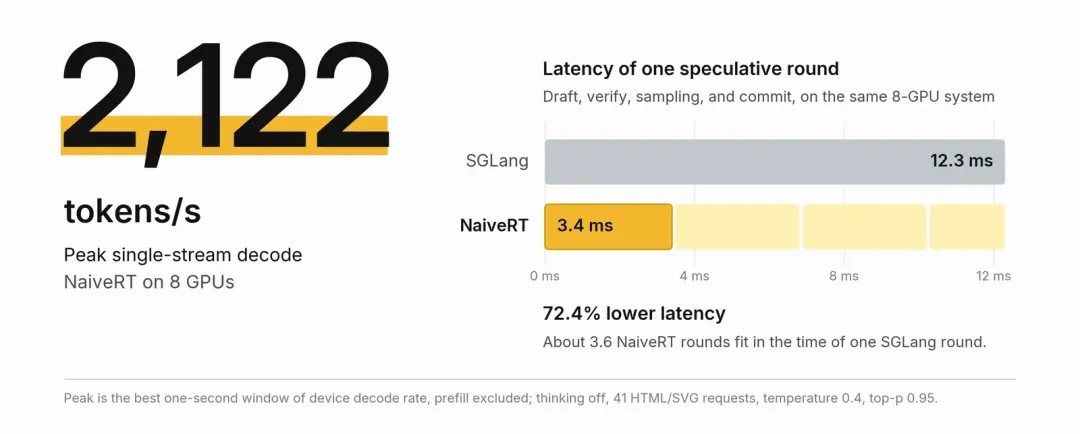
NaiveRT single-wheel speculative decoding time-consuming comparison
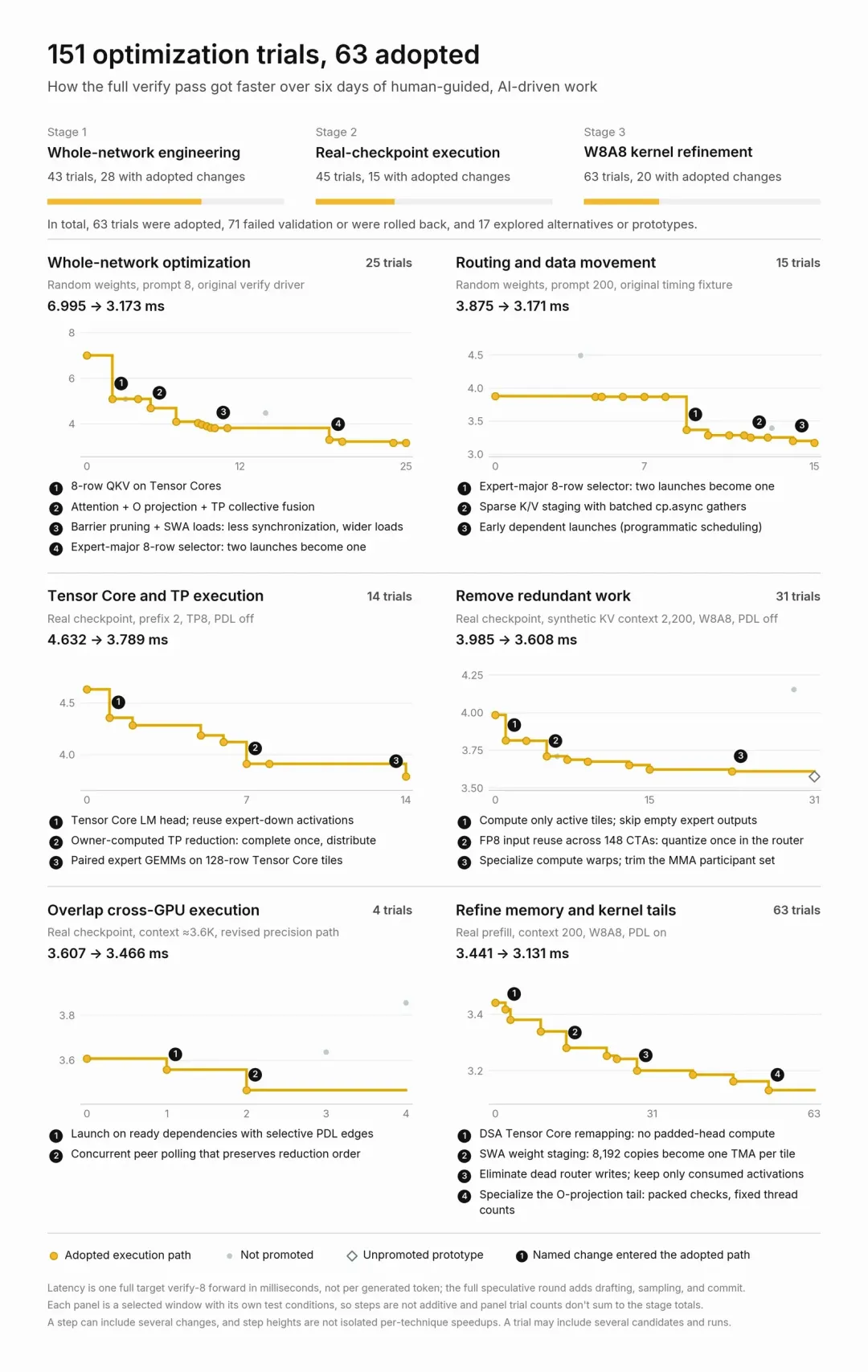
AI participates in the R&D process: In 151 rounds of experiments, 63 changes were adopted, 71 rounds of verification failed or rolled back, 17 rounds were explored.
AutoWM The mission was extended to world model research.
One researcher gave Naive-N0.5-Flash a research goal, calculation budget, and evaluation protocol, and the model continued to design, train, and evaluate the program and decide on the next attempt based on the experimental results.
The study began with the reproduction of FlowWAM. Early improvements to the adjustment of non-classifier guidance and timing were limited, and the model then shifted to data and training programs: rewriting video descriptions, expanding the training set from 2,500 video segments to 22,500 segments, eliminating samples with lower scores, and adjusting the sample and rollout structure.
As the experiment progressed, the model also found that some of WorldArena's indicators could be calculated without real reference video, and could be used to guide output selection. It began searching for results generated by different time steps, solving the backpack problem by using dynamic scheduling modeling, and further exploring Best-of-N video selection and post-processing strategies.
It's been a long time.400 hours, 15 rounds of main experimentsAfterwards, the team followed suit.WorldArena-1 Track 1The public protocols are measured in video quality ratings.77.43 pointsThe highest public score recorded at the time was 73.64 points.
This result includes a joint contribution of training improvements, reasoning screening and post-processing, and records how the model gradually adjusted research pathways in experimental feedback.
AutoWM Curve of Progress
Naive AIConsidering these practices as part of the exploration of recursive self-improvement (RSI)• To allow the model to participate in the research and development of subsequent models and systems, and to gradually expand the scope of work it can undertake.
RSI is a progressive self-improvement approach.
To enter the Grand Model Race in 2026, Naive AI has chosen a different path: to use AI as a starting point for AI research and development. It builds on the capabilities of the Naive series around R&D tasks while allowing AI to be deeply involved in architectural transformation, training and system optimization.
The disclosure of the technical report and two cases provided a number of specifically verifiable results for this route.
Next, it's more interesting to see what these results will bring for the next round of R&D. Raising the speed of reasoning can shorten the waiting time for production in experiments; models are better at reading papers, writing code and analyzing results, and there is an opportunity to help researchers find effective solutions faster. If these improvements can continue to accumulate, the team is expected to advance more effective exploration within the same time and resource budget.
And that's what Naive AI wants to do gradually.RSI is a recursive self-improvement.Closed Circles:To allow AI to participate in the research and development of subsequent models and systems, and to further enhance its ability to drive the next round of improvement.
What the RSI stands for across the industry is still a matter of debate.
In its proposal of 21 September, OpenAI made it clear that a fully autonomous RSI has not yet occurred and should not be pursued until it can be securely achieved.
Dream-RSI, which was released in mid-September by Google and agencies like Google DeepMind, took a different path: model weight moves, allowing the intelligent body to learn better exploration strategies from past search records.
Naive AI is the current practice, and so is Naive AI.Researchers get a sense of direction, AI takes on a lot of execution.The difference lies in the objectives:It's time to get the product and the executives involved in R&D into a two-to-one relationship.The Naive series is both a model created by the system and trained researchers in the system.
Two cases have already demonstrated the potential for AI to undertake specific R&D tasks, and whether this ability can continue to be transformed into the next generation of model advances, which will require further iteration to answer.
Model address:
The code repository:
The official link: