It's the first time in the history of the world.
AlphaFold predicts the structure of more than 200 million proteins in nature.
David Baker wanted to take a different path: not to predict what nature has created, but to create what nature has never created.
One morning in August, research assistant Jack Boylan summoned the results of the previous night's experiments.
Next to the lab's DNA sequencing apparatus, the test tube contains a large number of artificially designed DNA sequences that have never evolved in nature.
In a recent experiment, they threw six million pieces of this design sequence together into the same test tube and measured them at the same time.
Boylan's agency, AI BioDesign, just made its debut in Seattle on September 3, just minutes from the headquarters of the Allen Institute.
It is backed by $94.6 million from Paul Allen's legacy system, led by 2024 Nobel Prize winner Baker and genomist Jay Shendure.
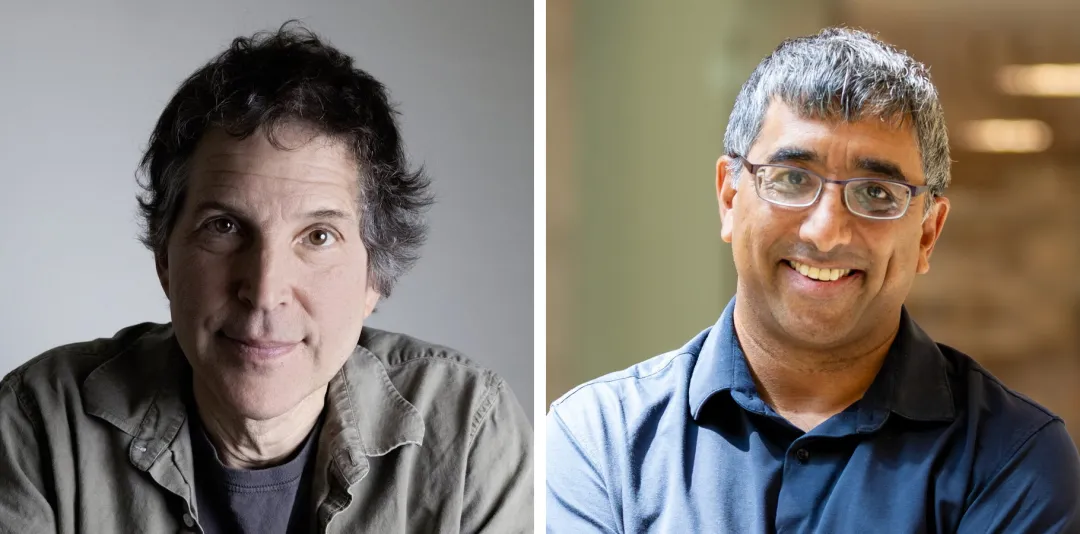
Left: David Baker, winner of the 2024 Nobel Prize in Chemistry. Right: Jay Shendure, a genomist.
In this era of computing that determines everything, they don't intend to use the nearly $100 million to train a larger model, but instead to write on that test tube.
The hijacking of cell machinesIn the test tube, it's a big one.Their game is to create a maddening closure:
AI designs, creates and measures in the lab, and the result is a feedback loop, where the model decides what to do next.
It sounds like the familiar "design-build-measure-learning", but the real difference is how the circle turned out.
There is no automation workshop packed with mechanical arms, and "the scale doesn't come from robots, it comes from parallels inside the test tube", said executive director Jesse Gray.
The so-called parallel inside the test tube, in Shendure's words, is to hijack the cell flow line left to humans by evolution and use it to make and measure millions of molecules.
The specific approach is to throw millions of design sequences together into the same test tube, allow the cells to make them individually, and then run them again under the same conditions.
In this way, when modeling the "rules of design", we are faced with mass examples rather than a limited set of naturally occurring ones.
What is the size of a molecule designed like this?
Below is a combination of proteins previously designed by Baker Laboratory: the purple and pink sections are AI-designed, and the white is the insulin wrapped around it.

An AI-designed insulin-coupled protein surface rendering chart.
Experiments are no longer validating conclusionsIt's just for the mouse model.What is even more interesting is the KPI of this production line.
The laboratories are organized into teams of five to six people, each dealing with a specific biological design challenge, with a machine learning team at their side.
What about the results of each round of experiments? Not only how many useful molecules are made, but how much the model has learned from this round.
The logic of traditional laboratories is to make assumptions and then design experiments to verify them.
AI BioDesign reversed the order: the experiment was first a "practice task" given to the model, followed by a cycle of "design pump construction pump measurement pump learning".
At the end of each round, the machine-learning team selects the sequence of models that are most likely to learn something new based on the results, and determines the next round of measurements.
The goal is to get as much information back as possible from each experiment, rather than producing a finished product as quickly as possible.
In the past, it was a human-controlled lab, and now the lab is listening to AI's arrangements.
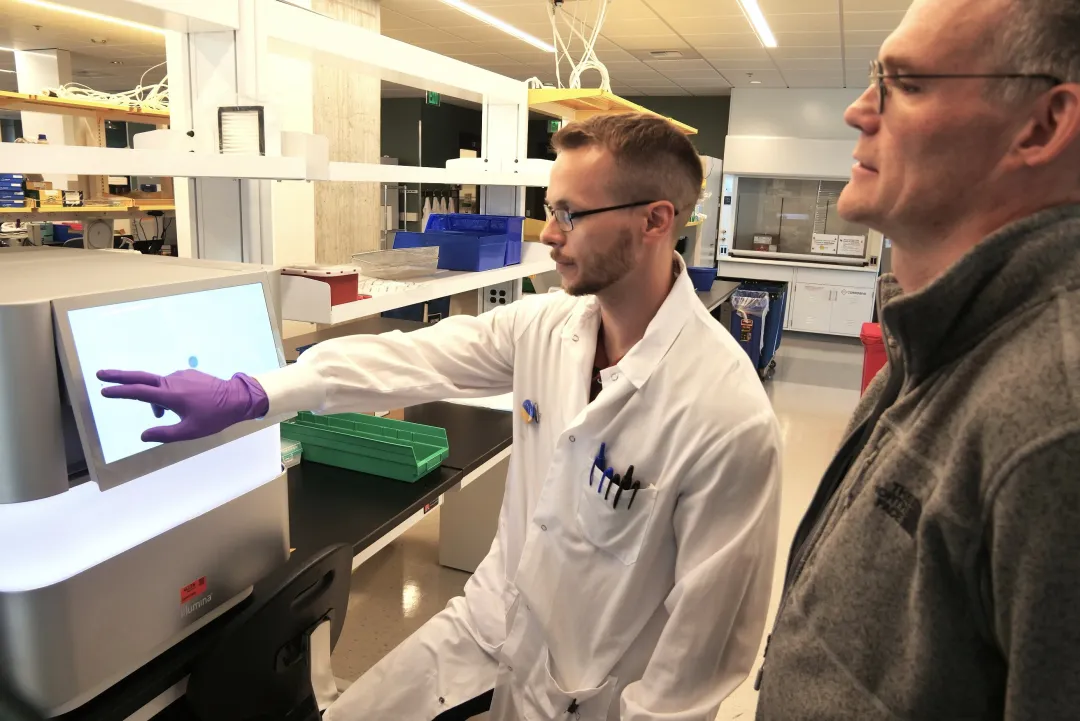
Jack Boylan, research assistant at the Allen Institute (left) with Jesse Gray, executive director of AI BioDesign, in front of the DNA sequencer in the lab.
Proteins that nature doesn't haveHe did it in 2003.This is not a story about "AI making proteins that nature doesn't have".
This is what Baker did 23 years ago.
In 2003, his team used the Rosetta software to design a protein called Top7:93 amino acids, a folding method unprecedented in all known proteins at the time.
The 2024 Nobel Prize in Chemistry was awarded half to Baker, who designed the computed protein, and half to Demis Hassabis and John Jumper of the AlphaFold team who predicted the structure of the protein.
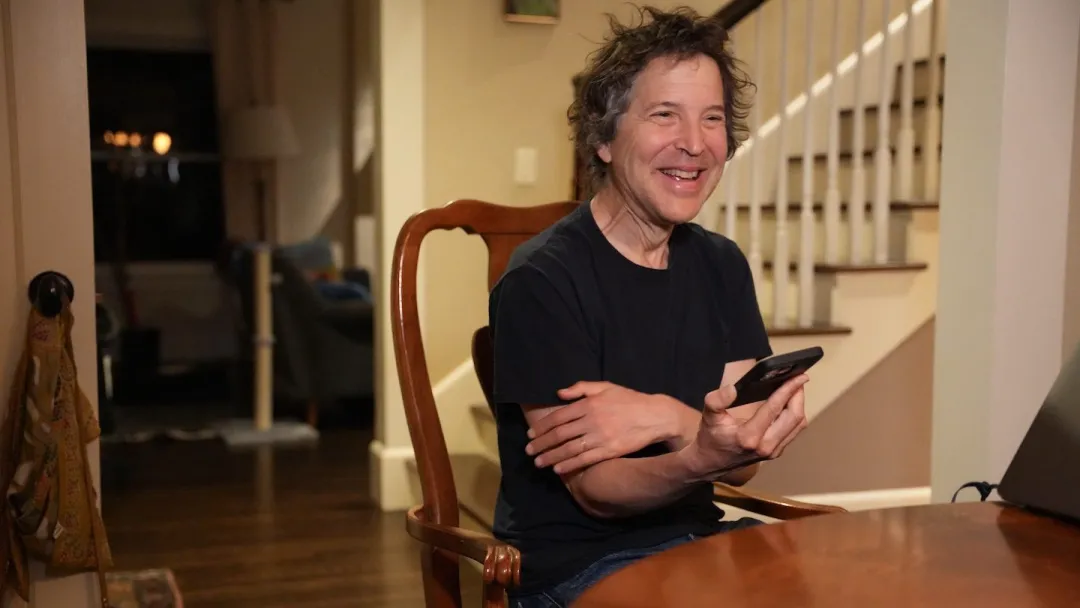
On October 9, 2024, David Baker received a phone call from the Nobel Committee.
If the AlphaFold solution is to "read": predict what shape the amino acid will fold into, Baker's solution is to "write": what shape should I make in order to achieve a function.
After half of what was read was pushed to the altar over the years, AlphaFold 2 and the larger models of the time followed the same path: they ate all the data that humans had already collected.
This half of "writing" is not that cheap. What nature doesn't have, you can't even look at in the database, you can only make it yourself, you can measure it yourself.
So it's been stuck in a real mud:
AI can spit out hundreds of thousands of candidate designs overnight, and traditional laboratories produce hundreds or even high-production designs a year.
The huge gap between design and verification is the ceiling that has been hard to break in this area.
In Baker's words, the real breakthrough of the project was the first time AI started matching the experimental capabilities of synthetic biology.
On the one hand, it generated millions of candidate designs a day, on the other hand, it measured millions, and the two turbines finally came together.
Not following the general modelInfrastructure for heavy storage experimentsWhen everyone was looking for a general model that could answer all the questions, even simulate the entire virtual cell, Baker and AI BioDesign took a different path:
Make a small set of models for specific problems, and then create a huge amount of new data specifically for each problem.
It's easy to understand.
The remaining specimens of natural evolution, just a small sample of what it has tried for billions of years to learn the rules of universal design, would have been a huge gap.
To fill this gap, there's a lack of data, a lack of data that you create yourself. To create data, you don't have to build it on a stack of graphics cards, you have to build it on a test tube, a sequencer and a lab.
The first stage is the computational infrastructure, and the next stage is the experimental infrastructure.
What's more, it's counterintuitive that even if the agency wins, the results are all free: models, data sets, experimental methods, experimental agents, benchmarks, all open.
What if someone else used that data to make money?
President Rui Costa said simply: "If a lot of companies are using this data to make the world a better place, we're lucky".
There are also concerns underlying the frenzy. Mass-producing molecules that do not exist in nature must be prevented from unexpected ecological impacts and malicious abuse.
There is an unbreakable link in this chain: the synthesis of DNA.
This is the industry's screening system. You just synthesize a piece of DNA, and the system takes it and blocks it from the genes of known toxins and pathogens.
A study published in Science in October 2025 showed that the Microsoft team used open-source protein design tools to rewrite 72 targeted proteins into about 72,000 synthesized homologous sequences, with the structure and functionality largely preserved, sequences incomplete, and a large number of leaks in four screening software.
The team then teamed up four synthetic companies to patch, and the detection rate rose sharply.
Microsoft team's AI protein design red team process: from synthesizing homologous sequences generated by targeted proteins to sending them into screening software verification.
The problem is that patches can only fill in the gaps that have already been discovered.
Baker's claim was that all synthetic DNA was recorded, sequentially recorded, and personally recorded.
He believes that this is a practical barrier to abuse.
Opened 18 months laterOpen a new drawer for biologyIt's been a long time coming.
Costa's time frame is 18 to 24 months to make real progress, open to researchers around the world within five years.
Baker's vision list says that a new treatment for a disease can be made in weeks instead of decades, that the plastic in the sea is eaten by enzymes, and that bio-computers consume much less power than silicon chips.
These are just directions for now. Baker himself admitted that a set of molecules that could be used would come up along the way, but he did not say why.
It's hard to say, but it's not clear.
Darwin admired the diversity of nature with his "infinite beauty".
But in Baker's view, the most beautiful forms are just a few samples that have been tried for billions of years, and the vast majority of the frames in the drawer have not yet been opened.
Now, he's using AI to pull the trigger and pull the trigger 6 million times.
AlphaFold has predicted the structure of more than 200 million proteins, and the path to "understanding nature" is well underway.
Baker's bet is that the closure of the next path is not in the model, but in the data: an energy source is constantly spewing out new data lines.