Putting a book on a shelf is not a complicated task: finding a space, pointing it in the right direction, pushing it forward. The real difficulty is when the contact occurs: has the book hit the side?
But the power and real robot hardware are tightly bound, the cost of power data collection is too high, and it's difficult to scale through UMI, egos, and so on.
There are even more tricky questions: Will the introduction of a new model change the structure of the model, whether it needs to be retrained and whether it will cause the model to forget its original knowledge?
These have always been problems that VLAs can't afford not to face.
LIFT (Late Reactive Injection of Force for VLA Post-Training) was developed by a team from the University of Transportation in Shanghai (Shanghai University of Transportation) in collaboration with the University of Luizhou, Wenchuan University, China, to teach the model to learn perceptual power through online training only, while retaining model pre-training knowledge, and to generate movements through high-frequency reactive forces.
This work was highlighted by CoRL 2026 and its core contribution was to go through the prior knowledge of pre-training and post-training training paradigms of high-frequency reactive operation based on mechanics to provide new feasible solutions to the difficulty of solving perceptual model scarcity in VLA. Even more than just VLA, the method proposed by LIFT can be applied in theory to any pre-training model based on MoT infrastructure.
Never Too Late for Force: Accelerating VLA Post-Training with Reactive Force Injection
I'm going to do it again.
The main page of the project:https://lift-policy.github.io/
The code link:https://github.com/y-wng/lift
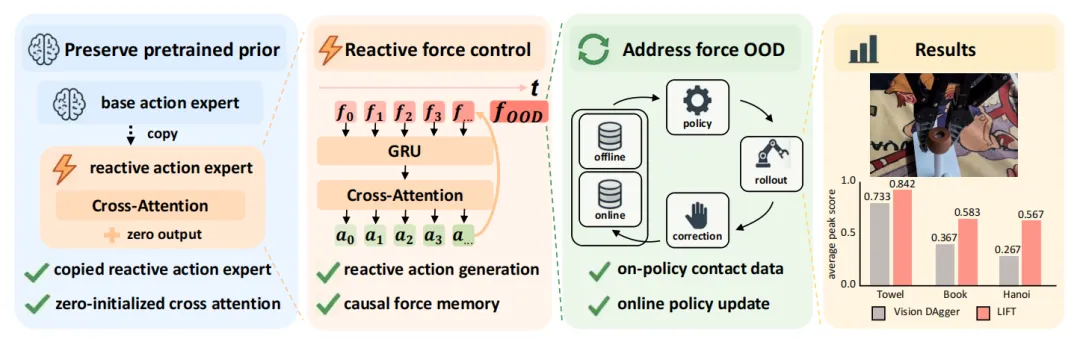
Figure 1 Overview of the LIFT method. LIFT repeatedly uses expert parameters for pre-training movements to correct online learning contact behaviour by injecting reactive forces.
See results: Force significantly improves mission performance
The team tested on three missions: folding a towel, inserting a book, and placing a Hanotta circle, and lifted the post-vision training score to:
I'm not sure what I'm going to do.
In addition to this, it is important to note that the number of children in the household increases.
The Hanotta circle is placed: 26.7 → 56.7.
It takes 20 to 30 lines of on-line data to achieve this effect. And not only can the intensive contact task of inserting a book, unfolding a circle, or the relatively simple task of placing a towel in a contact state enhance its performance and accelerate the process.
If you want to use good power, LIFT presents three problems that must be solved.
Three difficulty points need to be solved with good intentions
Timely response to contact: In real contact, momentary deviations can lead to a complete failure of the task. To use good force, the model must be perceived and adjusted quickly.
Maintaining the original capabilities: the addition of force does not allow the pre-trained model's original capabilities, such as space understanding, object operation and scenarios generalization, to collapse, otherwise the end is reversed, 1 + 1 is less than 1.
Compatible asynchronous data: the cost of harvesting dynamic data is high and the quantity is very small. If post-training data is not compatible with non-compatible data, it is difficult to ensure data diversity and ultimately overfit.
A complete and systematic solution to these three challenges has been proposed by LIFT.
Reactive injection, complete the control loop
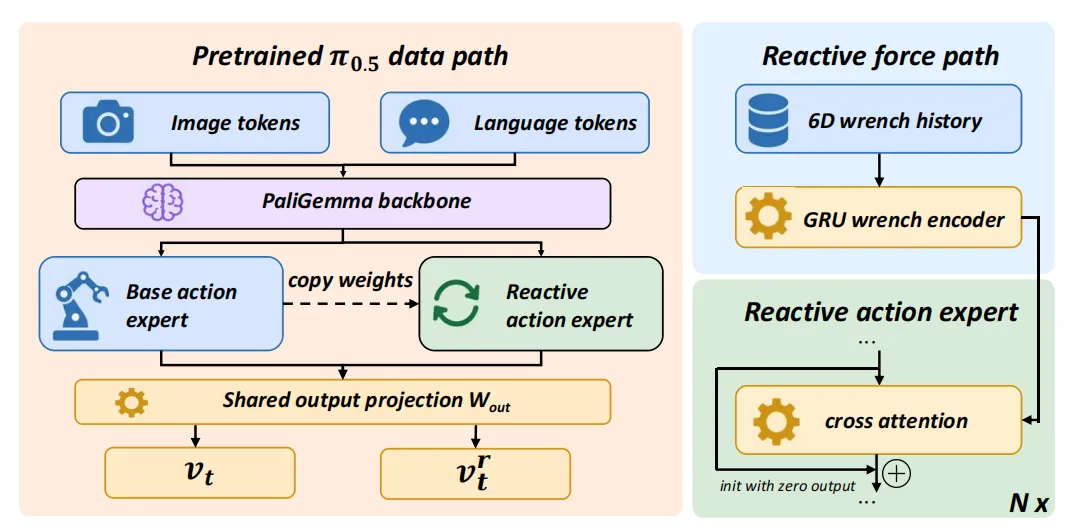
Figure 2 shows the LIFT architecture.
LIFT duplicates the parameters of the pre-training motion expert, obtained by a "reactive motion expert" who can adjust movements in a timely manner based on force feedback. It senses forces in the latest period of time through cross-causal attention, and accordingly adjusts movements in a high-frequency reactive manner; visual and linguistic information is pre-calculated and cached, which will significantly increase the closed-loop control frequency from 1Hz to 10Hz.
Coordinated movement expert output, retaining prior training and prior knowledge
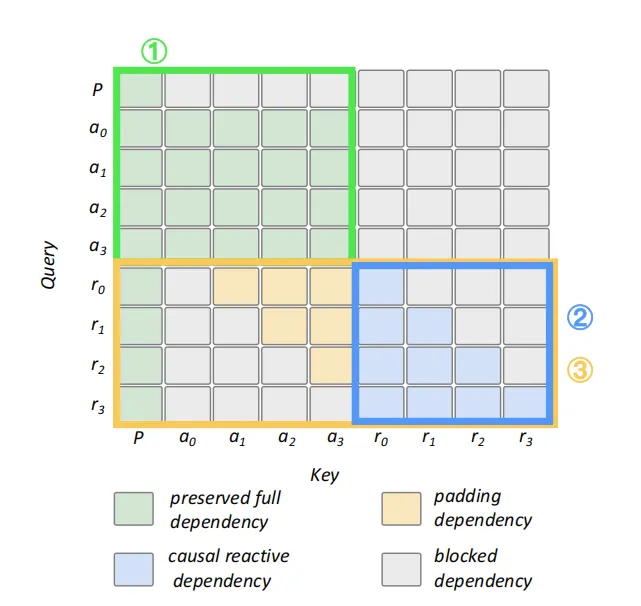
Figure 3 Disguises the cause and effect of distraction.
As shown in Figure 3, LIFT uses a displacement causal attention mask. P is the visual language forerunner, a is the base action token, r is the reactive token. 1 is the base action expert's attention, maintaining full attention. 2 ensures that the reactive action expert's attention attention is causal. 3 is the displacement attention.
Visual data and pulse correction mixed training
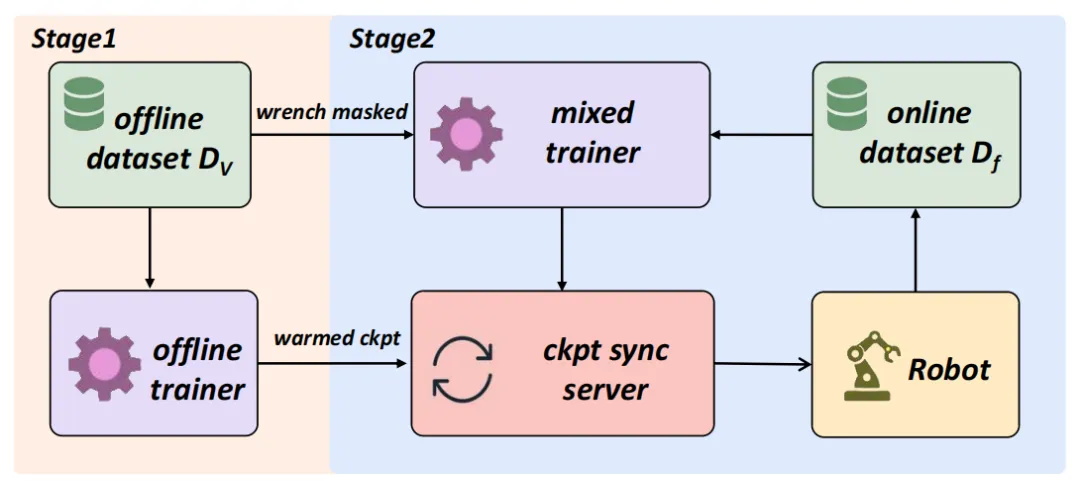
Figure 4 LIFT training pipes.
LIFT uses a two-stage training. In the first stage, the team uses RoboPocket to collect non-strength visual data to allow the model to learn the task at hand; in the second stage, the model is deployed to the robot, through online artificial correction, to learn the movement adjustment under real contact. In the second stage, the model uses both visual data and dynamic data to intercept its gradient through force masking for non-strength visual data.
Four key conclusions of the LIFT
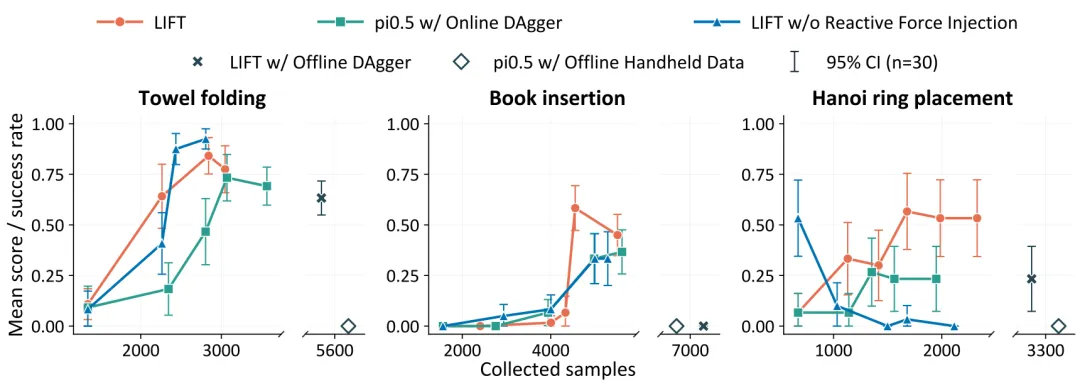
Figure 5 LIFT's main experimental results. The horizontal axis uses 10 fps of data collected online, using only part of human intervention data training and statistics. Each online experiment takes two to three hours, collecting 20-30 data.
It's only after training that you learn your strength.
During the entire experiment, the LIFT did not re-train with any bearing data.
The team demonstrated that post-training penetration is still a viable advantage, a more practical yet attractive route.
If you have a change of contact, you must act immediately
Many robotic strategies predict a future action at once, forming an action block. This design is conducive to action coherence, but it also poses a problem: if a robot encounters an obstacle while performing an action block, it can only wait until the next action block is generated to try to adjust it.
LIFT reactive input allows the strategy to be adjusted in real-time based on force perception within the movement block. Figure 5 compares LIFT to baselines with no reactive input, and the team finds that reactive input is particularly important for intensive contact tasks. In tasks with no complex contact, such as overlapping towels, reactive input still significantly accelerates improvement in task performance compared to pure vision strategies.
How to learn from real mistakes
Unlike power and vision, slight changes in position can lead to a large drift in the distribution of power. Once the power appears outside the data distribution, the model may blink. LIFT collects the bandwidth data online, allowing the data distribution to be greatly mitigated as the model updates. Figure 5 compares LIFT to the baseline of offline bandwidth data collection, proving this conclusion.
Learning ability and retaining prior knowledge
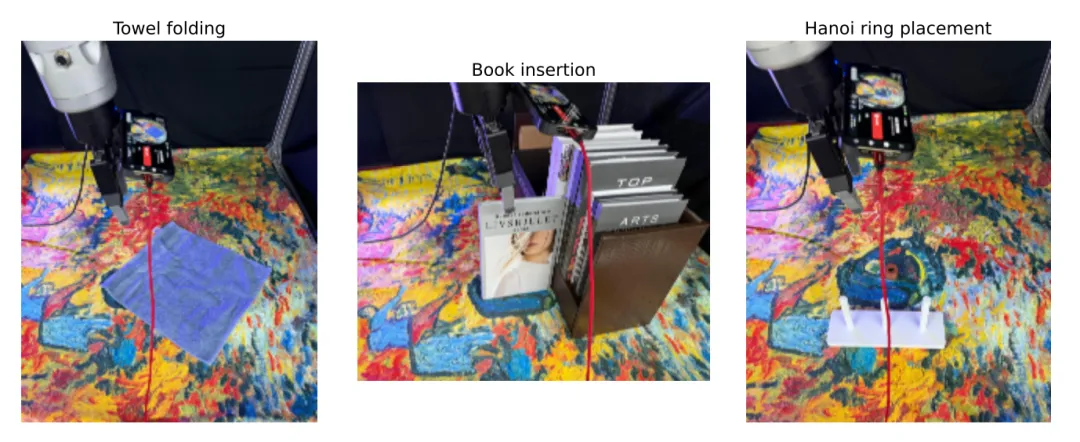
Figure 7 Tableware, objects and lighting changes.
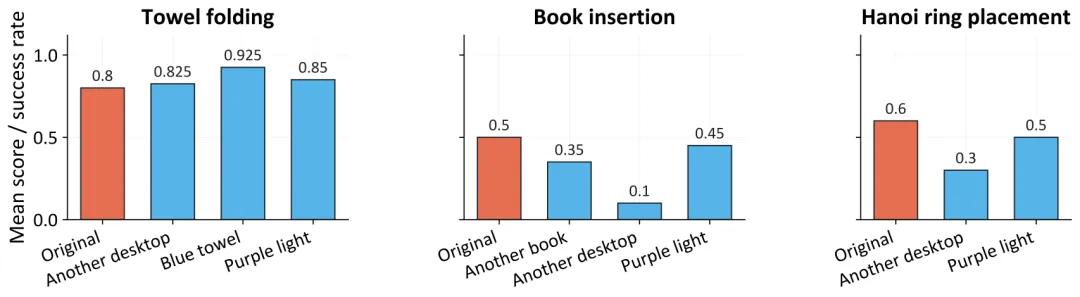
The team found that after post-training, the model retained the knowledge of strength and generalization capabilities, and the performance of tasks did not significantly decrease after changes in desktops, lighting, or even operating objects.
It's not too late to learn.
LIFT demonstrates a post-training pathway towards existing pre-training models: first using mass pre-training to build on task prior knowledge, accumulate spatial understanding capabilities, and then supplement contact details with a small amount of machine beam correction; on the model side, by replicating expertise, shifting causal attention and zero-initialization cross-attention, allowing new models to start from their original capabilities; on the data side, by online post-training, allowing the data coverage strategy itself to truly meet the state of contact.
As the paper's title suggests, it's never too late for force.