It's the first time in the history of the world.
Shockingly, Opus 5.5 disrupted Dijkstra's shortest path algorithm for the first time!
Just now, Vals AI has unveiled a breakthrough big enough to fit into the history of computer science.
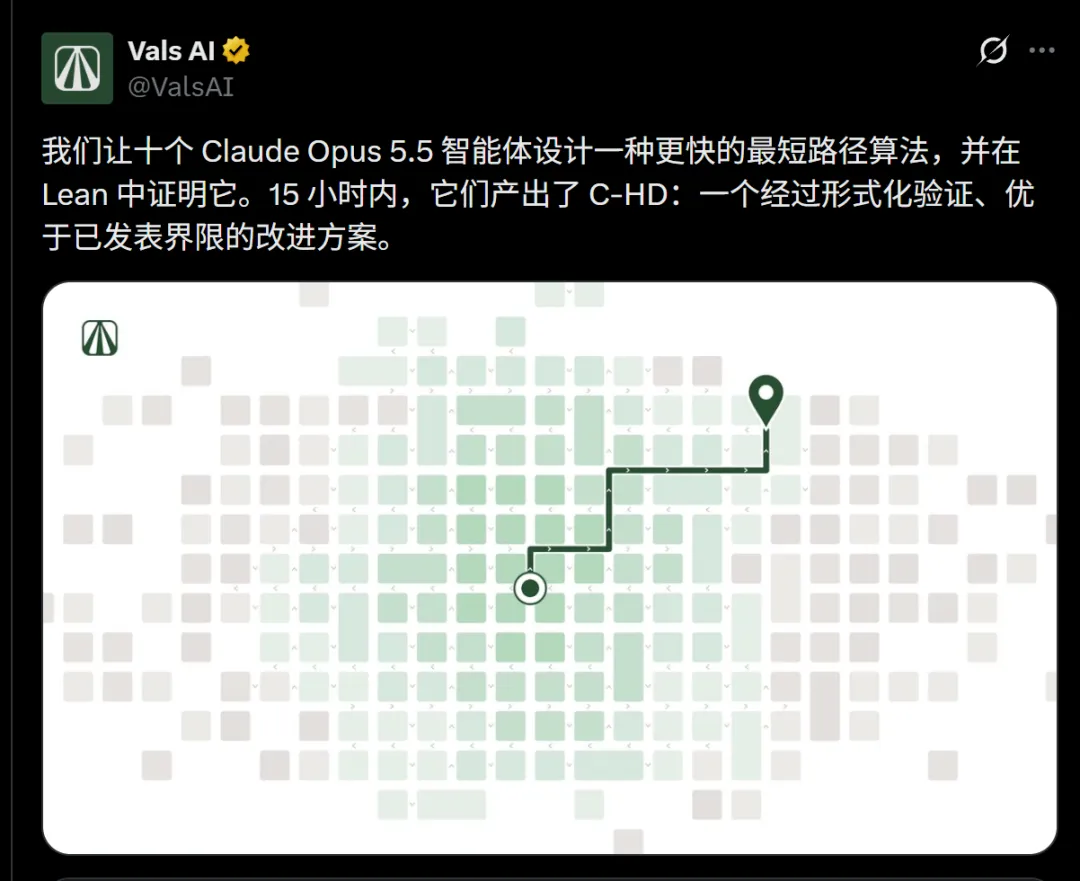
They sent 10 Claude Opus 5.5 Agents to challenge the classic CS undergraduate algorithm Dijkstra and found a faster path.
Dijkstra algorithms are a sacred and inviolable name for all those who have studied computers.
It is the cornerstone of computer science, and generations of top scientists have spent countless years exploring and trying to maximize its optimization.
This is a "classic problem" that has been studied deeply by humans, and they want to push it further, and it is difficult to climb.
This is not an engineering problem that can be solved by "writing the code a little bit elegantly", but that needs to be demonstrated mathematically from the bottom up: even on an unlimited data scale, new algorithms are indeed faster.
As a result, a miracle happened!
The Vals AI team put 10 Opus 5.5 smartphones in a sandbox where they could communicate on virtual message boards, search for clues, or even for a technical route.
After 15 hours, 733 intense discussions were recorded on the message board.
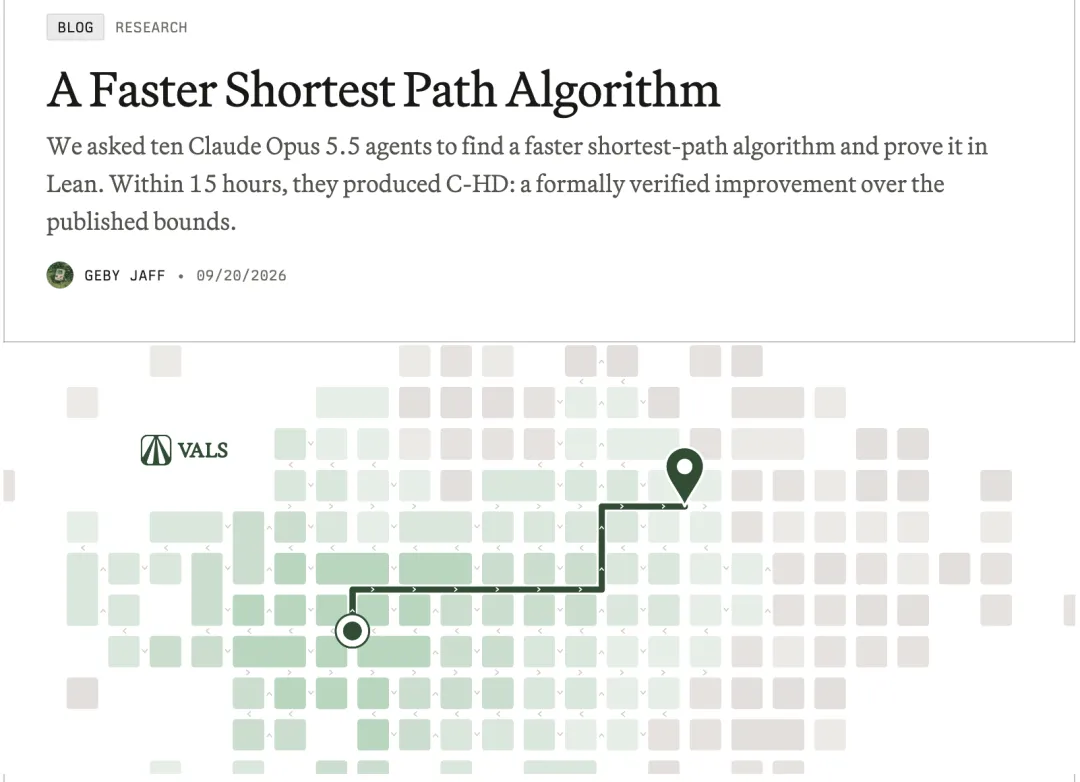
After 15 hours, they were delivered. The AI group not only gave a brand new algorithm called C-HD, but also included 289 files of Lean formalized proofs, which were thrown directly to the Lean Kernel for machine verification, and passed one-time!
For a moment, the algorithm circle was shaking.
Someone shouted: "A study that used to take humans years to try and make mistakes is now being replicated by Agent in half a day?"
Dijkstra on the Altar of AlgorithmsThe Dijkstra algorithm is an extremely simple and very core problem.
Given a graph containing several vertices and connecting them to one side, each side has a non-negative real weight. Starting from a certain starting point, you need to find the path to the minimum total weight of each of the other vertices in the graph, or judge it to be unreachable.
All internal operations (such as access node counting, middle distance storage) are counted in running time.
In this area, the Dijkstra algorithm, proposed by Edsger W. Dijkstra in 1959, is still common today.

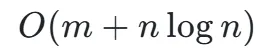 where n ≥ 2 is the sum of the vertices and m is the marginal number.
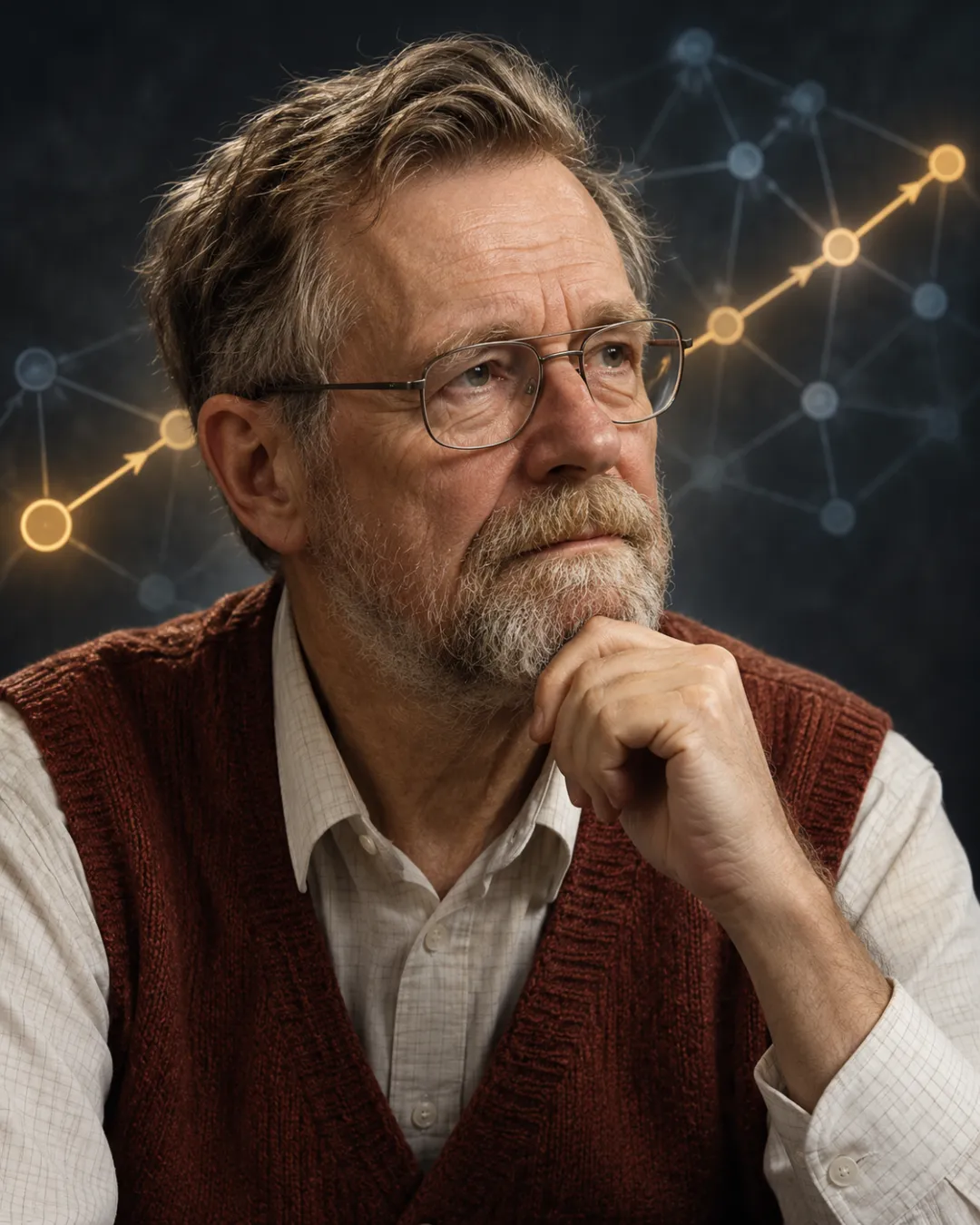
At the forefront of modern theory, when m≥n, there are other breakthroughs.
For example, a landmark paper in 2025 pushes complexity to the point where it's impossible to solve the problem.
And then there's a follow-up study in 2026.

。
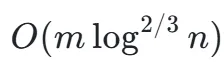
But when the density of the graph is in some intermediate state, Dijkstra is still an unshakeable king.
The ultimate challenge that humans have given to AI is AI.
To design a faster shortest path algorithm than Dijkstra, and to prove it in Lean mathematical formalization language.
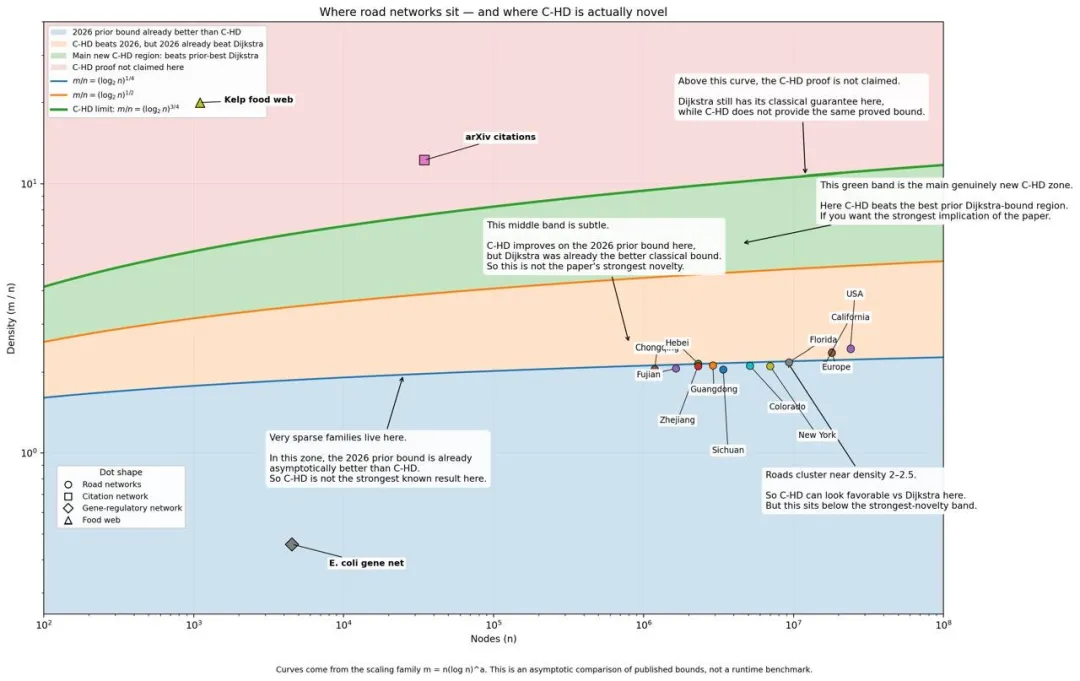
For 15 hours, 733 souls explored: 10 ways in which AI can "crawl" out C-HD algorithms.If what we have learned from the previous Hugging Face incident and the attack on the NS problem is that the intelligent body can greatly reduce the time it takes humans to make progress on the problem.
The most effective way for Agents to work together is to provide them with an "exchange forum" with a lot of people.
In the experiment, humans pulled up 10 examples of Claude Opus 5.5 Agent, filling the "value of effort".
These 10 Agents have an initial division of labor role, but are endowed with an extremely high degree of autonomy to reorganize work, share new findings, question each other, and shift computing power in what seems to be the most promising direction.
And then humans gave them a series of harsh prompts.
1. The shortest path must be found precisely on a vertical chart with a non-negative real-number weight.
2. There must be substantive improvements in the theoretical complexity.
3. Complete, reproducible Lean mathematical proof must be provided.
4. It must be contrasted with the most recent top human papers of 2025-2026, such as the cutting edge results of squeezing complexity to O (m \log^{2/3} n).
5. must record all failed attempts to prevent other Agents from repeatedly stepping on the crater.
6. Two independent "AI peer reviews" must be completed before being declared successful.
Then, in the 15-hour "Closed and Locked Country", the 10 Opus 5.5s went crazy, like a special force, demonstrating amazing collaborative capabilities.
They discover a dead end and immediately shout on the message board, "This is a dead end, don't try it!" If an AI comes up with a new point, other AIs will, like ruthless reviewers, go crazy looking for flaws.
Eventually, they yielded the ultimate resulting C-HD algorithm.
How dare you call the C-HD Dijkstra?The classic Dijkstra algorithm, which employs a greedy strategy, each time takes an honest approach from a currently unvisited summit, selecting a distance nearest it, and then expanding outwards.
Its time complexity can be stabilized at O(m + n \log n) after using the appropriate data structure such as the Fibonacci pile.
But 10 Claude thinks it's not fast enough!
The C-HD algorithm they devised was a fundamental innovation in strategy.

In the world of C-HD, the algorithm no longer looks at a single nearest point like Dijkstra, but instead marks a set of yellow "core axes".
They introduced an ingenious strategy based on inspired decomposition, with the following specific concepts:
1. Starting from the border of the source point and the current summit point.
2. Local searches conducted along the outer edges.
3. Newly encountered vertices are counted as search constraints, and unexplored leaf nodes are counted even when the distance estimate is not improved on one side.
4. Use the resulting search tree and "axis" to organize recursion work.
What's more, the AI also designed the algorithm to be rigorously "local invariant", meaning that every update must be kept as a true mathematical rule.
By carefully removing inefficiencies and limiting local searches, C-HD limits the uselessness of repeated searches and data structures.
As a result, within a specific scarcity range, the complexity of the classic Dijkstra is:
And the C-HD algorithm hardcore pushes it down to:
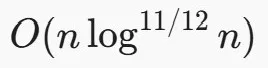
Specifically, the C-HD algorithm establishes the following boundaries of amazing complexity:

Among them, the scope of verification is:
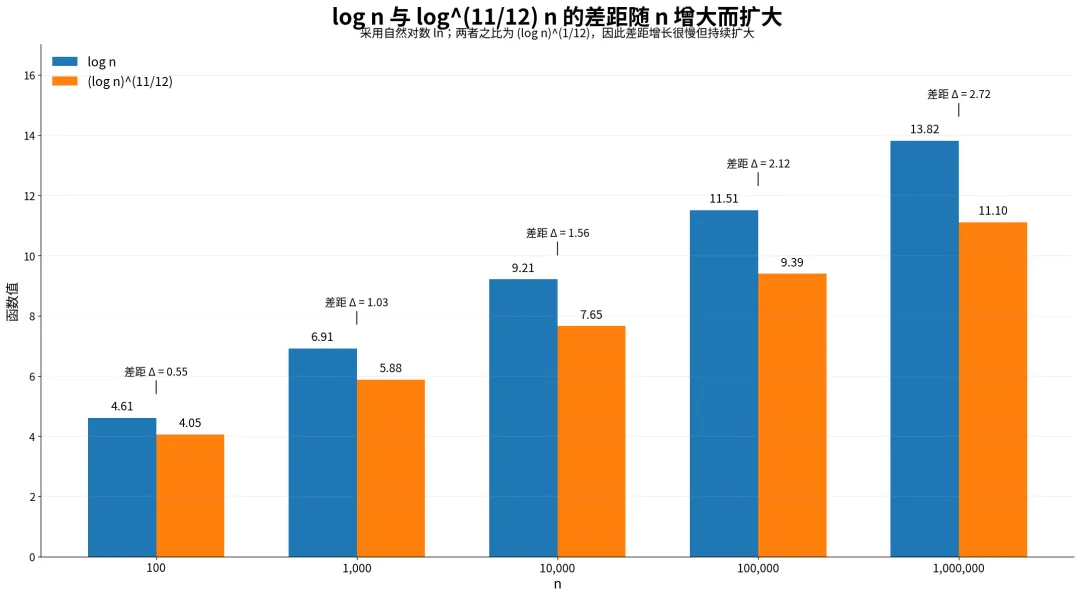
Dijkstra, on the other hand, has a pre-directional ratio of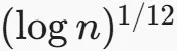 。
Within this particular sparse graph space, C-HD achieves a rigorous approach beyond complexity!
Next, they achieved formal verification of a ring containing the highest amount of gold.
Ten Claude submitted 289 Lean papers and constructed the complete theorem:
-- From namespace Frontier.CHD.Final:
theorem chd_CHDTarget : GateCTarget.CHDTarget GateCCalc.F :=
  ⟨chdProgram, chd_exact_within.1,
   bodyC KcC + 65536 * 9 + 100, chd_exact_within.2⟩
After a long period of compilation and machine verification, Lean Kernel shines the green light: prove it!
It can be confirmed: within the scope of AI-defined computational models and graph densities, the C-HD algorithm is absolutely able to correctly derive the shortest path and absolutely reaches its claimed limits of complexity, without using any unauthorized cheating axioms in the proofing process.
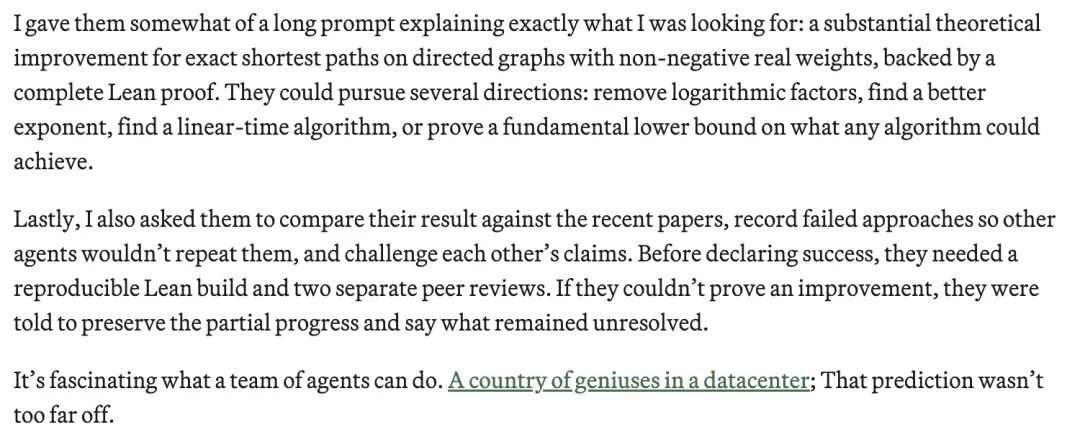
The developers of Vals AI exclaimed:
What a team of intelligent people can do is fascinating. The genius of the data center; this prediction is not far from reality.
If it ends here, it will be a perfect ending.
As soon as the C-HD algorithm was announced, the polar bears could not sit down. A developer named danalec created a project called C-HD on GitHub.
Using the high-performance C language (MSVC, C17), he stitched the C-HD algorithm into 1900 lines of engineering code and ran it into the same arena as the classic Dijkstra and 25 years old DMMSY algorithm.
As a result, everyone was silent.
In test data graphs, the C-HD algorithm is rubbed on the ground: it is still about 1.8 to 2.9 times slower than DMMSY.
It's even 1.4 to 2.8 times slower than the simplest Dijkstra algorithm!
What's going on? Is AI cheating on Lean's core?
No, no, no, no, no, no, no, no, no, no, no, no, no, no, no, no, no, no, no, no, no, no, no, no, no, no, no, no, no, no, no, no, no, no, no, no, no, no, no, no, no, no, no, no, no, no, no, no, no, no, no, no, no, no, no, no, no, no, no, no, no, no, no, no, no, no, no, no, no, no, no, no, no, no, no, no, no, no, no, no, no, no, no, no, no, no, no, no, no, no, no, no, no, no, no, no, no, no, no, no, no, no, no, no, no, no, no, no, no, no, no, no, no, no, no, no, no, no, no, no, no, no, no, no, no, no, no, no, no, no, no, no, no, no, no, no, no, no, no, no, no, no, no, no, no, no, no, no, no, no, no, no, no, no, no, no, no, no, no, no, no, no, no, no, no, no, no, no, no, no, no, no, no, no, no, no, no, no, no, no, no, no, no, no, no, and no, no, no, no, no, no, no, no, no, no, no, no, no, no, no, no, no, no, no, no, no, no, no, no, no, no, no, no, and no, no, no, no, no, no, no, no, no, no, no, no, no, no, no, no, no, no, and no, no, no, no, no, no, no, no, no, no, no, no, no, no, no, no, no, no, no, no, no, no, no,
In algorithm theory, O considers only trends when the data is infinitely large, while completely ignoring the constants.
While C-HD is somewhat less frequent in theory, in real-world engineering it requires a crazy amount of pre-processing. According to observations, C-HD algorithms spend 59% of their time processing 16-byte labels and 34% of their time on pre-processing when running a task.
At the actual scale of graphing, the theoretical steps that C-HD has omitted do not compensate for the enormous memory scheduling and pre-processing costs it has incurred for "flower-cutting tasks".
And, as the number of peaks increases, it lags behind the proportion of Dijkstra that, while shrinking, never keeps up with Dijkstra's actual physical time spent within the memory limit for human lifespan.
The developers commented: "Blogs write well, but the algorithm is too rigid in reality".
Perhaps this is the reason why humanity has not died in this direction: engineering is too biased for pure mathematics, but it has no practical value for engineering.
However, C-HD is still thought provoking.
The authors of Vals AI write: The prediction of a "genius nation" in a data center is not far away.
The engineering failure of C-HD does not affect its milestone in the history of AI.
In less than 15 hours, 10 Claude's introduced the C-HD algorithm, the "Light Brother Moment" in the field of AI.
It demonstrates that AI is fully capable of entering the uninhabited realm of pure theory.
They're not just looking for knowledge, they're actually looking for solutions to "combine, derive, create" that humans never even imagined.
The resulting crystalline structures of constant temperature superconductivity, the pathways of protein folding to cure cancer, and Liman's conjecture are all in sight.
In decades to come, when people look back at the beginnings of AI taking over scientific research, they will remember this event in September 2026.
Human algorithm textbooks might really need to be rewritten by AI.