In the last two years, the big model has jumped rapidly.
From multi-billion-dollar parametric models, to complex logical reasoning, to multi-modal understanding, to autonomous agents, the breakthrough of technological boundaries, everything seems to be declaring that AI is ready to take over everything.
However, if we look back from the laboratory to the front of the industry, an inverse is emerging: a large number of enterprises' AI exploration remains in the pilot and demonstration stages and has not really entered the business process.
McKinsey's research has noted that digital transformation in enterprises faces the long-term challenge of "easy to pilot, difficult to scale".
The question arises: Why is an AI that can perform complex tasks and is still "useless" after entering business?
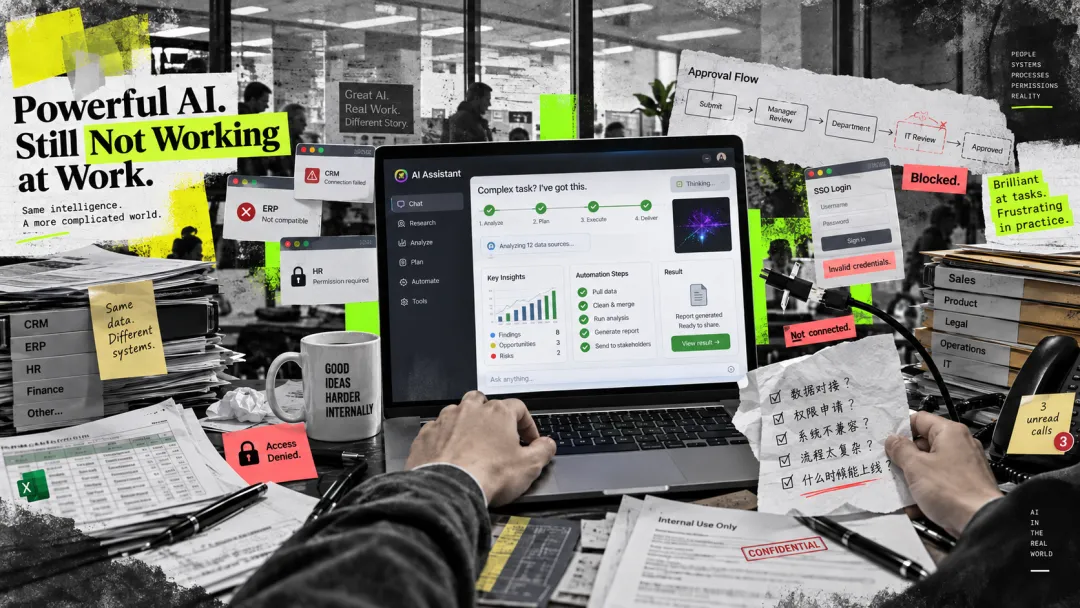
The answer may lie not in the model itself, but in the inherent "disease" of the enterprise: data is abundant but dispersed across different systems and business lines; AI applications can solve single-point tasks but cannot connect the entire process; old systems are costly; enterprises also have to consider real constraints such as security, compliance...
Ultimately, it points to the same conclusion: the core contradiction of enterprise AI is shifting from "is there AI capability" to "is there AI that can't be low-cost, low-risk, and efficiently embedded into existing business flows?"
And in this transformation, a long-underestimated entrance is emerging: "communication".
The reason for this is that many businesses operate around "communication", but the needs, feedback and experience in the phone are often left in the online interaction after the end of the call, making it difficult to get into the business flow and difficult to understand and replicate by AI.
As a result, the more realistic path forward than pushing enterprises to rebuild their systems on a large scale is to introduce lightweight AI capabilities that can be quickly integrated into existing business systems, allowing intelligence to gradually penetrate the real business landscape.
Based on this ruling, China United has launched a workflow intelligent system called the Connected Cloud Rhinestone. It cuts through the communication scenes that have taken place in enterprises every day, transforming the communication messages that were difficult to use in the past into data that can be understood and used by AI, allowing AI to truly enter business processes.
The reality of the three industry scenarios: "Communications data is sleeping".
To understand why communication is an important gateway to enterprise AI, we need to get back to the real world.
In industries such as logistics, financial insurance, and automotive sales, telephony is an important way for businesses to connect with customers, and a large number of critical business decisions are made in one communication.
The first is the courier industry: you can see the trajectory but you can't see the cause of the problem.
In fact, the real estate industry has completed a large number of digitized construction, GPS positioning, electronic faces, intelligent sorting, and other capabilities that allow companies to take control of packaging status in real time. However, there are still core pain points in actual operations: the reasons for site failure to harvest are unknown, and delivery success rate fluctuations cannot be traced.
The reason for this is that the courier makes a large number of calls to the customer every day, and the communication details are lost after the disconnection. When abnormalities occur, managers can only see abstract results, which can neither identify the on-the-spot syndrome nor guide the operation in detail. Therefore, what companies really need is to analyze calls through large models, locate the root causes of problems, and help optimize operations.
A similar dilemma exists in the financial insurance industry: the transformation dilemma of the so-called "blind play".
The financial insurance industry generates a lot of phone calls every day, but there is still an efficiency bottleneck in the middle, from reaching customers, understanding needs, and completing transformations.
The data shows that in the relevant cases, the average number of calls per person per day is more than 120, but the effective conversion rate is less than 5%. A large amount of time is spent on dial-up and mechanical repetition. The response strategies of sales crowning cannot be organized, and high-value communication data such as the budgets and preferences expressed by customers in the calls are lost with the end of the call, resulting in training of newcomers for several weeks, and the achievement of single efficiency is difficult.
Car sales are also a typical scenario: personal experience cannot be transformed into organizational ability.
Automotive sales rely heavily on communication judgments, and sales advisors need to quickly judge customer budgets, bid attention and purchase intentions, and adjust bidding strategies accordingly, and these capabilities often come from long-term experience. But experience is difficult to replicate, newcomer growth cycles are long. While AI tools on the market often require additional manual operation or retransmission, it is easy to disrupt the original rhythm of communication, and it is difficult to transform personal experience into organizational ability in the first place of sales.
Overall, the three industries, the three scenarios, all point to the same problem: communication data continues to be generated, but does not enter the business cycle; AI has the capacity to understand, but lacks the entrance to connecting business movements; employees have accumulated experience, but it is difficult to absorb organizational assets.
But solving these problems doesn't mean rebuilding a whole new digital system that, after years of digitization, companies have formed complex systems and business processes that change the cost and cycle length on a massive scale.
Therefore, the "last mile" of enterprise AI requires a more lightweight approach: how to make AI understand communication data and naturally integrate it into the next step of business decision-making without changing the original way of doing business.
Redefining standards: Lightweight AI platforms must go through at least these five stages
Since the problem lies in system cracks, data islands and disconnected processes, the solution should not just be to add more isolated AI tools, but a smart platform that can integrate with existing workflows.
In terms of connectivity, a set of lightweight AI platforms that truly enter the enterprise landscape needs to go through five core thresholds:
Data integration capabilities: Connected enterprises already have systems and communications data that provide a complete context for AI to understand business without having to push and rebuild like a "turbine";
Intelligent computing capabilities: understanding unstructured data such as voice, text, and more through large models, converting communication content into business insights, transforming dormant communication data from "noise" into analyzable business "signals";
Content generation capabilities: Generate labels, recommendations, reports and action guidelines based on business scenarios, allowing AI to move from understanding to supporting decision-making;
Scenario embedding: low-cost, non-re-development-targeted, with underlying communications as a natural gateway, embedding "senseless" AI into existing workflows without changing employee operating habits;
Security control capabilities: meeting the requirements of enterprises for data security, compliance and scale deployment.
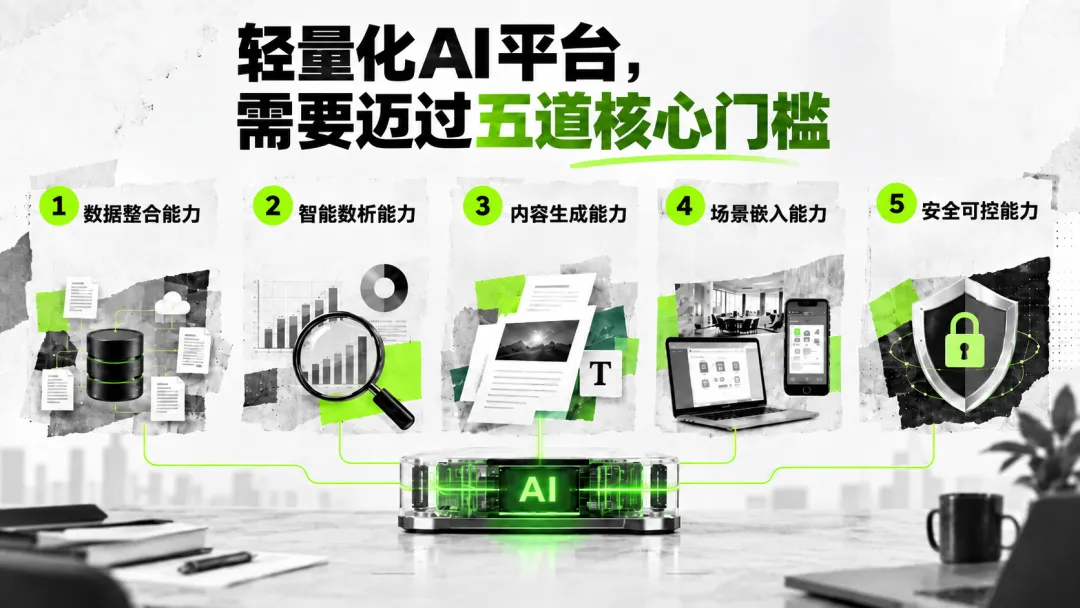
In line with its system architecture design, it uses communication capabilities as a gateway, data capabilities as a hub, scenographic applications as a carrier, connects offline marketing and service processes, and further connects data services and business systems.
In other words, it's not about "making calls sound clearer", but about further exploring the business value behind them and making each call "more useful to businesses".
Currently, there are three main types of AI applications focused on:
AI Analysis: Helping businesses analyze communication data that has been difficult to use in the past.
Using large models to analyze communication data, extract information such as user needs, service quality, business trends, and help businesses identify business growth points from bulk communication.
AI subsidy: Helping salespeople to increase turnover.
Through real-time voice transcription, knowledge recommendation, and customer tag recognition, sales experience can be synthesized and copied, and supporting follow-up marketing.
AI Assistant: Helping enterprise employees reduce the cost of organizing information.
To provide calls, summaries, and live recordings to enterprise employees, three types of audio smart transcripts of minutes and pending events, a key sequential event generation, the creation of a personal knowledge base, and a comprehensive improvement in the efficiency of enterprise employees.
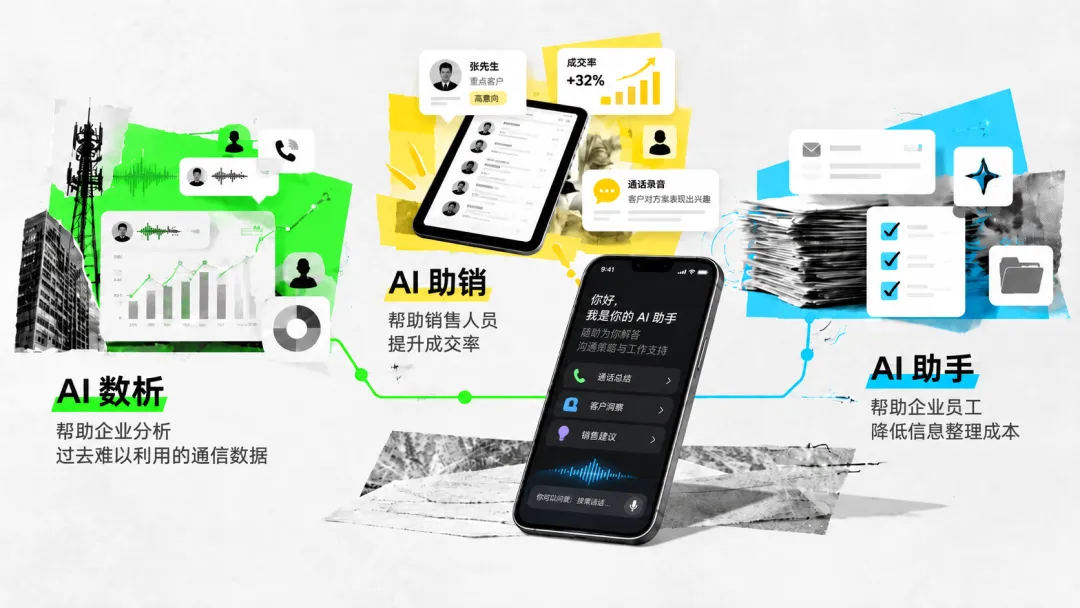
As you can see, from architectural standards to product matrices, the core question that connectivity rhinos explores has always been how to get communication data into enterprise business processes.
Whether this set of lightweight logics can actually generate value needs to be verified back in real business. Below, two real cases show how the lightweight thinking of Unified Cloud Rhinos landed.
Location verification, when "call" becomes the starting point of the data
The first is the courier industry, which translates from "results analysis" to "causal positioning".
Focusing on the core pain points of the courier industry, Linkedin's Cloud Rhinestone platform helps businesses further understand the business landscape by gathering communication between couriers and customers.
By performing semantic analysis of large models, companies can identify the reasons behind the failure of the collection, the key factors affecting the success rate of delivery, customer feedback-centric service issues, etc., and send the results to site administrators in real time, so that the information that has been hidden in phones has become an important basis for operational optimization.
The data shows that after some of the leading messaging brands adopted the "AI analysis" program of Unilever, the number of complaints received in the assignment class decreased significantly and the response time for abnormal items decreased from hourly to minute-to-minute.
In the financial insurance industry, from "blindshot" to "accurate touch" is achieved.
For issues such as low echo efficiency, slow growth of newcomers, customer intent to judge by experience, Connected Cloud Rhinos provides assistance around the three links before, during and after echoes:
Before the call: quick review of historical communication records, give communication advice and opening remarks, analyze customer value;
Outside calls: AI recommends speech nodes in real time, according to customer response dynamic adjustment strategies;
After the call: Automatically generate the "Customer Intent Tag".
Data shows that a team's conversion rate per person increased by 2.3 times, and the training cycle for newcomers was shortened from 2 weeks to 3 days. More importantly, sales people did not change the original way of working, and AI was providing assistance in the original process.
The two examples show that the key to establishing AI in an enterprise is not to add a new tool, but to find a place where AI can actually play a role in existing business processes.
Corporate AI is really getting into the deep water, and the spelling is "the last mile".
If we extend the horizon from specific industry cases to the long-term evolution of digital business as a whole, the technological upgrades of Chinese enterprises are undergoing a fundamental paradigm shift.
In the past, the central thesis of enterprise digitization was "does business enter the system", while in the rapid development of the big model, the thesis of enterprise AI has evolved into "can AI enter business seamlessly".
Continuing to improve modeling skills is of course important, and larger models, stronger reasoning skills, will undoubtedly drive AI forward. But for businesses, the more critical question is whether AI really reduces repetitive labor, whether it helps employees improve efficiency, whether it makes experiences reproducible, or whether it makes management more accurate...
Connecting communication data, AI and business processes is the direction in which we are exploring to make AI part of the enterprise's workflow from an independent tool.
In the past, telephony was the end of communication. Now, telephony is the beginning of data.
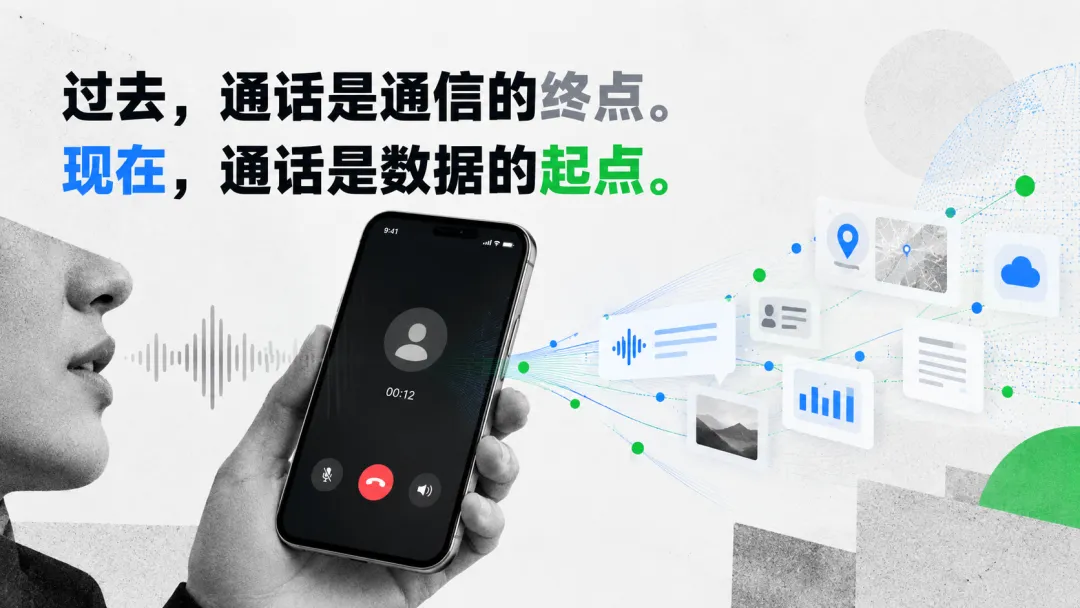
When each call is interpreted and analyzed correctly and becomes an important basis for driving business decisions, communication is no longer just a means of connecting, but an important gateway to enterprise intelligence.
Data shows that over the course of five years of systematic technological refinement, over 60,000 enterprises and 8 million users of services have been connected to the cloud. This practice undoubtedly indicates that, instead of relying on large-scale system restructuring, the lightweight introduction of AI into the real business landscape is becoming an important path for enterprises to choose to increase value using large models.
In the era of AI, Unilever wants to redefine what it means to call...