In the age of AI, is computer science losing its meaning?
Recently, a computer science Ph.D. student from the University of Texas at Austin (UT Austin) raised a disturbing question:
If the academic world of computer science is dead, where can an AI doctor like me go from here?
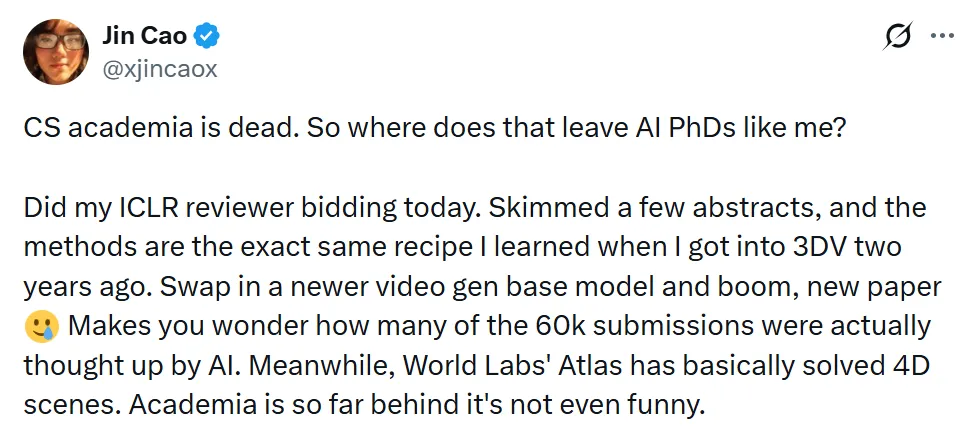
While participating in the ICLR review, he quickly browsed through some of the paper's abstracts, discovering many of the same approaches he had learned when he first entered the field of 3DV3D Vision two years earlier.
Instead of an updated video generating a baseline model with a similar set of methods, a new paper comes out.
It's questionable how many of those 60,000 ICLR posts were actually made up.
This is not the case with anxiety.
When the big model starts to get into the role of the researcher
In the past, many AI studies have revolved around a clear path: designing new model structures for specific problems, introducing new inductive bias, and then continuously optimizing on benchmarks.
But the basic model is changing this process. More and more cases indicate that the general model is beginning to enter areas that have been considered to require specialized design in the past.
For example, Atlas at World Labs demonstrates a powerful 4D scenario understanding and generation capability; and a new generation of large models, combined with 3D tools and robotic systems, also began to demonstrate surprising spatial reasoning and operational capabilities.
Cao Jin recalled a scene after the release of GPT-6 Astra: his flow of information was filled with GPT + Bl