Do language models and the human brain use similar methods of reasoning?
From the point of view of neuroscience, language is not the same as thinking. An opinion article in Nature in 2024, which summarizes evidence in neuroscience and related fields, suggests that the core brain networks that support language processing and systems that support complex thinking, such as reasoning, can be separated from each other: when language skills are impaired, some of the complex thinking capabilities are retained; and when tasks such as reasoning and planning are completed, the brain relies primarily on neural systems that are different from core language networks.
This view makes the cognitive capacity of large language models more worthy of exploration. Although language models are trained primarily through language data and the goal of predicting the next word, they have been able to complete tasks beyond traditional language processing paradigms such as reasoning, planning and tool use. Is this merely the use of the statistical laws of training content, or does the model learn the internal expression of a part of the brain's potential cognitive abilities as a carrier in language?
Both NeuroAI studies have found that there is a certain correlation between the internal expression of language models and the activities of the human brain's language networks,[2] and that multimodality models can also form structures similar to parts of the conceptual expression of human objects.[3] However, there is still a lack of systemic evidence for the relationship between language models and human expression for higher-level cognitive tasks such as logical reasoning that go beyond language processing itself. Furthermore, whether this correlation is functional even if the model is aligned with the existence of the human brain, i.e. whether human brain signals can in turn be used to guide models for robotic reasoning, remains an open question.
Recently, researchers from Peking University, Tsinghua University, and Microsoft's Asia Research Institute published a study in Nature Machine Intelligence that systematically explored the problem of rational reasoning. The study found that the internal expression of language models is partly correlated with the task mode fMRI activity of brain regions associated with brain reasoning; more importantly, it could be further used in the direction induced by brain signals to infer intervention model expression in the inference phase or to fine-tune model parameters in the training phase, thereby converting the model to a symmetrical coordinate between the model and the human brain into a neural pathway that can improve rational reasoning. The study thus advanced the relationship between language models and the brain from related expression analysis to functional neural guidance, and provided a new research pathway for the development of artificial intelligence.
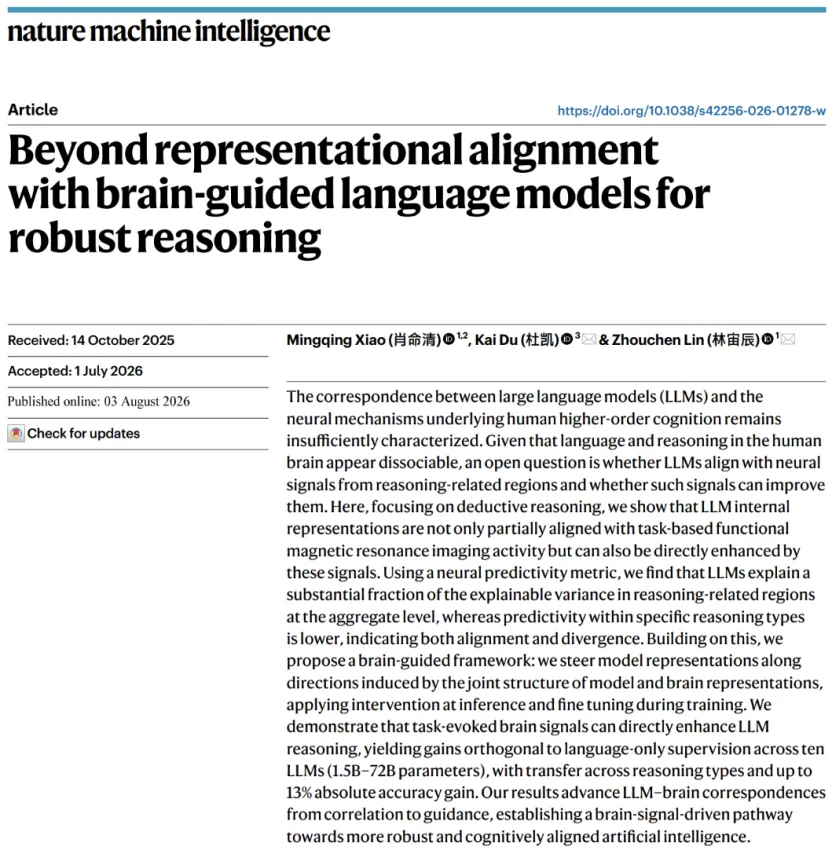
Beyond representational alignment with brain-guided language models for robust reasoning
The author of the paper: Shō Damanqing, Dukey, Lin Zhejiang
The following is a pre-print link:
The code link:https://github.com/pkuxmq/Brain-guided_LLM
This is the first time I've heard of this.
Background: AI is aligned with the brain
Artificial intelligence models can perform the same tasks as the human brain at the behavioural level, but similar behavioural performance does not imply that the two have similar internal mechanisms. The representation focuses on the correspondence at the internal representation level: under the same stimulus or task conditions, the model is extracted separately from the hidden state and neuronal activity of the human brain, and the structure formed by the two types of representations is compared to be consistent.
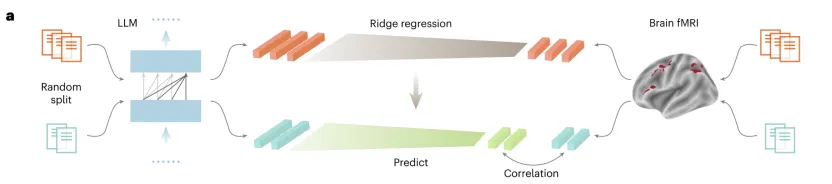
Figure 1: Neural predictive computing diagram
A common method is to use model expressions to predict brain activity and to measure the correlations between the predicted results and actual neural responses, an indicator commonly referred to as neural predictivity or brain score.[4] This method first learns on partial stimuli from model expressions to linear mappings of neural expressions and then predicts the brain activity induced by new stimuli that are not involved in the matching. Given that fMRI measurements contain noise, the results are usually categorized based on the explanatory limits of neural data.
Some of the expressions in deductive reasoning are aligned
The study used open mission mode fMRI data, where participants completed three-phase reasoning and two-phase reasoning and judged whether conclusions could be made on premise. To reduce semantic interference, the problem consisted mainly of pseudonyms, fictitious names, and controlled attributes. The study allowed 10 open source models from a series of Qwen, Llama, Mistral, Phi, and Gemma to process the same stimuli, with model parameters ranging from 1.5B to 72B, and extracted the activation characteristics within the model.
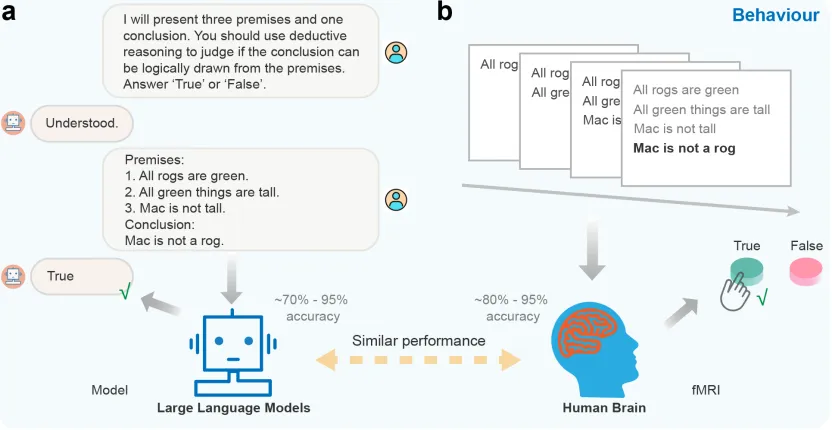
Figure 2: Demonstrate the rational design of the task
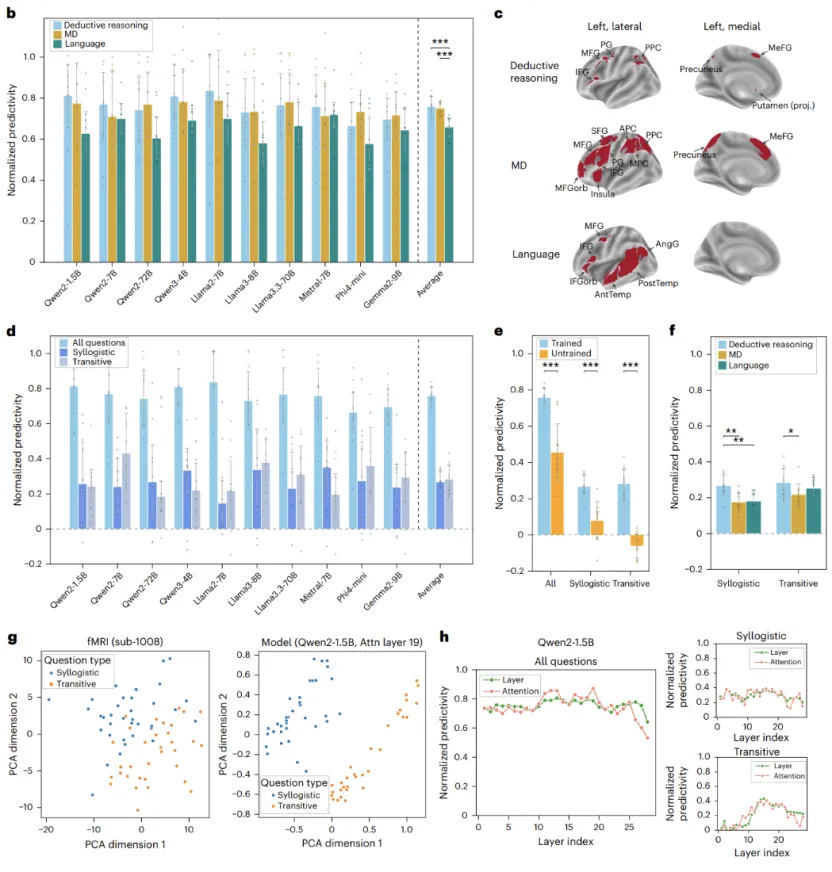
Figure 3: Neural predictive outcomes
The study calculated the neural predictability of the model representation with the brain's deductive brain regions, multiple-demand networks, and core language networks, respectively. The results showed that when considering the overall reasoning task, the model representation can explain on average about 76% of the explanatory differences between the relevant brain regions, and that there is a regional peculiarity: the neural predictability of the deductive brain regions and multiple-demand networks is significantly higher than that of the core language networks.
On the other hand, when analysing the two types of reasoning problems, respectively, the neural predictability significantly decreased to about 27%, indicating that, at a more subtle level, the differences between the model and the human brain are still present. Even so, the neural predictability of the model remains significantly higher than that of the untrained model and maintains regional specificity.
Overall, the results show a partial alignment of the model with the human brain: the model captures a structure that shares some of the reasoning activity with the human brain, with specific brain regions, but there are still significant differences within specific types of reasoning.
From relevance to neural guidance
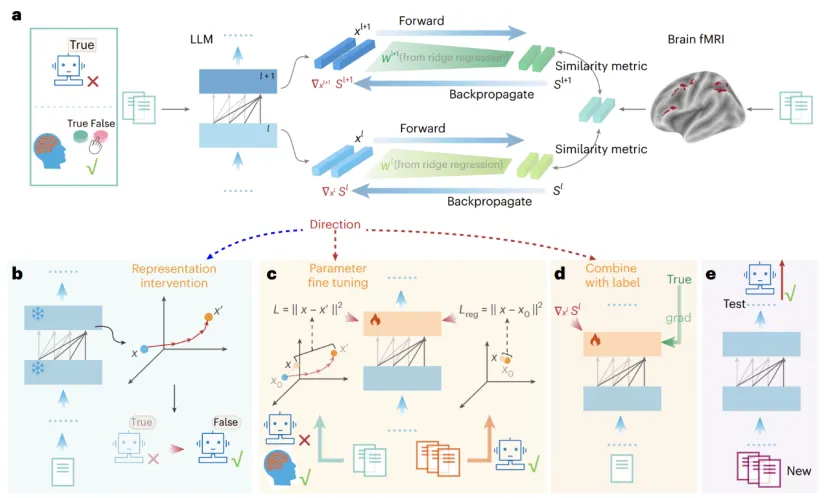
Figure 4: A diagram of the neural pathway
Based on the partial alignment of the mapping space, the research further proposes a neural guidance method based on brain signals. Specifically, the method first learns the linear mapping of the model's hiding state to the fMRI space, then answers the wrong questions to the model while humans correctly answer the correct questions, calculates the similarity indicators between the mapped model representation and the actual brain activity, and scales the indicator to the model's hiding state, thus getting the neural guidance direction in the model's hiding space. This direction is determined by the combined structure of the model representation and brain representation.
There are two uses for this direction: neuronal activity-guided expression intervention (NARI), direct modification of the internal expression of the neuronal activity-guided expression in the model inference process, without updating the parameters; and neuronal activity-guided expression mitigation (NARF), which internalizes knowledge of the expression direction into the model parameters through mitigation training.
NARI: Indication of intervention at the inference stage
NARI responded incorrectly to the original model, and accordingly the human participants responded correctly to the question of imposing constrained neural guidance on the attention output of the middle layer of the model. For the original error problem of incorporating the analysis, NARI ultimately achieved 100% corrective error coverage, significantly better than the random brain signal baseline and the random direction baseline that only retains the model's representation structure. This indicates that brain signal guidance can provide effective model activation guidance.
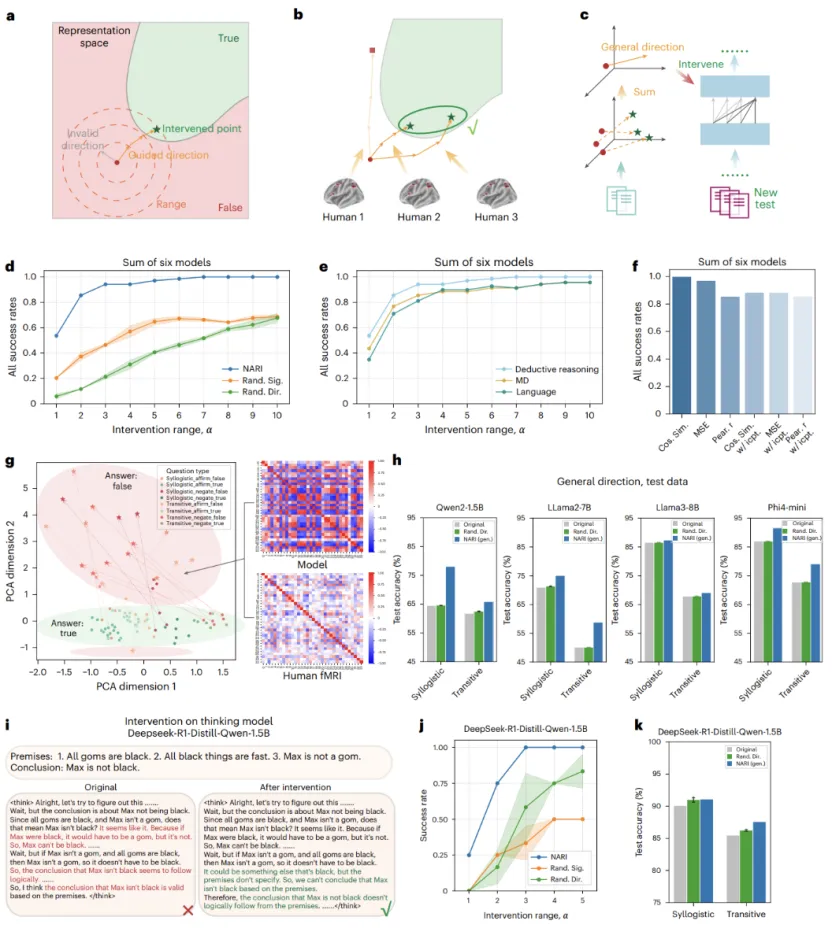
Figure 5: Results of brain-guided inference interventions
Furthermore, the method combines multiple problems and the successful intervention directions produced by the participants, which can be migrated to the general direction of the new problem. This direction improves test performance on new reasoning problems in multiple models, and can be extended to some extent to the model reasoning process with a mind-chain. This shows that the direction of brain guidance contains more general information related to reasoning that can guide the internal expression of the model.
NARF: Internalising neural pathways into model parameters.
NARF uses parameters to fine-tune the middle expression of the model closer to the target of brain-guided signals, thereby internalizing the knowledge of the expression level into the parameters to enhance the robustness of model reasoning. Studies have shown that language models still have robust generalization problems for even relatively simple reasoning problems [5, 6], such as the presentation sequence of premises that significantly affect model performance [6].
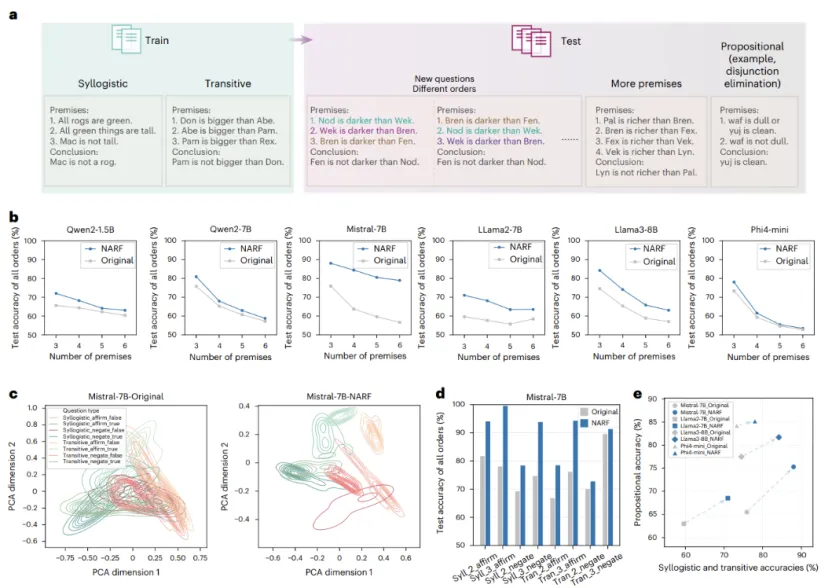
Figure 6: The results of parametric modulation of brain signals
The results showed that the modular model gained steady improvement under different number of premises and sequences, and the separation of right and wrong logical problems in the middle layer was also clearer. The performance gains could also be transferred to hypothesis reasoning, which demonstrates that the model learned is not specific problem representation, but has a certain cross-problem and cross-reasoning type generalization representation knowledge.
Neural guidance and language supervision complement.
Furthermore, the study reveals that the increased benefits of neural guidance are complementary to regular language level supervision. For this reason, the study combines two types of supervision: language supervision through the cross-sectional loss of the final output vocabulary, which directly binds the model to give the correct answer; and NARF, which simultaneously promotes changes in the direction of the middle expression towards neural activity closer to the human brain task.
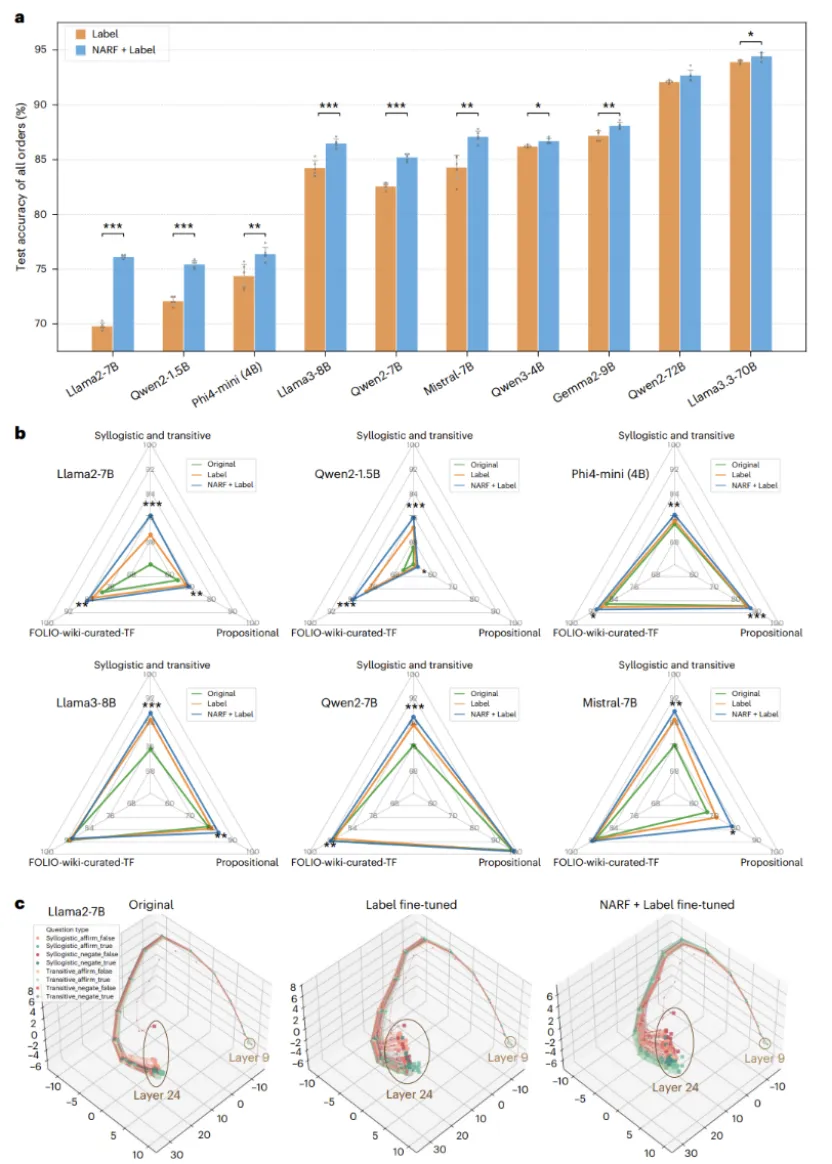
Figure 7: The results of a combination of parametric modulation of brain signals guided and language supervision
The results showed that the accuracy of the model improved by up to 13.2 percentage points compared to the consistent use of language monitoring alone (an average of about 2.2 percentage points), and that the improvement could be generalized to propositional reasoning with different logical structures and natural language first-order logic reasoning, up to a maximum of 13.2 percentage points. At the same time, the study also tested the setup of synthetic training data for language monitoring training, and the results showed that neural guidance still had additional advantages. Level trajectory analysis of the model's internal expression showed that neural guidance can form more distinctive inference trajectories between the expression of correct and incorrect logical problems compared to the use of language monitoring alone.
The study also extended this framework to the Human Connectome Project's relationship-processing tasks, showing that mission mode brain activity can also induce effective signaling intervention directions, and that neural guidance can also bring consistent gains based on language supervision, suggesting that the framework is not limited to a single iterative reasoning dataset.
Summary
Not only did the study reveal a partial alignment of language models with the internal expression of the human brain reasoning process, but it also further advanced the relationship between the two from the similarity of syntactic expression to whether syntactic signals can be used to improve the model. The results showed that the model corresponds to parts of the brain that are associated with brain reasoning and have brain region-specific characteristics. This part of the shared structure can also be transformed into parametric monitoring of the syntactic intervention and training phases of reasoning, and provides additional benefits for regular language monitoring. This provides a pathway to new brain-inspired AI at the internal expression level.
Current experiments are mainly focused on basic reasoning, and the time resolution of fMRI is also difficult to keep track of rapid changes in complex thought processes. In the future, more time-resolved modeling data such as EEG, MEG, and neural data covering more complex cognitive processes may support more fine-grained analysis and guidance.
References
[1] Fedorenko, E., Piantadosi, S. T. & Gibson, E. A. F. Language is primarily a tool for communication rather than thought. Nature, 2024.
[2] Schrimpf, M. et al. The neural architecture of language: integrative modeling converges on predictive processing. PNAS, 2021.
[3] Du, C. et al. Human-like object concept representations emerge naturally in multimodal large language models. Nature Machine Intelligence, 2025.
[4] Schrimpf, M. et al. Brain-Score: which artificial neural network for object recognition is most brain-like? bioRxiv, 2018.
[5] Malek, A. et al. Frontier LLMs still struggle with simple reasoning tasks. arXiv preprint arXiv:2507.07313.
[6] Chen, X. et al. Premise order matters in reasoning with large language models. ICML, 2024.