
It's the first time in the history of the world.
You let the AI Agent migrate a code library overnight.
The next morning, when I opened the terminal, I couldn't wait to see the message:
Three interface migrations have been completed, and I will then process the remaining two endpoints and add testing.
Then there's no context. If you want it to do the rest of the way, you have to hit two more words: continue.
I thought it was going to dry up, so it just gave you the "Next Step" cake, and the program went to work for it.
It's not a reversal of someone's experience.
When Opus 5.5 was released, the developers of running Agent discovered that the model's capabilities are strong enough to stop when you do it, and you don't force it to move.
Anthropic itself has also seen that within days of its release, an accompanying word-of-mouth guide has been posted specifically for this type of problem.
The official name of this "halfway slipper" is directly given in the opening list of evictions:
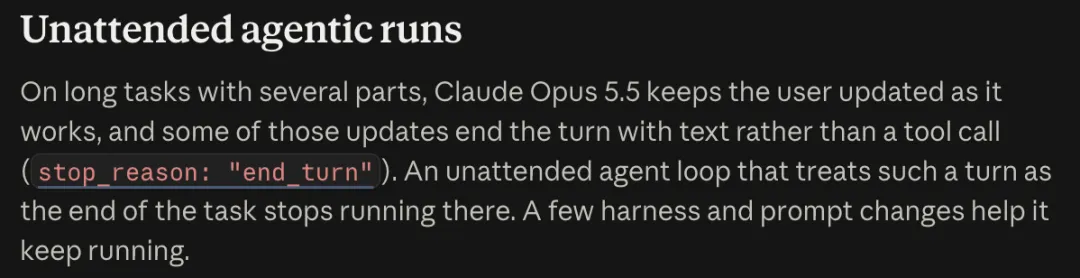
The unobserved agent reported progress and stopped halfway.
The reason behind this, you may not think about it: Opus 5.5 is so well-reported.
The problem is that when some reports are sent, it no longer moves, and the API gives the signal end_turn, which means "this round I'm done".
However, according to the old logic of Agent programs, there is only one rule of thumb: the model no longer calls the tool even when it is live.
A progress report is thus considered a crossover.
In this regard, the official guidelines are clear:
The end of the cycle of pure text should be seen as a report and should not be seen as a certificate of completion of the task.
So, the real problem is that the AI doesn't want to steal it, it's your program that's playing the next card for it.
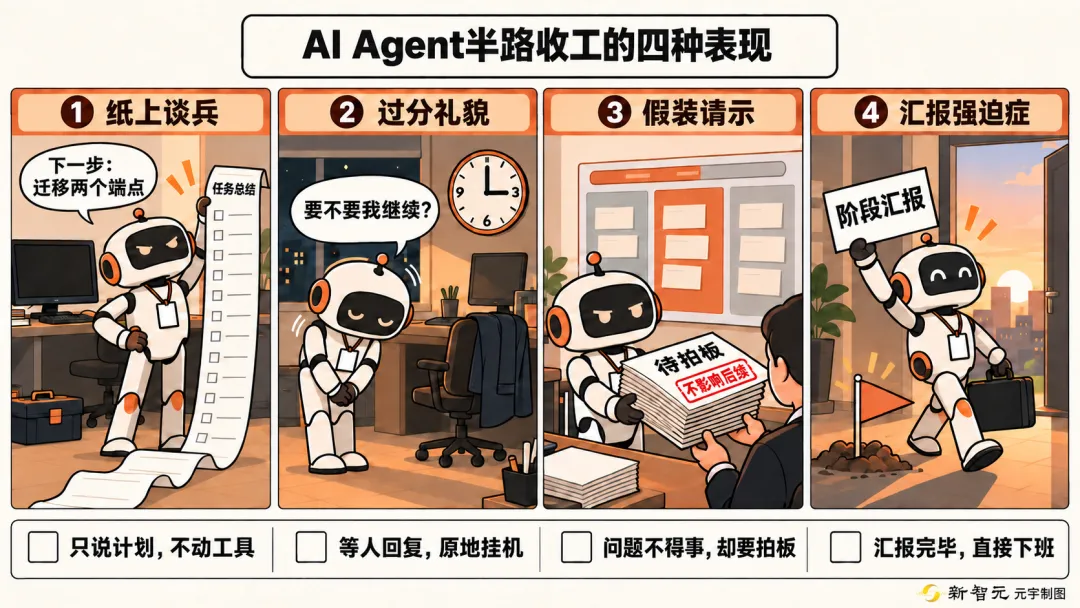
What is the harmful quality of life?Officials have summed up the halfway stop in four situations, and as long as you run Agent regularly, chances are you've met them.
The first is talking about soldiers on paper.
He wrote a long summary, finally announcing what to do next, but without using any tools, the next step is forever in his mouth.
The second is excessive politeness.
You stop and say, "If you don't mind, I'll go ahead and do something about it", and then you hang up and wait for the person who's not even in front of the computer to respond.
And third, pretend to show.
It lists a series of decisions that you need to tap into, but in reality, according to its own words, these decisions do not affect it at all for the rest of its life.
Fourth, compulsory reporting.
The model feels that the current round of words is large enough, or that it has just completed a small phase, so it doesn't have to stop and give you a summary.
Ironically, in Opus 5.5's official advertisement, "communication is more active, summarizing more clearly" is precisely its core selling point.
Who could have imagined that these good habits of the upper class, once put into the old unobserved process, would instead become an inducement to stop working?
How can we keep it dry and not fall into an endless cycle of death?
Officials gave three tricks.
The first is the task list.
Remove the details of a large task, give it tools or text to maintain, and make a side drawing on the model.
At the end of the iteration, if there are still unfinished tasks on the list, and the model doesn't explain what's stuck, your application automatically sends a message and names it so that it can continue to work.

The official follow-up example: "Your task list still has unfinished items: migrate the remaining two endpoints and update their tests. Continue to do it. If any are stuck, indicate where the card is".
The second trick is the Iron Face Receiver.
Pre-defined standards. At the end of each round, the mother gives a smaller model a control check.
The third trick is the hard drive.
If the same task is automatically repeated two or three times, it must be forced to stop and hand over a check.
In addition, the suggestion must be followed.
Officials gave a system prompter that could be copied directly, saying that there were two blocks:
It is also important to make it clear that you absolutely do not want these four shutdowns, but also to make it clear when to shut down, such as when you can't really move away from a user or touch a core resource that is intentionally protected.
Why did the old code suddenly report 400 errors?If half of the shutdown was to just grind the work, then the following migration traps are directly causing the process to collapse.
There are many changes in the API from Opus 5 to Opus 5.5. The original request for Opus 5 to be sent to the new model will be rejected directly, returning 400 errors.
1.Thinking parameters can no longer be closed.
If you disabled thinking, or manually specified budget_tokens, the system will reject the request directly. Either don't pass on the thinking field, or set it to adaptive, allowing the effort parameter to control the depth of thought.
2.tool_choice can no longer force tools to be called.
Tool_choice is set to any or specify a tool and is reported as 400. The official recommendation is to use auto, with strict tool calls or structured outputs, and to specify when and which tool to use in the prompts.
3.Thinking blocks bind the model to the context.
Accounts created after August 31, 2026 that modify system prompts, tools, or historical messages in the meantime, and return old thinking blocks, will default to direct error. Only additional, unmodified uses are unaffected.
4. Old versions of computer operating tools offline.
In the Claude API and Google Cloud, the computer_toolset_20260801 can be replaced. On Amazon Bedrock, the old computer_20251124 can also be used.
There's also the black holes that don't make mistakes.
The first is that there is no functioning process.
In Opus 5, the progressive text written by the model between two tool calls is a plain text block.
In Opus 5.5, the text is moved to the thinking block (thinking block), whereas the thinking block by default does not display the content (display is omitted) and is empty when returned.
If your interface only shows correct text, running long tasks is a quiet one. None of the requests failed, but the user thought it was dead.
The solution is to set the display as updates (beta) with only progressive summaries; or set as summarized, progressive and reasoned summaries back together.
Second, the answer was cut off.
Max_tokens controls the total amount of thought overwriting. In the past, the upper limit of thought time was turned off, and now it may not be enough to write half the answer off.
The third, unreasonable, also burned token.
Even if you don't get your thoughts back, you'll still be charged for the output tokens.
There are two parts of the code that are easy to forget about.
One is to distinguish the type when reading the results. In the content of the model returns, thinking and writing are separated, and do not assume the first paragraph as the answer.
The second is that when the tool is called back, the thought record of the model must be sent back in the original enclosure. Deleting a paragraph, changing a few words, changing the order, will be rejected.
This list is aimed at developers who use the Messages API to write their own code.
For Claude Managed Agents, all you need to do is change the model name.
The same medium fileIt's not what it used to be.Since thinking can't be turned off, effort becomes the only spindle to control costs.
Opus 5.5 supports five grades from low to max.
Officials say that the medium file can now match or exceed the high file of the previous Opus 5, and the cost is even less if it is a low file to handle simple tasks.
It sounds like a cheap whitewash, but the official immediately added a sentence: under the same rating, Opus 5.5 is much more thought-provoking per round than Opus 5, especially for high ratings.
In other words, if you move the original high-level static of the old project, not only will the cycle change in length, but the number of tokens output will also go crazy.
It's also called high, and what it's thinking is completely different.
One groundbreaking suggestion is: Starting from the medium and running around with your own data, you really need to raise your IQ wherever you go.
If you want to make it less gritty, drop it directly, it's much more manageable than yelling "Don't think too much".
Eliminating the taste of AIIt's all blacklisted.Finally, there is an absolute trick to making a front-end page in the guide.
If you don't give a clear design direction and let the model work itself out, it will most likely come up with a thousand-step AI interface.
At this point, if you write "Please avoid the general sense of AI" in the prompts, it will only change from one AI template to another.
The most effective way is to blacklist directly.
Directly listed in the official demonstration: Do not use cream color or gray-white background, do not emphasize slanted words in the title, do not use chapter number 01/02, do not wait for a wide font label, do not use capsule-shaped buttons.
The front-end example suggestions in Opus 5.5's official guide list five styles to avoid.
Models can understand the specific "I don't want anything" but can't understand the abstract "I'll take a look".
After completing this official guide, the biggest feeling was:
The model is fast-paced, and many applications of the scripts are still in use.
In the past, it was afraid that it would move its mind, forcing it to write down its reasoning step by step, but now it has to be persuaded to think less; in the past, it has worked hard to get it to report on time, but now it is reporting too fast, and it is still halfway there.
One agent can't do the work, and the modeling ability is only half that. The other half is how you define "finished", how you save the context, and how you allocate the budget for reasoning.
The next time your Agent is halfway through, don't hurry to yell at it, turn around and go through the loop you wrote yourself.