Every time important new models are released, our editorial departments usually get to work earlier than the news itself: they open the official website, live broadcasting and social media in advance, and the results follow, and everyone starts to write articles in the heat of the moment, while analyzing parameters, lists and demonstration cases to determine how far this technology has gone.
This set of processes is already quite skilled, and the big model industry seems to have formed a standard aesthetic: more parameters, longer contexts, more complex reasoning, and a list of capabilities that are getting closer and closer to being "all-powerful".
But there's a classic saying in the design world: Less is More. It emphasizes that design should be restrained, where it should be kept, and where it should be abandoned.
It's easy to focus on the limits of our ability, as if the biggest difficulty we face every day is the lack of a colleague in the office who can prove Lyman's guesswork.
In fact, most of the work does not involve the ultimate fate of human civilization. They are simply numerous, repetitive processes, demanding clarity, and a complex set of processes. At this time, what we often need is a tool that responds quickly enough, understands the words, can be used steadily.
On July 24, the latest model, Ling-3.0-flash, released by the Lions Group, follows this idea. It is a long-range workflow-oriented Flash model with total parameters of 124B, activation parameters of 5.1B, highlighting fast response, stable calling tools, and controllable costs for high frequency use. In the context, Ling-3.0-flash supports 256K, can be extended to 1M, and can maintain a higher callback rate under long inputs.
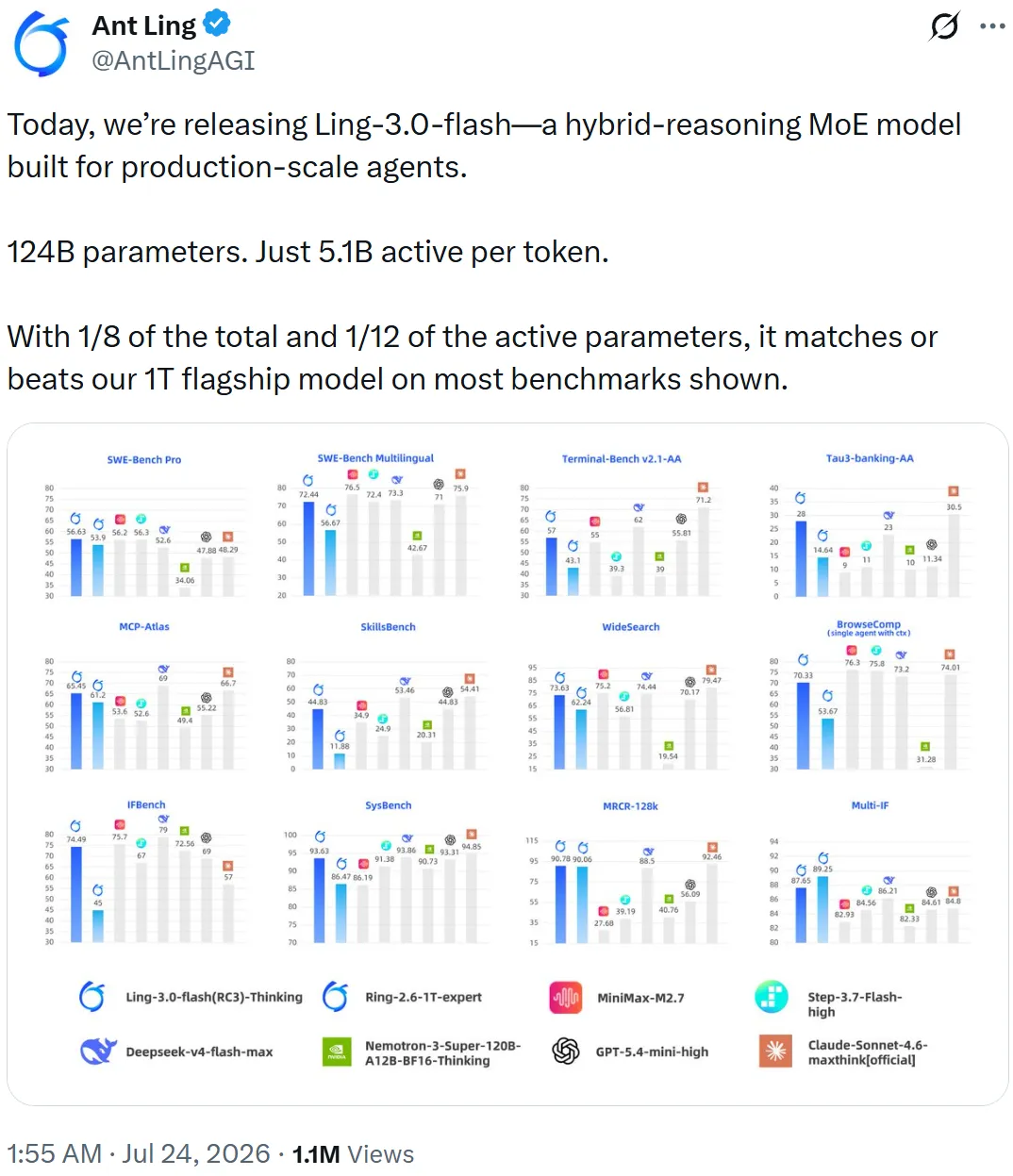
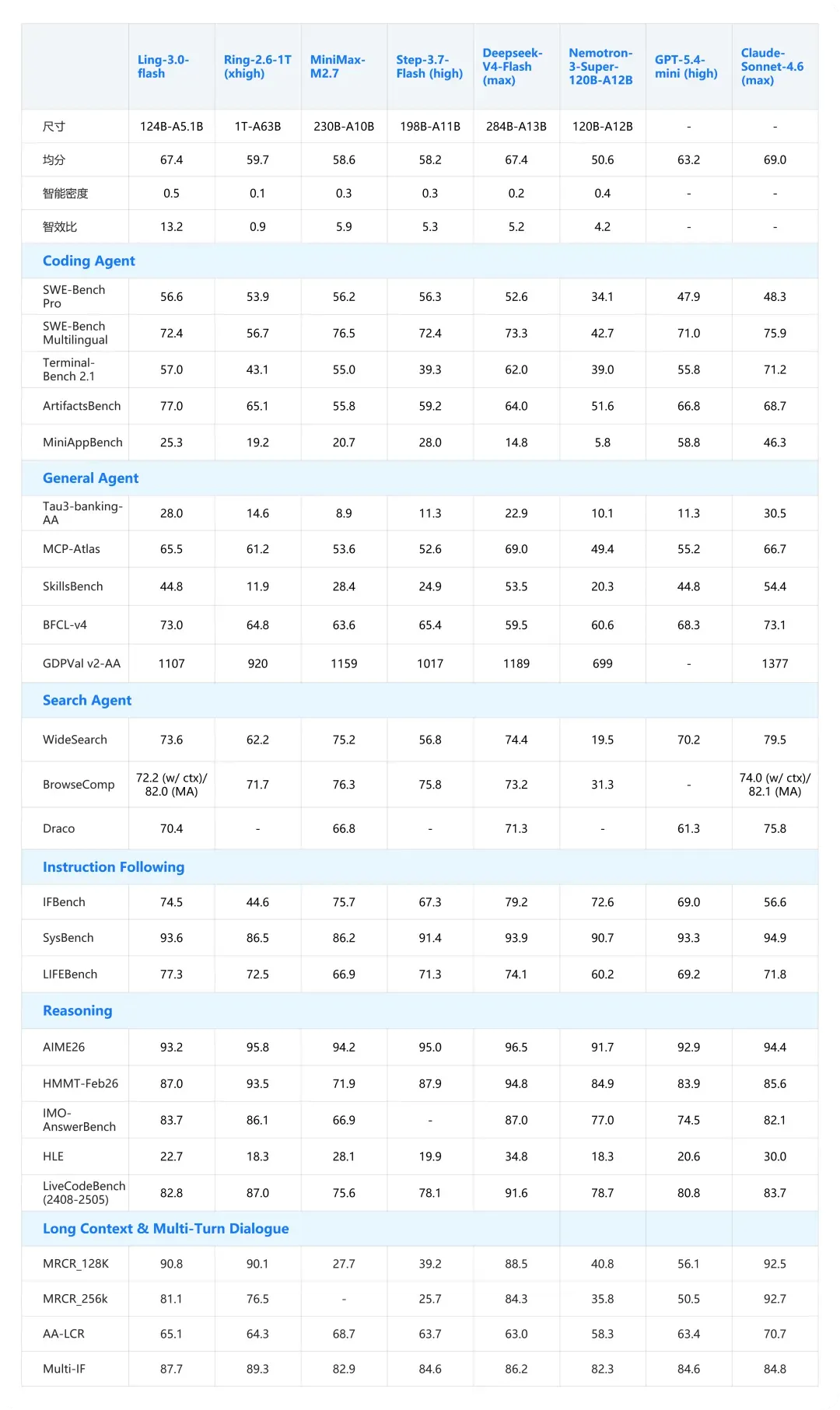
Officially rated as "intelligent and sophisticated", compared to the total parameters of the previous generation of the flagship thinking model Ring-2.6-1T (about 1T, activated about 63B), the Ling-3.0-flash uses only about 1/8 of the total parameters of the flagship, about 1/12 of the activation parameters, to achieve flagship "parameters and even beyond" in most benchmark tests.
Thus, the Ling-3.0-flash is not really a story about "another small model", but a change in thinking: the way models acquire intelligence is no longer simply to pursue a stack of scales, but to turn to the efficient compression of every inch of computing.
This trend is referred to as "intelligent density" ("IQ minus storage costs") and "intelligent efficiency ratio" ("IQ minus computing costs"), while Ling-3.0-flash is very prominent in both indicators.
From a product positioning point of view, Ling-3.0-flash is not trying to replace all-encompassing reasoning models with huge parameters, but rather wants to take on more "executive" work: complex models first search for information, develop programs and dismantle tasks, Ling-3.0-flash calls tools according to programs, modifies code, processes data, and continuously checks and corrects according to the results of operations.
In this way, the part that requires deep thinking can be given to the larger model, while the part that requires repeated execution and trial and error is done by Ling-3.0-flash. While ensuring the effectiveness of the task, it also reduces the wait and cost of calling the super-large model every step of the way.
This positioning is on the cusp of an emerging industry consensus. By 2026, the industry's discussion of Agents has shifted from "can't do tasks independently" to "what should be done by who in an Agent system". That is, a linear Agent system requires not only a big reasoning model that can be thought through, but also a relatively lightweight model that can accomplish basic tasks quickly and efficiently.
One-handed testing
Put "fast" and "stable" into the real workflow.
Currently, Ling-3.0-flash is free API calling at the open time limit (as of August 3rd, 23:00 Beijing time) and we're here to experience it for free and test it with real tasks.
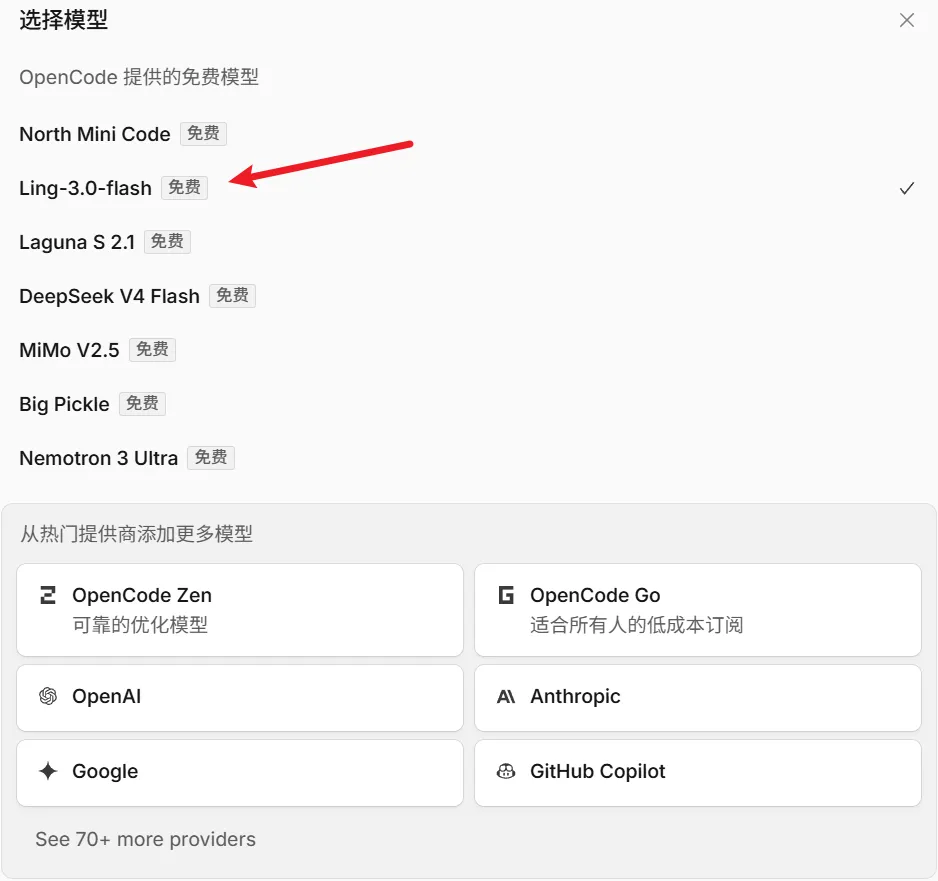
The test tool we chose is OpenCode, and after downloading it, Ling-3.0-flash is already one of the default free options and can be used directly without any additional configuration. Other tools, such as Claude Code, can also be configured automatically after claiming the API key for free on OpenRouter or Burlington's official platform.
The official experience platform:
OpenRouter experience address:
The first task was to build a simulated solar system. The result was somewhat surprising: not only did Ling-3.0-flash correctly draw up the relative relationship between the Sun and the eight major planets, but it also actively distinguished them visually with different colors and planetary rings.
The second task was aesthetically pleasing: we made it a "Less is More" Bauhaus-style "Machine's Heart Selects" website, with absolutely no image material.
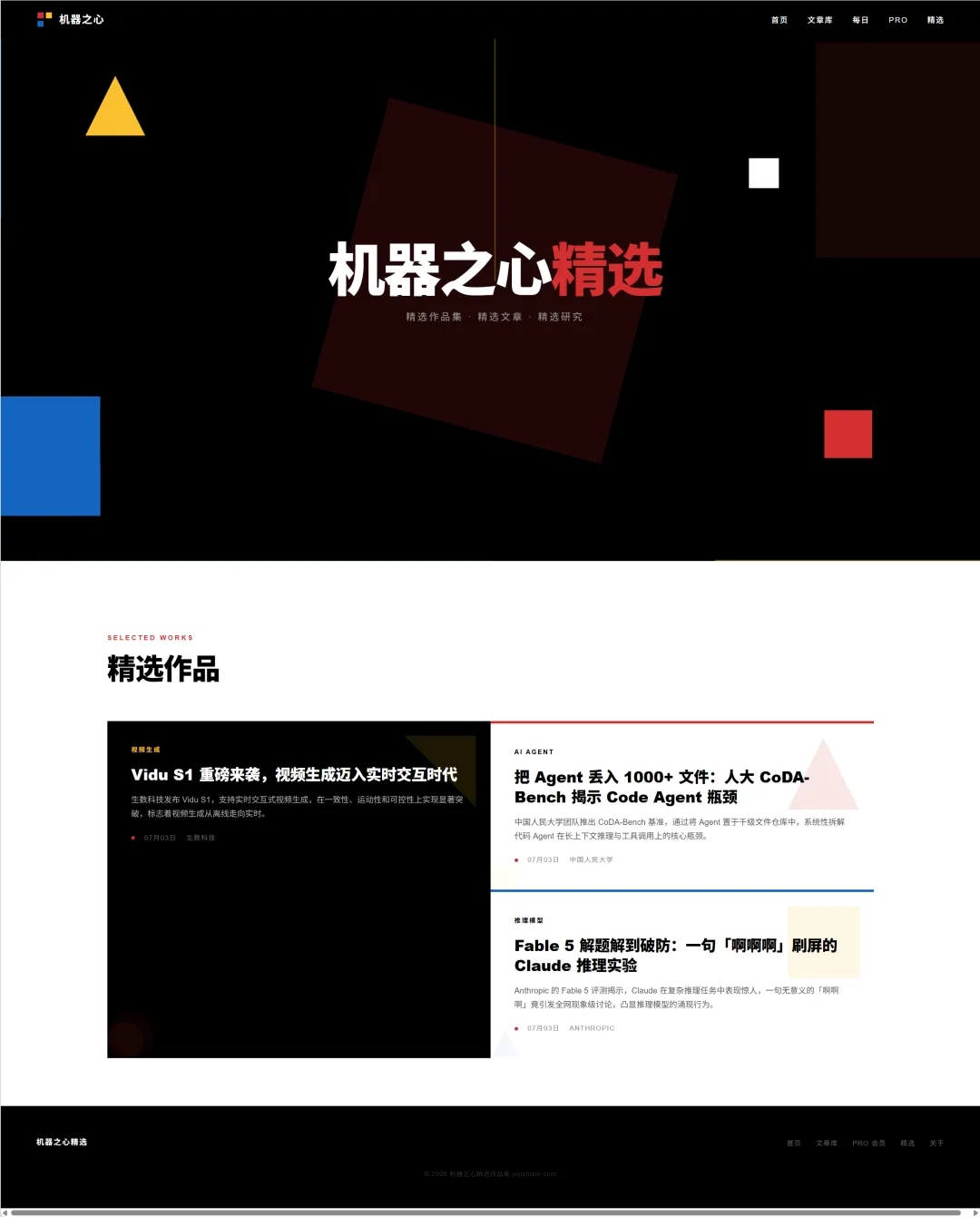
The product quite accurately replicates the graphic aesthetics of pure CSS/SVG in three-color, geometrical construction and non-asymmetric grid languages. This is also a side print of the official demo of the same type.
In addition to the visual display, we were more concerned about whether it could actually be embedded in the production process. So we incorporated it into our own workflow, instructing it to install "Machine Heart Data Skills", which integrates all the industry data from the machine itself.

Soon, Ling-3.0-flash configures these four skills into OpenCode. Once the API key is set up, it can query all the industry data at the heart of the machine in a way that is defined by the skill by asking questions in the dialog box.
For example, we have it retrieve all of the models and technical articles published by Bloomberg in the database, and thus summarize the evolution of Bloomberg's technology.
Based on 24 related articles in the database, the Ling-3.0-flash provides a fairly profitable outline of everything from infrastructure to MoE architectural breakthroughs over the years, to a main line that integrates full-model and intelligent body capabilities, and is clear enough to serve as a quick reference for the team.
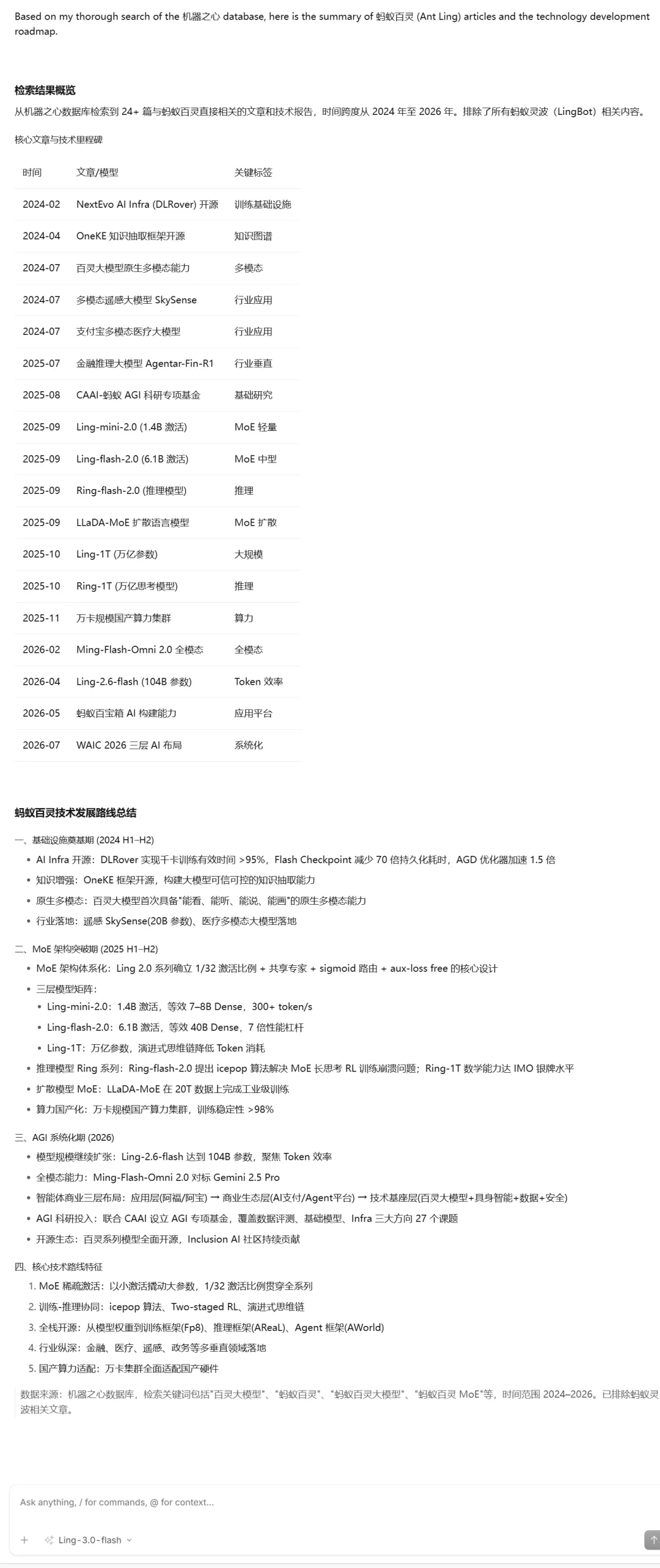 Scroll down and see
This kind of "reading a bunch of structured data, extracting points, organizing texts" is the kind of information gathering and structured output scenarios in which it excels.
Of course, we didn't just pick out what it was good at. We tried to get it to do a more complex project independently: using Vite + TypeScript + Three.js and the cannon-es physics engine to make a 3D physics tabletop sandbox. This time, it didn't run completely.
This result is not surprising, as opposed to the Ling-3.0-flash's own position: it was not designed for an omnipotent architect to "take complex projects from one sentence to the next", but was better suited as a step-by-step execution node after a clear planning of the architecture and path.
Our intuitive sensations and official characteristics are largely consistent: it responds quickly, performs steadily, and has low cost of access to the workflow on tasks with clear boundaries and clear verification signals; and once the task slides open, loose, and requires it to rise from scratch on its own, its shortcut becomes apparent.
This is exactly what an "executive model" should look like: using it in the right place is expensive; using it in the wrong place can be disappointing.
It's the back of an extreme "pressure".
A set of architectures that revolve around efficiency rewriting
The capabilities of Ling-3.0-flash are officially attributed to the common function of two lines: one is the systematic upgrading of the underlying architecture, and the other is Agent-oriented optimization for the productivity scenario.
The former determines "how many capabilities the same parameters can transform" and the latter determines "how these capabilities cannot be delivered steadily in real-world tasks".
Look at the architecture. The native hybrid linear focus is the basis for this upgrade.
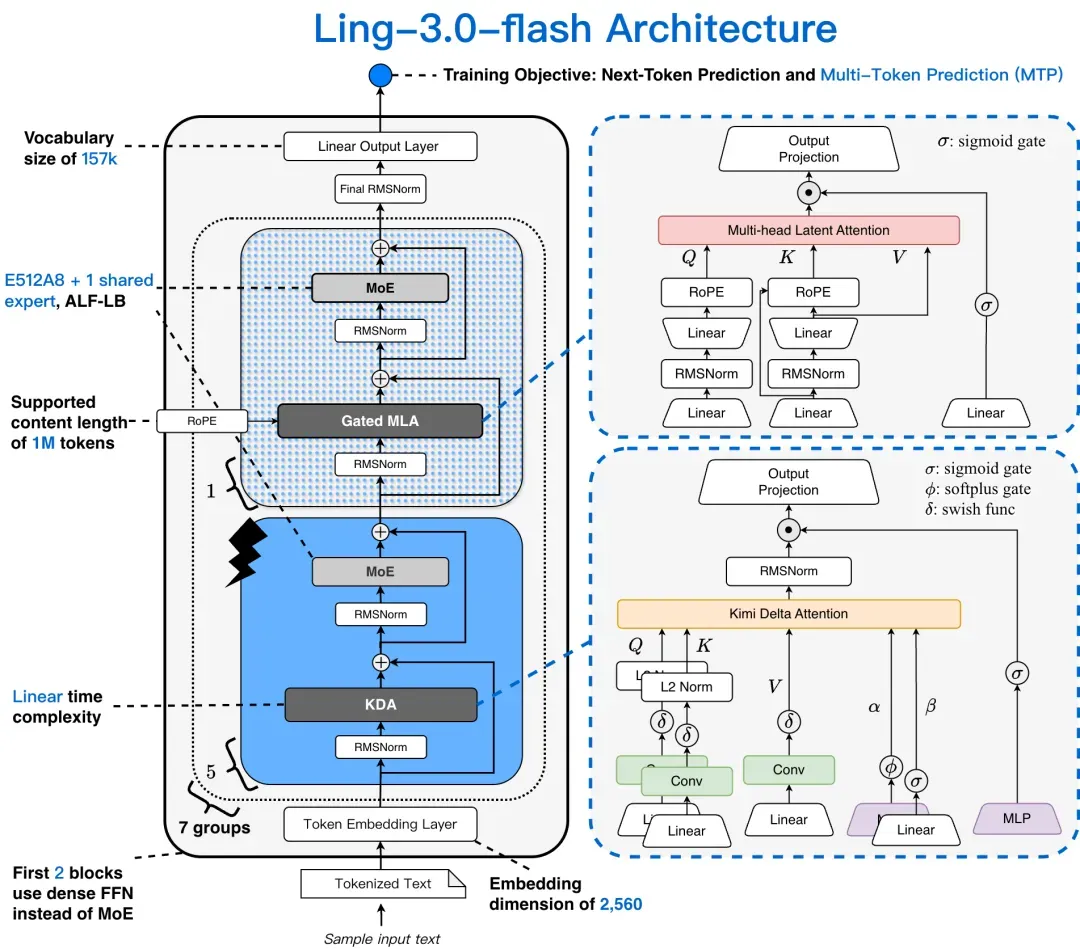
Unlike the previous generation of Ling-2.6, which migrated the architecture before continuing training, Ling-3.0 used a native hybrid linear attention architecture from the pre-training phase to replace the stacked KDA linear attention layer and MLA layer in a 5:1 ratio, i.e. each of the 6 layers contains 5 layers of KDA and 1 layer of MLA. Since the components are optimized together in the same architecture from the beginning of training, the model can accommodate both context processing efficiency and overall capabilities.
Here, KDA (Kimi Delta Attention, Moonshot, Dark Side of the Moon) is a linear attention mechanism proposed by Kimi Linear at the end of 2025, which subsequently became a common reference in the industry to explore efficient attention.
Its idea was to introduce fine-grained anti-corner gate controls in the Delta Rule state update: allowing different feature channels to have their own independent retention, decay and write controls, rather than forgetting to process memory uniquely using a universal spindle.
It is commonly said that when models read long documents, large libraries of code, they are more accurate in maintaining critical information across paragraphs, across steps, rather than mixing new and old information into a bunch.
MoE scarcity is further reduced as a direct source of the "Intelligent Efficiency Ratio". This oriented methodology is based on Efficiency Leverage and Ling Scaling Law, both of which have been previously proposed by Berlin: lower expert activation ratios can be exchanged for higher computational efficiency under the assumption of equal performance.
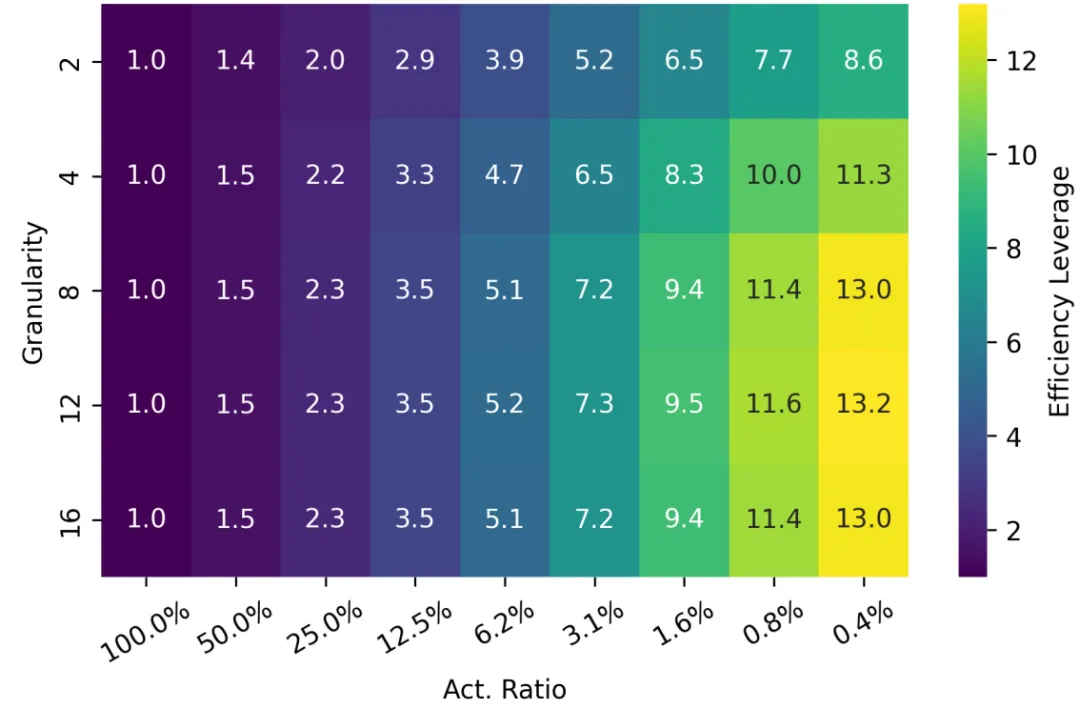
The lower the activation ratio, the higher the efficiency leverage, and the larger the calculation budget. The estimated value below 1e22 FLOPs.
Accordingly, Ling-3.0 further reduces the expert activation ratio for each Token from 1/32 of its predecessor to 1/64; that is, only a small portion of the total parameter of 124B is illuminated each time to achieve the jump with extremely low computational consumption driven model capabilities.
The hybrid linear attention, KDA, and the sparse MoE superimpose the three, forming the architectural underpinnings of the "cross-level challenge" at 124B (activating 5.1B) volume.
However, there are differing views within the industry as to whether the "linear attention + extreme scarcity" pathway can continue to maintain quality on a larger scale. A third-party analysis from Acing AI notes that the "quality alignment" of linear attention mixed architectures on a research scale (billion parameters) does not necessarily move smoothly to the front-end scale, especially in tasks such as long-range multi-contextual reasoning that are underestimated by standard tests.
Of course, Ling-3.0-flash doesn't have to go along a "know-it-all" path, but instead focuses limited resources on Agent and core reasoning. But it also reminds us that the scope of the "small-scale flagship" needs to come down to specific tasks, not speculation.
In addition to the architectural upgrades to the model itself, Ling-3.0-flash is specifically optimized for Agent tasks in real-world production environments, in terms of training, reasoning services, and multi-intelligent collaboration.
According to officials, the team has expanded the interactive training environment of Coding Agent, General Agent and Deep Research Agent to more than 10,000, continuously improving the diversity, quality and difficulty of the environment.
These exercises primarily enhance the model's ability to continuously plan, call tools, handle failed feedback and dynamically adjust execution paths under complex constraints. Officials say that Agent's capabilities have improved significantly compared to the previous generation's flagship Ring-2.6-1T, Ling-3.0-flash, with some indicators reaching the level of larger parameter-scale models.
The MiniAppBench can provide an external reference frame for this benchmark-required model to generate a fully available APP with just one user request. The 16 mainstream models that participated in the evaluation had an average pass rate of about 17%, while the Ling-3.0-flash had an average pass rate of 25.3%, and the total parameter size was about twice that of the open source SOTA model.
There are two other changes at the engineering level that address the question of "the longer the task of the agent, the more demanding the service":
One is the response speed. The longer the conversation rounds of the Agent task, the longer the context, and the longer the traditional reasoning service may need to re-process the context of tens of thousands of previous Tokens once the local caches are squeezed out, or the sessions are scheduled to other nodes, leading to a rapid increase in the latency of the first Token. Ling-3.0-flash builds a cluster-level caching system based on SGLang HiCache and Mooncake, which will upgrade caches from "examples private" to "cluster sharing", enabling existing contexts to be cross-layered storage, cross- node replication and on-demand recovery.
According to the official test, in a long-input scenario, a recalculation of the hit L3 Cache can reduce TTFT by 60% to 80% or more.
For scenarios such as coding agents and long document queries, this can reduce context overcompensation and speed up task continuity.
The second is coordination stability. In the face of complex Agent tasks, single logic links are vulnerable to decision drift, local misjudgments and insufficient capacity to tolerate errors. For this reason, Burin has upgraded the multi-intelligent collaboration architecture called "Ling Multi-Agent". Different Agents can work at multiple levels around tasks and reduce the biases caused by single logic paths through cross-validation, information supplementation, synergy correction and competitive "race horse".
According to the results of the officially demonstrated experiments, the performance of Ling Multi-Agent on BrowseComp and BrowseComp_zh will improve as the scale of collaborative computing increases. This suggests that in complex retrieval and in-depth research tasks, capacity expansion depends not only on individual models, but can also come from more efficient task assignments and test results.
In view of these changes, the product logic of the Ling-3.0-flash is self-contained: to maximize the speed, stability and cost of the "execution" link, and to rely on engineering to solve the problems of weighting and drift in long-range interactions.
Accordingly, this trade-off has also led to clear boundaries. Modeling resources are more focused on intelligence and core reasoning, space is still improved in terms of breadth of knowledge reserves and multilingual stability, and there may also be mixtures of Middle English in long conversations or high-pressure interactions.
For users, this means some clear "unsuitable" scenarios: extremely cold, requiring research tasks with a huge world of knowledge, the lack of a loose, open-ended need for "verifiable nodes", and the One-shot expectation of "a word to help me do the whole project"... These scenarios are better suited to larger reasoning models, or to have architecture and pathways planned and executed separately. The current version does not have native multi-modular capabilities, meets tasks that require understanding graphics or audio, and requires multi-modular modeling.
When "smart" started measuring density
From Ling-3.0-flash, an increasingly obvious industry shift can be seen: After Agent landing in the deep water zone, measuring the coordinates of a model's value moves from "how large the parameters are, how high the list is" to "how reliable the unit calculations, unit costs can be exchanged".
That's what a lot of companies are doing in 2026: instead of packing everything up with an expensive big model end to end, let the big model think, let the lightweight model execute the high-frequency landing, and use dynamic routing to reduce costs.
In this coordinate system, Ling-3.0-flash gives a good answer, but whether it applies to more tasks and scenarios still needs further verification. Next, comparisons between models may include not only how strong the capability is, but whether it can use less resources to use the capability where it is really needed.
And for today's developers, choosing a model like this is simple: first think about what to make it do, then explain the task boundaries and acceptance criteria, and then give it a quick execution.
Officially, the weight of the Ling-3.0-flash model will be officially open source after the end of the free trial period.