It's no longer difficult for AI to produce a poster. What's more difficult is for it to continue to work around the same design goals: understanding brand and product requirements, generating previews; discovering problems with the title, product location, or overall style, knowing where and how to modify it; while retaining confirmed content. Until the next activity, it can also continue previously established design preferences and effective experience.
The decision needed to be made here is to extend the input from the previous template to what tools to choose, what results to check, what local modifications to make, and what experience to accumulate.
It's about who makes these decisions and what steps to take.Agentic Visual Generation (also known as Agentic Visual Generation)It's a matter of research.
The research team from Ren Tan, Wan, Port-au-Prince and mmlab in Chinese created a classification framework around the scope of controller decision-making for this rapid development in their review of Agentic Visual Generation: From Generative Models to Agentic Control.
The paper examines systems that cover image generation, editing, video, slides, user interfaces, 3D and world models, and puts different technological paths into the same set of questions: what can systems decide before they create, what can they choose when they execute, what can they change after they see the results, and what can they leave behind at the end of the task.
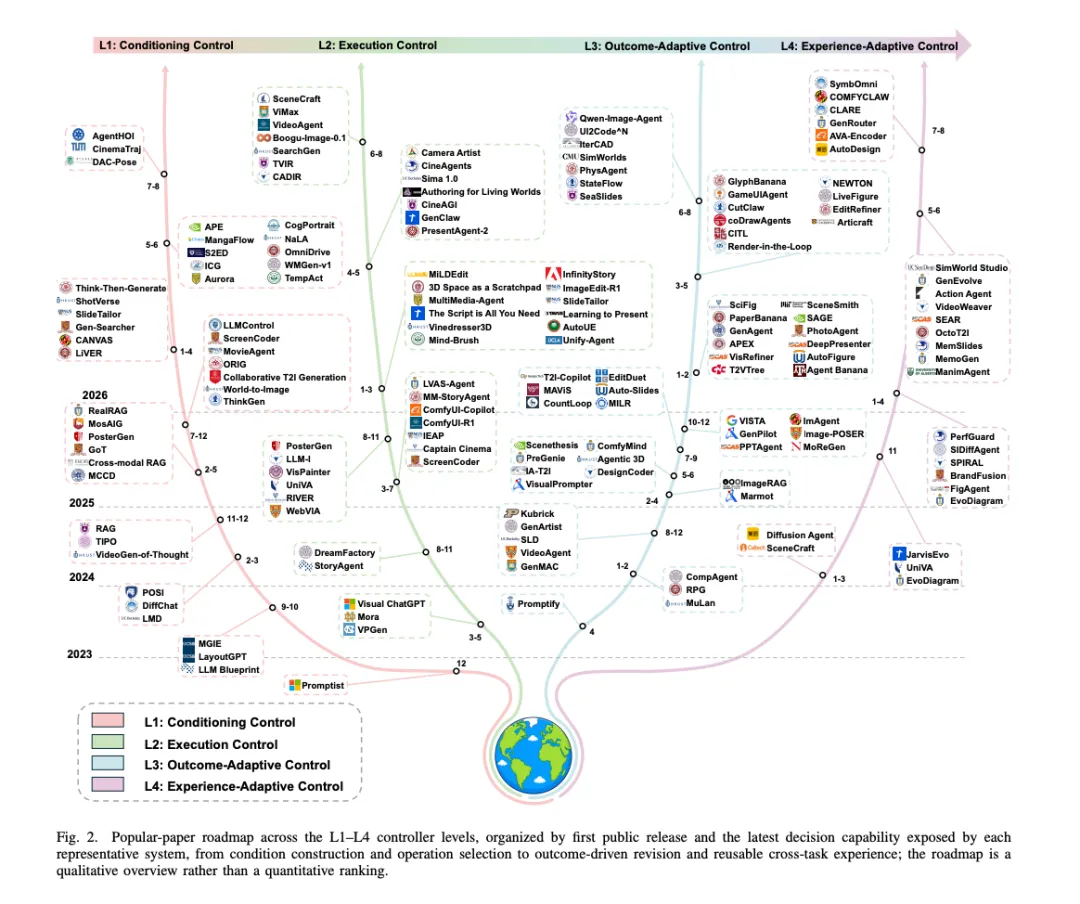
One of the most noteworthy aspects of this is that in the current work, systems that modify current tasks based on the results have already occupied the majority, and are still relatively rare to use the experience of completed tasks for subsequent independent tasks.
The paper is titled: Agentic Visual Generation: From Generative Models to Agentic Control.
Address of the paper:https://arxiv.org/abs/2609.06758
Project warehouse:
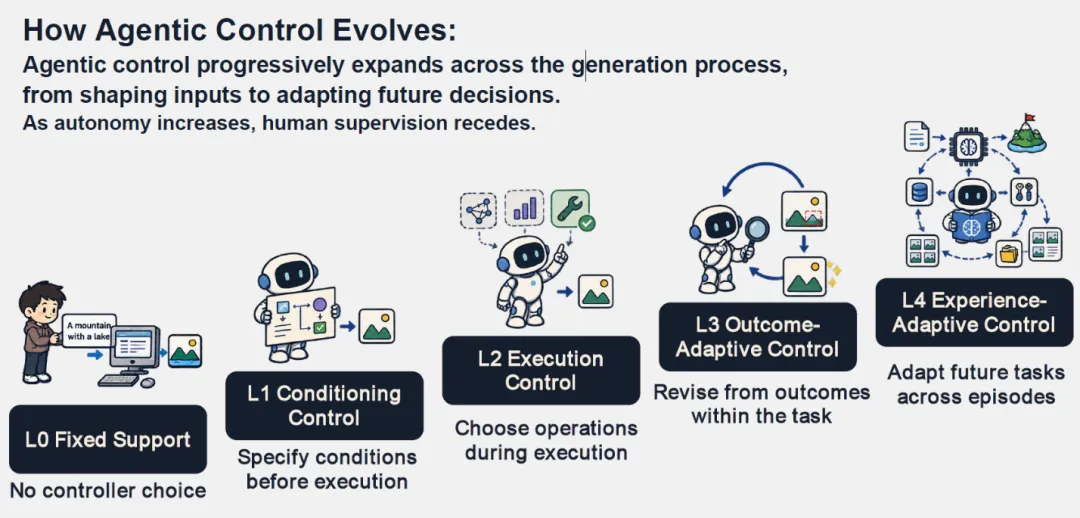
It's a classification that explains to what extent a mouse can be autonomous.
In existing systems, the controller is usually held by an LLM or VLM, who is responsible for understanding needs and selecting actions; an image, video generation model, and an editor, a renderer, are responsible for performing specific visual operations.
On this basis, the most far-reaching decisions that can be influenced by the controller are summarized, dividing the relevant systems into L0 to L4. L0 represents fixed support components and processes, defining the starting point of the summarized discussion; L1 to L4 corresponds to a gradually expanding four-tier control capacity.
L0: Fixed Support, providing the basic capabilities needed to generate
In L0, generators, editors, retrievers, evaluators, and fixed flow lines run on a preset path, providing generating, editing, and evaluating capabilities, but no controller decides which generating operation to use next.
L1: Conditioning Control, organizing requirements into conditions that the generator can use
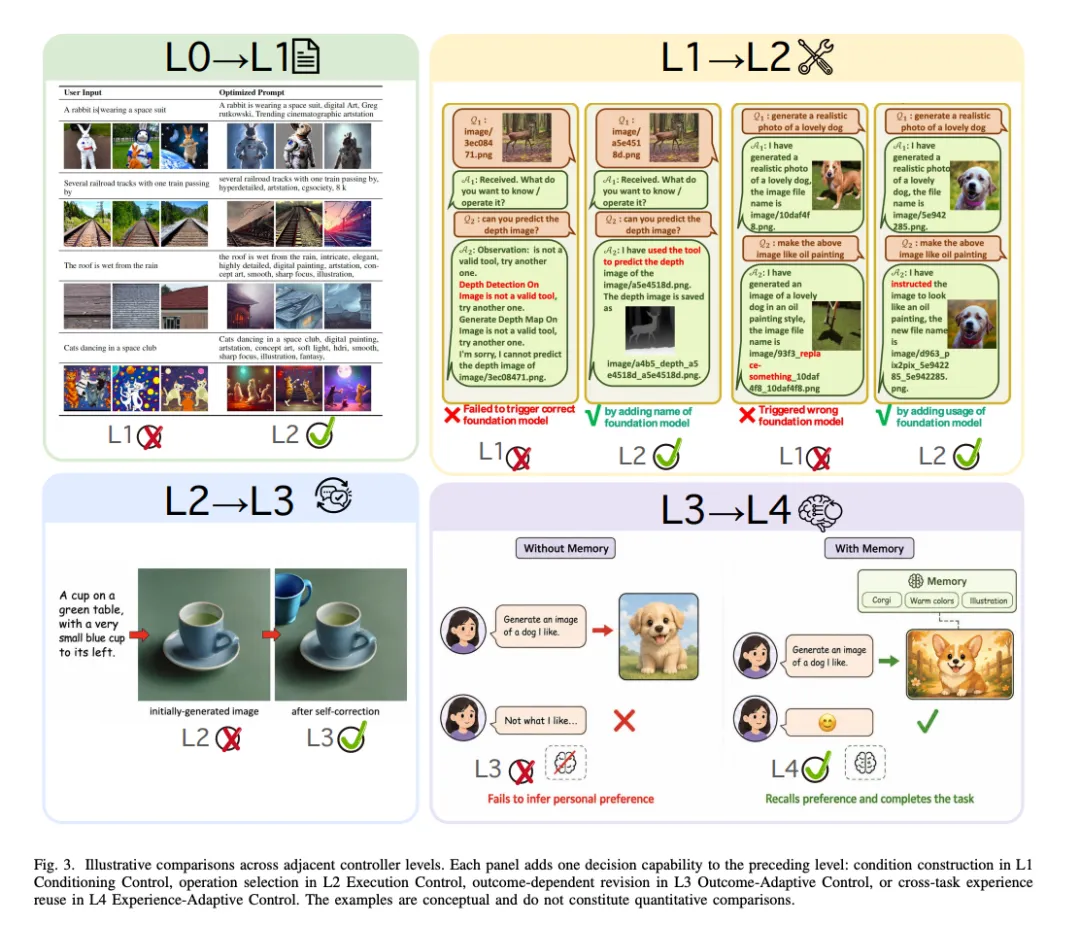
The L1 controller is responsible for preparing input conditions, such as rewriting prompts, planning object locations, selecting reference charts, retrieving knowledge, or designing lens and camera movements. LLM-grounded Diffusion breaks down complex requests into object descriptions and boundary frames, LayoutGPT generates two- or three-dimensional layouts, and World-To-Image retrieves definitions and reference charts. These conditions are eventually handed over to a predefined generator executor.
L2: Execution Control, selecting and organizing actual visual operations
L2 controllers begin to select and organize actual operations, including image generation, local editing, model switching, node compilation, and video rendering. Visual ChatGPT encapsulates the visual model as a tool, ComfyUI-Copilot produces executable node charts, and ViMax organizes script, footage, character styles, and clip production. The controller thus decides which capabilities to use to complete tasks.
L3: Outcome-Adaptive Control, adjusting follow-up according to the results generated
L3 turns visual generation into feedback loops. The system looks at images, videos, pages or scenes that have already been generated, and then selects local editing, reproducing, adjusting conditions, or stopping based on issues such as object absence, spatial relationship error, or action inconsistency. SLD, GenPilot, and PPTAgent show results-driven image editing, visual refinement, and slide editing respectively. Code reporting errors, physical simulation, and user feedback can also be feedback.
L4: Experience-Adaptive Control, which uses the experience of completing a task for future tasks
L4 will extend adaptive capability to new tasks. The system will preserve completed generation processes as long-term memory, capability archives, workflows or skills. OctoT2I, based on historical performance updating the generator capability archives, GenEvolve refines replicable processes from success and failure trajectories, and COMFYCLAW will immerse verified workflow building methods in skill libraries.
The range of controls extends from input conditions to execution of operations, feedback on the results of current tasks, and long-term experience of cross-tasking repetition, respectively, along L1 to L4.
After 300+ jobs, where is the next breakthrough?
Based on a sample of papers as of August 24, 2026, L1 and L4 have collected 49, 33, 202, 25, respectively. Growth after 2025 is mainly concentrated in L3, indicating that, according to the results, modifying current tasks has become the main route of recent research; by comparison, there are still fewer L4 capable of cross-task replication experience.
The more the experience is preserved, the better. Whether it is related to a new task, whether it is obsolete, whether it will bring old mistakes into new tasks, needs further verification.
How do you measure Agent's contribution?
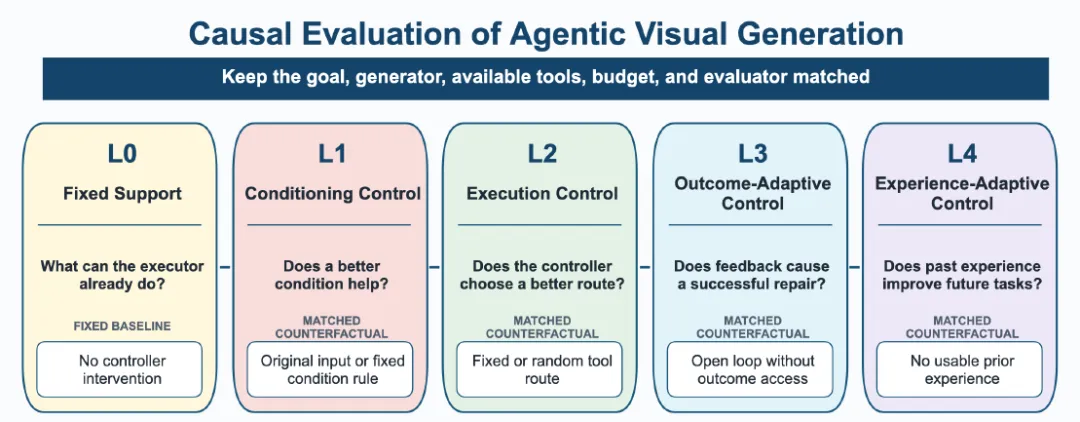
Production performance improved, possibly from a stronger generator, more sampling, or perhaps the controller did make a more effective decision. The paper proposed design assessments at the control level: fixed generators, available tools, budgets, and evaluators, with a gradual increase in a class of decision-making ability.
Among them, evaluating L1 to see if better conditions can improve the same generator; evaluating L2 to compare controllers in the same set of tools to select a more appropriate execution route, and distinguishing the benefits of choosing the route from the ability of the tool itself.
When validating L3, two versions can use the same initial plan, tools, and total budget, one to read and modify the intermediate results, and the other to execute on the established route. When validating L4, the new independent task compares the preservation, removal, or disruption of post-experience performance, and checks for negative migration and forgetting.
The evaluation will also record the cost of each correction, including whether the confirmed content is compromised, whether it meets user hardness requirements, and when the system should be stopped.
What is the meaning of this verse?
The overview focuses on the most far-reaching generation decisions that controllers can influence, organizing the relevant systems into L0 to L4. L0 defines fixed support components and processes, L1 to L4 respectively covering generation conditions, execution operations, feedback on the results of current tasks, and long-term experiences that can affect future tasks.
The rationale for more than 300 studies suggests that visual generation agents have clearly moved toward result-based modification of current tasks, but cross-task embedding and reuse experiences are still at an early stage. How to obtain reliable feedback, protect confirmed content, control correction costs, and keep long-term experience effective are key questions to continue developing in this direction. The paper also discusses the generator-as-controller: if the generator can directly rely on visual state decisions, feedback links may be shorter and localized adjustments will be more accurate; but it still uses the same set of standards to demonstrate that intermediate results do indeed change subsequent actions.
For researchers, this review provides a documentary map organized by decision-making capabilities and a set of aligned conditioned assessment approaches; for developers, it provides a specific perspective on examining system capabilities: which operations the controller chooses, whether the results change the next step, and what experiences will continue to influence future actions after the end of the task. Progress generated by Agentic Vision ultimately needs to be implemented into these observable and verifiable decisions.