In front of a big screen, two humans and two AI are playing a trading table game.
The game is somewhat similar to "Big Money": players must compete in four rounds of betting for jobs, deploy businesses, and trade assets with other players by bidding, ultimately deciding on total assets.
Cash is important, but the key to bridging the gap is that if similar businesses are connected in adjacent jobs, profits will continue to overlap.
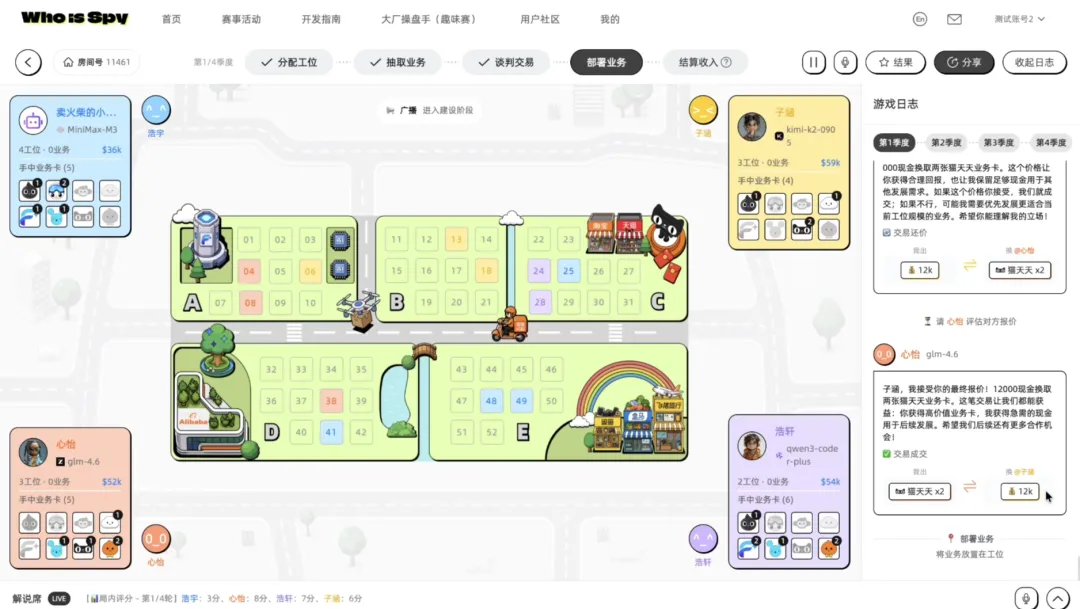
Other selected screenshots of the station, not real-world gameplay.
In the first three quarters, the situation was unstable. Until the end of the third quarter, an offer broke the balance.
"Hundreds of thousands?"
The human player, who wanted to buy a piece of work with only 250,000 yuan, mistakenly entered an offer of 100,000 yuan. The transaction went into effect immediately and his cash was significantly reduced; the other AI player, Kinchi, raised the cash to 370,000 yuan, temporarily rising to number one.
The situation on the ground looks pretty clear: with only the last quarter remaining, King's hands hold the biggest cash advantage.
But it's not all about cash.
For the past three quarters, another human player has been holding key positions and gradually deploying similar businesses in adjacent locations. As a rule, profits increase significantly once the business is connected; these profits continue to accumulate as each quarter is settled.
By the fourth quarter, Kinche had significantly reduced cash in order to continue expanding its assets, using large amounts of cash in exchange for jobs and business cards in the construction industry.
When the final settlement started, the rankings on the big screen jumped again.
In the third quarter, Kinche led with 370,000 yuan in cash, eventually dropping to fourth place.
AI, which dominated short-term trading, ultimately lost to a longer-term layout.
The award ceremony was held in Hangzhou and Beijing from 20 to 24 July 2026. The fifth Hardcore Youth Technology Festival is the largest annual technology event of its kind in the history of the ATH Group and Alibaba Taotank Group.
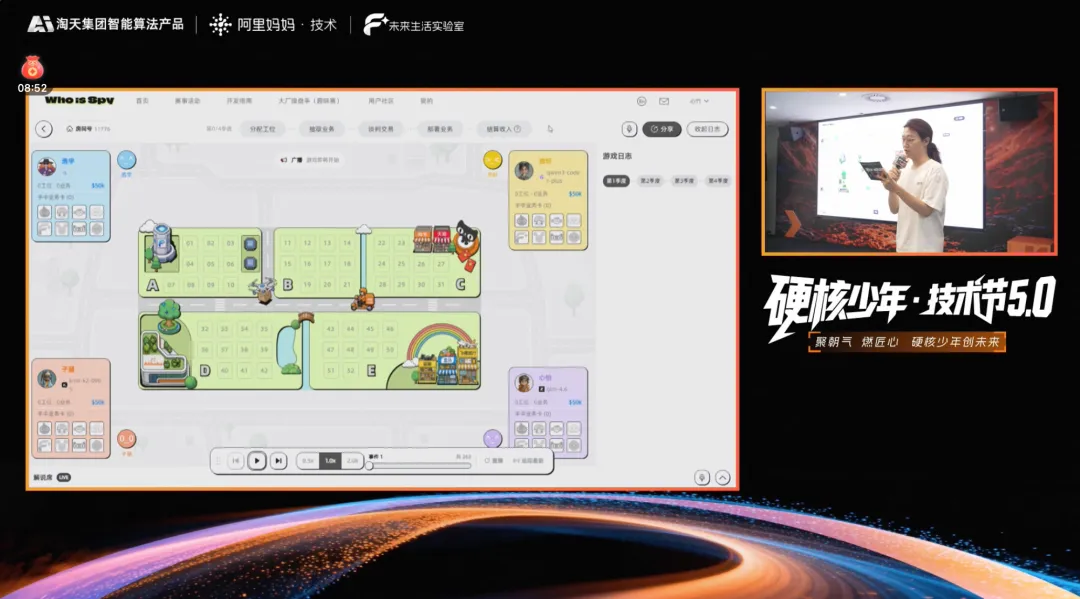
WhoisSpy.ai, the AI multi-intelligent platform that supports real-time combat and open expansion, is used to evaluate the actual performance of large models in social reasoning, negotiation and strategic gambling.
From previous year's "Who's Undercover" to this year's "Great Factory Players", the game's gambling complexity has improved over the years.
The agency also presents a shortened version of the current AI Agent: it is already able to read the situation, evaluate assets, initiate transactions, and execute multi-step tasks with clear rules; but in the face of the need to unify long-term gains, competitor behavior, and complex environments of change, AI may need to practice again.
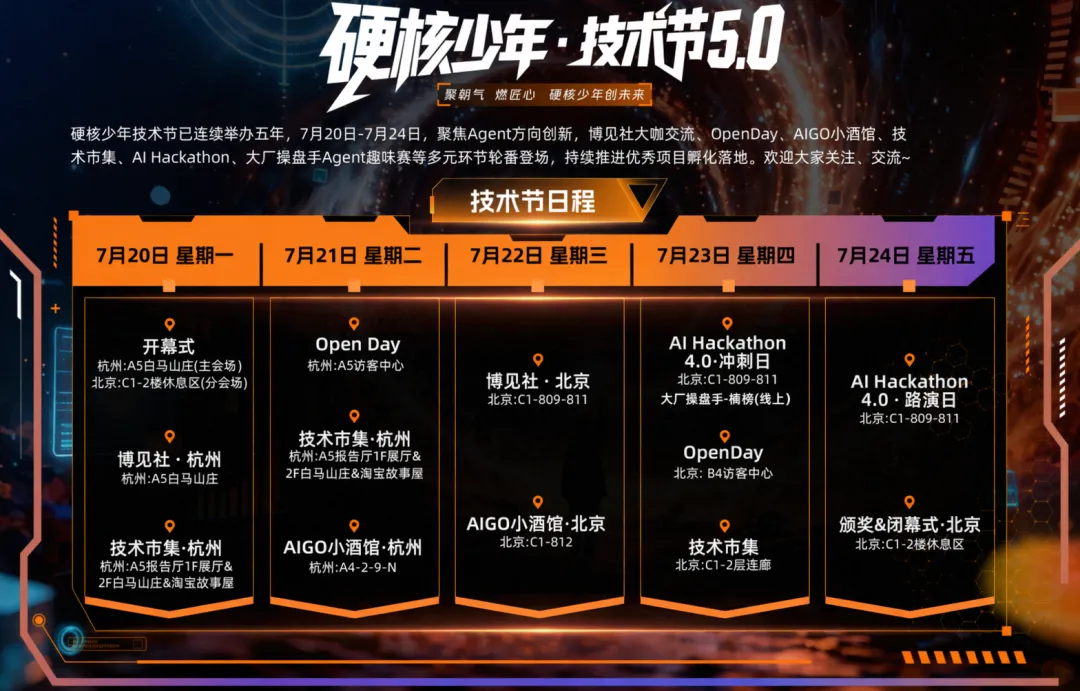
In five days, in addition to the man-made confrontation, events such as the People's Choice, Open Day, AIGO Mini Bar, the Technology Marketplace and AI Hackathon will take place in turn, covering academic and industrial exchanges, the release of technological achievements, project roadmaps and innovation practices.
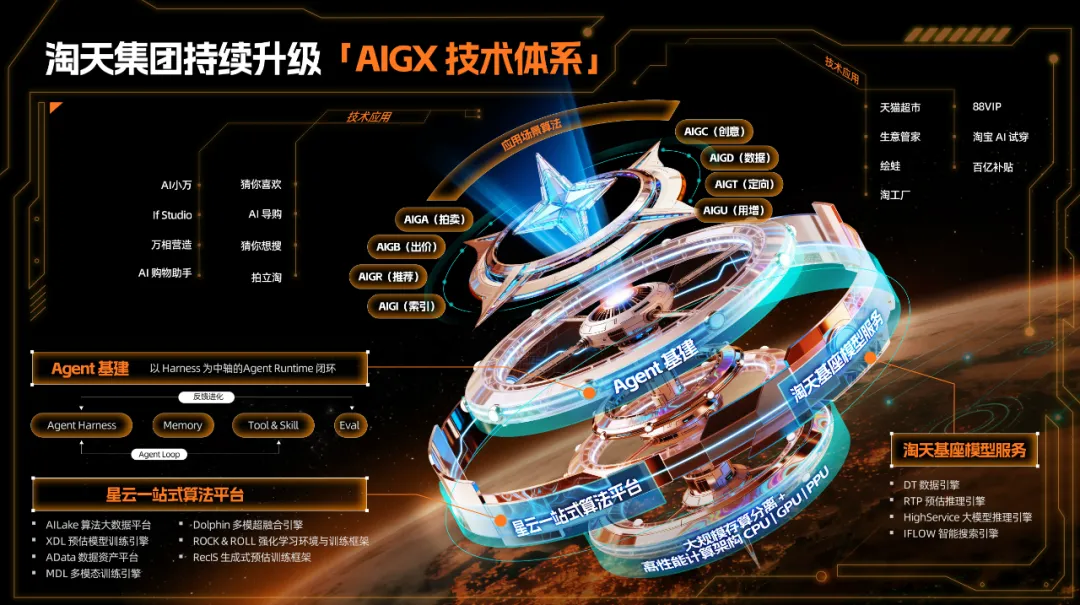
Around the Agent direction, the event released four outcomes of the AIGX technology system and put forward a core proposition: AI is moving from tools to partners.
The question also arises: what skills do so-called "partners" need to have and what kind of reality tests do they need to pass?
What's going on this time?The four outcomes of this technology event were the creation of a full-mode real-time Agent, a full-scenes AI creation workstation if Studio, Coupella's Intelligent Engine and the Agentic Recommendation System Dream, AIGI for full-mode perception, AIGC for content production, Causal inference for AIGU and the intent to understand AIGR.
They are entering the search, creation, marketing and recommendation scenes, respectively, and together point to a change: AI is no longer just delivering one-off results, but is entering business processes, continually engaging in understanding, decision-making and execution.
Without photography, AI can look around and search.
In the past, it was often used to identify a product before uploading a clear image to search for the same item.
The real-time Agent wants to make interaction more "online".
After the user opens the camera, the system can process video, images, voice and text simultaneously. In the movement of the lens, it not only identifies objects, but also combines the context to determine what the user is focusing on, what they want to know, and what they may need next.
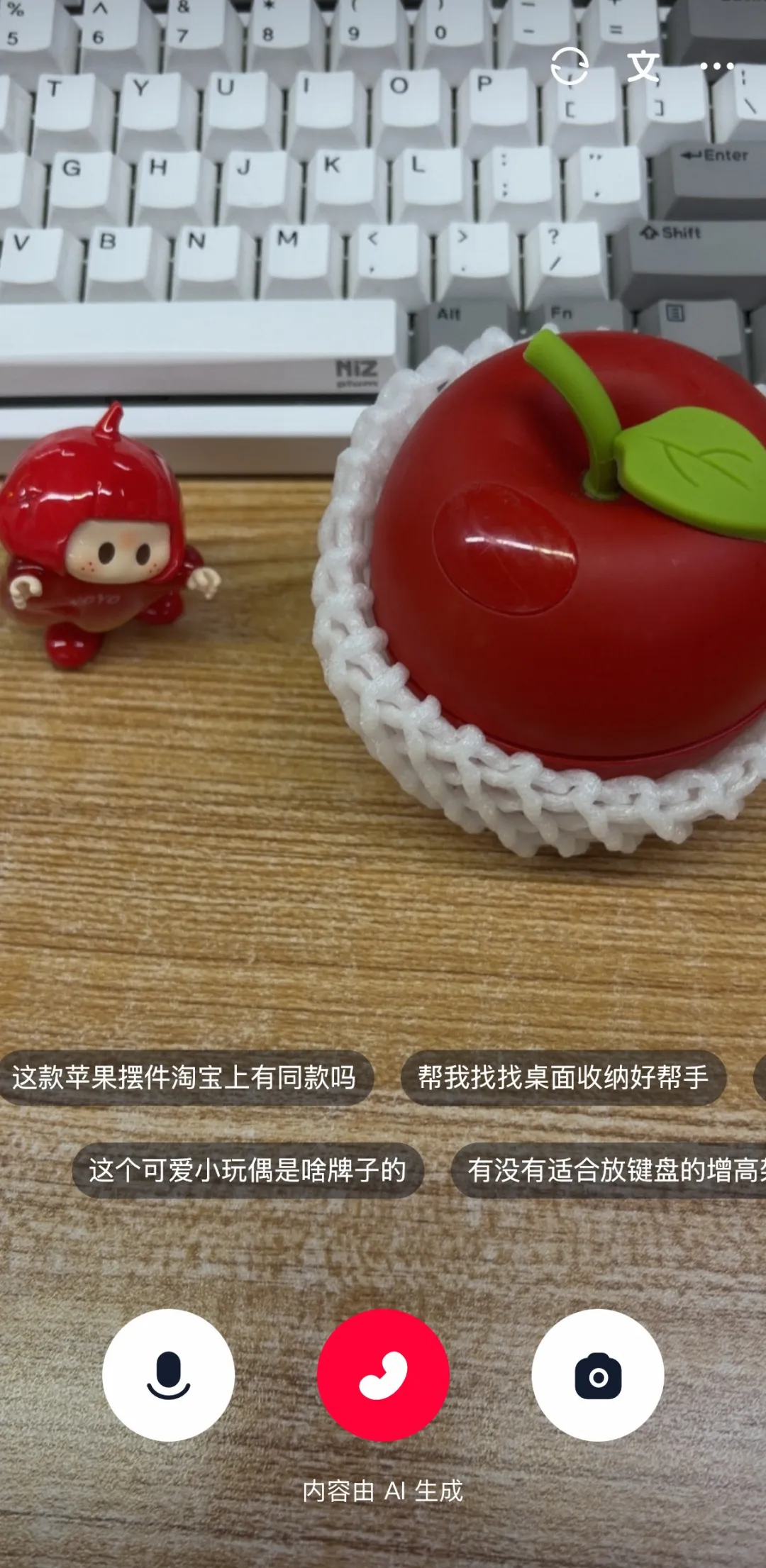
The user does not have to take a photo first and then exit the search for the current scene. The system can look at the margins, understand the margins, and connect "seeing", "seeing", "searching" and subsequent decisions.
AI is therefore no longer faced with a well-defined search request, but with a continuous, dynamic field of information. It needs to understand the intent in the interaction gradually, rather than waiting for the user to complete the question.
Instead of just generating content, AI is taking over the entire creative process.
For enterprise creation, the creation of content is often just the beginning. Images need to be painted, worded and edited, videos need to be clipped, and material may continue to be compiled into pages or websites.
This is the process that if Studio is aiming for.
The Intelligent Desktop integrates the design, video and construction of three types of Expert Agent, and has access to tools such as HappyHorse 1.1 video modeling, AI mapping, and image editing. Upon request, the system can disassemble tasks to allow different Agents to complete material processing, content generation, and page building.
Video experts are making big movies.
In the past, these links were scattered across different tools, requiring man-made repetition of material; now, different Agents can collaborate around the same task.
Production capacity is the "can't do it" solution, and enterprises are often more concerned about whether to continue to modify, connect the next link, and deliver on demand with stability.
It's not just about transformation, it's about AI clearing the red card.
In marketing campaigns, an increase in revenue after subsidy is issued does not necessarily mean the creation of new value. Some users would have purchased, and some growth may have been just to meet future needs.
Coupella's Intelligent Engine and its generating factors inferred the big model and wanted to settle the bill.
The system used counterfactual forecasts, long-term value assessments, and incremental modeling to compare the results of "red packages" with "non-red packages" to determine whether subsidy yields long-term gains and whether growth is merely a transfer from other commodities, channels, or periods.
Simply put, it's not just statistical about what happens after the red card is issued, but it's also about whether the subsidy is worth it, whether the growth is real, and who the red card should be sent to, how much it should be sent to.
According to data disclosed by the event, Coupella has covered hundreds of thousands of merchants since the double 11 went online last year, with AI red card conversions up 81%, leading to over 80 million yuan in revenue.
Not only do you know who you are, but you know what you want right now.
Traditional recommendation systems have been able to handle "thousands of faces", but the same person's goals at different times and in different scenarios can also change.
In the morning, when commuting, users may simply browse the information quickly; in the evening, when they open the tables, they may have entered a clear shopping state; and during the upcoming holidays, users may be choosing gifts for others that are not entirely in line with their long-term interests.
This is the dynamic change that Agentic's recommendation system Dream deals with.
Traditional recommendation processes typically optimize local targets such as click-through rate, length of stay, and conversion rate, respectively. Dream adds a layer of intent control: first judging the purpose of a visit based on the user's current behavior and context, and then routing tasks to different experts.
When users browse hand-in-hand, the system provides more exploratory content; when purchasing intentions are clear, they turn to product matching and decision-making assistance. This is what goes from "thousands of pages" to "thousands of pages": not only distinguish different people, but also identify the needs of the same person at different times.
At the moment, only in the "Guess You Like" (Guess You Like) scenario, Dream has led to an increase in the number of browsers, payout amounts and other indicators.
As you can see, four releases have broken down the "AI from tool to partner" capabilities into more specific ones: Snapdragon is responsible for understanding users in successive scenarios, if Studio allows multiple agents to collaborate, Coupella is involved in budgeting and management decisions, and Dream modulates recommendation strategies based on users' current intentions.
The technicians are starting to play.The topic ranges from modeling skills to family, retirement, consumption, emotions and workplaces, and people are starting to wonder: What other real and small problems can AI solve besides improving efficiency?
For the first time, the AI Hackathon 4.0 set up two courses for business innovation and inspirational mind-blowing, and received a total of 115 high-quality works, 24 of which went on the road. This year's project focused more on real needs, business value and user experience than merely demonstrating demos.
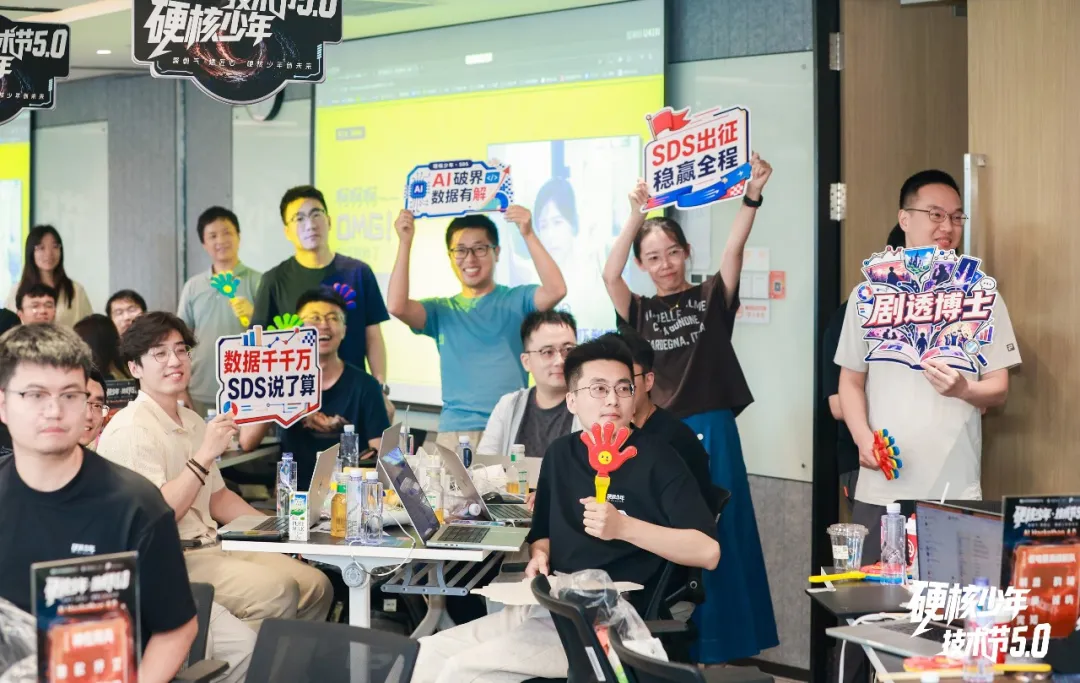
If you look at the name of the team, you can already feel the atmosphere of the scene.
The members of the "Low Energy High Resilience Team" called themselves "Battery One" and "Battery Two" and wanted to give a suspension card to low-powered people; the reason for "save money to buy tokens" was simple: others saved money to buy houses and they saved money to buy tokens; and a team called "The End of the World is Basics" tried to use basics to help people with disabilities make decisions.
Interns take first prize, AI goes into the details of life
The first prize of the Business Course was awarded to the "Audient Group of Five" made up of full-time interns.
They developed a hand-held Aging Family Decision Agent that enables children to submit oral or photo presentations to the family environment, systematically identify spatial risks, generate modification schemes, and match real products to Taobao.
The project also designs two perspectives: children see the risk position, modify the budget and improve the scores, and adults see the spatial effect of the modification. The digital agent "safety" is responsible for all communication, reducing the objection of children to the "ageing" and "aging" labels.
AI isn't just recommending products here, it's involved in the entire process, from discovering hazards, planning, to family consultations and buying decisions.
Javishan, who lives in my house, hopes that AI not only controls the device, but also understands what's going on in the home; "Hey, don't order" is aimed at impulsive consumption in direct-to-consumer shopping, which raises the question: Is this thing really necessary?
Several common trends can be seen from these projects: more than one-third of teams focus on family, retirement, visually impaired assistance and mental health in the workplace; several projects attempt to address context loss and multi-intelligent collaboration issues; and e-commerce projects are moving from commodity search to scenographic decision-making.
Alibaba ATH's vice president of technology, chief scientist of Taotank Group, and technology founder Liu Bo, said the most significant change this year was a significant improvement in completeness, with many projects approaching the product level.
Related information can also be submitted to PR
On the other side of the tech market, "technical drift bottles" quickly became a major live stage for developers.
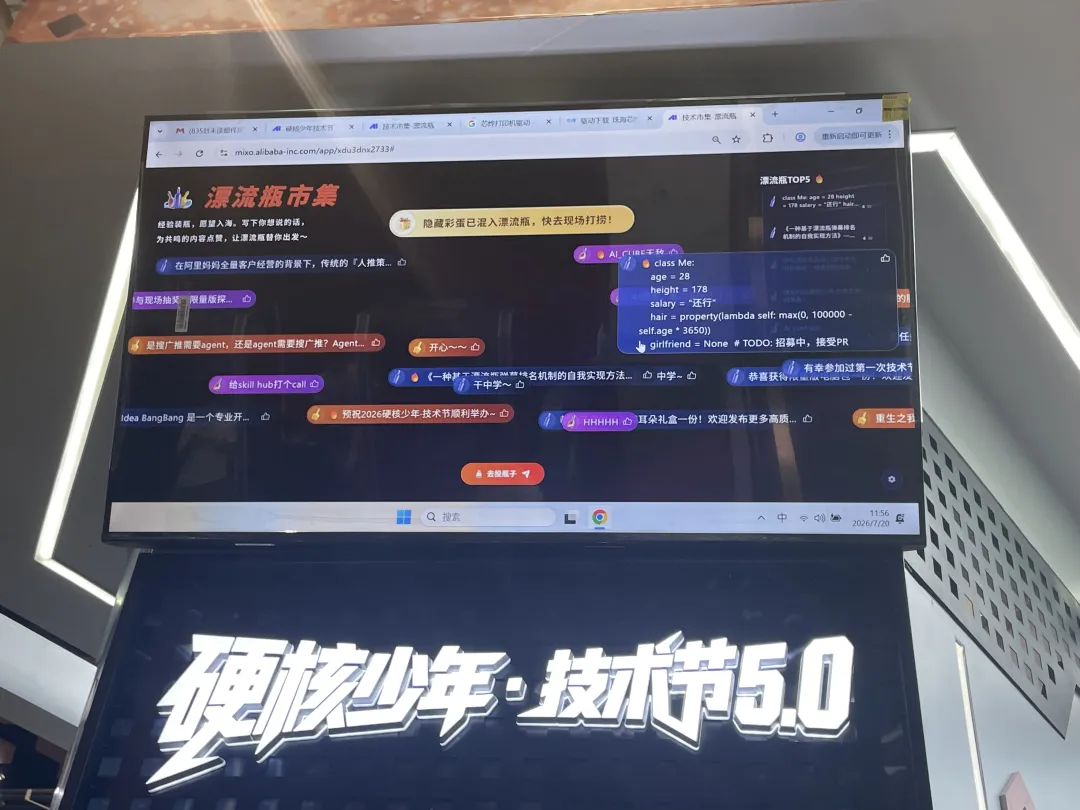
Some people have written a paper on how to create a self-fulfilling prophecy based on a floating-bottle projectile ranking mechanism. The article suggests that by pre-buriing high-quality content, it is possible to occupy the ranking bottle in the long term, with experimental results reaching SOTA in the technology-savvy scenario.
Sounds like a serious study, and it translates to: How to keep your floating bottle in the front row.
Some have also borrowed the title of a classic paper to write "Your Attention Is All My Need" to change subjects' attention from attention mechanisms to human attention.
One of the more intriguing ones simply put himself in a class:
class Me:age = 28height = 178salary = "还行"girlfriend = None # TODO: 招募中,接受 PR
Age, height, and income are all attributes, and emotional states are an unfinished development task. As for "accepting PR", it's also clear: projects are open for the long term, welcome submissions.
Paper titles, model terms, code annotations, open-source collaboration processes have all become a social language. Technicians have not abandoned their way of expressing themselves, but simply moved it from the code warehouse to the floating bottle.
This kind of positive humor has saved a lot of people's feelings about technology.
We'll talk about the frontier and the landing.Capacity gradually develops and applications begin to enter everyday life. The technical section further asks two questions: at what stage did the intelligent body develop? and how should model capabilities enter enter enterprise processes and continue to work steadily?
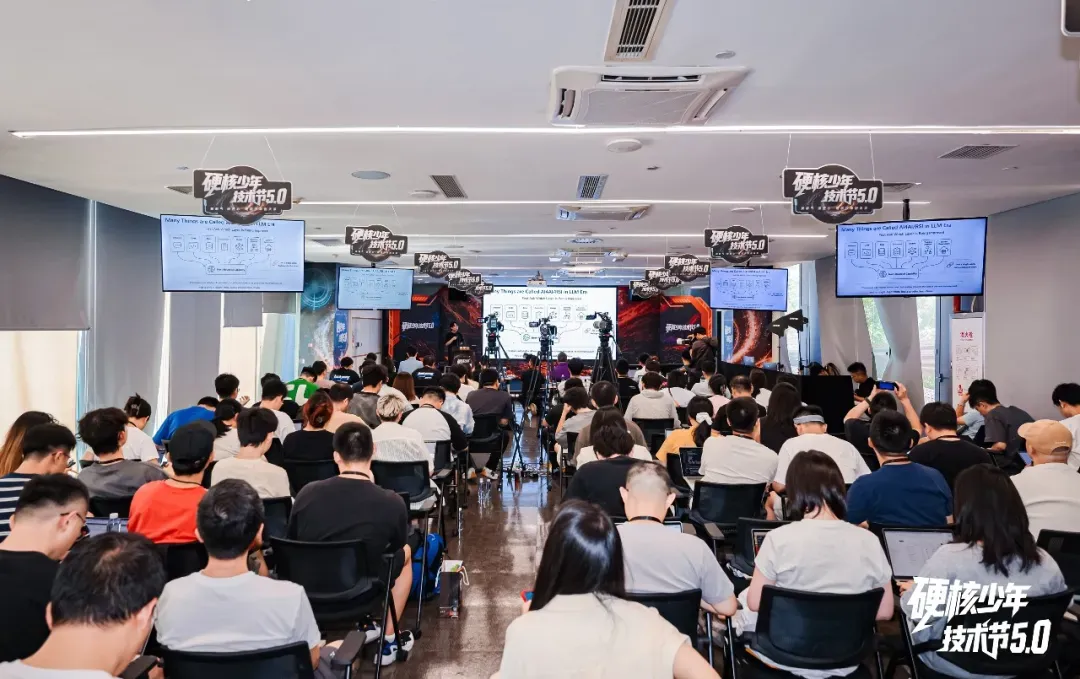
At the Hangzhou Academic Field and the Beijing Industrial Field, discussions took place in both theoretical and production directions.
Hangzhou Academic Field: Where has Agent gone?
Today, systems that can call tools, write code automatically, or plan multi-step tasks may be called agents, but they are clearly not at the same stage.
The judgments given by the Hangzhou Academy are relatively cautious: the whole of the intelligent body is in the phase of transition from the early to the mid-term, and some areas may be close to the mid-term, but development in different directions is not balanced.
The environment, interface and feedback mechanisms of the Coding Agent are more mature and easier to form execution loops; the physical intelligence still faces identification errors, failure to act and environmental changes; the intelligent body capable of autonomous learning, accumulation of experience and continuous evolution still lacks complete theoretical support.
It is not the same as being able to run independently for a long time.
There is also a disagreement in the discussion: from generative AI to intelligent agents, quantum or mass change? One view is that the underlying is still dependent on the baseline model and human feedback and no fundamental change has occurred; another view is that the shift from "generating answers" to "doing tasks" has already constituted a change in the application paradigm.
Attendees further dismantled the gap into several basic capabilities: low latency models support high-frequency decision-making, Harness is responsible for understanding objectives, dismantling tasks and calling tools, long-term memory is used to preserve cross-tasking status, and continuous learning will execute feedback and bring back updates to capabilities. Only these links form a closed loop, allowing Agents to move from one-time tasks to repeatable, improving long-term collaborations.
In any case, the intelligent body still has to solve problems such as goal setting, result verification, failure correction, experience bottlenecks and long-term auditing. It is moving from the respondent to the executive, but there is still a distance from independent responsibility.
Beijing Industrial Field: Let's get Agent into real production first
If Hangzhou discusses the theoretical boundaries, then Beijing's industry is focused on AI entering the real production process.
The keywords for the discussion went from "generating content" to "building the world".
In video and visual creation, single generations do not meet production requirements. Characters, scenes, commodity materials and colors need to be consistent across different shots or versions, and the output must support modification, replication and delivery.
Nuclear technology is scanning and reconstructing some of the video footage as a 3D video base, first determining the location of the person, prop and camera in 3D space, and then completing the content generation by video models. 3D space is responsible for consistency, video models are responsible for image expression, so that scenes can be used repeatedly in multiple frames.
This type of system does not generate every single shot from scratch, but rather matches the scene, characters, and locations, and then continuously adjusts and expands around these already existing contents. The same set of assets can be used repeatedly for different shots, both to make the front and back images more coherent, and to save reproduction and repetitive return work.
METU attempts to handle complex creative tasks through Agent Teams, with different Agents each undertaking analysis, design, generation and performance evaluation. The user provides objectives, the system is responsible for dismantling tasks, summoning tools and organizing collaboration.
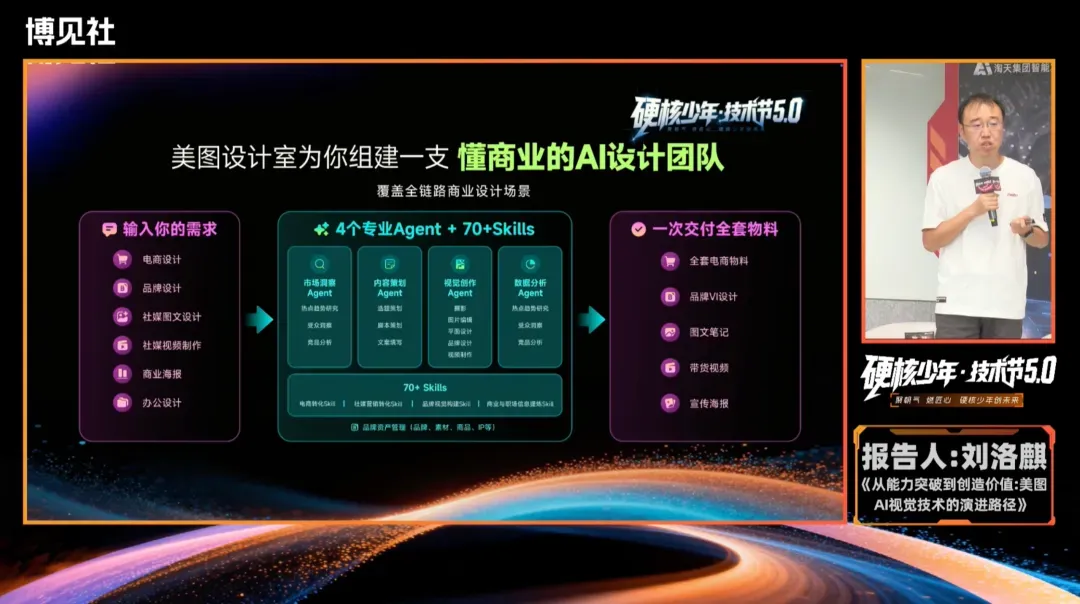
In actual production, different agents are responsible for planning, generating, modifying or analyzing the corresponding task information and retaining it. Complex tasks do not have to be all over one system, and each link is easier to join. The end result is not just a few images, but also the complete content that can continue to be used for deployment, operation and performance evaluation.
These practices show that after Agent enters production, the focus is not only on whether the content can be generated, but also whether the results are accurate, the process can be controlled, and whether it can access subsequent business links.
How AI is becoming a partnerBack to the starting question: what skills do so-called "partners" need to have and what kind of real-world tests do they need to pass?
The answer given by Ali in this technology session can be summarized in three levels: AI needs to move from tool to partner, first having the ability to understand, make decisions and execute tasks; then getting out of the dialog box and into people's lives, production processes and social relationships; and finally having theoretical and real double-checks to prove that it is not only capable of completing tasks, but also capable of continuous, stable and controllable participation in collaboration.
The so-called partners do not have to do everything for people and do not have to guarantee victory every time, but instead understand the change when the environment changes, continue to cooperate in the process of advancing tasks, accept corrections when the results deviate and return control when necessary.
AI has shifted from answering tools to participating co-authors. Next, it needs to prove itself in more real-world scenarios: it can not only complete tasks, but also work with people in a stable, controllable way.