How much does it cost to train a top-notch text graphics model?
Qwen-Image, HunyuanImage, and other closed-source systems such as GPT-Image-2 and Nano-Banana-Pro, while surprising in their effectiveness, are not always open to the public. For the vast majority of research institutions, entry tickets to the race are too expensive.
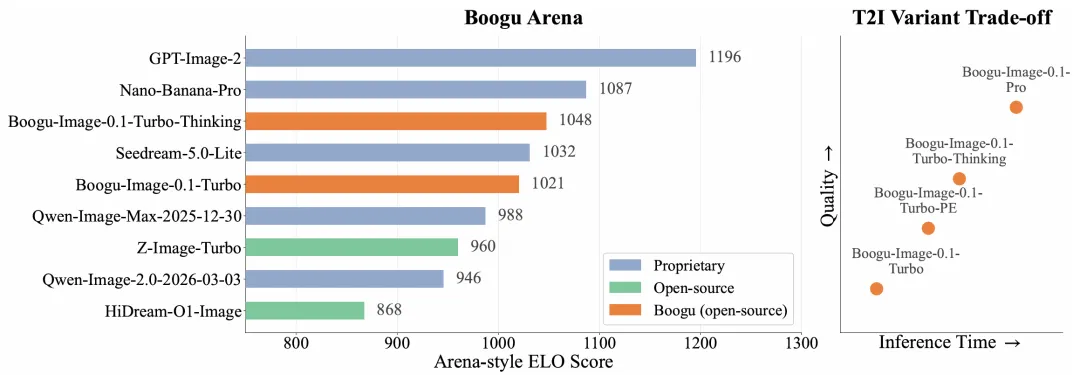
Recently, Huawei's Leibniz Institute in Hong Kong and a team of six universities, including University of Hong Kong, University of Hong Kong, and University of Hong Kong, released the Boogu-Image-0.1 series, which, with just 2.08 million independent images and a theoretical training cost of about $400,000, achieved the first open-source, close-to-closed-source unified model family on multiple benchmarks. The model power, code, and training formula are all open-source with the Apache 2.0 protocol.
Boogu-Image-0.1: Boosting Open Agentic Multimodal Generation through Understanding under a Minimal Budget
ArXiv's paper address:https://arxiv.org/abs/2607.13125
HuggingFace article address:https://huggingface.co/papers/2607.13125
The code repository:https://github.com/Boogu-Project/Boogu-Image
Try it online:

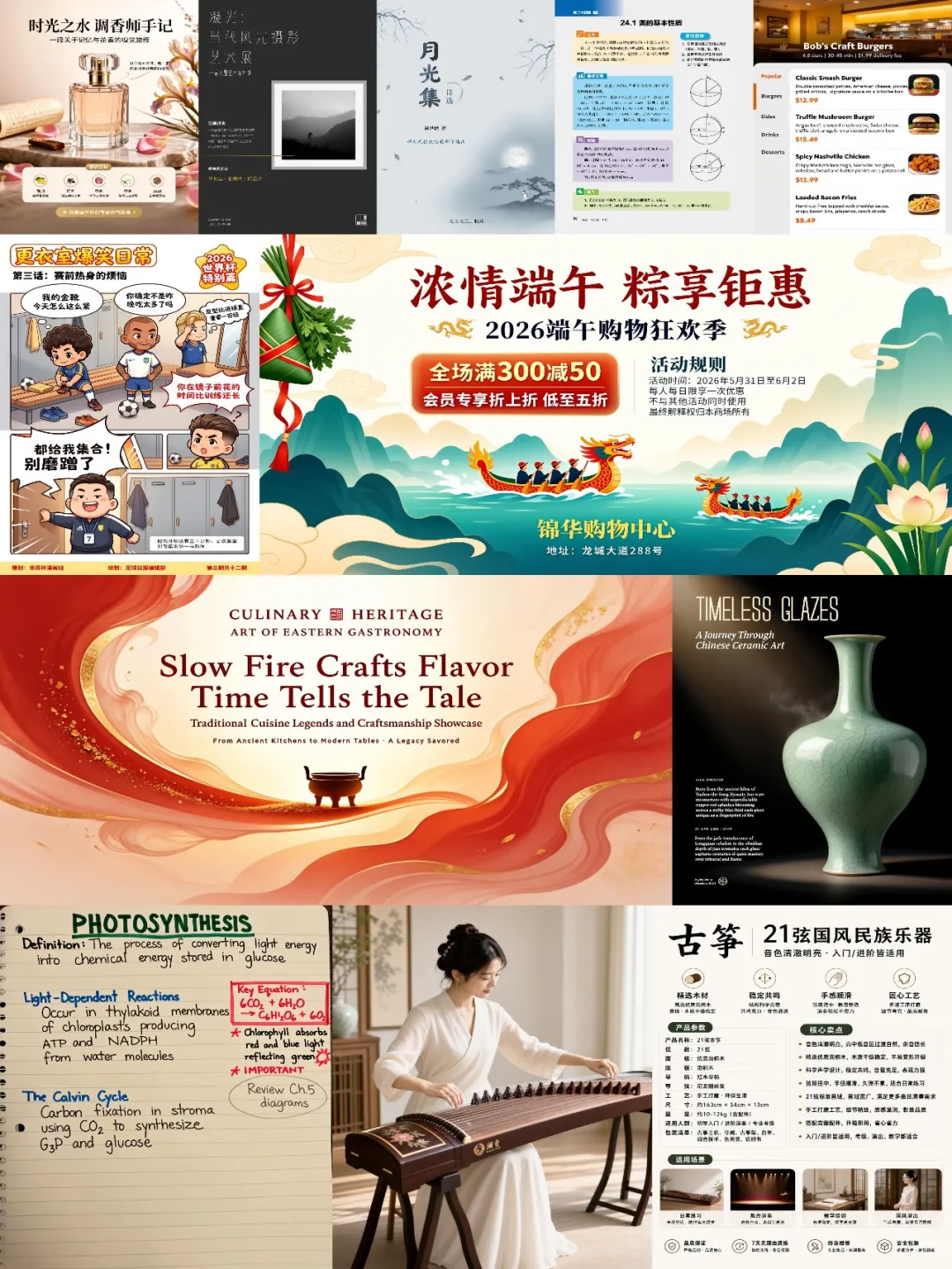
It's been a while since I've been able to do this.
The core judgement of the Boogu team is that image generation is moving from Text-to-Image to Requirement-to-Image.
Users have long been dissatisfied with giving a descriptive prompt. They want models to understand complex intentions, implicit constraints, multi-layered instructions, or even cross-modal contexts. While the real needs are extremely diverse: some just want to draw a quick map, others need fine-grained posters.
As a result, Boogu has elevated "understanding" to the status of a citizen of equal importance to data quality, training formula, and dismantled it into every link in the system:
The team likened the text encoder to a "sensor" in the text graphics model: it determines the maximum amount of information available to the entire system. Systematic experiments confirmed that the encoder's size was extended from 1.7B to 14B, generating a single-tone quality improvement and unseen synchronization. Finally, Boogu chose Qwen3-VL-8B to strike a balance between capacity and deployability in the open source community.

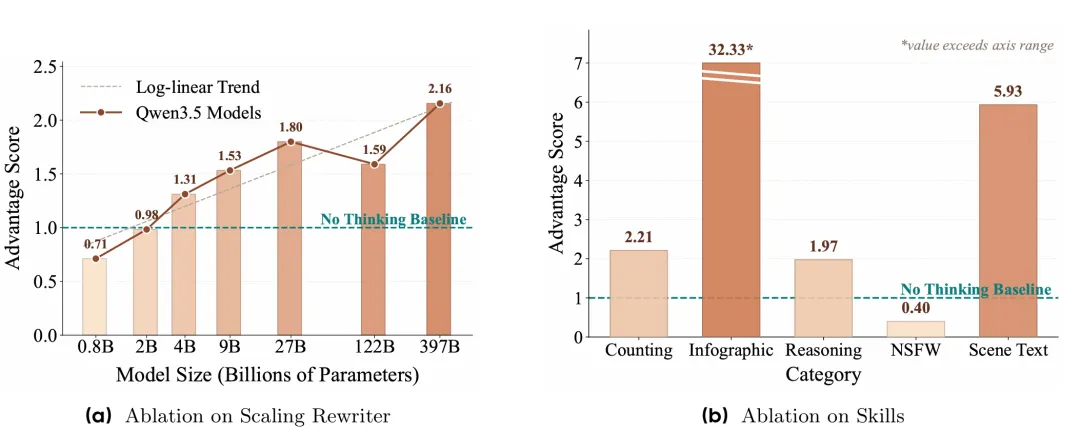
Agentic suggests rewriting: to be a "translator" rather than a "comedian". The paper proposes a design principle that is often overlooked. The rewriter should be constantly changed to the bottom line: when the user prompt is clear and complete, it is retained and only intervenes when the intent is blurred. Experiments show that the stronger the rewriting model, the greater the gain (0.8B to 397B is almost linearly improved), and in dimensions such as counting, reasoning, and scenarios, ability-oriented rewriting leads to multiple advantages.
Model routing: make the right model work the right way. Turbo and Base produce almost no difference on many simple requests, but the reasoning costs are 50 times different. Boogu uses Agent to estimate the difficulty and dynamic distribution of requests, leaving the heavy model to a truly complex task.
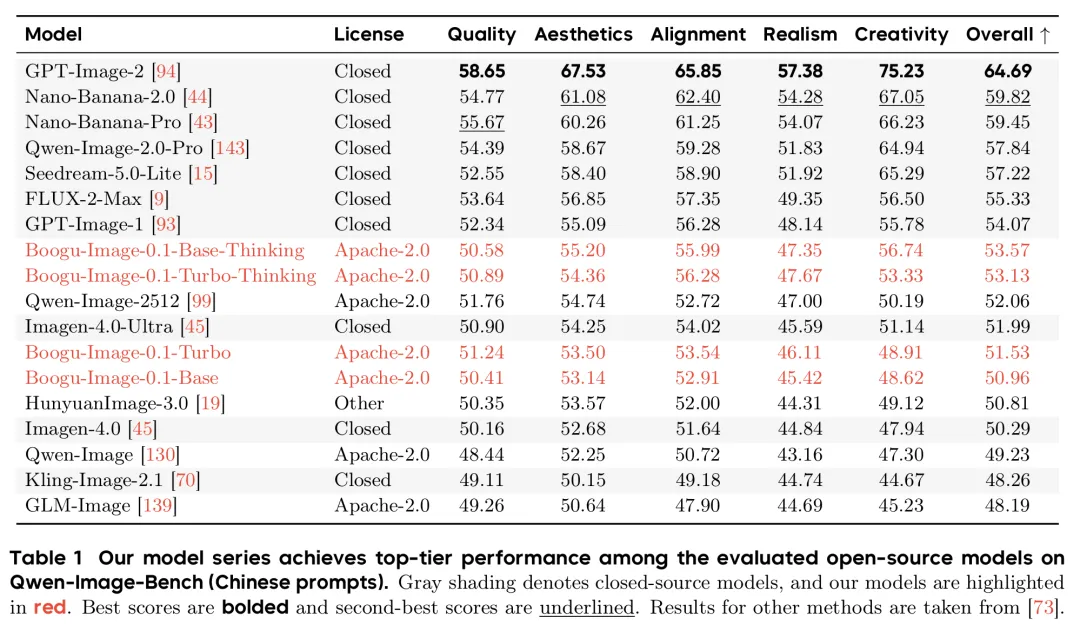
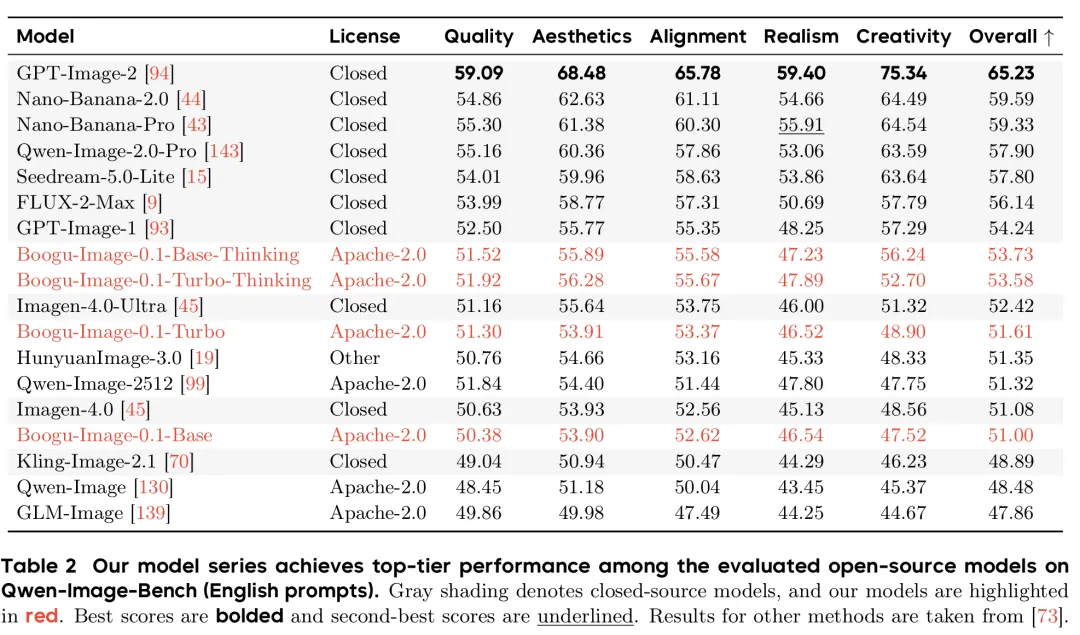
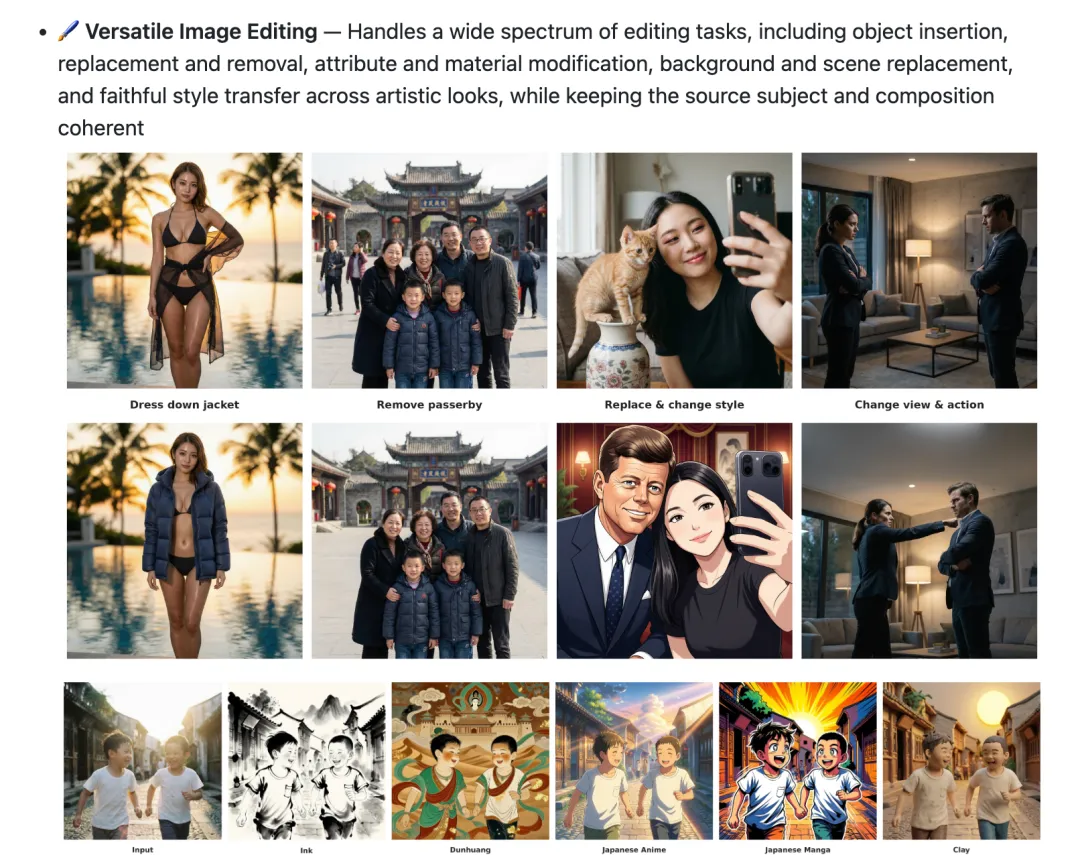
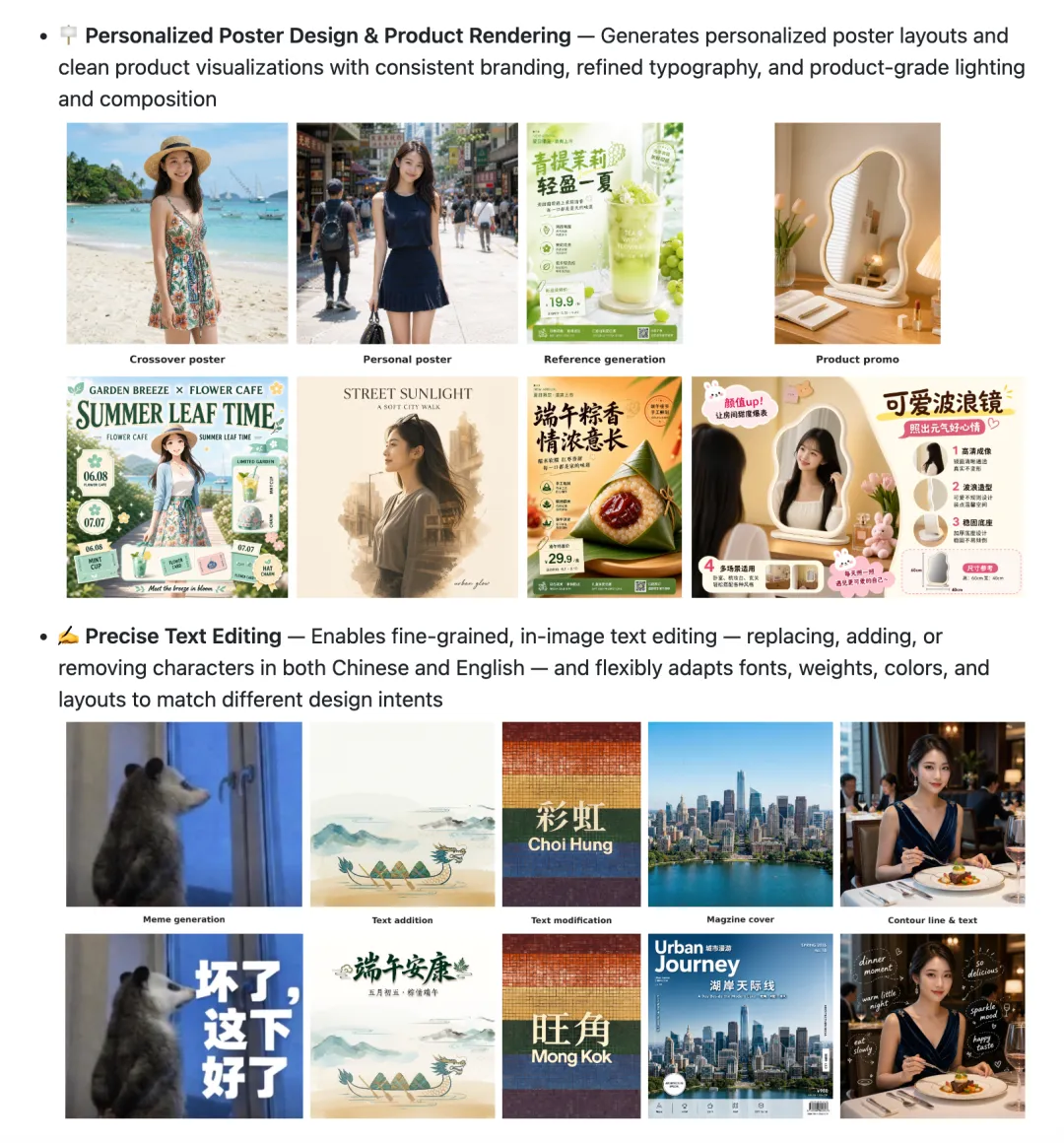
Boogu-Image-0.1-Turbo-Thinking ranked first in the Arena blind test with an Elo rating of 1048, followed by GPT-Image-2 and Nano-Banana-Pro. In the newly released Qwen-Image-Bench, its Base-Thinking variant scored the best overall score of the open source model in both Chinese and English bilingual languages; the editing model Boogu-Image-0.1-Edit-Thinking scored the highest overall score of 4.64 on the ImgEdit-Bench.
Tech reports that dare to tell the truth
What's interesting about this 71-page technical report is that it's not just the results, it's also a lot of details in the industry that are rarely written into the paper.
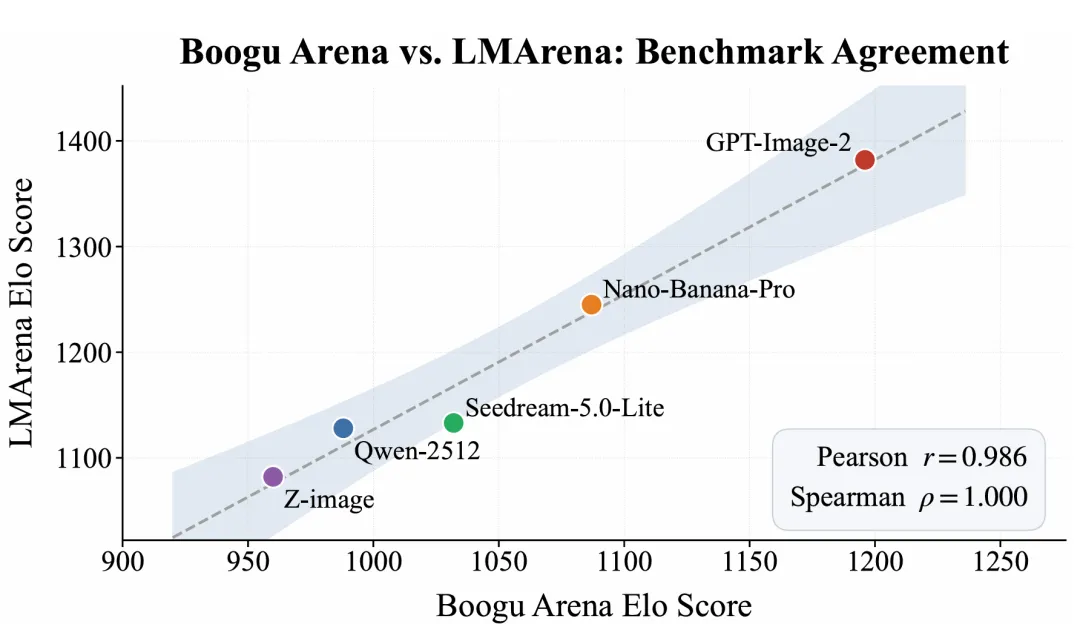
Public benchmarks are failing. The team compared LMArena's human preference rankings with GenEval's DPG-Bench scores with six recent models and found a clear upside-down ranking: GPT-Image-2 with the strongest human preference ranks only midway across two academic benchmarks. The team directly announced that they no longer use these benchmarks as primary assessments, and called on the community to reconsider their applicability.
"Details rich enough" are not enough, but structured data can be saved. The team hit the performance ceiling with models trained with 188 million open-source data; while training using a small amount of human-precursed "Boogu Syllabus" instructional outline data (only 2162,000 individual samples) can improve overall performance. The principle is simple: systematic particle breakdown, full coverage, enough data for each category.
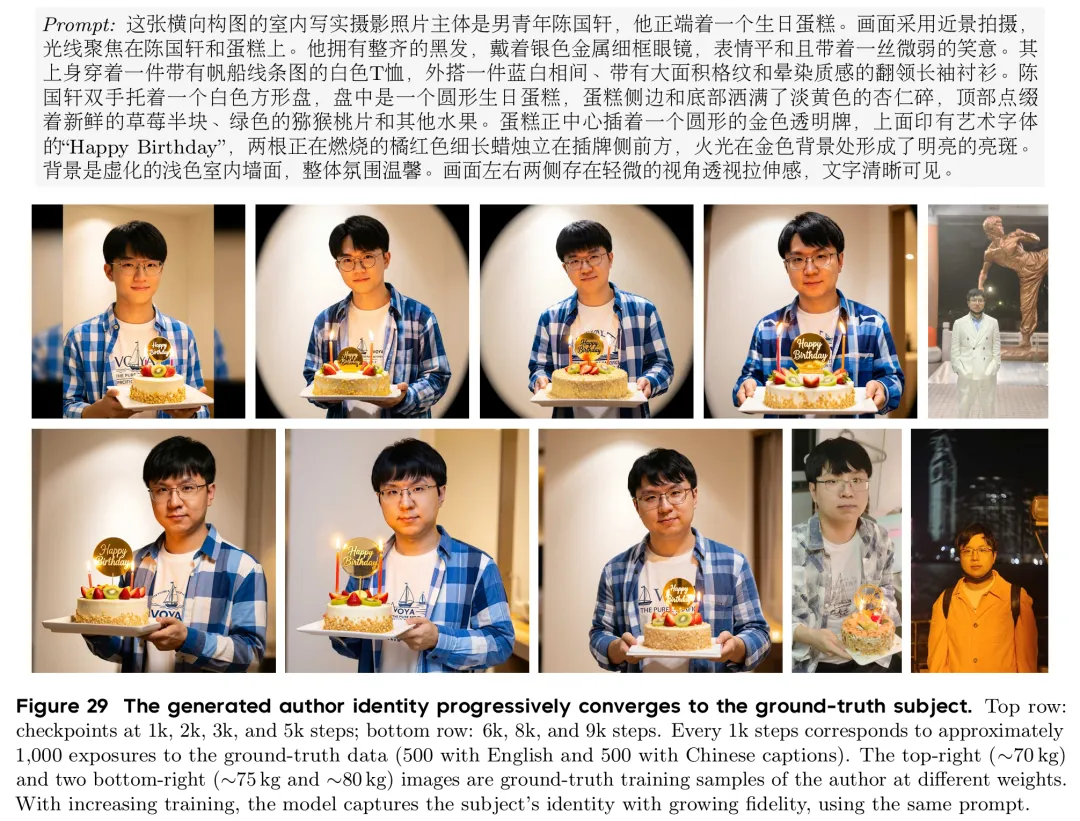
Several repeatable quantitative conclusions. One character needs to be stably rendered, requiring at least 300 exposures during training; covering 3,500 modern common words is enough to meet everyday Chinese rendering needs. It allows the model to remember a never-before-seen identity, requiring approximately 4,500 language matching exposures.
Don't blindly filter "bad data". Watermark, over-exposure, motion-blurry images don't have to be discarded, as long as they are clearly described in detail in the caption, which allows the model to understand and controlledly avoid these visual elements.
Using RL with caution. Gravity Aesthetics RL will allow the output distribution to narrow: allow models to paint "a 60-year-old Chinese woman", while heavy RL models tend to produce an idealized image with a refined fit. Boogu chooses to put human preference into the understanding system rather than into the generator, using RL only on problems that do not compromise diversity, such as body structure, text rendering, etc.
In addition, as one of the earliest open-source models of native 2K training, the team found that the standard dynamic time deviation strategy at 2K resolution produces an "over-squeezing" effect that slows down the curve and gives a simple and effective cut-off correction; the appendix also proposes an untrained reasoning enhancement method called BOG (Boosted Orthogonal Guidance), which structured DiT predictions into two-dimensional matrices, reinforcing information perpendicular to the flow field, and to some extent enhancing the quality of photographic art.
Written at the end
Boogu-Image-0.1 is of course limited: world knowledge is still lagging behind the closed-source system, text rendering only optimizes Chinese-English bilingualism, and complex multi-player interaction scenarios will still result in anatomical distortions. But under a $400,000 budget constraint, it provides a reproducible, verifiable pathway and exposes past Tibetan engineering experiences within industrial teams in papers.
As the team put it in a statement: "We hope that Boogu-Image-0.1 will allow image generation to go further into a system that "really understands what users want".
Presentation by the team
Boogu's team from the Huawei Hong Kong Crafts and Models Application Laboratory (Leibniz), Hong Kong University of Technology, Hong Kong University of Technology, Hong Kong City University, Hong Kong Chinese University and Nanjing University have completed the project together. The project is led by Chenyang Lei, whose authors include Chenyang Lei, Rui Liu, and Chao Huang. The team is committed to understanding unified intelligent multi-body model generation research, models, code, and training formulations that are driven by the Apache 2.0 protocol.