As the number of academic publications continues to grow, high-quality academic synthesis has become an important entry point for researchers to rapidly enter unfamiliar fields, navigate research connections and keep up with the latest developments. But writing a true synthesis is not easy: it usually requires reading a large amount of literature, continuing to keep up with the dynamics of the field, and investing a lot of expert time.
In recent years, Deep Research and automated Survey Generation systems have been able to retrieve papers, organize data, analyze and generate long texts, and even quickly produce tens of thousands of words of research reports.
But if you really compare a high-quality Academic Survey, the problem is much more complicated.
How should a paper be organized? How should it be classified? What sections should different papers be placed in? What citations should a claim be supported by?
These problems are not simply enlarging the context, generating more text, citing more papers, or solving them. The existing Deep Research and automated Survey Generation systems, which often revolve primarily around retrieval, analysis, writing, and analysis, come closer to a Research Report rather than a structured, rigorous Academic Survey.
To address these issues, the team at Zhejiang University, Shanghai Transportation University and their collaborators launched the Deep Academic Survey (DAS) in an attempt to automate the AI to complete a published Academic Survey within an hour.
In contrast to the traditional "recovery loop writing" flow, DAS uses the Stateful Agentic Framework to redefine the entire process as Stateful Agentic Closed-Loop Manuscript Construction.
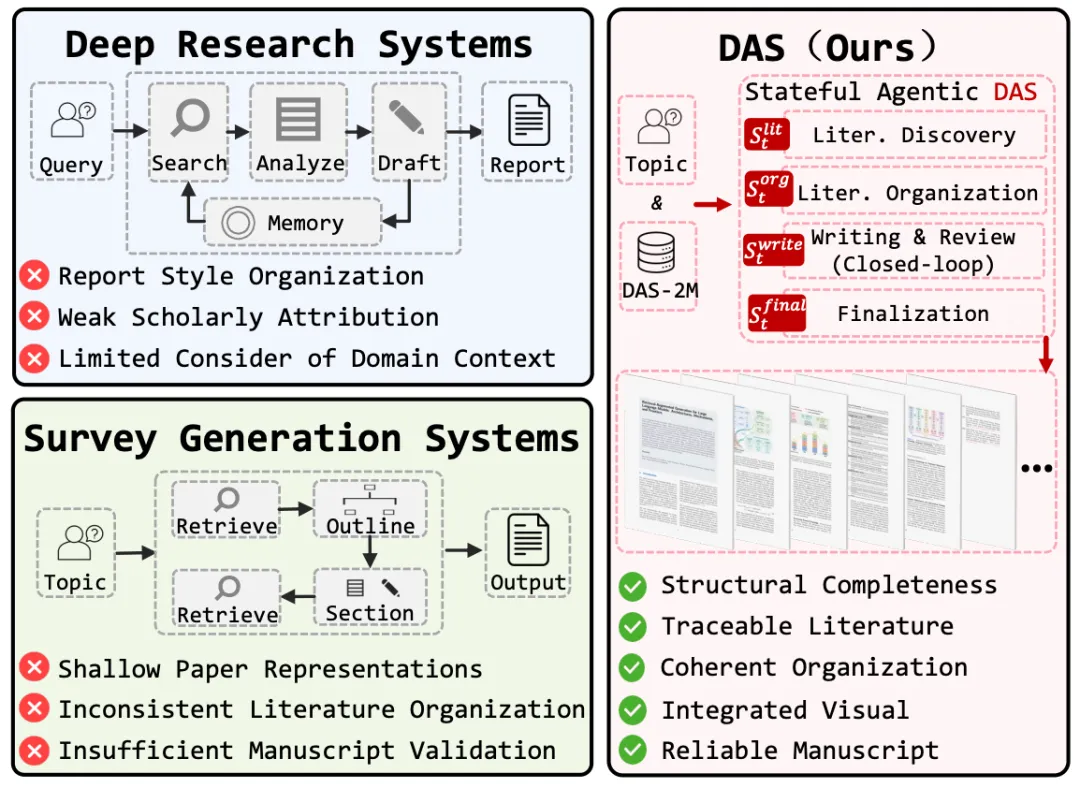
Figure 1 compares existing Deep Research and automated synthesis generation systems with DAS
On the DAS-Bench's 30 Survey Topic, DAS was rated on four core dimensions of Citation, Taxonomy, Discourse, and Manuscript Reliability, with a final average score of 4.34, the strongest baseline for full participation in 30 Topics at 4.03.[3] In an expert anonymous review, DAS was favored by Naive RAG on 27/30 Topics and AutoSurvey on 19/21 Shared CS Topic.
Currently, the project website has directly opened up 220 DAS automatically generated Hot Directions Survey, complete results and comparisons of different approaches can be viewed online.
Link to the paper:https://arxiv.org/abs/2608.18034
Address of the project:https://zhikaixu24.github.io/projects/DAS/
The code link:https://github.com/ZhikaiXu24/DAS
Address of the data:
In the face of nearly two million papers,
The first solution to DAS is not "writing", but "reading".
DAS's subsequent retrieval, organization and writing are based on an underlying literature infrastructure called DAS-2M Literature Metadata Lake.
The team analyzed nearly 2 million arXiv papers since January 2020 and used LLM's extraction of structured Metadata for Survey Writing, including methods, datasets, experimental results, innovation points, and limitations, and now DAS-2M is fully open-source to Hugging Face. Relying solely on Title and Abstract is equivalent to a more detailed "pre-understanding" of large-scale papers in advance: a paper only needs to be analyzed once and can be reused on different Survey Topics.
On this basis, the DAS builds lexical and semantic indexes. After the user enters Topic, the system first retrieves the universal candidate literature from DAS-2M, builds a Candidate-Grounded Taxonomy based on these candidate papers, and uses Reverse Paper-to-Section Routing to determine which sections each paper should support.
Thus, the Taxonomy, Paper Assignment, Paragraph Planning and Citation Planning that followed DAS are no longer based on scattered search results, but instead share the same set of replicable document representations and candidate sets.
From organizing to writing,
How did DAS form the Agentic Closed Loop?
The core of the DAS is not simply the sequencing of multiple Agents, but maintaining a continuously updated Manuscript State: the candidate documentation determines the further constraint of writing on Taxonomy, Taxonomy and Routing, while the Review finds that the problem can reactivate the corresponding Writing State. The entire Survey construction process is therefore no longer a one-time flow, but a Stateful Agentic Process that can be continuously updated and reversed.
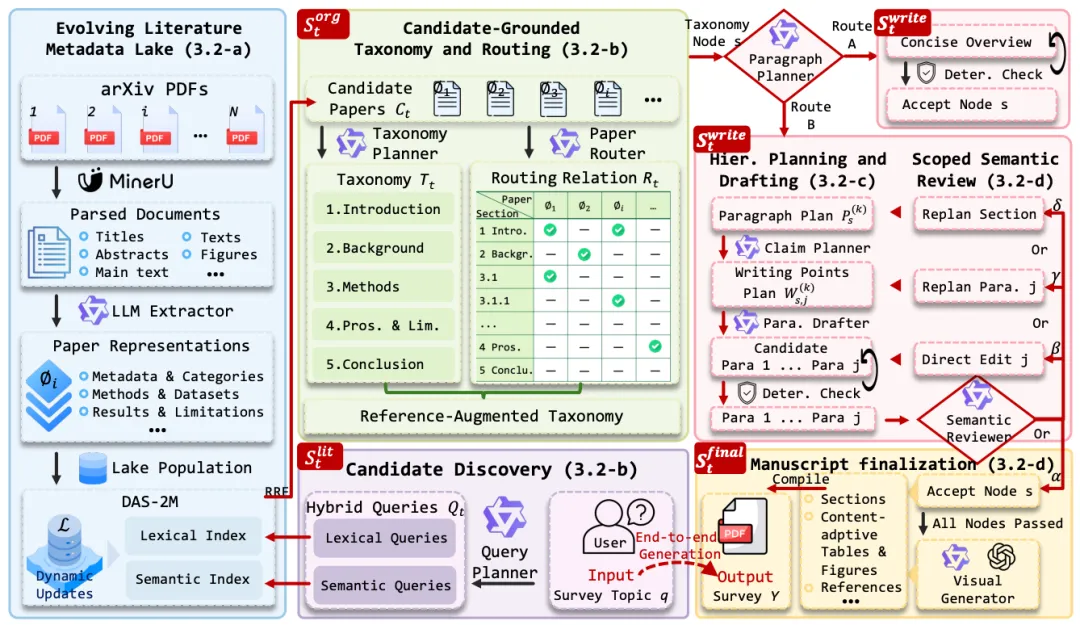
Figure 2 shows the overall framework of the DAS.
DAS will also continue to do tiered planning: Taxonomy → Paragraph Plan → Writing Points → Claim → Citation Group before it actually generates the form.
In other words, the Citation is not supplemented after the actual writing, but at the Claim-Level Planning stage determines "what Claim should be supported by what papers" and then completes Paragraph Drafting accordingly.
Writing also does not mean ending. The Semantic Reviewer checks the chapter's objectives, discusses logic and Citation Support; if a problem is found, the system executes Direct Edit, Paragraph Replan or Section Replan according to the scope of the problem, and re-enters the Review. At the same time, Deterministic Validation is responsible for checking certainity constraints such as Citation Identifier, Cross-reference, LaTeX and Compilation, thus forming the closing loop of: Generation → Review → Repair → Re-evaluation.
Eventually, the content is entered into Manuscript Finalization through Review, the system completes Figure, Table, Bibliography, Cross-reference and LaTeX Assembly, and compiles the complete Survey PDF.
This is also what DAS emphasizes as "publish-oriented": the goal is not just to write a text long enough, but to ensure consistency and reliability as much as possible from literature organization, claim/citation planning, to references, charts, and the final manuscript.
What is the effect?
The entire 220-page survey is now available for direct viewing.
Of course, for a Survey Generation system, it's not enough to just look at Benchmark scores and finally look at the paper actually generated.
Currently, the DAS website has opened up a complete Survey of 220 popular research directions, while also providing the results of methods such as Codex, GPT Deep Research, AutoSurvey, InteractiveSurvey, which can be directly compared horizontally. The qualitative comparisons in the paper also show that there are significant differences between the different systems in terms of Citation Stacking, Grossness Attribution, Replication Structure, and Figure and the syntax.
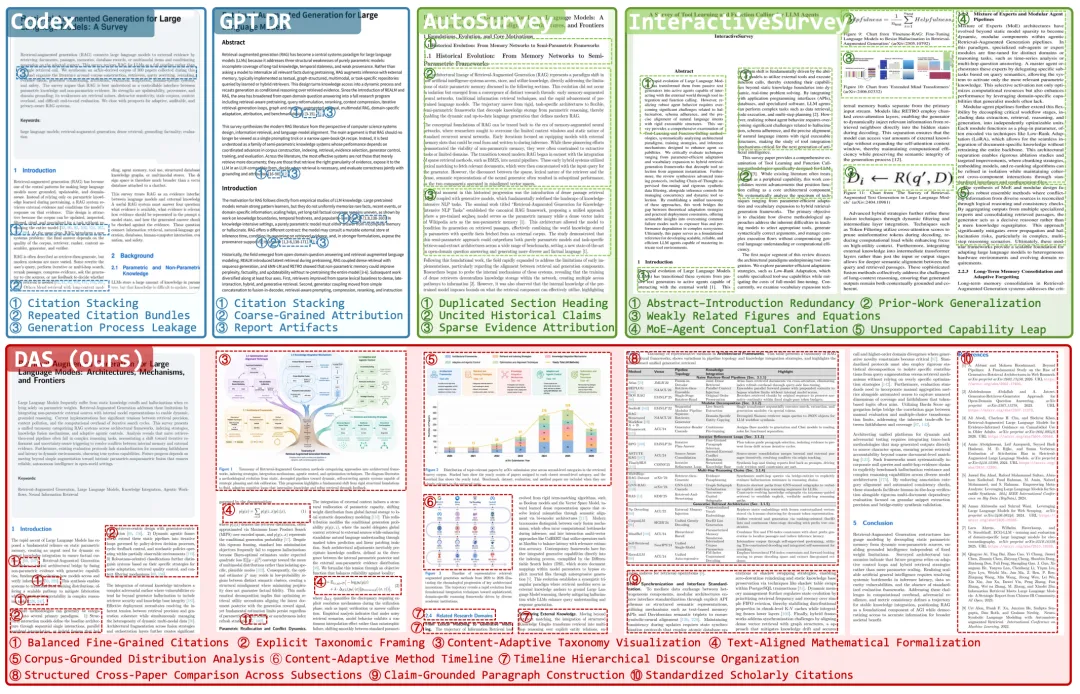
Figure 3 is a comparison of the quality of the Codex, GPT Deep Research, AutoSurvey, InteractiveSurvey and DAS.
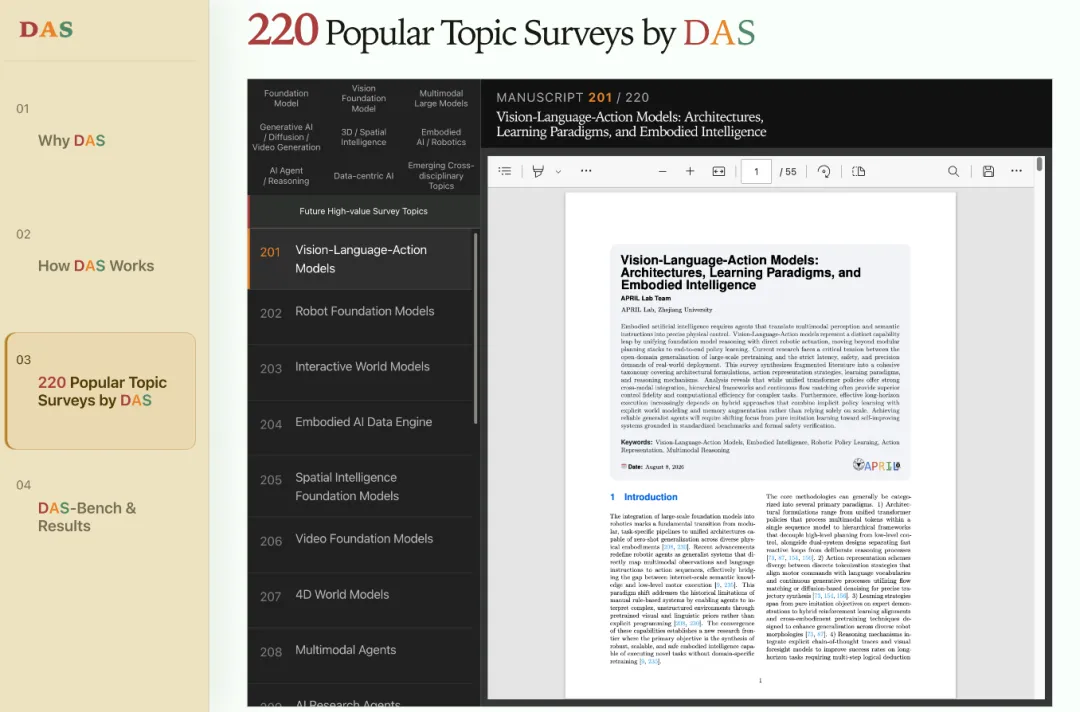
Figure 4 The official website of DAS has now opened the full generated results of 220 popular Topics.
Instead of just looking at a Benchmark score, it's better to look directly at the results.
Address of the project:https://zhikaixu24.github.io/projects/DAS/#manuscripts
How far away is AI from actually "writing a survey"?
Of course, direct publication does not mean that a researcher can be directly replaced in completing the final post. DAS-generated surveys still require artificial verification; at the same time, Academic Survey Evaluation itself is still an open problem, and different Judges may still differ in particle size assessments. Cross-Judge Evaluation in the paper also observes this phenomenon.
As DAS-2M continues to be updated, we can further explore the future of dynamic document tracking, manned collaborative modification, and maintainable and sustainable Agentic Academic Survey Construction.
The ultimate question that DAS wants to explore is not "Can AI write a long article at once?" but:
In the face of growing academic literature, can AI, through a traceable, modifiable Stateful Agentic Closed Loop, help researchers get into unfamiliar areas faster and continue to organize and understand evolving academic knowledge?
Introduction by the author
The paper was co-authored by Dr. Xu Zhi Kai, Ph.D. student at the APRIL Laboratory of Zhejiang University, and communication author Zhang Jiangnin, a researcher at Zhejiang University's Hundred Program.