Earlier this morning, the 25 winners of the Fields Prize, including Tao Te Ching, issued a joint statement entitled "A Severe Misalignment of AI in Mathematics". The signature list ranks from 1978's Pierre Deligne to this year's winners, including Schultz, Maria Viazovska, June Huh, Maynard, James Maynard, and others.
The statement does not deny that AI is powerful, that it has a huge role, after all, AI has been able to solve major unresolved problems in several branches of mathematics. The problem is: it is too soon. These solutions are often announced in a hurry, in order not to write a normative paper, in order not to disentangle new methods and new ideas, or in order not to cite related works from others.
The 25 winners of the Fields Prize feared that producing "true/false" judgments in increasingly rapid batches would destroy the ground for new ideas, breaking the critical human heritage chain among mathematicians.
In a blog post, Tao added that they had planned a more comprehensive enquiry process, like the one in the Juliet Manifesto in June, but felt the situation was urgent and had to issue a statement first.
The day before the announcement was made, another important conjecture was confirmed by AI.
Komlós speculation proved by AI
On 10 September, arXiv No. 2609.11189, entitled "Vector Balancing via Directional Total Variation" ("Vector Balancing by Directional Total Variation") was published in Combined Mathematics and General Function Analysis, full text, page 18, without graph.
The last sentence of the abstract is: This proof was discovered by Odin Automatic AI Research Agent.
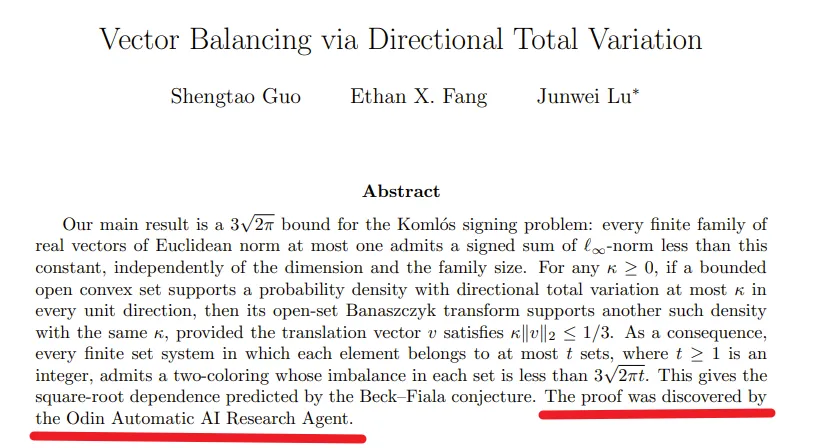
The paper claims to have proven the Komlós conjecture. The conjecture, first presented by Hungarian mathematician János Komlós in Spencer's famous 1985 account of the six-fold standard deviation, is one of the most famous unsolved problems in discrepancy theory for forty years.
This speculative statement can be very concise: give you any number of vectors with a length of no more than 1 e, no matter how many of them are in the space, always add a positive or negative number to each, so that after adding up, the values on each coordinate are stuck by a constant that has nothing to do with the dimension, the number of vectors.
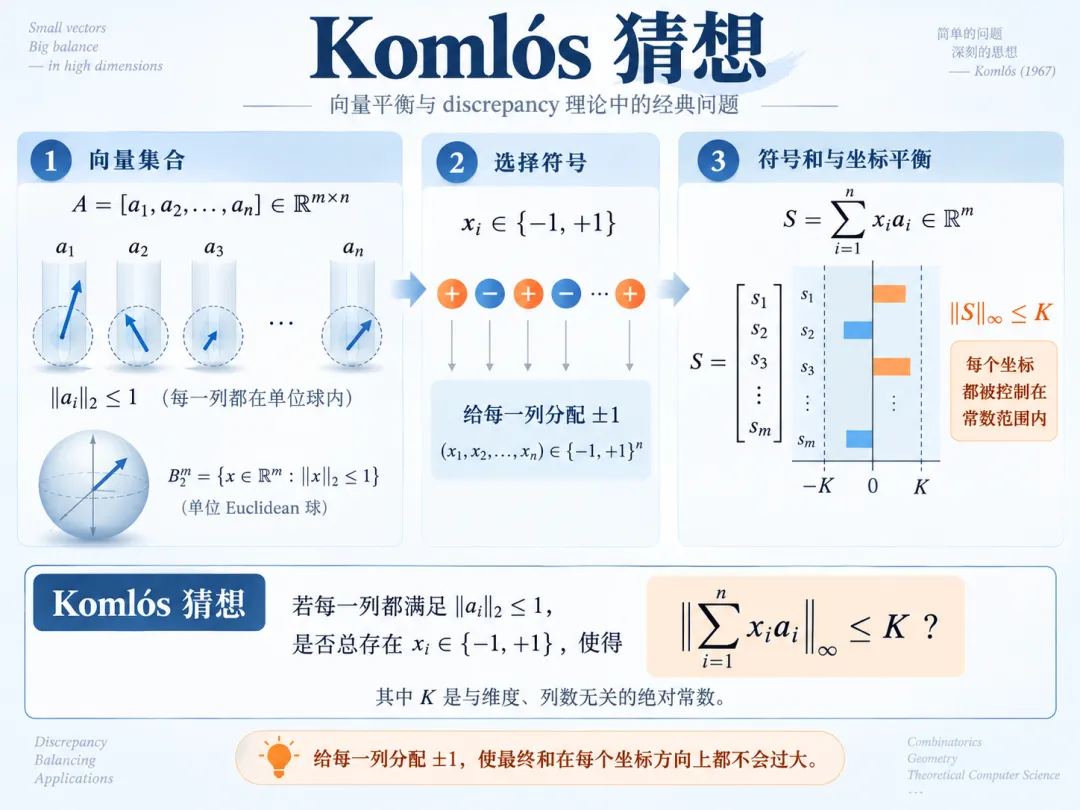
The Komlós Conjecture is one of the most famous unsolved conjectures about vector balances in combinatorics and differential theory. It was proposed by mathematician János Komlós in conjunction with computer science, geometry, and combinatorics.
For forty years, this "constant" has remained untouched. In 1998, Banaszczyk made O (√log n) using the Gaussian measurement method, a boundary that has remained untouched for 28 years.
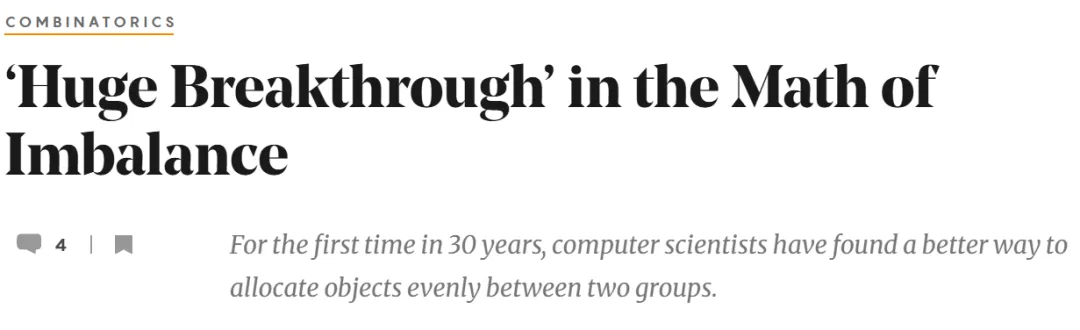
This year, Nikhil Bansal and Haotian Jiang pushed it to Õ(((log n)^{1/4} at STOC 2026), which Quantum Magazine published on August 21 in a special report calling it a "huge breakthrough", concluding by writing that this progress may reignite the pursuit of Komlós's constant world.
Three weeks later, the pre-print version directly delivered the constant: 3√√2π, which is approximately 7.52.
Three biological statisticians and Odin
The paper was signed by three people: Shengtao Guo, Ethan X. Fang, Junwei Lu. The full text only gives one of the units to Junwei Lu, the Biostatistics Department of the Harvard School of Public Health, and two others without labels.
This is not a combination of authors who appear in dissertations on the theory of differences. This direction is frequented by Bansal, Rothvoss, Dadush, Nikolov, who have a theoretical background in computer science and convex geometry, while Lu's main battlefield is high-dimensional statistics and biostatistics.
But this isn't the first time the trio has done this. On August 16, the same trio signed the same tag Odin, uploaded paper 2608.15515 on arXiv, claiming to fully prove the Talagrand convexity conjecture on the Boolean supercube.
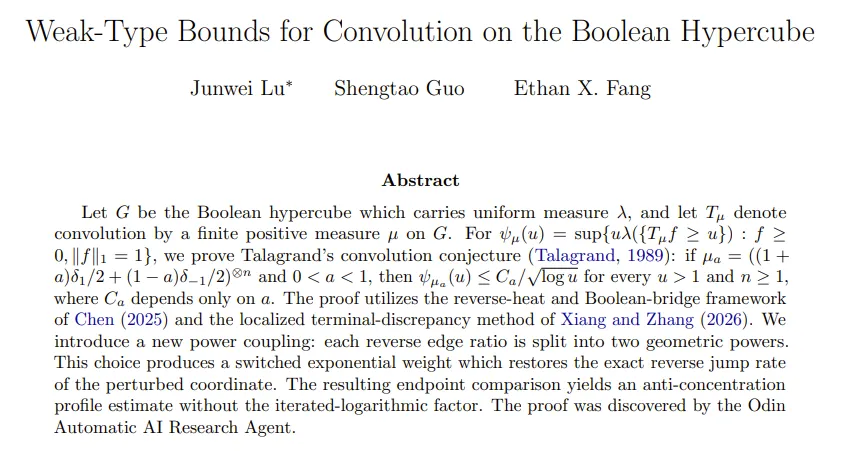
The Gaussian case had previously been solved by Eldan and Lee, as well as Lehec, and the Bull case had been pending; in November 2025, Yuansi Chen proved that only one factor (log log)^{3/2} was disrupted by the anti-thermal flow method, and in June 2026, it was narrowed down to the log log log, a paper that claimed to completely erase this last loss.
It is noteworthy that this claim has been picked up by colleagues. On 10 September, Alexander Shaposhnikov posted a paper reworking the Talagrand convexity conjecture using a convex method, writing directly in the quotation that the Bull case had recently been solved by Lu, Guo and Fang, noting that it was an AI-generated proof.
In other words, the combination has already been certified once before.
As for what Odin is, the paper doesn't say a word - it's not DeepMind's Aletheia, it's not Harmonic's Aristotle, it's not Axiom, it's not OpenAI's any open system.
The paper's complete substitution for AI's role is two sentences: Odin is used to find proof, and the final proof is that the author rearranges the text.
What does this paper say?
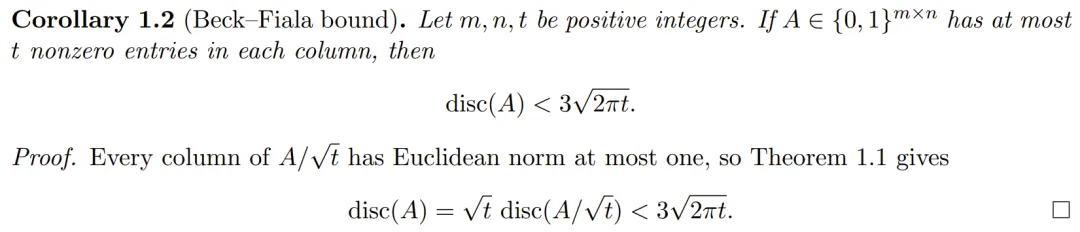
The main theorem has only one line: for any positive integer m n and any dimensional vector m v1 to vn, as long as each vector's Euclidean range is not greater than 1, there exists a set of ±1 attributions, so that the l∞ range of the symbols and the band is strictly less than 3√ ((2π).

This immediately leads to the inference that if every element in a set family belongs to a set t at most, there exists a binomial chromosome that makes the imbalance in each set less than 3√(2πt. This is precisely the square root dependence relationship that Beck and Fiala predicted in 1981, when they only confirmed a linear 2t−1 that year.

The key to the method is to replace the Banaszczyk key. The Banaszczyk 1998 framework relies on a Gaussian measurement rule: as long as the Gaussian measurement of the target convexity is large enough, the vector can be inserted.
The invariant used in this paper is the "directional total variance", roughly speaking, which measures how much mass will deviate from its original position when a probability density moves slightly in one direction. The key is that, for a cube of fixed length, there is a density that prevents this quantity from dimensional degradation. The rest of the work is to prove that Banaszczyk's geometrical variation can keep the quantity the same at every step of the iteration.
The paper itself outlines a clear boundary: the whole argument is existential, and no polynomial time algorithm is given; the constant 3√(2π) also does not claim to be optimal. As a reference, the best known bottom line is from Kunisky's construction of 2023, with approximately 1+√2 ≈ 2.41, and considerable gaps between the two.
What is the meaning of this verse?
Of course, we can't say yet that "Komlós guesses have been solved", after all, peer review is still necessary.
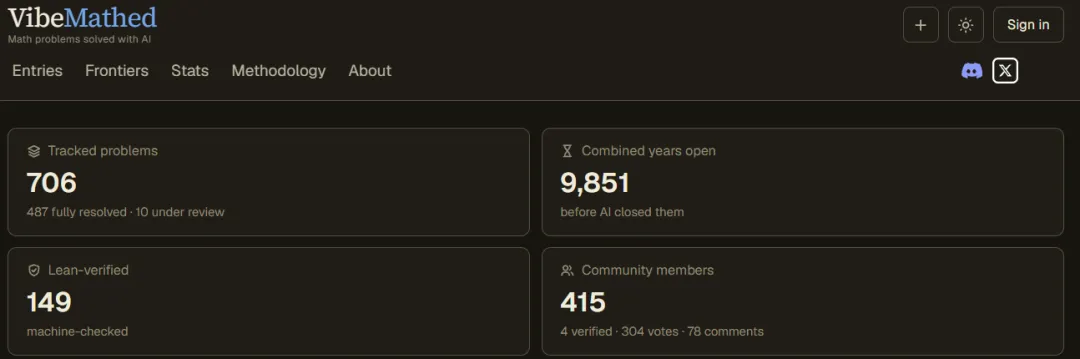
Interestingly, the result falls right into the structural rift that the winners of the Fields Prize have described: claims are far faster than verification. It should be noted that VibeMathed is currently tracking 706 entries in mathematical problems involving AI, and in the last week alone there has been an influx of claims such as the Navier-Stokes equation (compulsive case), Smale's speculation of anomalies, and the intersection of prime numbers.
The traditional peer review mechanism is based on the premise that "the pace of human refinement of new ideas is largely matched by the speed of verification". Today, three statisticians, with the Odin system unknown to the outside world, in less than a month's time, have unleashed evidence against Talagrand's conjecture and Komlós's conjecture. The efficiency of the algorithm's mass output of symbols and conclusions is rapidly hitting the entire academic community with a buffer belt that was originally used to understand, digest and transmit new mathematical intuition.
This is the underlying reason why the 25 winners of the Fields Prize, including Tao Te Ching, have appealed. If future mathematical research turns into a war of self-defense claimed by AI, the community ecosystems that human mathematicians rely on will be irreversibly impacted.
3√(2π) Time will tell if it can't be tested; but after that, how the mathematical community coexists with this frenzy of calculus is really an unsolved question that hangs in everyone's head.