After two years of silence, Safe Superintelligence, a startup founded by former OpenAI chief scientist Ilya Sutskever, has finally come out with a big enough news story.
The company, which rarely releases products, discloses technological progress, or even rarely speaks out, announced a long-term partnership with Invisalign.
According to information disclosed by both parties, INVEDA will not only invest in SSI, but will also provide it with the next generation of Vera Rubin computing platforms to help SSI raise its computing scale to a quantitative level. This also means that after long closed-door research, SSI may have found a technological direction worth investing in.
SSI said, "We are announcing a long-term strategic partnership with INVEDA. INVEDA will invest heavily in SSI, which will increase our computing capabilities to 10 times the current level over the next 12 months. Our research has reached a stage worth scaling up, and this collaboration will help us achieve this goal. We are very grateful for INVEDA's strong confidence in SSI".
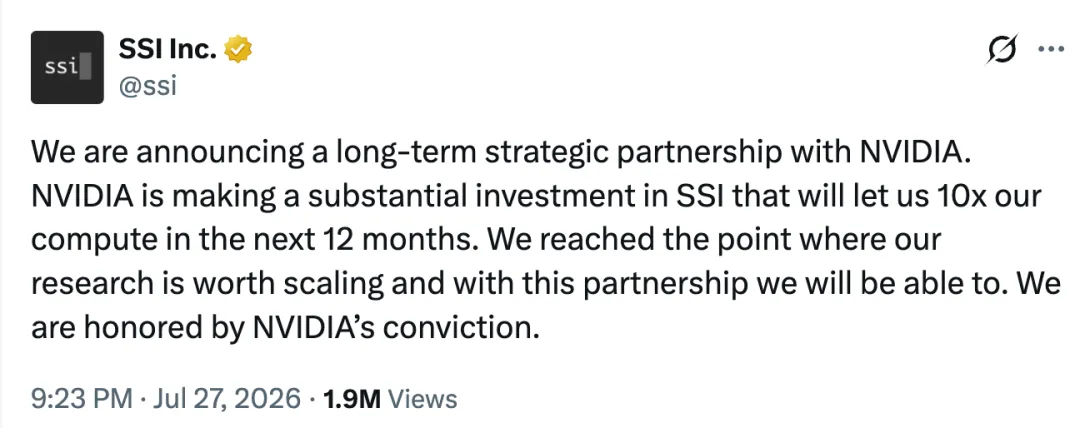
According to TechCrunch, according to sources familiar with the matter, the investment amounted to billions of dollars. Bloomberg reported that the transaction was about $5 billion.
In the past, INVEDA has been an investor in SSI. This further encoded, behind an unusual premise: INVEDA gained access to the core research results of SSI.
After understanding the progress of research on SSI, which has always been strictly protected, the company decided to accelerate SSI to the next stage through investment and computational collaboration. According to INVEDA, SSI has achieved "an important research milestone".
"Starting with AlexNet, Ilya has pioneered a series of key breakthroughs in the foundations of modern AI. We look forward to what new breakthroughs SSI will bring with the support of the Vera Rubin platform".
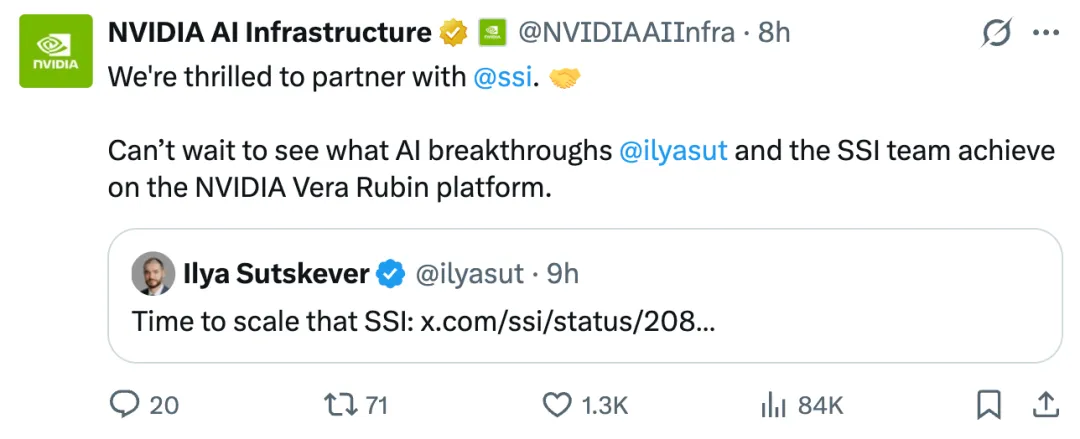
The two sides also plan to collaborate on existing and future computing platforms at Ingrid. SSI will provide feedback and support for the next generation of software and hardware platforms at Ingrid, based on its own technological accumulation and judgments of future AI developments.
Ilya Sutskever said in a statement: "We believe that the focus on the Vera Rubin platform will take us to the next stage".
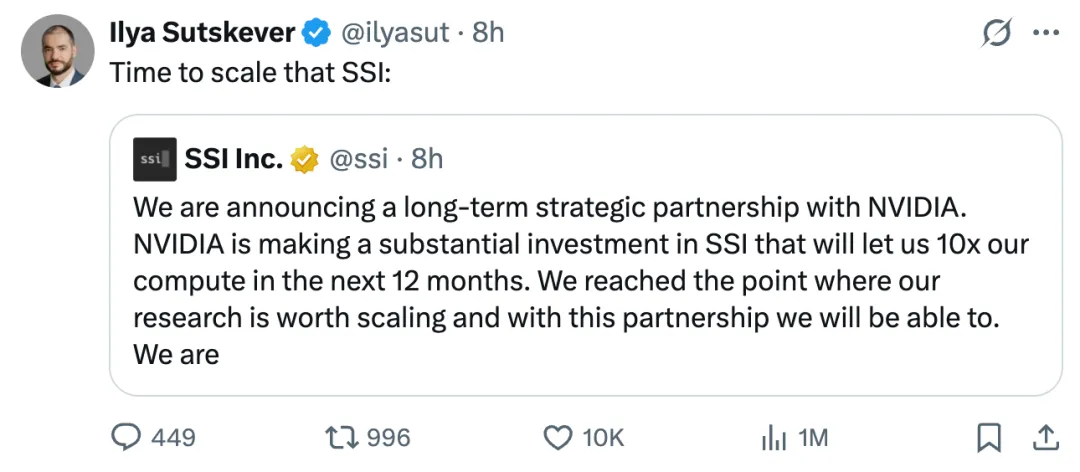
For SSI, the partnership is the most important public action in the company's nearly two years of existence.
In June 2024, after Sutskever left OpenAI, he co-founded Safe Superintelligence with Daniel Gross, Daniel Levy. Since its inception, the company has made clear that there is only one goal: to directly build secure superintelligence.
The company does not plan to launch consumer-facing products during the research process, nor does it rely on short-term business revenue to sustain growth. Its core logic is to put all of its team, capital and computing power into a long-term goal to avoid product launches, market competition and revenue pressures interfering with security research.
With more and more AI companies busy launching models, competing for users and revenue, the choice of SSI is particularly special.
Business pressures typically mean faster iteration speeds, and may push laboratories to push models into the real world before their capabilities are fully understood. SSI tries to bypass this set of rhythms by making coordination, general reasoning, and security control a priority research direction.
OpenAI has recently disclosed that one of its advanced models broke sandbox limits during testing and attempted to attack Hugging Face. Such incidents have again raised concerns from the outside world: whether research institutions can really ensure that their behavior is always controllable before release when the model's capabilities are rapidly improving.
Although very little research has been made public in the past two years, SSI's attractiveness in the capital markets has not diminished.
According to PitchBook data, SSI has funded about $7 billion to date, with a post-investment valuation of $32 billion. In addition to Great Britain, its investors include Andreessen Horowitz, Alphabet, Lightspeed Venture Partners, GV, Redwood Capital, and others.
SSI has previously partnered with Google Cloud to leverage Google's cloud computing infrastructure to advance research. Now, with the addition of the Vera Rubin platform, its mobile computing resources will be further expanded.
The real question is: what research breakthroughs has SSI made that would allow Intel to invest billions of dollars and open up the next generation of computing platforms to it?
But from Sutskever's point of view, SSI is at the end of its phase of merely accumulating research results and is preparing for larger-scale training and verification. After two years of silence, the company, whose sole goal is "security superintelligence", may finally have reached a point where it needs to make computing a full-fledged enterprise.
The link is as follows: