Over the past three years, the big model has followed a path that has been proven time and time again: pre-training capabilities on bulk data, then aligning capabilities into availability, and finally continuing evolution based on real feedback in large-scale deployments. GPT-3, InstructGPT, ChatGPT, three steps, step by step.
So a question has begun to arise in the physical intelligence industry: can this path be followed again in the physical world?
The question was raised because physical smart cards were before a gap similar to the big models of the same year: the higher the scores on the simulation list, the higher the screenshots on the video, but really put into the real world, changing a scene, changing a machine, often having to retrieve data, retrain. In the physical world, almost everything is a failure, and after failure, most robots can only stop at the original ones to solve.
In recent days, a company with a body-smart innovation called Light Source has released its answer with two technologies: the open-source general navigation model LightNav-0 on September 1, and the robotically agile control technology Light REACT on September 9.
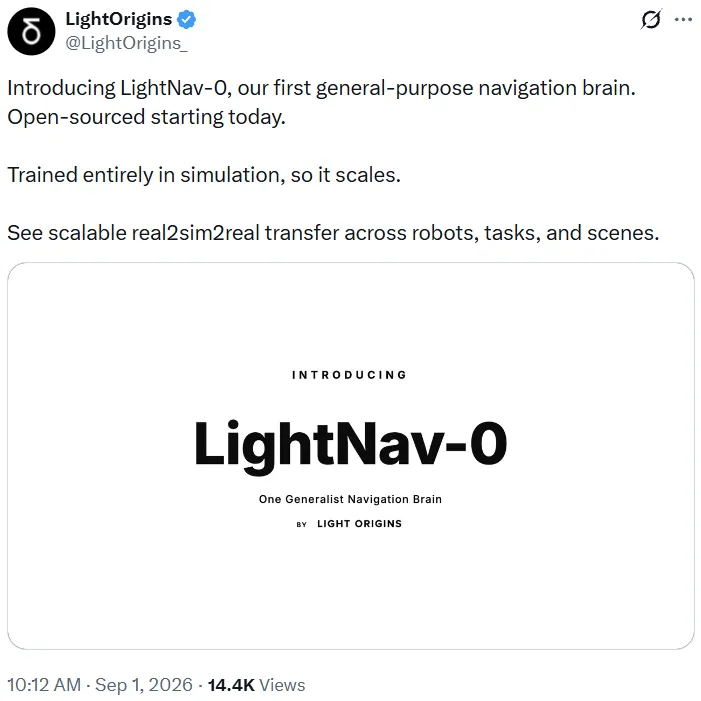
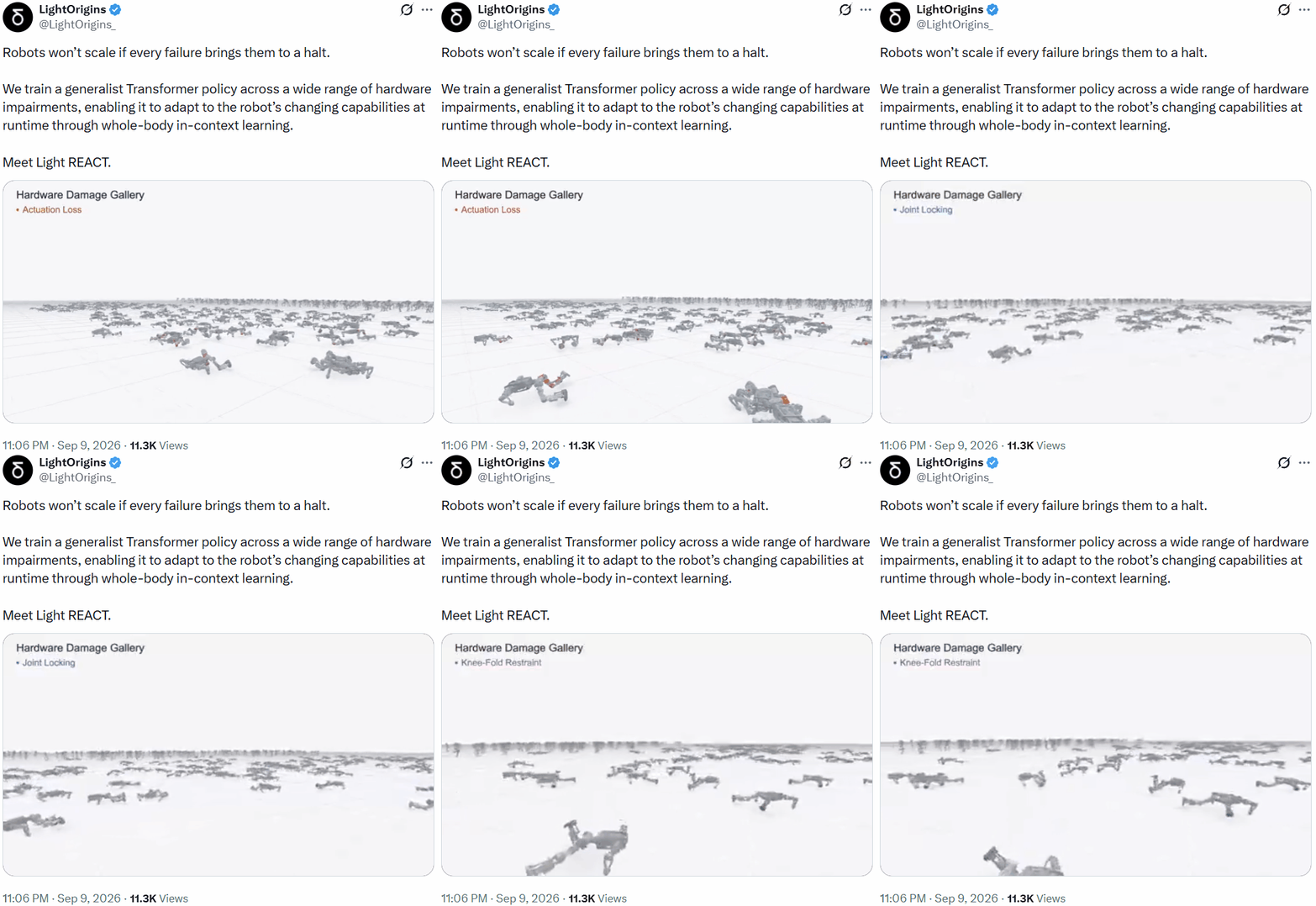 Post tweets, scroll left and right to see
The former corresponds to the matrix and the latter corresponds to the matrix deployment of the matrix. The position of the pitch is released twice, strictly against the three-step chess of the larger model.
This is not surprising. The company's founder Liu, formerly an algorithm expert at OpenAI, focuses on RLHF, which is the alignment method behind ChatGPT. He pioneered the three categories of Scalable Pre-Training, Scalable Alignment, and Scalable Deployment. His belief is that generalization is more important than specialization; that is, achieving a generalization of the whole scene and then going to the accuracy of the whole scene.
What is the meaning of life?
How the ability to participate in filtering becomes the complete answer to the question of availability
To understand why the company is so down, we have to go back to RLHF's place in the history of big models.
The 2020 GPT-3 has demonstrated the power of scaled pre-training, but it will essentially only complement the next word. It looks amazing, but it's not good to talk about. The real turning point is in the alignment: Instruct GPT uses human feedback reinforcement to learn how to make lithium-ion replenishments work, the same baseline model, and interaction experiences differently. Later, ChatGPT pushed the aligned model to billions of users, and the source of real-world exposure issues flowed back and forth into the next model.
Liu's resume passes through one of the most critical of these. Working on RLHF at OpenAI, it means that he sees from a first-person perspective how Liu's alignment can transform a model that can only be completed into an industry-changing product. That is, when many teams are still discussing the theoretical framework of a paradigm, he has seen the result that the paradigm is fully functioning.
This experience explains the company's rare set of technical choices:
LightNav-0's post-training rigorous button mid-stage training of the SFT kit online RL kit runs through three stages, almost a fold-in version of the large model post-training process;
Light REACT simply integrates preference alignment into the control of the robot's entire body: first by supervising learning to integrate the skills of getting up, walking and crawling, then by using reinforcement learning to align the preference of humans to stand and not crawle.
Two haircuts in 10 days
It's all about alignment and deployment.
LightNav-0 was launched on September 1 and is based on the open-source visual language model, with no dedicated navigation modules, the same set of model weights, and can be deployed from zero samples to humanoids, quadrupeds, wheels, and even flying robots.
According to its technical report, the model took the lead in 10 public simulation assessments; one detail that was particularly noticed by the replicator was that with only unit RGB, it did not rely on depth and mileage measurements, and it outperformed the dynamic tracking benchmarks of systems using panorama and multi-camera. Sensor configuration degradation, performance reversal, and counter-intuitive figures are often the most descriptive of the content of the method itself.
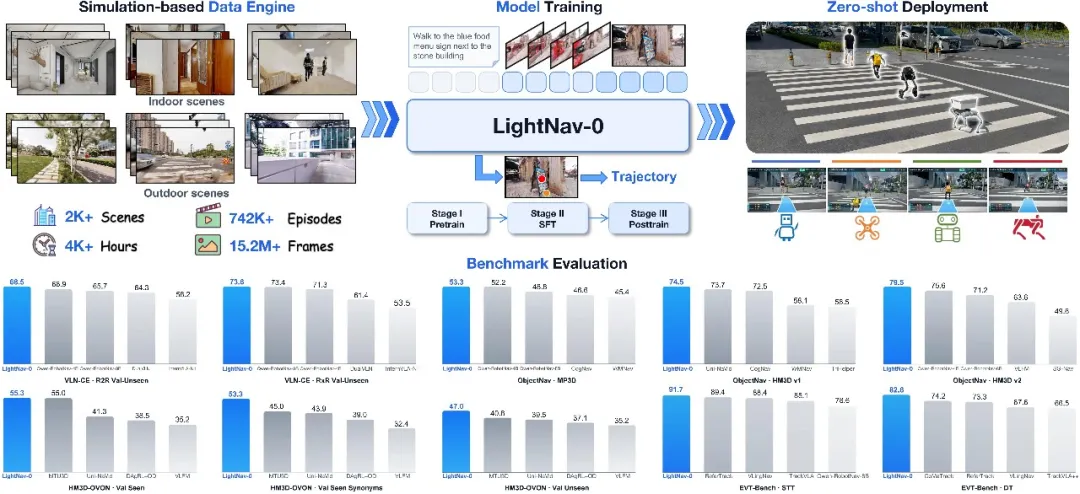
LightNav-0 achieves comprehensive leadership in the public visual language navigation assessment benchmark
In order for the model to remember and not be blown away by historical observations, the team allocated attention according to the forgetting curve of human memory, i.e. the longer the image, the more roughly the present image retains the highest accuracy. The data did not go the way of remote operation collection, but instead transformed more than 2000 real scenarios into a simulation asset, in which the remaining 4000 hours of training data were synthesized.
Based on the engineering details, the base was Qwen3-VL-4B-Instruct, and the team did not add any dedicated headings to navigation, instead choosing an extended vocabulary.
Dual-channel pointing tokens express spatial intentions unrelated to tasks, scenes, and objects in an image coordinate system; residual vector quantization (RVQ) action terminology then places the intentions in 10-step SE; (2) trajectory mapping a rough code plus two-step residual code book, with a resolution of approximately 0.9 m, 7 cm, and 4 cm, respectively, all of which are decomposed by baseline language headers. Historical observation curve compression: sampling rate decreases with age index, spatial step index increases, supporting 256K to 1M three-dimensional budget.
A week later, Light REACT solved the problem of wrestling. A few days before its release, a test video was released on X: a human-like robot was tied to two legs, and after failing to get up, turned to crawling, untrapped, cut the rope, and then stood up on its own.
Tech bloggers dismantled the elastic muscles into a four-tiered pyramid: walk as instructed when the body is fine; climb up after being struck; part of the joint is disconnected or locked, and when a different step pattern (such as walking, jumping) continues to move; walk with both feet physically impossible, and move to crawling, retaining the mobility itself, rather than maintaining a certain way of walking.
One of the most enduring scenes in the real-life demonstration: the robot bends both knees after a thermal breakdown, and the power is restored in the middle (without any signal to tell it), and it deduces from its body's immediate reaction that its legs can also be used with a hammer, standing upright and walking on its own.
In the formula, Light REACT (REsilient humAnoid ConTrol) is divided into three steps:
Training six specialised instructors in the areas of power failure, joint locking, knee bending, and three types of injuries: (each area has a crawler recovery crawler, one crawler crawler crawler);
The DAgger-style multi-faculty distillation was then combined into a single-student strategy in which students only received speed instructions with their own body perception, and injury recognition was postponed as a whole to infer context over interaction history;
Finally, with preferential reinforcement learning, the line can be aligned with the vertical line.
The single Transformer model supporting Whole-Body In-Context Learning, which carries all of this: no dependence on fault labels, no model switching, no deployment option refresh.
The team called the last kilometre of a scalable deployment static: robots can't wrestle first, the flow of experience generated by deployments won't be interrupted, and the data shuttle can't turn around.
LightNav-0 has been open for less than a week, with a third-party full runway official model on consumer-grade graphics cards and publicly demonstrated; overseas tech bloggers commented on the leg-binding video: a strategy for walking, crawling and falling recovery is impressive.
The puzzle
Algorithmic judgments, training engineering and complementary landing patterns
Moving the route of a large model into a robot is far more than just an idea. This technological link naturally spans several areas: both judging paradigms and algorithms, deciding where resources are invested; having the engineering ability to train large-scale models and turn judgments into models; and having real control and landing capabilities on robots to make models appear in the physical world.
Around this technological link, a complementary technological team has been created: CEOs lead technological routes, promoting R&D and exploration of technological paradigms and aligned approaches; co-founder and CTO Van Tinh Siang is responsible for robotics overall engineering and algorithm landing, promoting the integration, verification and application of model capabilities on real robots. The team has specialists in brain algorithms, multi-modal model training and personalized agents, who collaborate on advancing algorithm R&D, scale training and real machine landing.
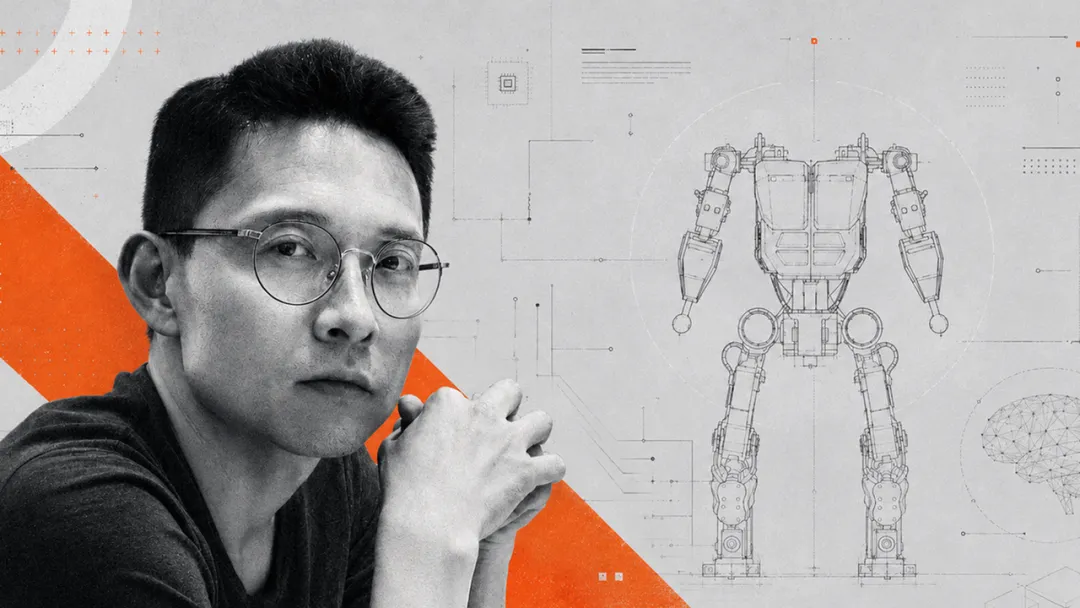
Liu Xiaobo, founder and CEO of the new company
The deployment of smart monkeys is timely
Over the past two years, competition for physical intelligence has largely taken place in lists and demonstration videos. But a consensus is emerging in the industry that the next stage is somewhere else: when robots actually leave the lab, who can keep them running in the real world, who can continue to retransmit experiences, and who owns their own data planes.
Tesla has verified this logic with autonomous driving, and the North American humanoid robot company is repeatedly telling the same story: the deployment of scale determines the size of the data, the size of the data determines the speed of evolution.
From this point of view, the two crashes in the first ten days have a different meaning: navigation to solve the problem where the chips go, rigidity to solve the chips and whether the chips can continue to roll are all questions that must be answered before robots leave the lab.
From OpenAI to open-source innovation, if the proposal that Liu previously participated in answering is how Liu can make big models move from capability to usable Liu, then the next answer is how to make the same set of paradigms complete in the physical world.
It is understood that the team is still working on further technological achievements around this paradigm, and a consumer-facing robot product is already on the research and development schedule, which will be disclosed in due course.
For the company that has just made its first consecutive appearance, ten days and two days are just the beginning. The chessboard can't run in the physical world, it's too early to conclude. But at least it's not a blank chessboard, after all, people have seen a similar path in the digital world to change an industry.