It's the first time in the history of the world.
I can't hide, this time I can't hide at all!
Google DeepMind、Figure、1X、Genesis AI、Dyna Robotics……
One of the hottest robot players in Silicon Valley is the same data "blood donor".

The Dyna-2 runs a million hours of Scaling Law, behind it.
GENE-26.5 The first person to use the data to complete a 20-step meal with one breath comes from here.
It's clear that "data collection" isn't enough to take these top customers.
In the hands of this mysterious company, there is another more powerful data processing and algorithmic capability.
The hardest corner cases in the industry, with their hands tied up, transparent gloves on, fast-moving and distorted images, are still in their hands and can be retrieved as models.
And it's because the entire chain of acquisition, processing, algorithms, and delivery is open.It is capable of storing 1.5 million hours of high-quality data and delivering 2 million hours of cumulative data globally.

Fast-moving + multi-handed mirrors, still stable recognition
It's basically the data infrastructure behind leading robotics companies.
Today, the mysterious company that finally uncovered it is Maxinsights!
Physical AI, a Silicon Valley-based team with almost all of its main customers in the United States, returned to the domestic market in March.
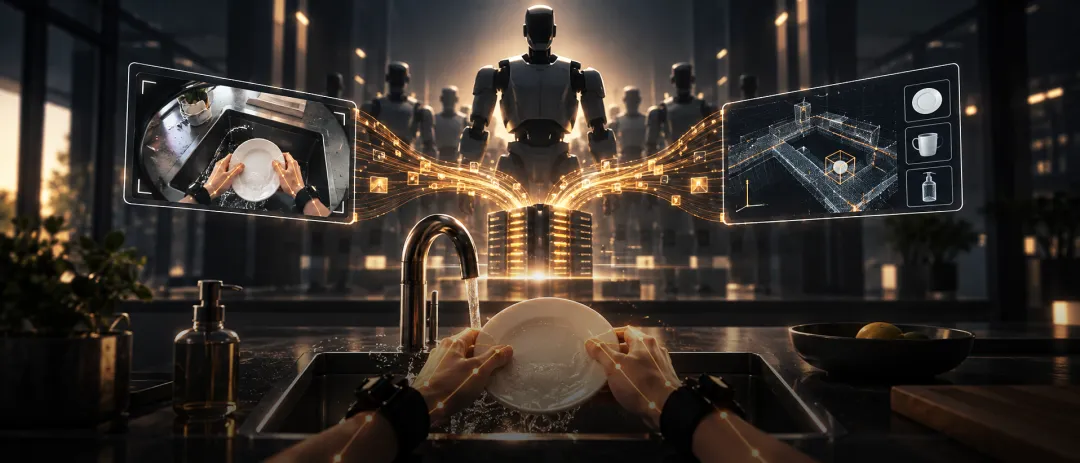
It's about turning real-world human experience into a training fuel for Physical AI.
Human daily videosHow to Become a Physical AI ReplacementSo the question is, why would a data company train its own model and make it so sophisticated?
The answer is the doorway from Physical AI to the real world.
Let Physical AI explain how to fold clothes, and let it really fold clothes, with lots of detail in the middle.
Where should the hand be grabbed? How is the corner of the garment compressed? How should the next move be adjusted after the fabric slides?
These experiences are seldom written down in full, but human beings use them daily.
Large language models can run on the Scaling Law because the Internet has long replaced it with text; visual models have inherited billions of images.
There are billions of hours of videos on the Internet, but hardly a single scene that captures how people work from a "hands-on" perspective.
The first is data, also known as egocentric data or ego data, which provides a way of recording data.
From the operator's point of view, take a picture of how the hands interact with objects and how the environment changes before and after the action.
It brings learning materials closer to the task itself.
In the past, the main practice of teaching robots how to work was remote control. That is, a person with remote control devices would grab a cup, put on a towel, and the robot would record every move.
This kind of data is high quality, but expensive, slow, and a robot can produce several hours a day, and the data and the specific robot itself are tied up and replaced by another machine.
The first person to call the value of the data is here.
The collection of equipment follows the operator, records the scene he sees, and the interaction of the hands with objects.
The operational experience that people have accumulated in the kitchen, workplace and living space gives them the opportunity to enter the training system.
However, this is only the first step.
Video is not like training dataFor example, in a video of a human holding a bottle in a kitchen, people look at it and see what happens.
After entering the training process, further dismantling is needed.
Which hand holds the bottle, which hand starts to rotate, from which turn the movement starts, where it ends, and how the wrist moves in space.
If the two hands are crossed, the fingers are stuck in the bottle, or the movements are too fast to cause blur, it is difficult to judge.
A label that says "the bottle is being bottled" does not explain these details.
The robot wants the data to be structured, not an image.
Where is Maxinsights' algorithm? A demonstration of the team's ability to put three layers of capability into the same data.
What's the solution to this algorithm?He said, "Come and see a man with his hands strapped and his movements unable to catch up".
People are active in a real environment, the upper half of the body is always moving, and the hands are also crossed, obscured by objects. The tracking system must restore body and hand gestures as accurately as possible from the ever-changing images.
But in the video demonstration, even in this case, the algorithm tracking still maintains a higher accuracy.
MaxEgo's self-developed hand and gesture information extraction is an important part of this processing capability.

The tracking of the shadowed hand remains stable.
It's hard not to put your hands in front of the camera in order to facilitate the algorithm.
The more reliable the tracking, the better the opportunity to retain these details for subsequent training.
And when we look at the space, people go out for a circle.The system will be able to return to its original location.?
The test here is SLAM, which is the process of identifying one's own location and creating a map of the surrounding environment.
As the cameraman moves, positioning errors may accumulate gradually. People clearly return to the starting point, but the trajectory of the system recording is not necessarily correct.

In this demonstration, the trajectory can be better closed and aligned with the starting point from the exit to the return of a circle.
As a result, hand movements have a more complete spatial background.
How the hand moves, where the person is positioned, and the geometry of the surrounding environment can be understood together.
It's the hard work behind the team's hard work.
Maxinsights' core engineering team brings together top companies such as Waymo, Google, Meta, QCraft and others, as well as senior engineers from Stanford and Berkeley's front-end labs, who have worked extensively in autonomous driving for many years.
As an industry driven by bulk data, the team has a long-standing experience in managing and transforming multi-million-dollar endpoint data.
Today, with the shift to robots, underlying engineering methods and data links are still well-established.
Finally, let's look at the movements, the trajectories, and what people do.
In the presentation, language markup is generated by self-developed video understanding and markup models that can more accurately match actual operations.
In the Maxinsights data system, this information is organized according to environments, tasks, subtasks, and action instructions.
For example, an operation in a hotel room can be broken down into:
Hotel rooms → Cleaning rooms → Putting water bottles → Putting water bottles on the table with your hands.
This connects the trajectory of the movement to the meaning of the mission: the model can both obtain information about how the body and hands move and know what the movements are aiming at.
How the body moves, how it moves in space, what it is doing, the three layers of information combined, a daily video has a more complete learning value.
The deeper the data is processed, the more information models can learn from the original images.
According to internal evaluations, from MaxEgo 0.5 to 1.0, the critical error indicator in the relevant difficulty cases dropped by more than half.
Algorithms are supported by 2 billion human gesture data, as well as a verification system that consists of artificial correction and high-precision reference data.
This also explains why data accumulation and algorithmic ability are mutually beneficial.
In addition to gesture tracking, spatial positioning and motion understanding, there is also deeper physical information to dig.
According to Maxinsights, there is also physical and environmental geometry, position of objects, and the most difficult and valuable contact information.
As a result, the Maxinsights process also combines quality inspection, format unification, video understanding, spatial processing, gesture tracking and artificial correction with pre-delivery inspection and format conversion.
The two models combined to automate QA in four phases, handing over 98% of the quality control coverage to the machine, which handles only the portion that the machine does not allow.
The results of the study were corrected and the training data were returned to the next version of the model.
This is a more streamlined aircraft: the more delivered, the more accurate the model, the cheaper the label.
The work of 5,000 people was first "electronized".Besides the technology, Maxinsights is more difficult to replicate than anything else.
How to get 5,000+ collectors from all over the world to continuously and unabashedly capture real life.
MaxinsightsIn many countries, direct pipelines have been installed by local teams.CommunitiesThe network covers 2,000+ harvesting environments, 50,000+ scenarios and 450,000 hours of monthly harvesting capacity.
It's based on an Agent platform:
It looks at the distribution of the data and finds that "there's enough after-restaurant cooks, there's not enough repair rooms", and then puts the equipment and people at a disadvantage.
It recognizes ineffective footage, displays footage, wears deviations.
It also allows the scene to rotate once every two weeks to avoid the same kitchen being photographed to model fatigue.
Who is the collector?
Many are housewives, restaurant cooks, workshop workers, farmers who harvest different fruits on farms, engineers who repair various cars, care for elderly people, etc...
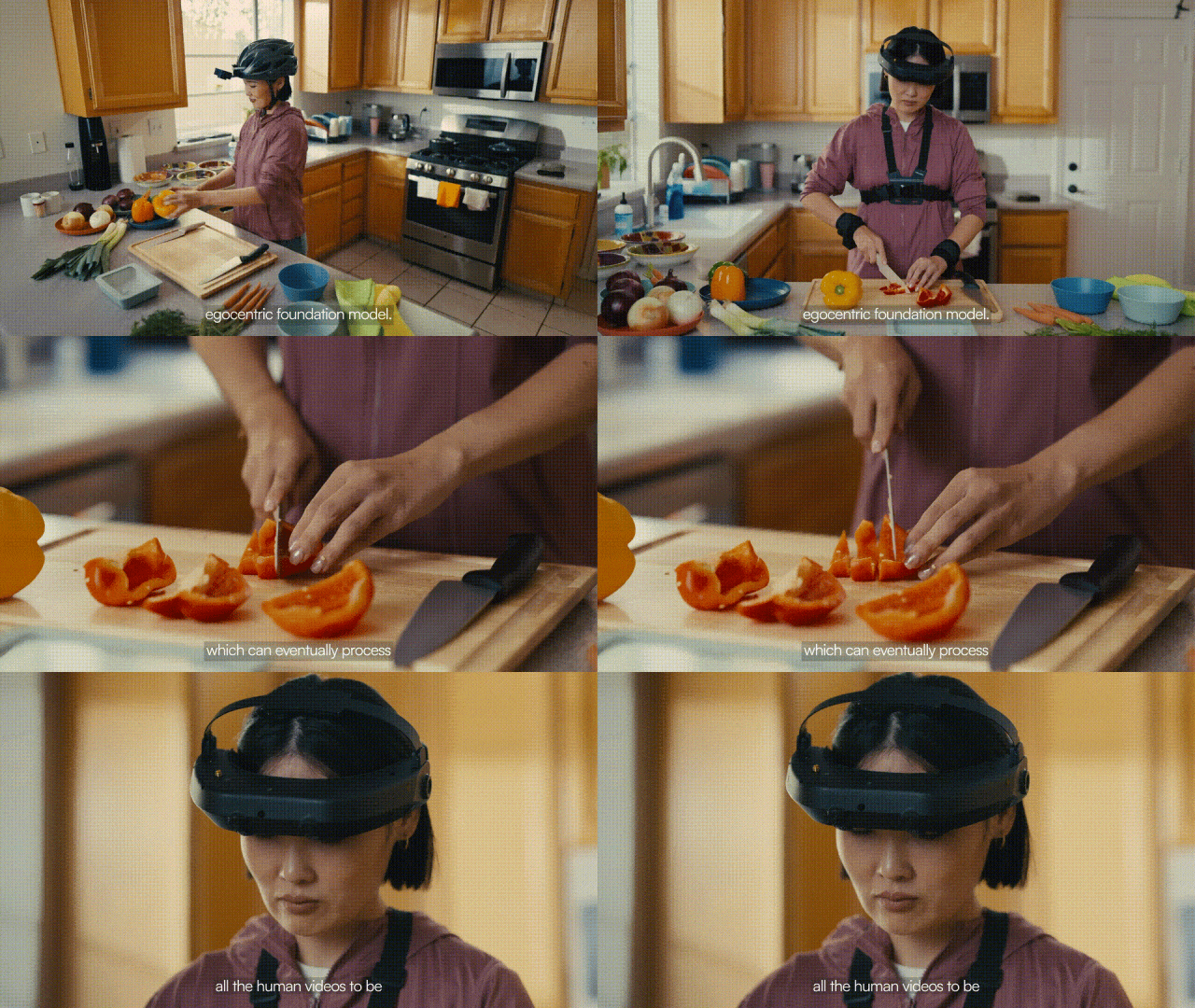

For decades, a woman's sense of cutting, choosing, and bottling has only existed in her own muscular memory.
Now, with her camera on, she makes a meal, and these movements are broken down into hand tracks, movement timing and semantic labels, becoming the first lesson in robotics to do household chores.
This is probably the first time that ordinary people can sell "crafts" directly to Physical AI.
For model companies, this is also the most indispensable part of the puzzle.
In real life, messes, mistakes, and on-the-ground adjustments can't be done in the lab.
Millions of hours of model trainingTwo of the hottest robots this summer were the big ones, according to Maxinsights data.
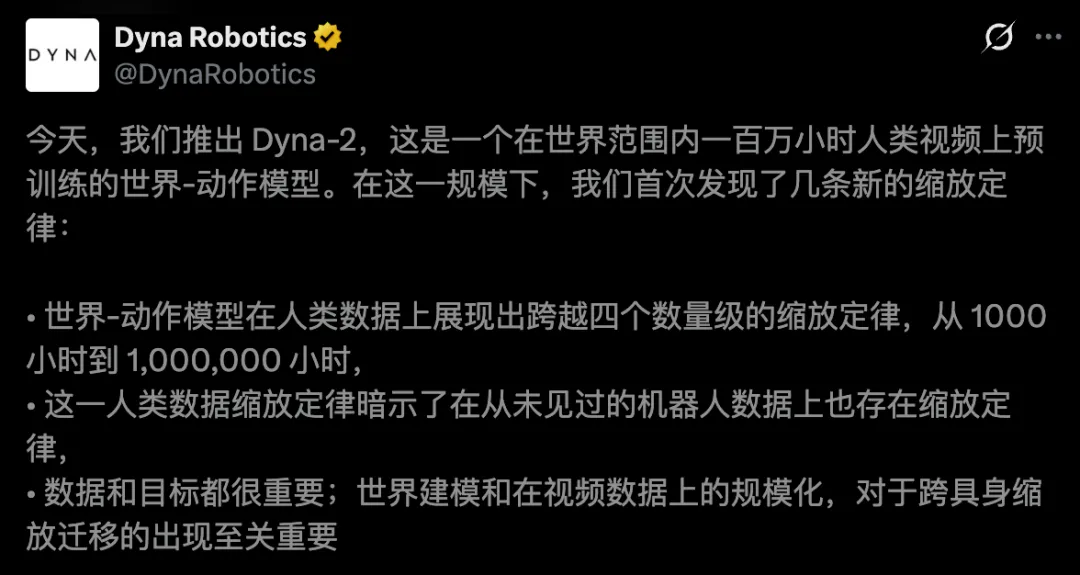
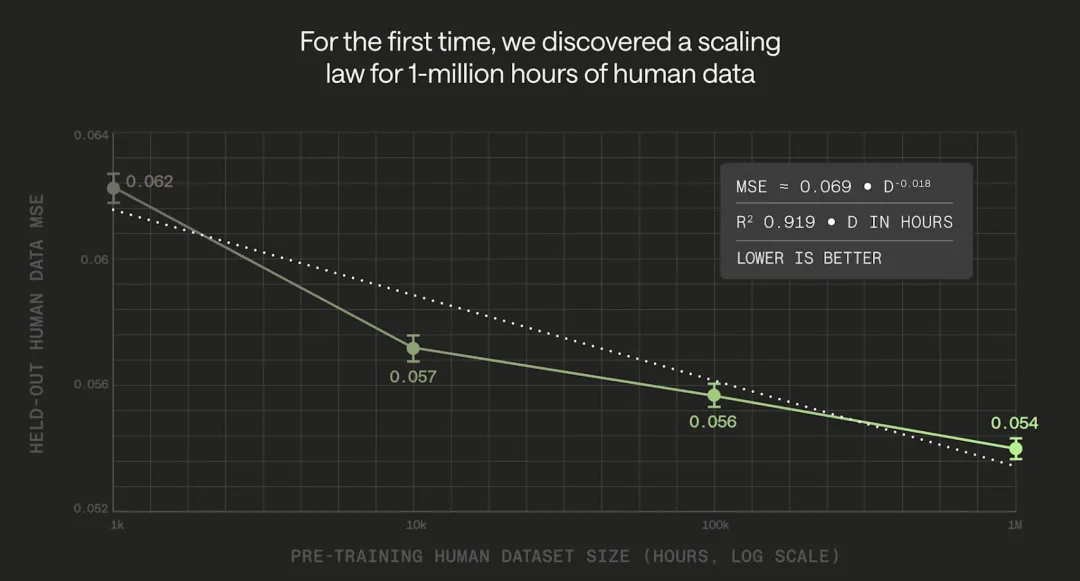
On August 10, Dyna Robotics released Dyna-2, the first human-made training video with 1 million hours.
That's the equivalent of one person staring at each other for 170 years.
From 1,000 hours to 1 million hours, the model's performance continued to improve across four quantitative levels, temporarily missing the ceiling. And with more human data pre-trained models, it performed just as well on unprecedented robot data.
The biggest supplier in this one million hours is Maxinsights.
Back in May, Genesis AI released GENE-26.5, a 20-step meal with two hands: cutting, laying eggs, rolling fruit, and no one holding hands in the middle.
GENE-26.5's first data partner was Maxinsights.

Genesis used first-person video and sensor-enabled glove data together, resulting in many high-difficulty skills that can be autonomously executed with less than an hour of robot-exclusive data.
Silicon Valley's two out-of-body smart models are backed by data from the US company.
Maxinsights' core customers in the U.S. have always been the focus of the business. From sample evaluation to bulk deliveries, it has accumulated experience of continuous collaboration with local frontline teams and expanding with training needs.
Maxinsights' "home base" is the same hard core.
Beginning in 2024, the company switched to remote-operated data collection, following in the footsteps of Bay Area's leading base models and robotics teams to this day. It has accumulated over 2 million hours of first-person data, over 1.5 million hours of handheld tracking and language markup in warehouses.
The capacity of Dyna-2 is 450,000 hours per month and the training capacity of Dyna-2 is 1 million hours per month, which can be used for more than two months.
It's like the massive EGO data you've been looking for all over the world, and you've been around for a while, and you've found that it's actually in Maxinsights' hands.
 After the Scaling Law
Dyna-2 proves one thing: that the scaling law in robotics exists, and you haven't seen the ceiling for a million hours.
The rules of the game have since changed.
The second half of the competition for physically intelligent people is going to be very simple: who can sustain, stability, and cheaply fit the real world into a model, who can run fast.
Last year, Tesla ordered Optimus team collectors to wear helmets, backpacks, five cameras facing their hands, and over and over shirts.
At the end of August, Figure launched the crowdfunding platform Index, where ordinary people open their own app, unpack their clothes and get their money.
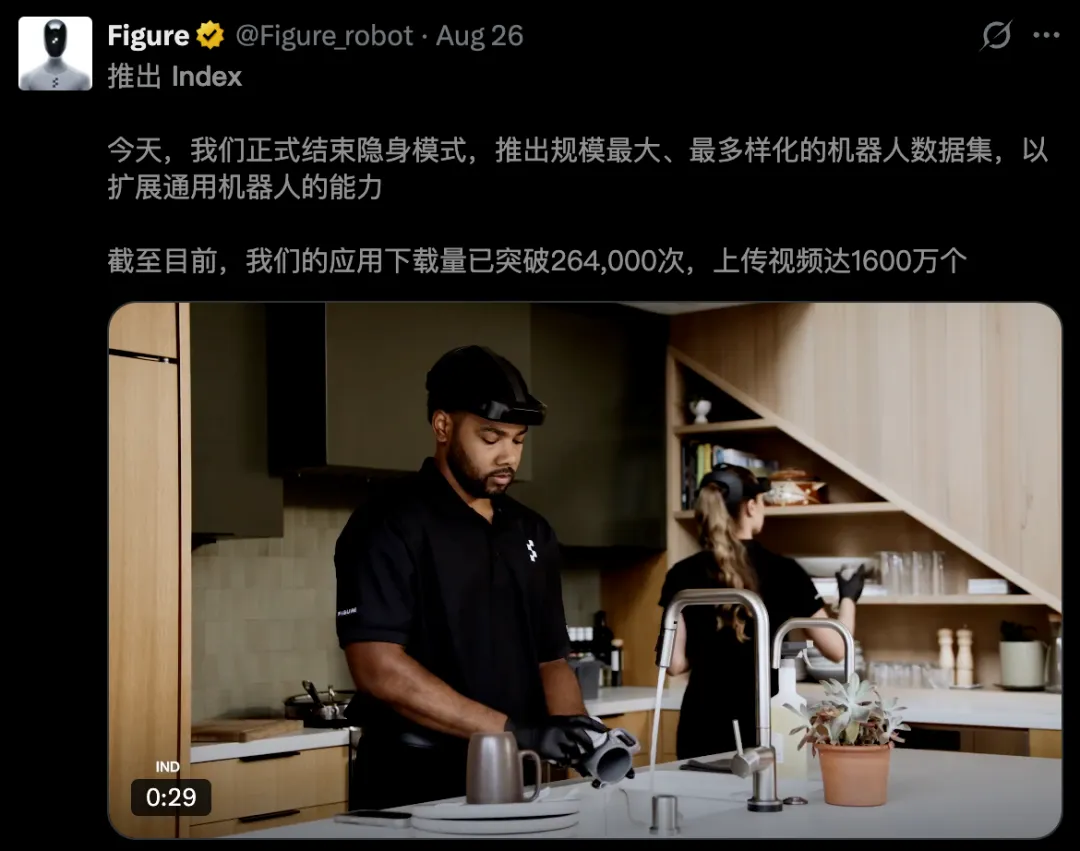
The reason why Lensla and Figure are taking the shot themselves is because the world has never prepared a "human-activated Internet" for robots.
The Internet of Physical AI has to be built from scratch.
Maxinsights, on the other hand, is one of the few companies that actually build it.
The word "manufacturing" is not an exaggeration. People need to actually perform tasks, sensors need to be continuously collected, and data is then synchronized, verified, labelled, and quality-tested before it is finally converted into a form that the training system can directly consume.
Maxinsights summarizes this in one sentence: Physical AI's Scaling Law, which is also a Manufacturing Law.

The entire pipeline is a series of closures, the good rate is multiplied. Each of the four closures is 95%, with only 81% remaining from end to end; each mentions 99%, or 96%. Up to 10 million hours of scale, these 15 points determine whether it is delivered smoothly or mass returned.
This is why Maxinsights brings together hardware, models, value systems, global operations and delivery pipelines. It is positioned to become a data and learning infrastructure for Physical AI.
In addition to the delivery, Maxinsights also saw the following test.
After one million hours, the scale is still important, but more importantly, every new hour brings a new physical experience to the model.
He called it Experience Density: the same hour, repeatedly grabbing placement on a fixed desk, and hand-to-hand coordination, constantly changing state of objects, an hour of using tools, learning the difference in value. It's just noise on a 10,000-hour scale, and up to 10 million hours is the budget itself.
After the data scale increases, the similarity of 10 million hours to existing data will be much higher than that of 10,000 hours in the same year.
This is the reason why Maxinsights' Agent platform is focusing on data distribution for gap settlers.
So the ultimate answer to this system is two questions: when customers expand their training needs, the data can't keep up; every hour of follow-up is a world the model hasn't seen.
One and a half million hours is a starting point for Maxinsights.
The first million hours is the question of whether the scale works. The next 10 million hours are the question of how much an hour is worth.
Photographing the world is just the beginning, and continuing to turn it into a model-learning material is the hard work of this engineering race.