On the platform, human robots in red fist suits and human fighters in shields face each other. The human fists out, the robot leans back and forth; the human legs up, it pulls back a step and holds its weight; it waits for the empty arm to appear, its single-legged support, the other leg draining toward the opponent.
The video is 38 seconds long and features full-length live footage, with no acceleration. On the evening of September 7th, Yuke's Tech released this free-to-play video of the G1 humanoid robot, while giving a technical quality: the world's first fully self-mastered robot combat powered by a world model in real time.

The video's cover is a human-machine standoff image, the original video is 38 seconds long and has been viewed more than 62,000 times for 15 hours.
The three completely autonomous words are the watershed of the entire video. In the past year, almost one person has been standing behind every punch a humanoid robot has thrown on the podium. This time, the remote control is down.
01.
Every last punch was borrowed.
In May 2025, the CMG World Robotics Competition brought the G1 to the battle platform, where the live broadcast of the robot's offensive was remotely controlled by the field-side operator. The U.S. robotics wrestling federation, such as REK, UFB, went further, using VR headsets and handles as samples, and robots were actually the remote replacement for the operator. More exhibits on the platform depended on a pre-set motion library, boxing, fencing, and standing upright playback, with no real interaction between the two programs.
The three models have one thing in common: decision-making is in the hands of humans, or in the script, robots are only responsible for executing the limbs.
The difference in this video is precisely due to the decision-making power. In the image, the G1 will follow the opponent's position adjustment, and after the opponent moves, it will no longer wave an air punch, but re-direct, punch, and take. According to the official caliber, with no predetermined tricks, no man-made remote control, the robot automatically performs forecasting, flickering, attacking, focusing on recovery, running from perception to prediction, from decision to execution.
In the same timeframe, the robot must do four things: see the opponent's movements, assess the threat, decide on the response, and send instructions to the entire joint.
According to the traditional layered architecture, these four steps are executed in sequence. Camera collection, state estimation, planning for solutions, engine response, each loop consuming the time budget.
There is only one solution, which turns the reaction into a predetermined one. The robot operates a propulsion engine: it determines the current observation and a set of candidate actions, first calculates what happens next, then selects the most favorable trajectory for the body to execute. Clash pushes this requirement to a limit, the opponent's behavior is unpredictable, collisions and disturbances continue to occur, and the propulsion is directly out of balance.
The model is responsible for thinking, the body is responsible for building.
One is single-legged. The G1 is about 1.32 m tall, weighs about 35 kg, has 23 to 43 joint motors (depending on the configuration), and the joint peak torque is up to 120 m. When the single leg is supported, the entire body weighs on one side of the ligament and ligament, while the other leg has to be accelerated out, and the torque impedance is slightly lower than the side.
The second step is the reverse withdrawal step. The moment the shock is absorbed by the joints, the low deceleration ratio, the power-controlled joint program allows the motor to reverse the discharge power in the collision, then the whole body coordinates the adjustment of the posture, in a few steps to recover the weight.
02.
Official silence, opening of the paper
There are no papers, no data delays, no evaluation benchmarks, the internal structure of UnifoLM-X2-1.0, and no official word.
Three weeks ago, on August 17, a paper published on arXiv, RoboStriker. The authors from the Shanghai University of Transportation, the Shanghai AI Laboratory, the Chinese University of Science and Technology, the Chinese University of Science and Technology, and the Shanghai Institute of Innovation, studied the same thing: allowing the G1 humanoid robot with 29 degrees of freedom to learn fully autonomous boxing and complete its real-machine deployment.
Let's be clear about the relationship. The paper's signature has no Wu-Tang and no official X2-1.0 link to the study, it is the academic response to the same topic, not Wu-Tang's official paper. Its value lies in the fact that it is the only system of its kind that can be unlocked in the open channel at the moment.
The paper first answers the most fundamental question: why is it so hard for robots to get their hands on a fight?
The answer is that the G1 has 29 degrees of freedom, with each control cycle filling 29 digits, and the vast majority of these combinations are physically unstable. Reinforcement learning requires extensive exploration to discover tactics that can collide in 29-dimensional joint space, robots fall before they strike their first punch, and tactical intelligence has absolutely no chance of emerging.
RoboStriker's solution is to change a map. Instead of exploring 29-dimensional space, first distill what physics can do into a 32-dimensional still space, unifying it into a unit supersphere, where every point on the sphere corresponds to a standing motion.
The map is drawn in three steps.
The first step is to find a professional boxer, use the Xsens conventional motion capture to collect 30 minutes, 50Hz movements, punch, defend, step, turn the full coverage, double the mirror and re-direct it to the G1 to train a tracker.
The second step is to distill the learner's knowledge of the tracker into a 32-dimensional space, with a shared decoder, hidden code, and 29-dimensional linking instructions.
The third step, first, is to bat, then to bat. The batting phase uses the anti-movement pioneer (AMP) to restrict the style of action, making the robot look like a fighter rather than a fighter; the batting phase uses the hyperspace neural fantasy (LS-NFSP), with each robot playing two sets of strategies, with the best response strategy responsible for attacking evolution, the average strategy responsible for stabilizing positioning, nine percent of the time tricking, and one tenth of the time walking the old way.
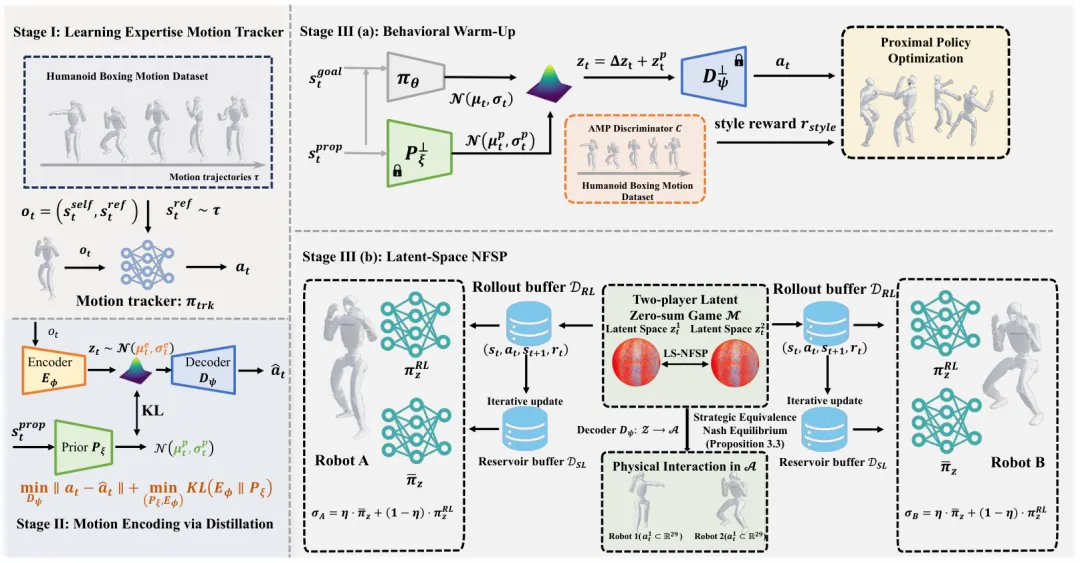
(Source: RoboStriker paper Figure 1, arXiv:2608.16195 ― left-hand motion tracker pre-training with hyperspace distillation, right-hand for AMP behaviour pre-heating, right-hand for hyperspace neural fiction self-hypnosis)
The paper conducted a contrasting experiment. 8D and 16D were too tight, and the movement reconstruction error was up to 128.2 mm and 85.9 mm, respectively; 64D movements were more precise, the search space expanded, tactical learning slowed, and the attack drop rate dropped from 0.685 to 0.520; 32D cards were right on the balance between confidence and tactical ease of learning.
The training costs are also worth mentioning. The entire system is trained on a single RTX 4090, with 4096 parallel desks running simultaneously in the Isaac Lab simulator, a physical loop of 200Hz, a strategic frequency of 50Hz.
The result came first. RoboStriker crossed the line with eight baselines, winning completely. The method of playing directly in 29-dimensional joint space was 100% victorious. The attack drop rate was 0.685, 4.8 times the original space baseline of 0.142; the clash rate was 0.824, which means that for more than eight percent of the time, the robot maintained an effective hitting distance with directional alignment, without negative avoidance.
The meltdown experiment removed the most valuable parts. Taking out preheating, tactical learning directly, the drop-point rate is only 0.050, less than one-third of the complete model. Taking out the AMP-style constraints, robots are still attacking, the frame is broken, the drop-point rate is down by 28%.
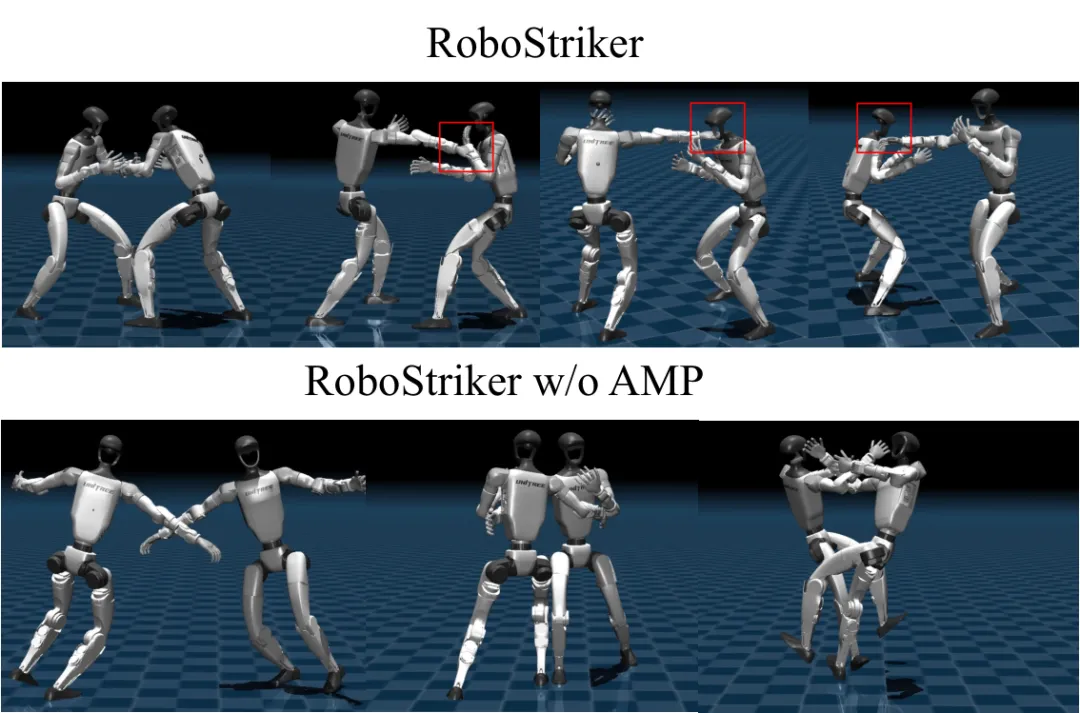
(Source: RoboStriker paper Figure 4, arXiv:2608.16195 ― MuJoCo simulates visual contrast, removing the robot posture after AMP)
The real machine deployment is also running. The two G1s are paired in the gearbox, running at 50Hz on the ONNX Runtime of the in-flight CPU, the two machines are coordinated through ROS 2, and the markers on the pelvis provide each other's position at 100Hz.
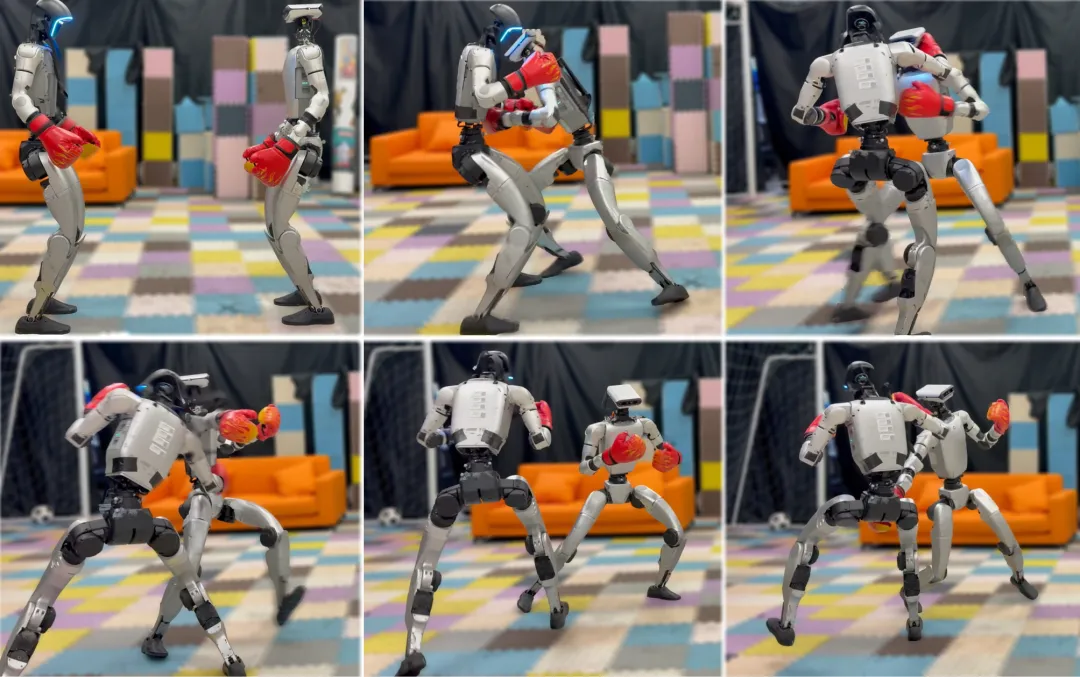
(Figure 3, arXiv:2608.16195 from the RoboStriker paper)
It's been noticed.AttentionRe-broadcastShareThank you.See moreThe Robotics Hall0/0
00:00/00:04 progress bar, 0 percentPlaying00:00/Double the speed.Full screenIt's double-speed broadcast.0.5 times as much.0.75 times that.It's 1.0 times that.One and a half timesTwo and a half timesIt's clear.It's raining.Keep watching
After watching the 38-second video of the G1 attack, I couldn't bear to turn over the paper overnight...
After watching the 38-second clicking video of the Yū Tree G1, I couldn't bear to turn over the paper overnight...The Robotics HallIt's been synchronized to look at.Write your comment The video details.It's been noticed.AttentionRe-broadcastShareThank you.See moreThe Robotics Hall0/0
00:00/00:03 progress bar, 0 percentPlaying00:00/Double the speed.Full screenIt's double-speed broadcast.0.5 times as much.0.75 times that.It's 1.0 times that.One and a half timesTwo and a half timesIt's clear.It's raining.Keep watching
After watching the 38-second video of the G1 attack, I couldn't bear to turn over the paper overnight...
After watching the 38-second clicking video of the Yū Tree G1, I couldn't bear to turn over the paper overnight...The Robotics HallIt's been synchronized to look at.Write your comment The video details.Video: Two G1s close to each other in a motion capture environment, note that this is an experimental image of the paper, not the official video from Utrecht (source: RoboStriker project homepage)
Here, papers and videos can be compared together, and the differences are more informative than similar ones.
The paper features dual-machine matches and human-machine matches in the video. The paper uses a dashboard to tell the robot where the opponent is, the video does not interchange the opponent's perception from where, and the image log only records the request of the strategy server. The paper's strategy runs on the robot's own CPU, and the video log shows that heavy throttling runs on workstations outside the platform.
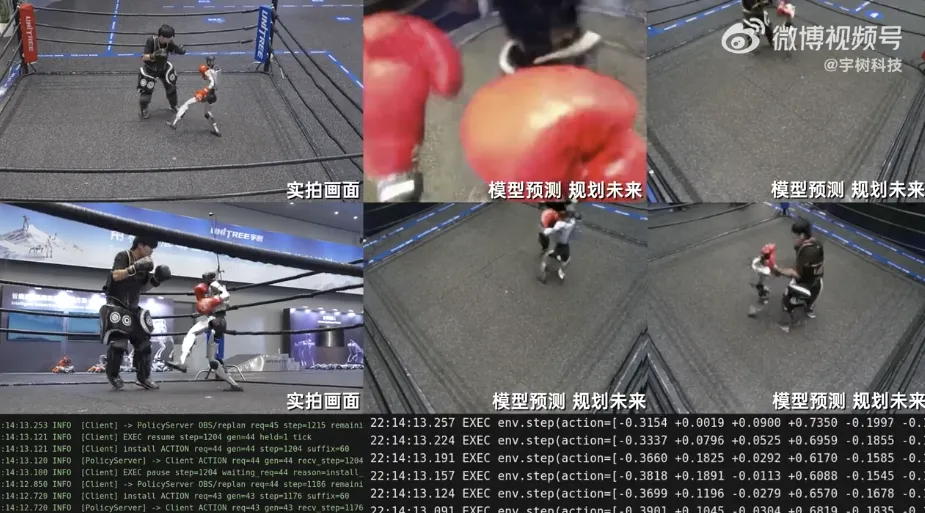
(source: U Tree official video capture. Left-column real-time imagery for human-to-machine play, middle-right two-column model prediction for future planning for model projection imagery, bottom log tab can be seen [Client]→OBS/replan requests from PolicyServer with env.step action)
The longest-suffering is the difference in routes. The paper is based on the theory that tactics evolved from the mutual evolution of two intelligences; the official narrative follows a model of the world, predicting the future. One responds to tactics from where and one responds to actions with what. From the engineering logic perspective, the two questions will eventually come together in the same system.
Unanswered questions should also be listed clearly. The papers do not report real probability of victory, do not publicly fail cases, do not interact with real people, theoretical parts are rigorously proven on the main page of the project rather than in writing. On the official side, there are no papers, no delays data, no benchmarks.
03.
It's just a test.
Look at this list of capabilities: prejudging external disruption, maintaining dynamic balance, controlling contact force, real-time replanning of emergencies, each of which responds to real operational needs in unstructured environments.
In the previous live broadcast, the fist belonged to the operator. This time, the fist belonged to the model. The model in the paper was playing a double machine in the mobile capture shelf, the model in the video was playing a human machine in the workstation, and the next version of the question to be answered was already there: to move the projection back to the robot's own body, to change perception from the marker point to its own eyes.
Until that day, the 38-second downtime record, really becomes a daily one.