After completing its multi-million-dollar A-Round financing, the commercial garden robot company wants to incorporate its expertise into reusable system capabilities.
In the spring of this year, a machine weighing about 300 kilograms slowed down along the course of the top-level women's professional golf tournament (KLPGA) in South Korea, sliding through the grass, leaving a neat scratch.
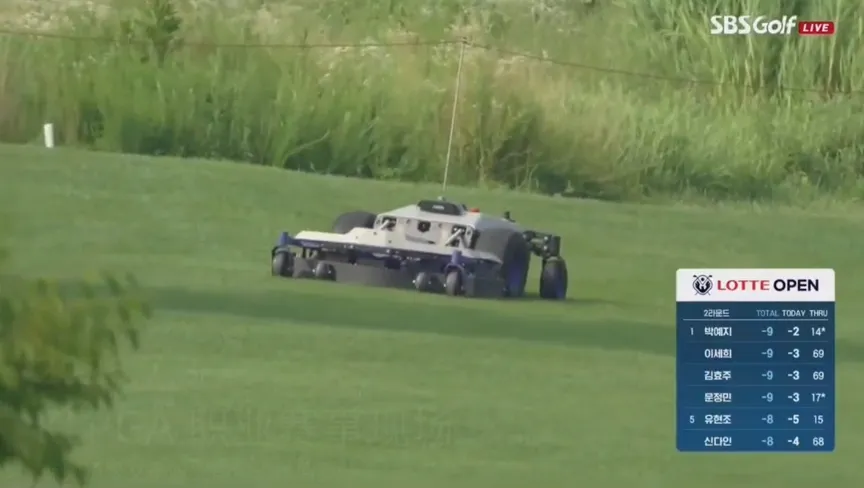
The machine comes from a Chinese company feeding ironclad technology and technology (PANDAG). Recently, it has just completed a multi-million yuan round of financing, with exclusive investments from Cloud Venture Capital and financial advisory from StarCape.
For most people outside the industry, lawnmower robots are not unfamiliar. But what Iron Beast Technology does is not exactly the same as the race track that people are familiar with.
01.
It's a rough road
In the past few years, gardening has split into two different paths.
Consumer-grade lawnmower robots quickly entered the European and American households, completing the first round of market education. IDC data shows that in 2025, the global shipment of Unlimited lawnmower robots reached 131.8 million, an increase of 182.4%. The cumulative shipment of smart lawnmower robots from brands such as MOVA has exceeded 500,000.
However, the commercial park trail is almost a blue sea.
Large commercial landscapes such as golf courses, photovoltaic parks, municipal green spaces, and long-standing lack of automation schemes covering the entire operation process. Traditional riding, hand-held machinery only completes basic lawn mowing, complex terrain and ultra-high grassland scenes, and man-intensive and inefficient pain points are always present.
According to NALP data from the American Association of Horticultural Professionals, 60 percent of horticultural maintenance companies have long-term vacancies, and labor costs are expected to increase further by 2029 by 20 percent.
But the shortage of labour is only superficial. The deeper challenge of business gardening is that executive work and professional experience are difficult to replicate on a large scale.
The top management team is often invited to provide guidance to locations where there is a lack of established systems, but it is not enough to really improve the level of local grassland construction by upgrading equipment alone, and the local team needs to be trained and mentored for six months or even several years, with long cycles and high costs.
This is precisely the opportunity that Eating Beasts Tech has seen when it opts to enter the commercial park circuit.
In 2021, when the industry is largely focused on consumer-grade garden robots, the team opted to enter the commercial field. In their view, the last decades of automation have largely changed the way production is done in the industrial sector, and similar changes will also occur in these labor-intensive and highly reliant outdoor commercial landscapes, such as golf courses, photovoltaic stations and other commercial green spaces.
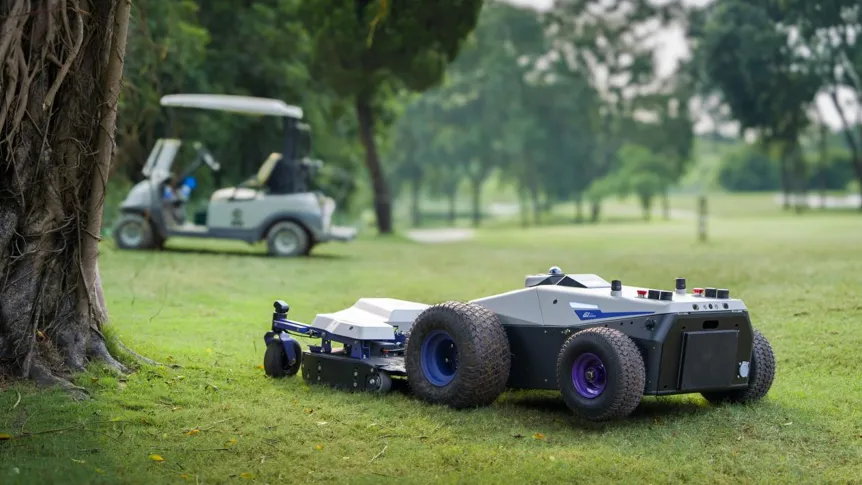
But a commercial garden robot is not just a magnification of a garden robot.
02.
Different logics
Domestic users buy consumer equipment that improves the convenience of living. Commercial customers buy productivity systems that are able to access green space operations and continuous delivery of operational results.
For commercial robots, running is just a starting point, and long-term hard work is valuable. Liu Zhou Yongfeng said that commercial garden robots do not only complete tasks in professional stadiums, municipal green spaces and other scenarios, but also really enter the daily operations of professional teams, continuously delivering stable results in different seasons, conditions and terrain.
This determines the difference in product design logic.
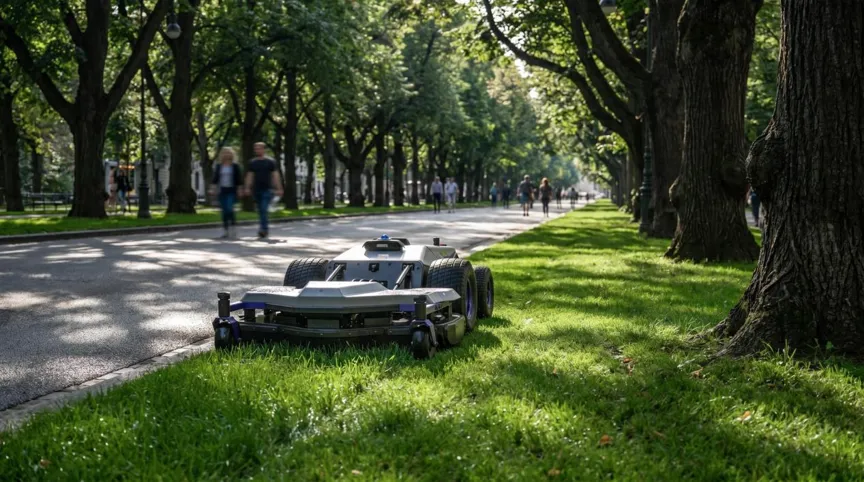
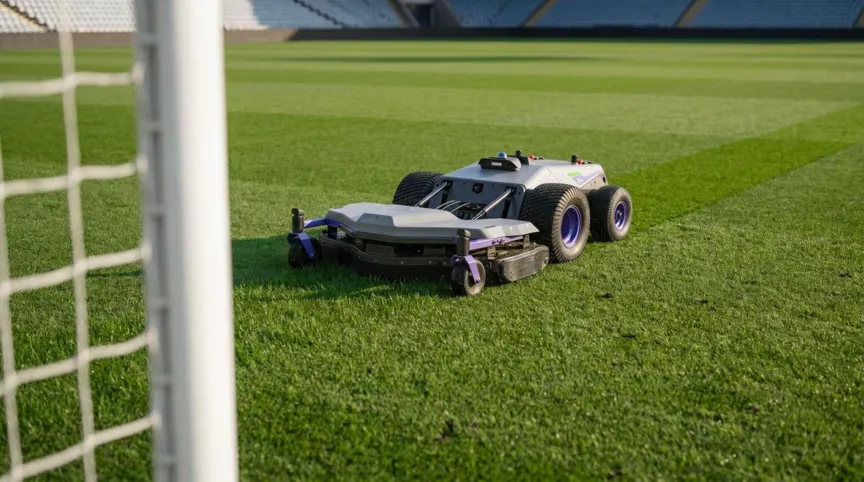
The PANDAG G1, introduced by Food and Animal Sciences, is the world's first commercial modular lawnmower equipped with a laser radar fusion system. It uses a loaded bottom and fully modular design, walking, cutting, energy systems supporting rapid dismantling replacement. The three-wheeled lawnmower system is geared towards high grass, dense vegetation and heavy loading operations, and can be completed simultaneously during the cutting process.
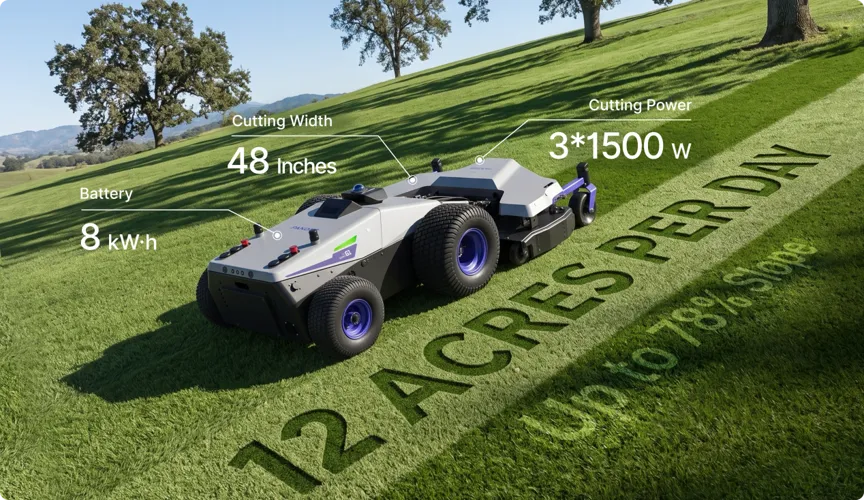
Energy and sustainability design also revolves around the use of commercial efficiencies. The product is equipped with vehicle-specific batteries, offering 8 degree electricity and 16 degree electricity in two configurations, supporting long-term continuous operation and automatic refueling, with a maximum operating area of up to 12 acres per day (about 486,000 square meters). The product is equipped with self-developed AI lawn mowering algorithm and LiDAR laser radar system, which can adjust the operating strategy according to the dynamics of varieties of varieties of herbs.
But hardware is just the foundation, and the real differentiation of ironclad technology lies in the closed loop between actual execution and operational data.
To understand the value of this closed loop, we need to go back to the real-world scenario of commercial green space operations: it is not a one-time lawn mowing task. The landscape of the same site changes continuously with the seasons, weather and intensity of use, and the professional team adjusts the way it operates accordingly. Once robots enter the real environment, the operating data begins to record the system of relationships between the landscape, the terrain, the parameters of the equipment and the results of the operation, and is used to modify products, algorithms and operating strategies.
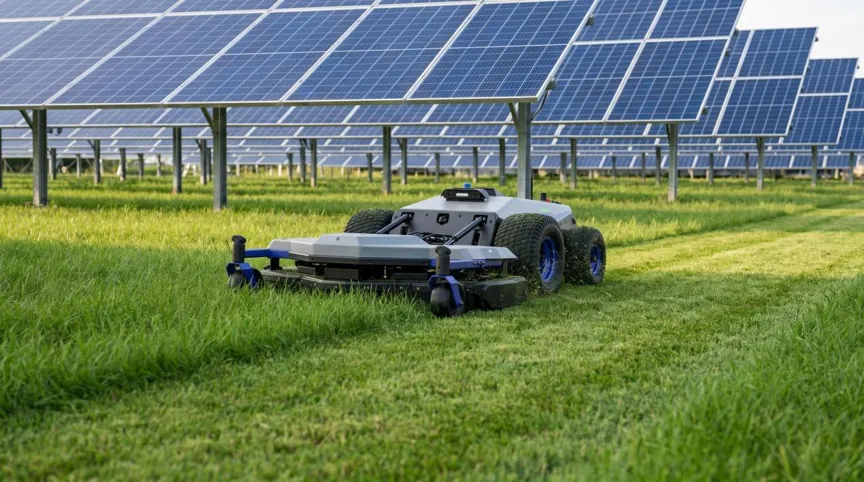
The PANDAG G1 is equipped with a navigation system combining laser radar and binocular vision, which can still stabilize the mapping and continuous operation of satellite signals in areas such as bushes and buildings. Currently, these real operational data are mainly used to replace products, algorithms and operational strategies.
03.
Access to high-standard green transportation and maintenance sites
The reliability of commercial products must ultimately be verified by the market.
The first production facility chosen by Food and Beverage Technology was Japan, a market with a strict reputation. The team took Japan as the starting point for product recycling and testing, from the very beginning of the equipment being questioned, to continuous recycling, eventually taking over the Japanese top-level commercial agency agent.
A Japanese customer operated incorrectly and the equipment flipped sideways from a slope of two to three meters high. Customer feedback said it might need to be repaired, but the equipment ran steadily for 2-3 months before it was repaired. On-site inspection found only one axle slightly deformed and did not affect the overall operation.
In 2025, the company completed its first standalone production line and achieved mass production deliveries. The company has signed a number of regional head agents overseas, including a partnership with one of the largest local golf operators in South Korea.
In July this year, the PANDAG G1 debuted the South Korean KLPGA (Women's Professional Golf Tour) tournament arena, participating in tournament maintenance. The choice of the golf course as a verification scenario is precisely because it best reflects the fact that green field maintenance is not a one-time trimming: the terrain changes continuously with the weather, grass varieties and tournament schedules, robots not only complete lawn mowing, but also adapt to the professional team's long-term continuous maintenance process.
At CES 2026, as a Chinese enterprise focused on commercial lawn mowing at CES, PANDAG G1 was nominated for the CES 2026 Best of Awards category and received mainstream media coverage such as USA TODAY in the United States, thanks to its complex topographical capabilities and AI dynamic path planning technology.
Currently, the products have entered overseas markets such as North America, Europe and Asia-Pacific, and have been used to promote customer delivery and channel collaboration in several regions.
04.
What is the meaning of this verse?
Mowing the grass is the most demanding entry point for customers, but it is far from all the needs of commercial gardens.
It is precisely from this high frequency task that Ferrotechnology is cutting through, allowing robots to enter the daily operation process of commercial green space, and gradually incorporating perception, execution and operational experience in complex outdoor environments into replicable system capabilities. Ferrotechnology is the entrance to the current stage, while the long-term direction is to allow robots to undertake more professional green space maintenance tasks. This is the core logic behind the distinction between commercial robots and consumer-grade equipment, and is the true long-term value of Ferrotechnology.