Recently, the latest list of the official ECCV 2026 CAD Challenge was released, and the team from the Bit Unlimited Unified Wuhan University, with a score of 96.39 points on its self-developed intelligent body system, beat the rest of the 27 global teams to take the top spot.
This outstanding performance in the world's top computer vision competition not only means that Bit's unlimited technical capabilities in the field of physical 3D production are validated by top international academic assessments, but also further highlights its technological path around "physical 3D data infrastructure".
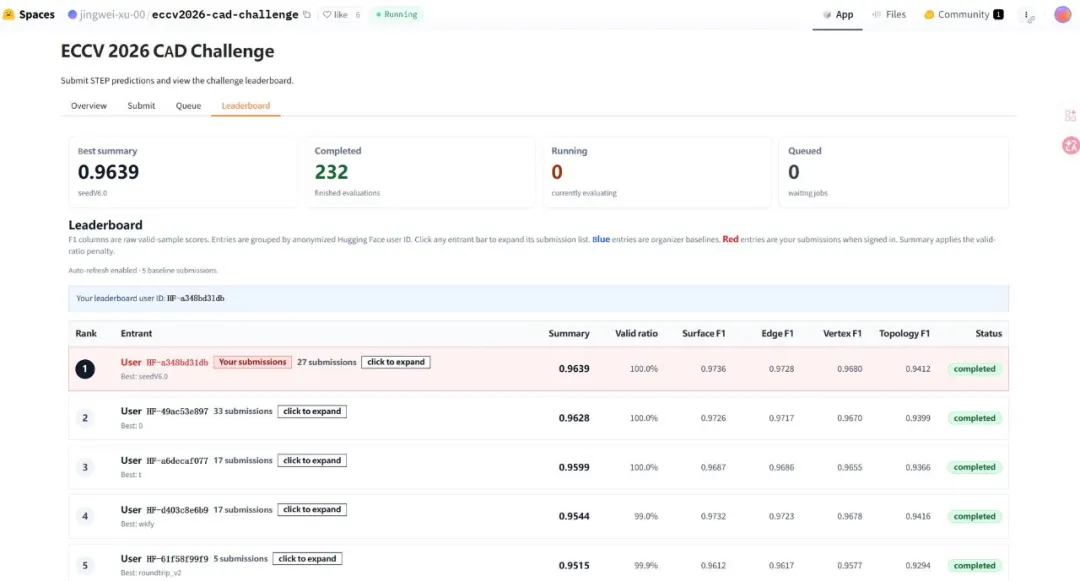
Link to the list:
Top academic trials to reconstruct the boundaries of AI Understanding the Physical World
The three summits in the field of computer vision, CVPR, ICCV and ECCV, also known as the "three summits" in the field of computer vision, constitute the "top of the pyramid" in global AI visual research.
The ECCV, organized by the European Computer Vision Association (ECVA), is held every two years and represents the highest academic standards in the field in Europe.

Public data shows that ECCV 2024 has about 13000 posts, received 2395 papers, with an acceptance rate of only 19.0%, and 188 selected oral report papers, with an acceptance rate of only 1.5%, with low acceptance rates reflecting extremely high technical content.
The strength of domestic research is also continuing on this stage: In 2014, the joint team of the Shanghai AI Laboratory had 45 papers cited, eight of which were nominated for Best Paper on Cloud Data Processing, and the results of universities such as the University of Jilin, Hunan University, the University of Electronics and Technology, and the University of Jiangsu were also featured frequently.
The CAD Challenge, organized by ECCV 2026's official workshop "The Path to Manufacturing: Evolving 3D Generation to Intelligent Computer-Aided Design", aims to verify whether AI can generate manufacturable CAD models, focusing on cross-innovation between generative AI and industrial engineering, and exploring how to drive 3D production from visual appearance to editable, parameterizable, constrained and manufacturable CAD.

Unlike the conventional visual runner-up competition, the criteria for this evaluation are very strict: entrants need 3D rendering and engineering view based on input (HLG view with hidden line graying processing), output standardized STEP format BRep (border representation) geometry models. The system uses the OCCT geometry core to grid the predicted results with hidden real values, point cloud sampling and Hungarian matching, from Surface F1 (curve) to Edge F1 (side) to Vertex F1 (top) to Topology F1 (top) to determine a four-dimensional overall score, and superimpose valid samples on valid_ratio to determine the final ranking.
At the heart of the competition is whether AI can move from "understanding an object" to "understanding and reconstructing a design".
The organizing committee's requirements for fairness and rigorousness were equally stringent in the design of the rules: each account submitted a daily limit of three times, no more than 30 times in total, and ranked only when the aggregate score exceeded the official baseline; the competition test set contained 927 hidden samples of STEP true values, requiring the teams to independently predict each sample's STEP documents, any missing, OCCT unable to open, grid failure or overdue samples were determined to be ineffective.

The rules of the ECCV 2026 CAD Challenge
How to solve the "CAD generation" problem: Analyze the unlimited technical paths of bits
In recent years, companies such as Meshy, Tripo and others have promoted the development of "Visual 3D", with the core goal of producing "visual aesthetics" models that primarily serve entertainment settings such as gaming, video and virtual imagery. Industry demands are different: models need to be machine-controlled, accurately assembled with other parts and with real physical loads, requiring rigorous parametric structure and topological consistency, rather than just a "beautiful mesh skin".
The difficulty in creating CAD is that AI not only understands the appearance of objects, but also understands the design intent behind them, the assembly relationship with the manufacturing process, the output of editable, parametrically modifiable engineering documents, rather than the discrete triangular grid.
This type of problem corresponds to a real work scenario of a line engineer. For example, in the design of consumer electronics structures, an outer shell of equipment that requires both thermal and structural strength, the inner walls are often filled with dense thermal splitting spots and cabinets, and according to exterior rendering diagrams and two-dimensional engineering drawings, engineers need to repeatedly push the round angle radius, the pull angle and the assembly pass: rounded corners can cause the injection voltage to break down, insufficient pull angle can cause the removal of the mold, and small deviations in the position of the card buttons can cause the microprocessor to resonate or loosen.
These engineering details often go through the entire process of 3D modeling, school nucleus and modification. From sketches to productive STEP documents, senior engineers often take days or even weeks to model, school nucleus and return to work. Precision machinery and home research are equally dependent on experimental trials to determine installation relationships, motion interventions and resistance pathways. These valuable modeling experiences and design intuitions are long-standing in the human brain and are difficult to replicate or transmit efficiently.
The base model of the Arko series, developed by the BitInfinity team, covers text, images, point-cloud/grid generation CAD, and CAD editors that support natural language interaction. The underlying structure is based on the parametric modeling language and the OpenCascade geometry kernel, directly producing editable, manufacturable industrial-grade STEP/STL files, rather than just visual grids for display.
Bit Unlimited's technical architecture is divided into three layers: the bottom is an end-to-end data engineering system of 2.1 million sets of physical 3D data sets, covering the three main areas of consumer electronics, mechanical structure, and home life; the middle layer uses the "continuous pre-training + post-training + agent framework" to form the "understanding, planning, modeling, modeling, evaluating, optimizing, and modeling" complete technical closure; and the top layer is a product matrix for C-end Maker and B-end industrial customers.
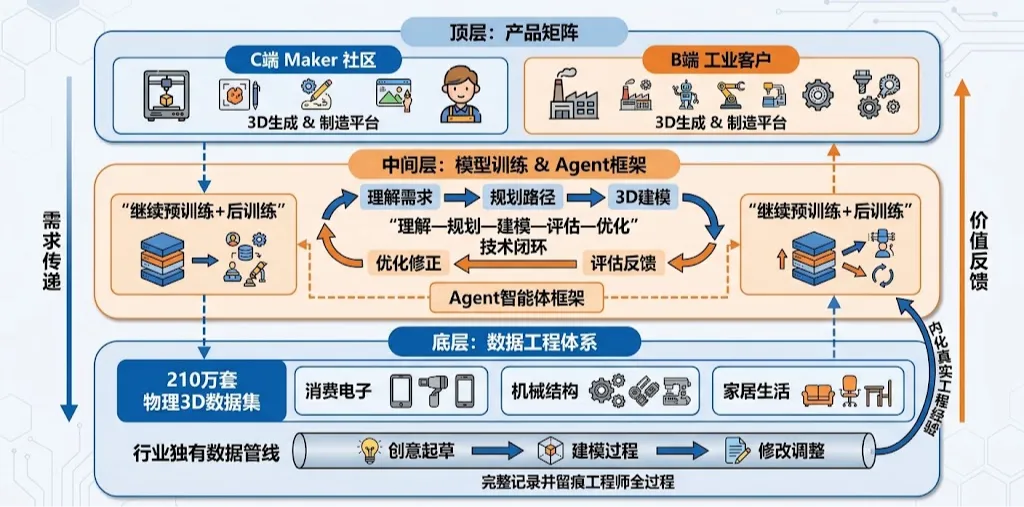
Unlimited technical architecture by Bit
It is worth mentioning that the official list also includes a baseline item called the "GPT-5.5 Extra-High-Thinking Baseline", which is why the organizing committee used the current strongest general multi-modal large model GPT-5.5 as a benchmark and launched a high-intensity reasoning model to measure the lead in the competitive program versus the ability of the general large model. According to the list, the team of Bit Infinite Unified Wuhan University ended up scoring 96.39, about five times that baseline score of 19.32, showing a significant lead in the relatively general large model.

GPT-5.5 Extra-High-Thinking Baseline ranking
This also underscores the differences between the General Large Model and the Special Physics 3D Model: even strong General Logic Models, which are not specifically optimized for "outputs that can be processed directly, rigorously assembled parametric STEP files", understand more "image semantics" than "engineering geometry". Figurative bits are unlimited in specialized data, structured 3D representations, parametric code generation and engineering evaluation, forming systemic technical barriers, and are driving 3D production from "looking similar" to "structure correct, parameters controllable, results editable", laying a key foundation for intelligent design, simulation engineering, automated manufacturing, and Physical AI.

Comparison of indicators
AI CAD:
The core evolution of the next generation of 3D production
If the main battlefield of 3D production over the past decade is "making AI paint", then the main battlefield over the next decade will be "making AI paint".
In global 3D digital modeling platforms, the demand for gaming and entertainment for visual effects is just the tip of the iceberg, and the demand for "physical 3D" covering the entire chain of design, installation and manufacturing accounts for 80% of the real market share - digital infrastructure for consumer electronics, automobiles, homes, precision manufacturing, and other physical industries.
The evaluation criteria for visual 3D is "is the rendering of the image surprising" and the physical 3D criteria are "is the model actually manufactured, assembled, and used". In the midst of this is a completely different technical paradigm and data system, so capital is gradually realizing that whoever leads the way in this puzzle of "manufacturing Internet data" can take the lead in AI's original engineering track.
The Prometheus Project, an AI startup led by Amazon founder Bezos and funded by institutions such as Morgan General, Goldman Sachs, and Blade, has reportedly raised $12 billion in its latest round of financing, valued at $41 billion. It aims to create "artificial general engineers" to design, validate, and manufacture physical products, greatly compressing industrial research from the full cycle of conception, design, validation, and manufacture of silicon.
Bit Infinite is the global story behind the markup, and the company that pioneered the key puzzle in China. Since its inception, Bit Infinite has positioned itself as a "physical 3D data infrastructure" company that mathematically and code-wise calculates engineering models that can be manufactured, assembled, and moved, enabling AI to understand spatial geometry and motion trajectories in a natural way.
The first step in the ECCV CAD Challenge is not just a single-point technical verification, but the path of "structured 3D+AI CAD+Physical AI" which is systematically confirmed in international top academic assessments. The next stage in the production of AI 3D will inevitably move from "visible" to "usable", from visual geometry to engineering geometry, from game entertainment to real manufacturing.
As more C-end Makers and B-end industrial customers start using Arko products, each model, each modification, each engineer's design decision will be transformed into a definitive advantage for "industrially-scaled landings" by "experiencing trace-pipe line continuous anti-feeding model training" to form "the stronger data flywheel, the longer-term pricing of physical 3D data engines".
Team backgrounds and technical accumulation
Supporting this technological breakthrough, Bitt is backed by a team with top-notch big model pre-training experience and deep industrial data accumulation. As the company's head of pre-training, Zhou Pingyi, the co-founder and core number two of the Huawei Chiang Kai-shek model, has led the development of three generations of models, from the Chiang Kai-shek Alpha 200 billion parameter Dense model to the Sigma billion parameter MoE model. He has published 25 summit papers, cited more than 1,000 times by Google Scholar, and holds two US patents, and is one of the few scientists worldwide to have had a hands-on experience in the training of trillions of parameters.

Bit Unlimited co-founder Zhou Yi
Unlike natural language and image generation, physical 3D production requires not only visual-level similarities, but strict engineering constraints such as dimension gaps, assembly relationships, topological consistency. This means that model output needs to be tested for manufacturability and engineering accuracy, rather than relying on "looking reasonable" in the sense of probability, which is highly in line with the technical path that Bitt adheres to indefinitely.
At the data engineering level, Bit Infinity has built a complex team of 150 M.Sc. and 3 Ph.D. students, and has established a deep production research and collaboration mechanism with Shanghai University of Transportation, Jiangsu University, Guangdong University of Technology, where the team from Wuhan University has jointly won the world's first ECCV CAD Challenge, continuing to promote the integration of geometric understanding theory at the forefront of academia with real-world data scenarios.
ECCV 2026 Workshop Official Result Statement
In terms of ecosystem and capital layout, BitInfinity has been selected for the NVIDIA Global Acceleration Program (NVIDIA Inception Program) as Intelligent AI's official partner, and is at the top of the AI industry in Shanghai's Modelspace. Its shareholder portfolio covers major Asian projects (such as KeyFlow, Liquidity), multi-billion-dollar venture capital (such as early stage investments in projects such as Uber, Tech, and Galaxy General), and venture capital (such as the successful IPO of 12 companies), demonstrating the high recognition of the capital market for its technology routes.
PreA round of tens of millions of yuan financing from industrial investors, over-crowding by publicly traded companies Cvc and the former shareholder of Pyongyang Gold Holding Talent Group, and the simultaneous launch of A round have also received investment plans from several well-known institutional investors.
From the top of technology to the world's largest 3D Token call model company
From the strategic positioning of Asbestos' "Promises Project" to the self-developed Arko base model, which took first place in the world's top academic assessments, and the substantive technological achievements of Bit Infinite, the Chinese team is fully capable of achieving the global SOTA level on the emerging track of the "physical 3D baseline model", and the breakthrough is entirely based on training in state-owned computing. This is not only a brand-level honour, but also a key milestone in allowing Bit Infinite to practice its long-term vision of "AI to truly understand the physical world".
In the future, with the continuous flow of customer data, model capabilities and data scale forming a closed loop, this dual-wheel drive strategy of data engineering and model capabilities will translate the technical capabilities validated by ECCV CAD Challenge into products that serve real-world industrial scenarios such as consumer electronics, mechanical structures, and household life, further demonstrating the limitless barriers to competition in the path of "physical 3D data infrastructure".
The long-term goal of BitInfinity is clear: to become the world's largest 3D Token calling base model company, driving the AI process in global manufacturing using autonomously controlled technology routes.
The ECCV CAD Challenge is the first of its kind in the world and is just the beginning of this long-term strategic narrative.