The robot grabbed the bricks and was about to put them in the bowl.
Humans will instinctively stop, look, and re-direct; but many VLA robots won't. It's clearly still receiving a camera image, but its hands continue to perform the old actions generated hundreds of milliseconds ago, finally putting the blocks into the air.
This is not a model that "didn't see", but it was not allowed to rethink it at all during this time.
OmniAI team at Zhejiang University's ACES laboratory and the latest work at the Alibaba Institute.VLA-CorrectorThe VLA's prediction of a series of actions was indeed effective, but between the start of execution and the next reasoning, there was also a dangerous one.Blind area。
The paper: VLA-Corrector: Lightweight Detect-and-Correct Inference for Adaptive Action Horizon
Authors: Yi Pan, Miao Pan, Qi Lu, Jiaming Huang, Man Zhang, Siteng Huang, Xin Li, Jie Zhang, Yongliang Shen, Xuhong Zhang, Wenqi Zhang
Unit: Zhejiang University;Alibaba DAMO Academy
Link to the paper:https://arxiv.org/abs/2607.01804
The main page of the project:https://zju-omniai.github.io/vla-corrector/
The code is:https://github.com/ZJU-OmniAI/vla-corrector
Their answer is straightforward: they don't have to force the large model to recalculate every step, and they don't have to let the robot do the whole thing with its eyes closed. They give the VLA a lightweight Corrector with an approximate parameter of 40M to let it know when to continue and when to stop the error.
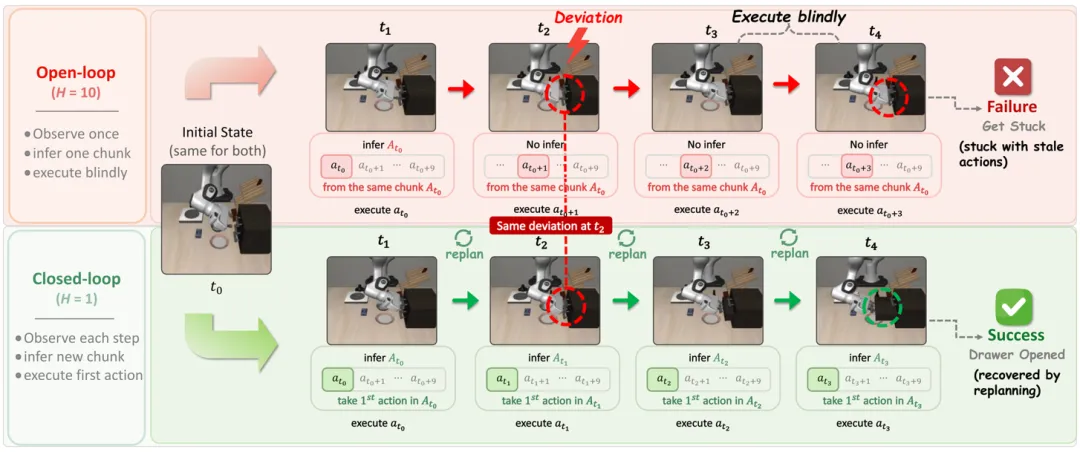
Comparison between long action horizon and strictly closed-loop execution
VLA clearly has been staring at you, why haven't you seen yet?
The mainstream generation VLA now uses the action chunk to minimize the cost of reasoning: a model looks at a picture and breathes in to generate a future move; the larger the H steps before the robot performs them continuously. The larger the H, the fewer calls the model makes, the more consistent the action.
The cost is equally obvious. Sliding when grabbing, slipping two millimeters when inserting, or moving the target, the next action is already "outdated". But as long as the horizon is not over, the robot will still do as planned. Small deviations quickly roll into a big mistake, and until the next reasoning finally arrives, the state may have shifted to irreversible.
Setting H to 1, of course, can be a step-by-step closing loop, but it's equivalent to calling a VLA for each control step. The paper's horizon sweep also calculates this well: with π0.5, for example, extended horizons can reduce the policy call by about 4 times, but the success rate will drop from about 64% to less than 49%.
So the question is not to guess the "best H" anymore.When is the current move no longer credible?
Don't keep re-planning.
Only the moment the action fails to take over
The VLA-Corrector does not modify the VLA main load, but instead adds a "monitoring torque interruption torque correction" alongside the reasoning link.
The first step is to monitor. The Latent-space Vision Monitor (LVM) learns a very localized question: after performing this action, which direction should the visual characteristics change next? When running online, it constantly compares "expected changes" to "real changes" in the camera. The model does not directly predict pixels, but predicts visual dynamic residues in latent space with high information density. It helps to reduce static background, light interference, prioritize the dynamic parts that are important for the execution of tasks, while reducing learning difficulties and making predictions more accurate.
The second step is to disconnect. If this deviation persists and is not a single action, the system immediately clears the stale actions that have not yet been performed in the queue.
The third step is to correct. Simply ask the VLA again, and you may only get another action that doesn't go the same way. Therefore, the Online Gradient Guidance (OGG) will turn the newly detected visual deviation into a gradient signal, only guiding the resumption of reasoning after the interruption, and pushing the new action in a more recoverable direction.
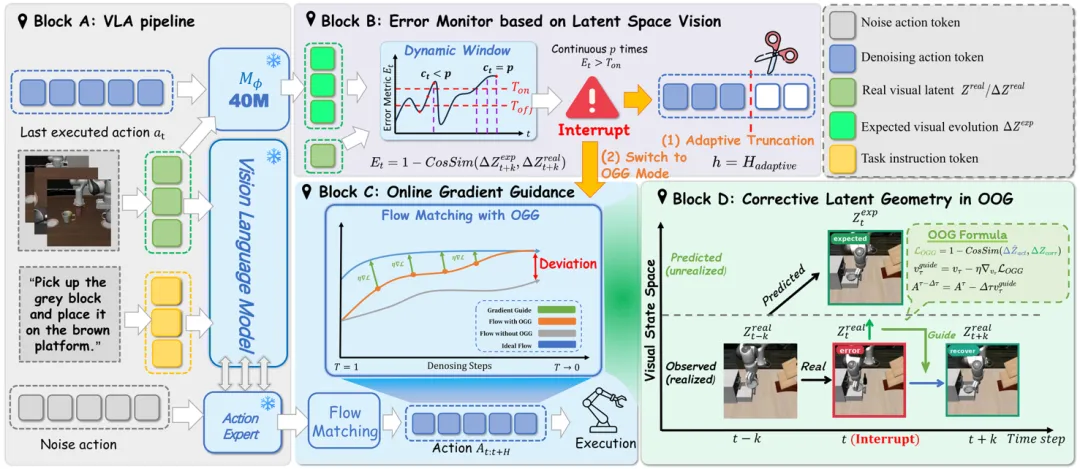
VLA-Corrector: Monitoring, disrupting and correcting
It's not a fixed horizon, it's a fixed horizon, it's a fixed horizon.The event-triggered adaptation horizonWhen transportation is smooth, the big step goes forward; when it comes to grabbing, aligning, inserting these easy-to-mistake stages, always ready to cut back on short-sighted corrections. In experiments, 83.7% of the intercepts happen precisely at these critical stages.
In other words, it is not a choice between the opening and closing rings, but the closing feedback is used at the most valuable moment.
The success rate is rising and the number of calls is falling.
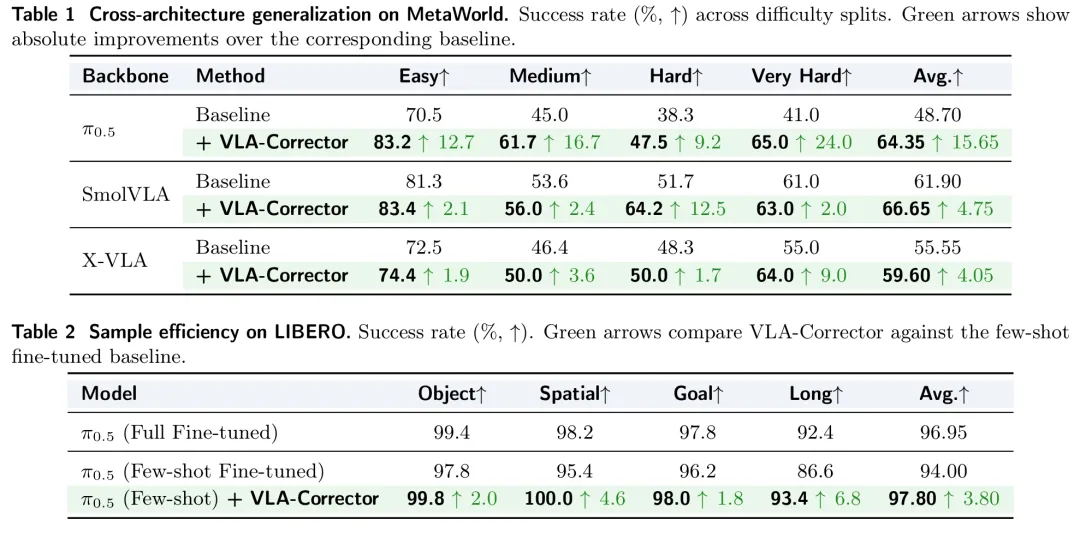
On MetaWorld, the average success rate after adding π0.5 to the VLA-Corrector is from48.70%, up to 64.35%In the Very Hard mission, upgrades were made to:It's 24%.。
What's even more interesting is that it hasn't been changed by a crazy increase in reasoning frequency.61.90% increased to 73.00%The average policy call comes from:19.27 down to 15.64It's easy to understand why: throwing out expired moves in time is far better than continuing to waste a whole chunk of the budget on a failed track.
The results on the real AgileX PiPER mechanical arm are more intuitive.55.6% increased to 73.3%• Success rates in disruptive recovery missions of man-made animal movements or targets are based on:40.0% jumped to 68.3%On LIBERO, the few-shot model of the Corrector has been added.97.8%This is up from 96.95% of the fully fine-tuned baseline.
The real mechanical effects of the VLA-Corrector
This work is truly worthwhile insight.
In the past, we used to understand the reliability of VLA as "the first to predict perfect action". But once robots enter the physical world, the action will in turn change the environment and the plans will expire at any time. A long block of action that never makes mistakes is not realistic, and what is really important is that the system can not know as soon as possible that it has deviated and retain its power to interrupt.
VLA-Corrector gives a very inspirational system breakdown:The big model is responsible for proposing the plan, the small model is responsible for auditing the plan, and the executive layer has the power to stop at any time.This could be closer to a reliable landing site for physical intelligence than a bunch of big backbones.
Of course, it is not an all-in-one recoverer. The OGG is still limited to the basic strategic capabilities. But the true core of VLA-Corrector is that it can effectively suppress errors that are amplified in the open-circuit blind area, significantly reducing the difficulty of VLA policy recovering from errors. It changes the solution of the problem: no longer requiring strict closure when VLA, but allowing the system to actually close the loop at the moment of closure.
In a nutshell:Robots don't always have to make mistakes, but they have to learn not to keep making mistakes.
Introduction by the author
The work was carried out jointly by the OmniAI team at Zhejiang University and the University of Alibaba, and the first author was Pan Wing, a master's degree graduate student who focused on action-chunked VLA's open-circuit blindness and real-world robot error correction.