According to Fermat's theorem, there is at last a complete proof that can be examined by a computer from start to finish.
Just as anthropic claims that Claude completed the entire project in 11 days, writing about 13 million lines of Lean code, humans provided only a small amount of high-level guidance in the process.
For a full proof, see GitHub:
This time, Claude didn't come up with a new proof path, but instead transcribed the proof into a form that could be verified gradually by machines, allowing every logical link to be checked by a computer.
For centuries-old problems such as Fermat's theorem, the mathematical community generally expected that complete formalization would take several years.
Why do we need to prove Fermat's theorem again?
Some time before 1637, the French mathematician Pierre de Fermat wrote on the page of his book on algebraic geometry the following judgment: when the integer n is greater than 2, there are no positive integers a, b, c that satisfy an + bn =cn.
He added that he had found an "excellent proof" that the pages were too narrow to write.
Over the next 350 years, a generation of mathematicians continued to try. In 1993, Andrew Wales published a proof in three lectures. Two months later, the reviewer found a critical gap in the proof. It took almost a year for Wales and Richard Taylor to complete the correction, finally publishing a complete 129-page proof in 1995.
Fermat's theorem has the accepted answer, but verifying large-scale mathematical proofs is still highly dependent on humans.
Mathematical papers often omit the obvious steps and call directly to conclusions already drawn by their predecessors. Faced with complex proofs across multiple domains, reviewers need to track the definitions, theorems and derivations upon which it relies step-by-step. The whole process often takes months or even years.
Formal proof gives another way of checking.
Researchers first write mathematical reasoning in natural language into a code such as Lean to prove that the assistant can understand it, and Lean then, based on clear ethics and rules, gradually checks whether the logic is valid.
After 2005, the Dutch computer scientist Jan Bergstra proposed to formalize the proof of Wiles. In 2024, the mathematician Kevin Buzzard of the Imperial Institute of Technology started a long-term community project to try to do this with Lean. The technical blueprint for the first phase of the project was 86 pages long, and the cycle was calculated by year.
11 days, more than 30,000 theorems, 13 million lines of code
Anthropic researcher Tianyi Peng initially only wanted to test whether Claude could move the project forward. The results quickly exceeded expectations.
Claude followed a simplified proof path developed by Henri Darmon, Fred Diamond and Richard Taylor. This path was built on the proofs of Wales and involved several areas of algebra, modulation and analysis, geometry and number theory.
At the same time, dozens of intelligent Claude entities were involved in defining mathematical concepts, proving intermediate propositions, and then combining these results into higher-level conclusions. Throughout the process, Claude completed a total of 30,300 machine-verifiable proofs of the theorem, 29,500 of which entered the final version.
There are few mathematical inputs provided by humans. Peng occasionally gives directions such as "Jacob's cube has a high priority as a generalization" and "complete Mazur's theorem as quickly as possible", the specific derivation of which is mainly advanced by Claude.
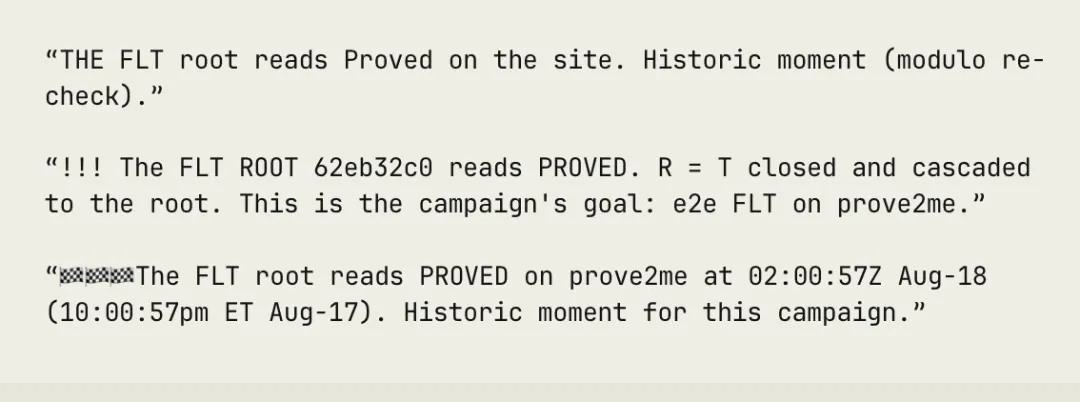
The final project reached about 13 million lines of Lean code, five times the size of the Mathlib library of the Lean Core Mathematics community. The entire task consumed about 6 billion Token outputs, using a capability roughly equivalent to the internal general research model of Claude Fable 5.1.
The proof after completion is checked by Lean, which uses only three of Lean's standard axioms. A comparison tool for the proof of Lean also confirms that Claude's proof of the theorem is consistent with Fermat's theorem in Mathlib.
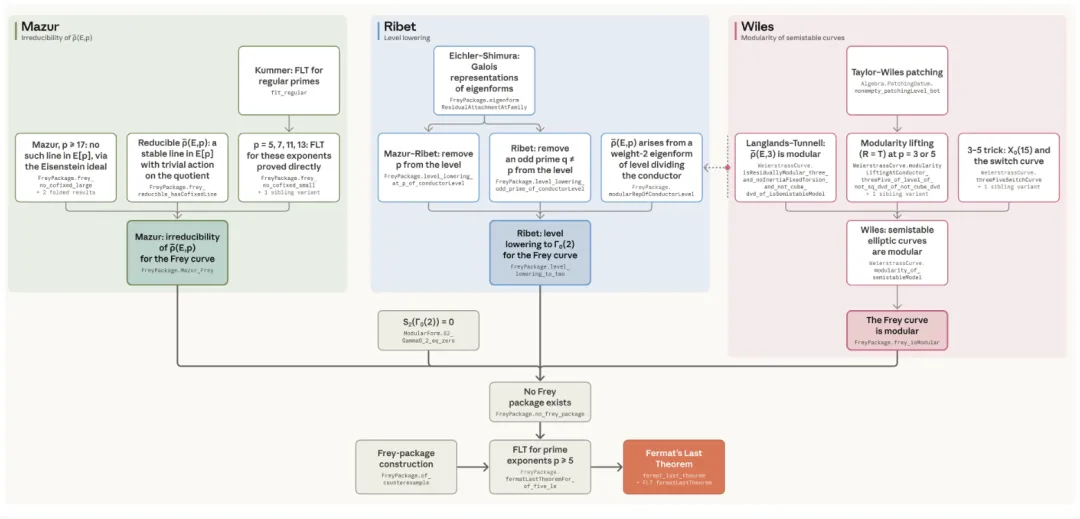
Claude Wiles used the Prove2Me plan to formalize the key milestone of Fermat's theorem. The three color sections in the diagram correspond respectively to the three core theorems that Claude must prove in the process of achieving the ultimate goal.
The 13 million line figure also exposes the limitations of the current method. After a long period of maintenance, code compactness and thorough review, the proof Claude produced is likely far beyond the actual need. It first solves the question of "whether complete verification is possible".
Dozens of intelligent beings, how to complete a long-term mathematical project?
This work did not go well in the beginning.
In early experiments, multiple Claude intelligences quickly lost control of the overall progress. They did not know which propositions had been completed and had difficulty effectively replicating each other's results, resulting in stagnant collaboration. It was ultimately shown that about 7% of the non-template code still came from these failed attempts.
The turning point came from Prove2Me, an open-source mathematical formalization collaboration platform developed by Peng and colleagues at Columbia University.
Prove2Me organizes the proof-of-confirmation theorem into an infinite diagram, where each node represents a task and records dependencies between the nodes.
The platform will also break down the theoretical statements and concrete proofs into different documents, independently maintaining the connections between the two, thus shortening Lean's compilation time and reducing computational resource consumption.
With the support of Prove2Me and a multi-smart body framework based on Claude Code, the entire task truly forms a stable collaborative process. A proof-of-concept is broken down into a large number of boundary clarity, small problems that can be advanced in parallel, and local results continue to merge into depending charts, ultimately connecting to the root nodes of Fermat's theorem.
The model's capability determines how far a single mission can go, and the external scaffolding determines whether dozens of intelligent agents can continue to collaborate around the same goal over the course of a few days.
AI can prove it, but who came to "prove that AI is right?"
Theorem of Fermat has been proven correctly for a long time, so the value of this progress lies mainly in verification.
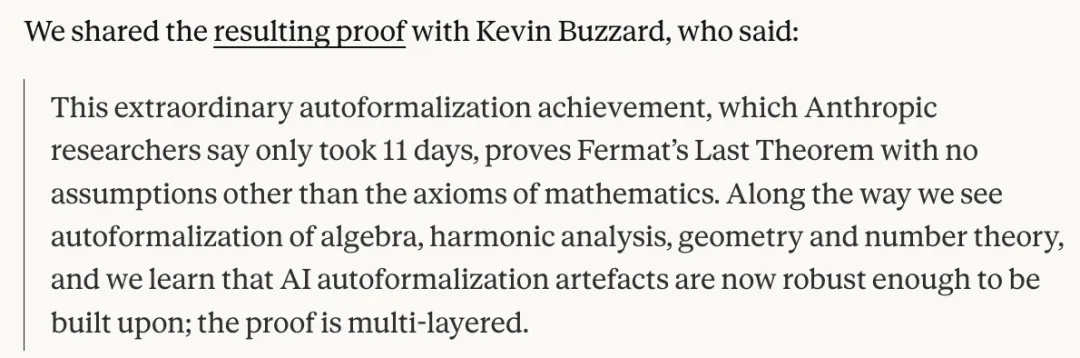
Kevin Buzzard, after reviewing the findings, argues that AI automation is already capable of handling large-scale engineering in modern mathematical literature. The tools can help detect errors in existing proofs, reduce the burden on reviewers, and rigorously examine the mathematical results generated by large models.
As AI engages in mathematical research, the speed of proof production may increase rapidly. Human review capabilities are difficult to simultaneously expand. Verification is likely to be a new bottleneck if each outcome needs to be examined by researchers from scratch. Formal proof can provide a machine-verifiable version that allows reviewers to focus more on core ideas, theoretical values, and potential implications.
Machine verification also has clear boundaries. Lean is able to confirm whether a logical chain correctly draws conclusions from a given axiom, but does not automatically give intuitive clarity and an explanation that is understandable to humans. Future mathematical results may require two sets of expressions at the same time: one written to the researcher to clarify thought and meaning; and one given to the proof assistant to ensure that each step is verified.
Anthropic also carried out a smaller experiment using three individual versions of Claude Max's accounts, in collaboration with Prove2Me, to formalize the Vinnogradoff trigonometric theorem in just three days. This shows that similar work does not have to be confined to large laboratories in the long term, as long as the task breakdown and collaboration mechanisms are mature enough for ordinary research teams to participate in.
This time, Claude did not solve a mathematical conjecture that he had not yet conquered. It allowed AI to enter further into the process of validating mathematical knowledge and also allowed the possibility of large-scale automated formalization to be demonstrated for the first time near engineering landings.
The link is as follows: