
It's the first time in the history of the world.
Whether you like it or not, the 50-page document you wrote overnight is rapidly devaluing.
It's not your fault, it's just that in a few minutes, an AI can spit out a word that's pretty much the same, almost impossible to replace.
All workers are confronted with this cruel reality:
Today, being able to write a long document proves that you haven't really thought about it.
This was said by Tara Seshan, the product manager of OpenAI Codex and ChatGPT Work.
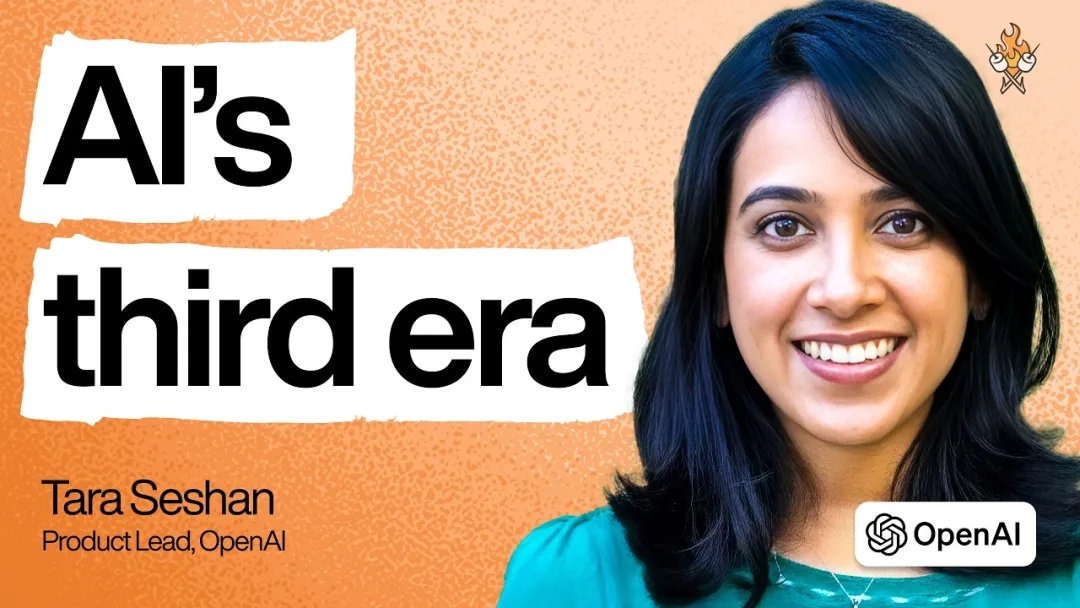
Tara Seshan
In an 81-minute interview on Lenny's Podcast, she also made a more sobering statement:
If you make a product for the current model, it will fail; if you make a product a year from now, it will also fail.
When everyone has top-notch tools in their hands, when AI is evolving into a "permanent online agent colleague", where is the working people's shield?
Tara shares this logic that runs inside OpenAI and deserves to be read carefully by any worker who doesn't want to be eliminated.
The ship was delivered alive.Human beings are only responsible for "managing".Tara describes the evolution of AI products in three phases:
Stage one: Conversation (Chat), you ask it and it answers.
Stage 2: Co-Pilot, to help you work in a specific situation (such as writing code).
Stage three: Permanent AI colleagues, long-term online, remembering the context, and independently performing complex tasks.
The dividing line between humans and AI is moving upward at a rate visible to the naked eye.
From the past "complete the next line of code" to today's direct delivery of targets, running from the backdrop of automated workflow.
Whether it's the "Smart Body Command Center" at the end of the Codex desktop or ChatGPT Work, which covers all forms, reports and business analysis, all point to the same trend: the executive layer is being taken over by AI as a whole.
In the words of Tara, "Agent is responsible for sailing ships, man is responsible for steering them".
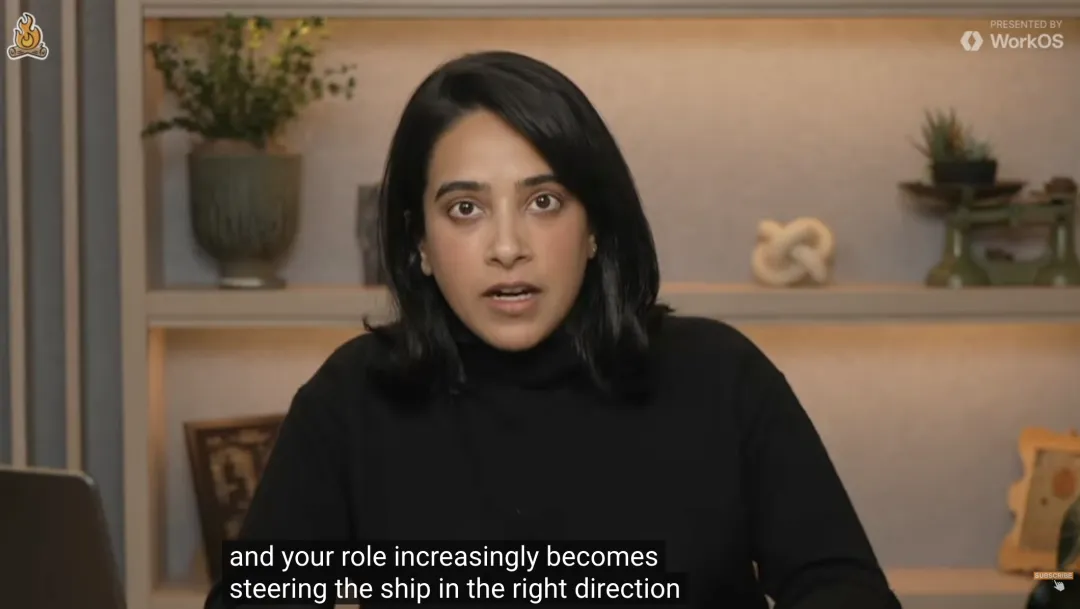
In the interview, Tara said that the agent is responsible for sailing the ship and the role of the person is to lead the ship in the right direction.
When the life of the boat is taken away by AI, the core value of humanity is left with only five things:
Where to go?
Responsibility for the results
It's a good idea to make a decision about the quality.
Injecting position and expression (to the soul)
Collaboration, caring and motivating teams
OpenAI has abandoned its one-year roadmapWhy is it that saying "stand now" or "bet a year later" is a dead end?
This is what we're doing now: the model is evolving too fast.
In order to get around the shortcuts of today's model, you work hard to design a complex set of product mechanisms; the result is that tomorrow's generation of models will turn into a worthless "cut-off".
Bet one year later: It's like being blind.
The whole life of the product, based on the assumption that it will most likely fail, is destined to be lost.
This led to the famous quote in the tech world: "The model you used today was the craziest day of its life".
Tara pointed out that the most ridiculous part of the phrase is that everyone agrees on the word, but when they're really good at it, they're unwittingly at the level of the "most ugly" model in front of them.
In order to break this deadly human inertia, OpenAI's internal leverage cut off the rigid "one-year roadmap" and forcibly shortened the scale of planning to two to three months.
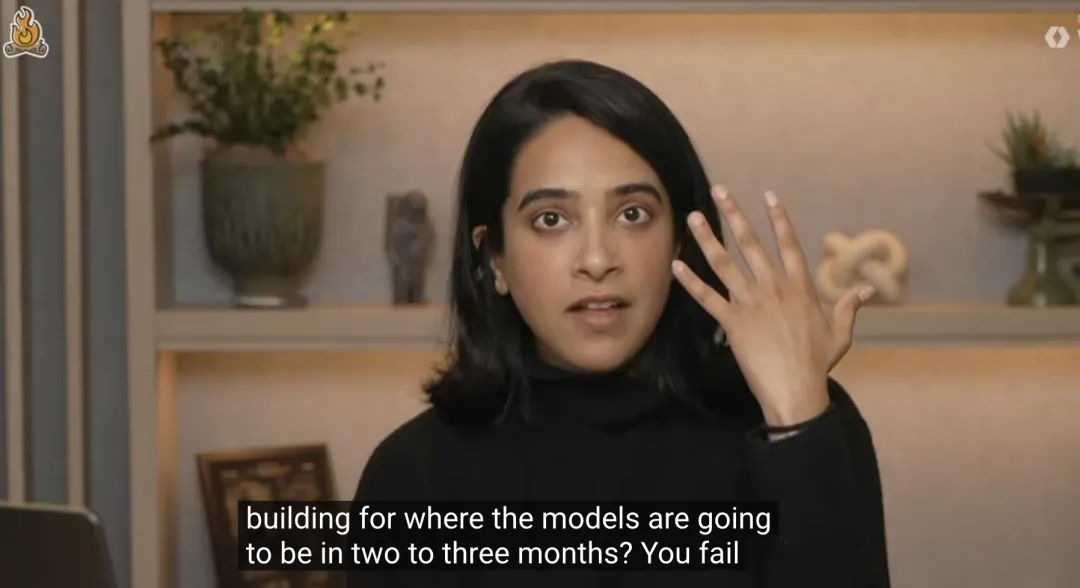
In the interview, Tara said that the product had to be made according to the model after two or three months, and the bet would fail in one year or so.
But this short two or three months was not a blind trial by knocking on the door, nor was the "black box" allowed inside.
Tara's real bottom line is: don't make long-term name plans, but the product has to stick to the real progress of the research team.
The product team and research team were asked to communicate at a very high frequency and to align a bottom line: What capabilities will the model become stronger at the end of the day and when specifically will the time node be in place?
After touching the bottom, the product quickly stepped on the technological breakthrough drums to replace it.
It did not abandon the roadmap, but instead turned the plan table on the wall into a "real-time navigation instrument" that was modified according to front-line battle conditions.
Farewell to the perfect document.Just write to your Maoist philosophy.Tara comes from a culture that values writing very much, and in the past, she used to grind her briefs to the point of no return.
But at OpenAI, she has completely changed her habits: she only writes long documents for herself.
Because "complete material" no longer represents "deep thinking", the value of long documentation as an intellectual qualification has been reduced to zero.
Now, prototypes that can run directly, A/B test data and user feedback, have completely replaced empty documents.
But she maintains a very clever rule of thumb: write 70% of the program and go to those who need the authorization, and leave the remaining 30% for them to complete with you.
The reason for this is realistic: a perfect solution is presented before you, and other people's ideas will only explode from it; only if you stay "on the sidelines" will the other person be willing to reach out and work with you.
Two types of writingWhat can outsource and what can't give AI?Tara divides her writing into two categories:
Report type writing
Thinking type writing (logic, path selection, controversial judgement): never outsourcing to AI.
Why can't thinking writing give AI?
Because it's the process of getting your ideas straight, of pushing the wording, of revising the whole process over and over again.
If you give it to AI to write, the text is there, but this "think clearly" step doesn't take root in your brain.
In order to prevent her brain from deteriorating, she also gave herself two harsh disciplines:
1. How many people a document should be sent to read, how many times should you read it yourself.
2. The amount of time that a meeting will take up for everyone, the amount of time to prepare will be sufficient for this sum.
Your ambitionIt's the ultimate bottle.When the threshold for design, analysis, code, and prototyping is lowered to a very low level, something that used to take a team to do, one person can now run it.
So what is the difference between men and women?
"Ambition is ambition".
Real high-level players will not only use AI to automate repetitive work, but they will use it to expand the boundaries of their abilities.
This has also completely disrupted the responsibilities of product managers (and all knowledge workers):
In the past: Kung Fu spent time sorting, writing documents, and reviewing these peripheral rituals.
Now: find the key problems that determine success, make the sharpest assumptions to verify it very quickly.
The most important thing is to lift the team's ambition.
When others come up with a plan, your value is to ask, "Can the ceiling be higher? Can it be 10 times faster?"
Three black words inside OpenAIThese three phrases correspond exactly to three self-exams.
One is that it can't be done any faster.
One question of ambition is not enough, and the goal can't be lifted up.
The third most interesting sentence: whether you yourself are using this product every day, whether you can't get rid of it, or if you put all the taste and pressure on it, it's not good to use this judgment.
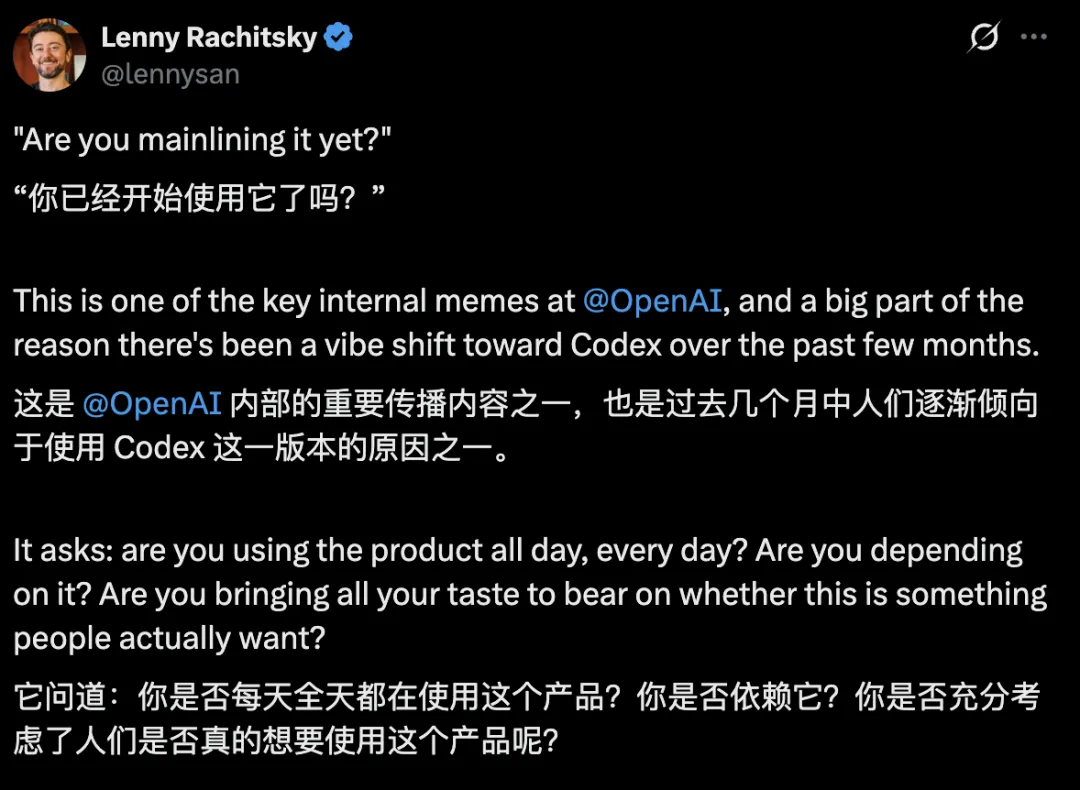
Lenny asks her how the wind on Twitter has shifted from the Claude Code to the Codex over the past three to six months, and what has changed inside.
Tara's response was: "Nothing has changed". The team has been self-employed at high intensity, receiving fast feedback, and the way it works hasn't changed from start to finish.
The only change is that people outside are starting to notice.
There is no "compilation test" in knowledge work.The process must be disrupted.Writing the code is result-oriented: the agent changes the code, runs the test again, it's over, it's not over, it's not over.
But the work of knowledge is completely different.
In one final PPT, it says "90% success rate" and you can't just look at the numbers and choose to believe.
You've got to see what the original input is, and how the middle reasoning moves forward.
That's why the core design of ChatGPT Work isn't about delivering a "beautiful finished product" directly, but instead is about making references, inputs, and deeds half-lived and giving you complete control over the whole process.
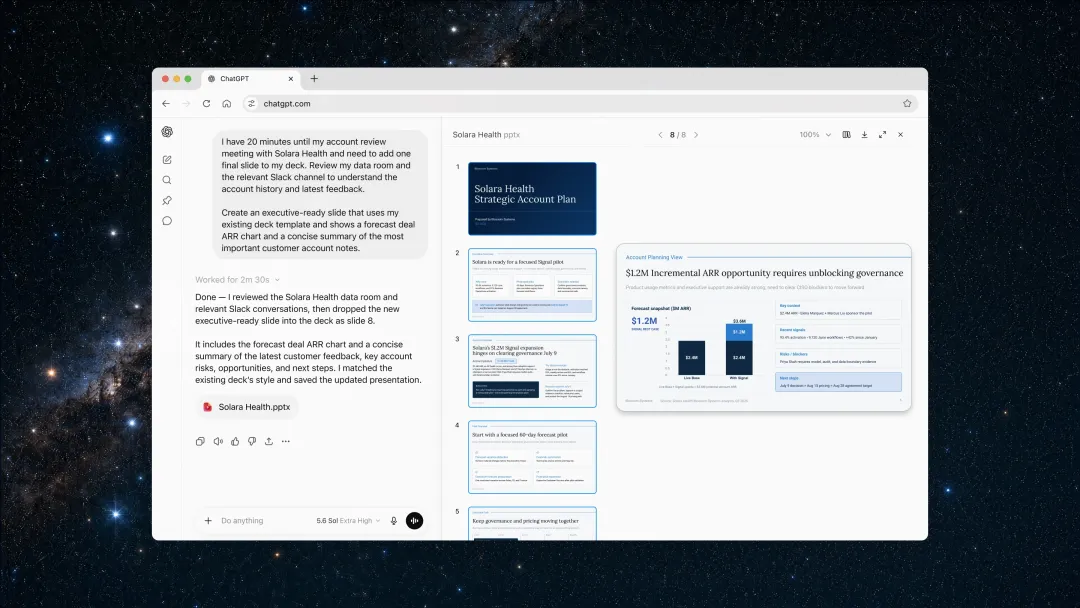
With only 20 minutes left from the customer, ChatGPT Work delivers the 8th page slide in 2 minutes and 30 seconds.
The tools are available to everyone, and the underlying capabilities are rapidly being leveled.
In the age of AI taking over "boating", the only thing that really determines your worth is whether you have mastered the truth.
Where do you want to take this boat?