It's the first time in the history of the world.
Large-scale language models of "word-by-word" self-report generation are the core bottlenecks of slow, costly reasoning.Speculative decoding(Speculative Decoding) - allowing a lightweight "draft model" to guess a whole word first, then "criticise" by a large model at a time - is one of the most mainstream free-speed ideas in recent years and has been widely adopted by mainstream frameworks such as vLLM.
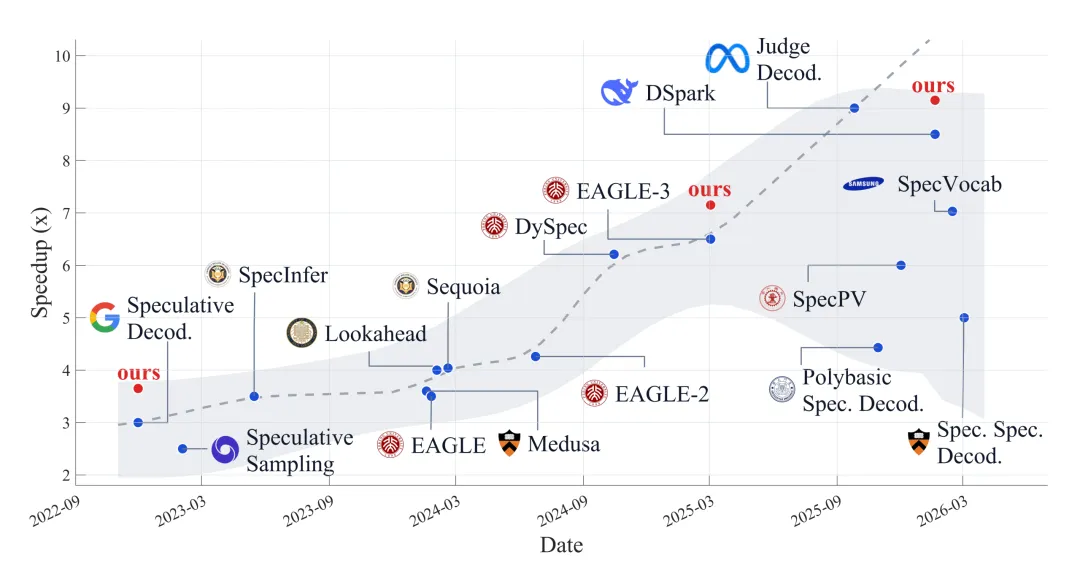
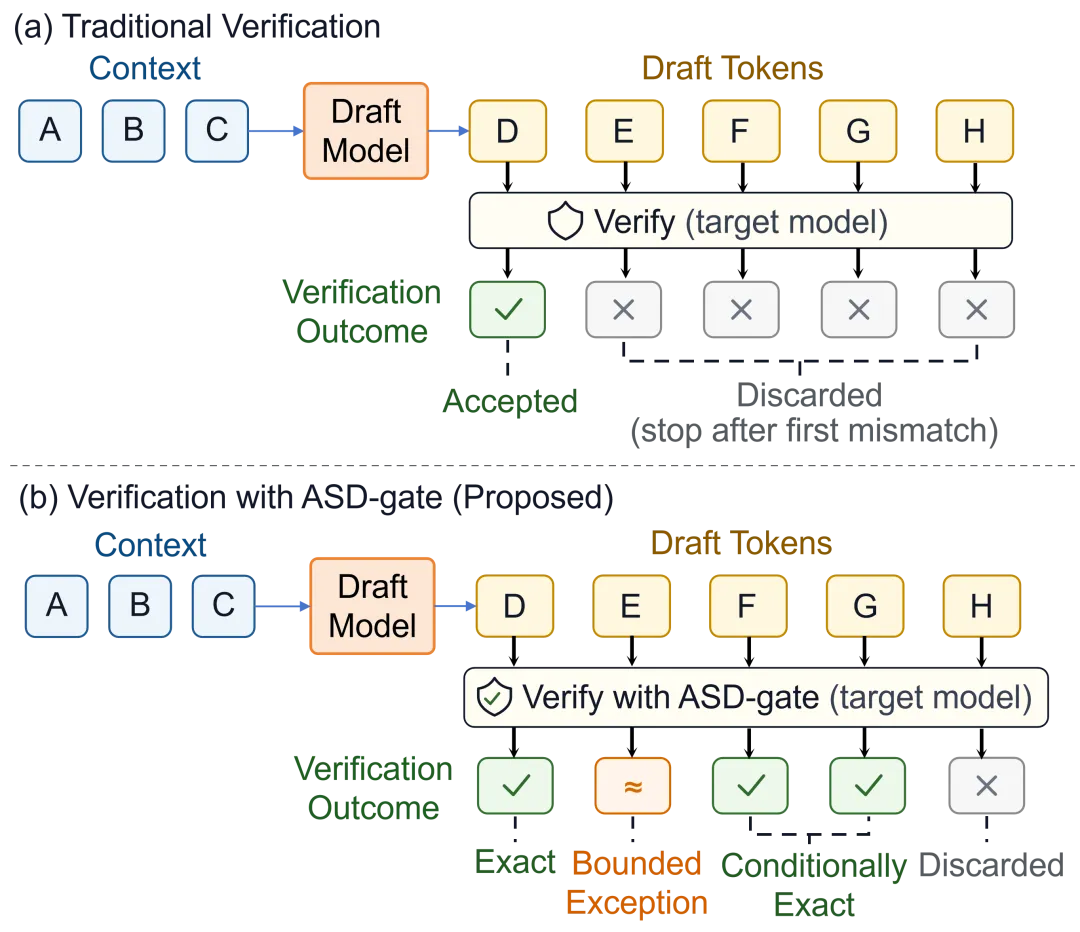
But it has a "strict" rule of thumb:As long as the draft is inconsistent with the best option of the big model in the first word, verification immediately stops, and all subsequent draft is scrapped.Even the big model has already criticized the whole thing.
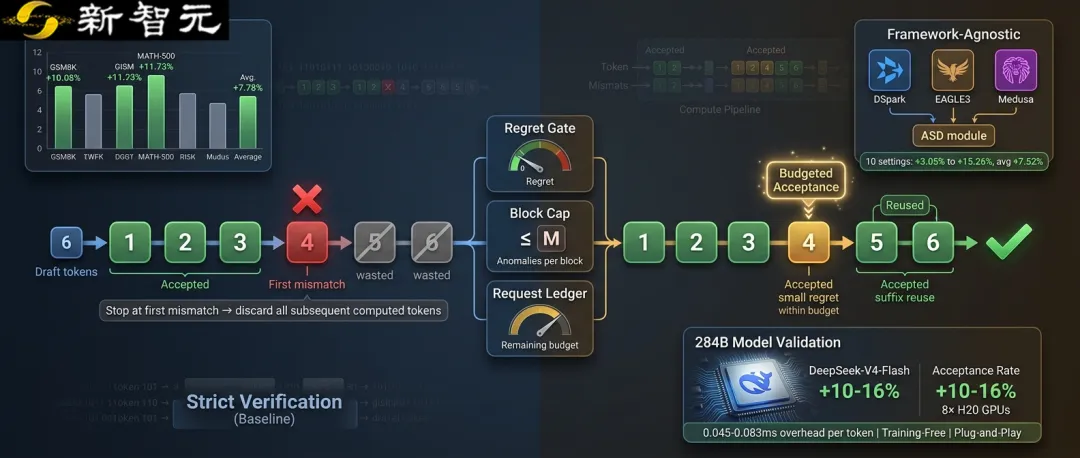
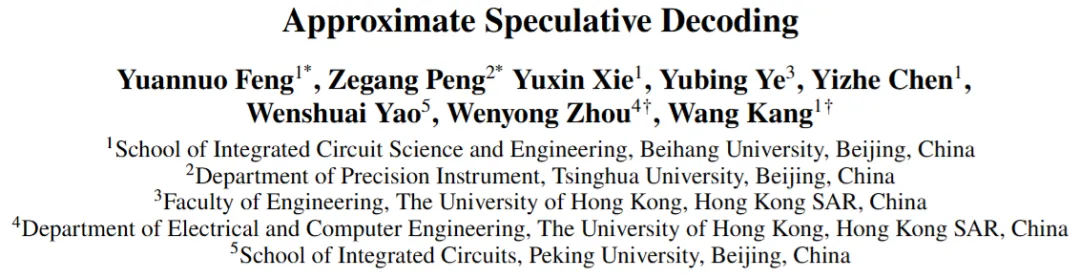
According to a joint team of Beijing Aerospace University, Tsinghua University, Hong Kong University and Beijing UniversityApproximate Speculative Decoding (ASD)In a strictly controllable budget, it is selective to accept the very few "big models would almost want to choose" disagreements, and to keep the rest true and well calculated.Turn around and use it.。
Link to the paper: https://arxiv.org/abs/2608.03447
Open source code: https://github.com/Kissmetothemoon/ASD
A few key figures:
It is also available in Qwen3-14B + DSpark-14B.7 missionsAt the top, fixed load throughput average rises7.78%(distance)3.64%–11.73%The average number of tokens accepted per round increased from 3.85 to 4.20;
There are three drafting frameworks in DSpark/EAGLE3/Medusa.10 groupsAll the positive gains in the settings3.05%–15.26%The average.7.52%),Highest rate of 15.26%;
It's not.284B ParametersOn the ultra-large model DeepSeek-V4-Flash on the 8-bit H20 GPU, the end-to-end acceptance rate of validation is upgraded to about10%–16%;
Verifier adds logic to each output token only0.045 mm 0.083 millisecondsandThere's no need for training, no need for tweaking, no need to run a big model.The budget is set at zero and the standard speculative decoding is strictly reversible.
More importantly, ASD is aIt's called a plug-in verifier module.This is the first time that I've been able to do this.There are several mainstream speculative decodes like DSpark, EAGLE 3, Medusa and others.AlgorithmsIt's all happening at a very fast pace.
Background of research
Large language models are generated by word-for-word tokens: every time a word is output, a large model with hundreds, tens of billions of parameters must be run over and over again. Generating a thousand-word answer means that hundreds of thousands of consecutive large models are computed.
Speculative decoding is the practice of allowing a small amount of "draft model" to guess a few words at a time, followed by "criticism" by a large model (target) at a time. The right word is directly adopted and the wrong place is discarded, and the draft is re-generated by the large model. Under strict theoretical assurance, this method can be used to generate an output that is completely consistent with the large model alone and is therefore widely adopted.
However, there is an inherent waste to the traditional "criticism rule". Standard greed verification uses binary judgments: if the draft is inconsistent with the big model's best choice (argmax) in the first word, the verification is stopped immediately, and all subsequent drafts are scrapped.
It's like a teacher criticizing a transcript: a student misspells the first word, and the teacher misspells it.It's been criticized afterwards, and it's been ripped apart.The rules, while "strict", were wasted on the review work that had already been done.The problem is that in this round of parallel verification, the big model has actually calculated the logits for each location of this entire draft. These calculations have already been made and are discarded as the first discrepancy arises.
What's even more subtle is that when a large model assigns a position to the back, it's "assuming the previous draft is complete" to be calculated in a linear manner.If we are willing to accept the small discrepancy at the front and the long line at the back, it is probably still the best option for the big model:
They would have been justified.
Token inconsistencyIt's not the same as mission failure.
The team noticed a fact that is often overlooked: that the draft and the big model are "incompatible" with a word, which does not mean that the final answer is wrong.
The paper gives a very intuitive example: the same mathematical result can be written as1776、1,776Or with a box.\boxed{1776};37×48with48×37In logic, "because...so"... is replaced by "because...so"...Literally different, but ultimately the answer is exactly the same.In other words, the difference in the token level is only an "imperfect proxy signal" for the quality of the task, not the error itself.
Of course, the team also emphasizes that accepting a word that is not greedy will change the decoding trajectory.It's not harmless optimizationThe real problem is not "ignorance of dissent".
How can we control their "cumulative costs" throughout the entire range of requests while allowing very few discrepancies and not allowing approximate errors to accumulate as the output lengthens?Simply loosening each draft would cause the deviations to overlap over and over again in the multi-line decoding code; each piece would reposition the "allowability limit" and not be responsible for the deviations already introduced in the same generation. This is exactly what ASD needs to solve.

Research methods
The core idea of ASD is that instead of accepting "one-sided" in the first disagreement, rather than in a strictly controllable budget, selectively accepting the very few disagreements "the big model almost wants to choose" and then repeating them directly and then continuing to choose in line with the greed of the big model, this part of the word without having to make any more approximate decisions, and without having to run an extra step forward for the big model.
When a draft word doesn't match the big model, ASD first calculates this discrepancy:It's a pity".(regret): The lower the regret value, the more "nearly flat" the word, the less harmless it is. In order to prevent "drinking" from evolving into a quality slip, ASD set three thresholds:
A local regretted gate controller: The regret value of a single disagreement must be small enough and too unwise to be rejected in comparison to "how many words can be saved after it";
Block caps for each exceptional number of timesIn a draft block, a maximum of several disagreements is allowed, so as to avoid the concentration of water in a single block.
Request-level ledger through the entire request "Regret Budget ledger"The total cumulative acceptance of deviations in the entire generation phase is constrained within the fixed budget and should not be allowed to accumulate with the length of output.
The three work together to make approximations quantifiable and auditable.
Another key design of the ASD is:It's been done before and after the recycling".After accepting a disagreement word, the subsequent draft word is rearranged by the big model under the "new foreword to the disagreement", where a subsequent foreword is often the greedy choice of the big model. This foreword can be submitted directly, neither requiring additional forewords to the big model nor requiring new approximate decisions.This is the main source of acceleration.。
In engineering, ASD is aIndependent, or plug-in, verifier modulesIt doesn't rewrite the draft model, nor does it change the overall process of speculative decoding, only replaces the "first disagreement is cutting" step in standard verification with "the longest forward option for budgeting" to insert an existing flowline.
Free of training, free of tweaking, free of draft modelsThe complexity of the new arithmetic is only O (K) before the additional large models are required.
The framework is unrelated, broadly compatibleWhether the top layer uses a speculative decoding algorithm such as DSpark, EAGLE3 or Medusa, ASD works on the same link as "after the big model has finished segmenting", so it can be directly mounted, that is, plugged in.
The budget is set to zero = originalB=0 is strictly degraded to standard greed validation, fully compatible with existing systems, and can be cut back at any time.
The results of the experiment
The team tested the effectiveness of the approach with two problem systems.
Question one: Can the "budget allowed" differences really be raised?End to endSwallowing?
In the Qwen3-14B evaluation of seven missions with DSpark-14B, covering GSM8K, MATH-500, HumanEval, MBPP, MMLU, MT-Bench, and Alpaca, ASD's fixed load throughput was more stringent than speculative decoding.It's all up.It's the size.3.64%–11.73%(Average)7.78%In the following table, the acceleration ratio is equal to 1.00 on the scale of "only large models, no speculative decoding":
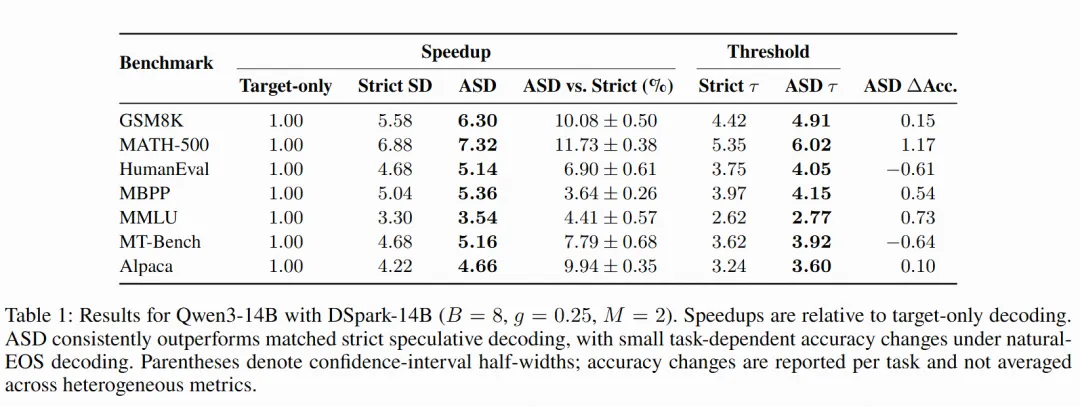
The fastest are mathematical class tasks MATH-500 ((+11.73%) and GSM8K ((+10.08%), with an average acceptance length of 0.67 and 0.49 tokens per round, respectively.
In the quality audit of the natural end decoding (which ends with the actual pronunciation), there are seven tasks:Five accuracy rates remain unchangedOnly HumanEval (~0.61 points) ≈MT-Bench (~0.64 points) showed small fluctuations of about 0.6 percentage points.
Question 2: As a generic module, ASD replaced speculative decodingAlgorithmsIs it still in place?
To demonstrate that the benefits came from the verification end module itself, the team directly mounted the same ASD verifier on it without tying it to a draft algorithm.DSpark, EAGLE 3, Medusa are three different algorithms for decoding speculation.On top of that, cross-validation was done on multi-target models such as Qwen3/Llama-3.1/Qwen2.5, which is the most common type of cross-validation.All 10 groups set up positive gains:
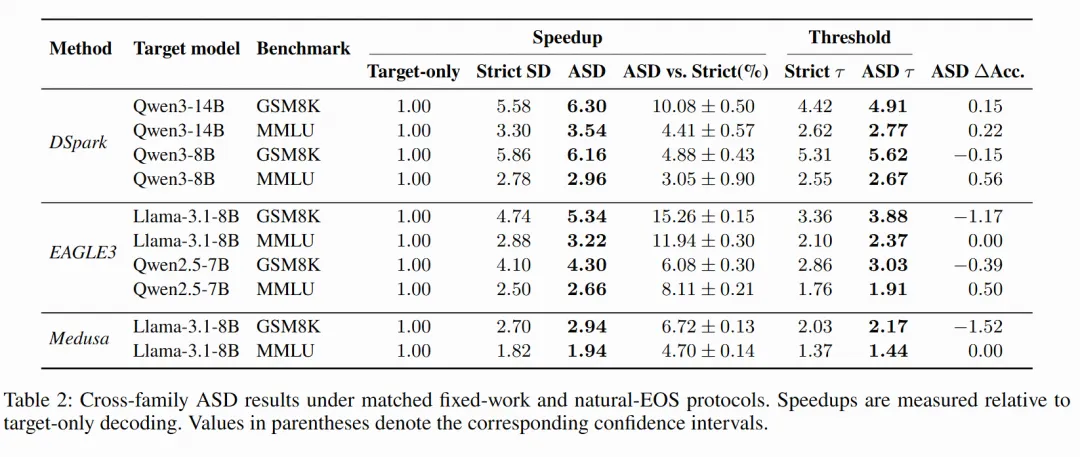
10 groups to raise distances3.05%–15.26%(average)7.52%Each 95% confidence interval is strictly greater than zero, and the average acceptance length of each group is increasing: the same verifier module, attached to which speculative decoding algorithm, can lead to a direct acceleration, indicating that the acceleration comes from the same verifier module.The verification end mechanism itselfThese increases have also been achieved at a strict baseline.1.82×–6.88×On the basis of the acceleration, the ASD pushes the ceiling further to "add a layer".1.94×–7.32×。
Melting and spending:Compared to "local-only-release" MARS-type, Fuzzy-type controls, with ASD at +6.5% on GSM8K; +5.3%; +5.1%; +9.7% on MATH-500; +6.0%; +7.3%), highlighting the irreplaceable role of "request-level budget ledger". At the system level, verifier logic itself only adds about each output word.0.045 x 0.083 millisecondsWhile the target verification time decreases due to the reduced number of rounds of verification, the target verification time decreases.It's 1.48 times 1.51 milliseconds.Real acceleration comes from the reduction of expensive verification rounds, rather than from hidden expenses.
The super-large model verifies:It's the first time I've ever seen a flash drive like this.284BIn large-scale experiments with DSpark (with 8 H20 GPUs, FP4 to FP8 compatible settings), the acceptance rate on the GSM 8K-Confirm verification set of 1,000 independent examples increased (A/P).10.08%–11.48%Accuracy fluctuations of not more than 0.30 percentage points; GSM8K and MATH-500's verification end-to-end acceptance rate overall increase approximately10%–16%。
It doesn't hurt.Put the scales on the stageCivilization does point out that accepting non-greedy words will change the decoding trajectory, defined by ASD as the upper limit of cumulative local regrets.It does not guarantee that the output is word-for-word consistent, semantically unchanged or that the task must be correct.。
For this purpose, the team used two sets of independent audits to clarify the weights: a fixed load rating measured throughput, and a natural end decoding audit separately for accuracy, generated length and output hash discrepancy.Over 95% of the request output trajectory changes(Hash disagrees), but the accuracy of the detection did not decrease. In most cases, the accuracy can even be doubled by searching the Pareto front.
This confirms the paper's central position:A token discrepancy is not the same as a mission failure, but any approximate trajectory cannot be considered "accurate" or "absolute secure".The trade-off between speed and behaviour should be explicitly modeled, publicly disclosed, and audited by specific applications. In actual deployment, the three spins can first be frozen on separate data (budget B, gate control g, block upper limit M), and then quality audits for each model and task.
Future prospects
The positioning of the ASD determines its imaginary space: it only modifies the acceptance decision "after the big model is finished", with improvements to the draft-generating side.Nature is intertwined, overlapping.In this way, there are several directions to look forward to:
Combined with stronger draft models, tree-shaped draftsThe longer the candidate is given at a time, the more candidate paths, the greater the chance of "accepting a small discrepancy, unlocking an entire piece that has been solved", and both are expected to superimpose a higher acceleration rate.
From greedy verification to sample verificationCurrently, ASD acts on greedy decoding; whereas random scenarios such as creative writing and open dialogue require speculative sampling to rely on rejection of sampling to strictly maintain output distribution. How to introduce "budgetized acceptance" to sampling is a natural and important next step in accelerating sampling under the premise that distribution biases can be verified.
The three-way valve should be smarter.: Current budget B, gate control g, block upper limit M are offline frozen on independent data; in the future, they can be made to adapt to task types, model confidence, generate length adjustments, or even introduce semantic-level, task-level acceptance signals (e.g. math, code task direct validation of the final answer) to memorize "book of regrets" in a dimension closer to task quality.
Closer theoretical boundariesThe paper also admits that the current account is limited by the upper bound of the "cumulative local regret" and is not a complete sequence seemingly guaranteed. In the future, if a closer distribution margin can be given, "proximity" can be equally verifiable and testable in theory.
Super-large model deployment to production levelThe 284B experiment was limited by the FP4→FP8 compatibility pathway, mainly by sculpting acceptance rates and accuracy; subsequent production-level MoE large models, end-to-end landing on separated reasoning services, and the supporting task quality audit flow lines will be a key step in the engineering landing.
From an application point of view, high concurrency scenarios such as dialogue, code generation, mathematical reasoning are extremely sensitive to "delay per word" and "word cost", while ASD's "non-training, plug-in, budget-to-zero" features make it promising as one of the mainstream reasoning frameworks such as vLLM, SGLang.Selectable verifier modulesGrayscale, under the assumption that the quality of most tasks will remain essentially unchanged, uses all the computing effort that has been spent to provide a general and low-cost acceleration pathway for large-scale, low-latency model services.
Seven, the knot
ASD provides a training-free, widely compatible speculative decoding acceleration pathway: it is itself aIt's called a plug-in verifier module.Without modifying the draft, only the "budgeted longest forward option" is used on the verification end to replace the "first disagreement is the cut-off", using as many scores as possible as the large model has already calculated.
It's not about the frame.It's not about rewriting the model, it's not about changing the process, it's about uploading it directly.There are several mainstream speculative decodes like DSpark, EAGLE 3, Medusa and others.AlgorithmsAnd in these algorithms,It's all happening at a fast pace.;
It's not training, it's not tweaking, it's not adding big models.And swallow up.Highs of 15.26%The average of the main experiments is about7.8%The cross-algorithmic average is about.7.5%;
It's not.284B super-large modelIt's still up there.10%–16%the increase in the acceptance rate at the end of verification;
There are three gates that lead to deviation.There are boundaries, controllable, auditableThe budget is zero and there is no way to go back to the norm.
It provides a new option for low-cost, efficient deployment of large models without sacrificing the accuracy of most tasks.