It's the first time in the history of the world.
Hugging Face is about to hit the big screen!
Just yesterday, Huang Rinpoche himself announced on the official blog of Invisalign:
Invitada has signed a final acquisition agreement with Hugging Face for a total of $129.303 billion.
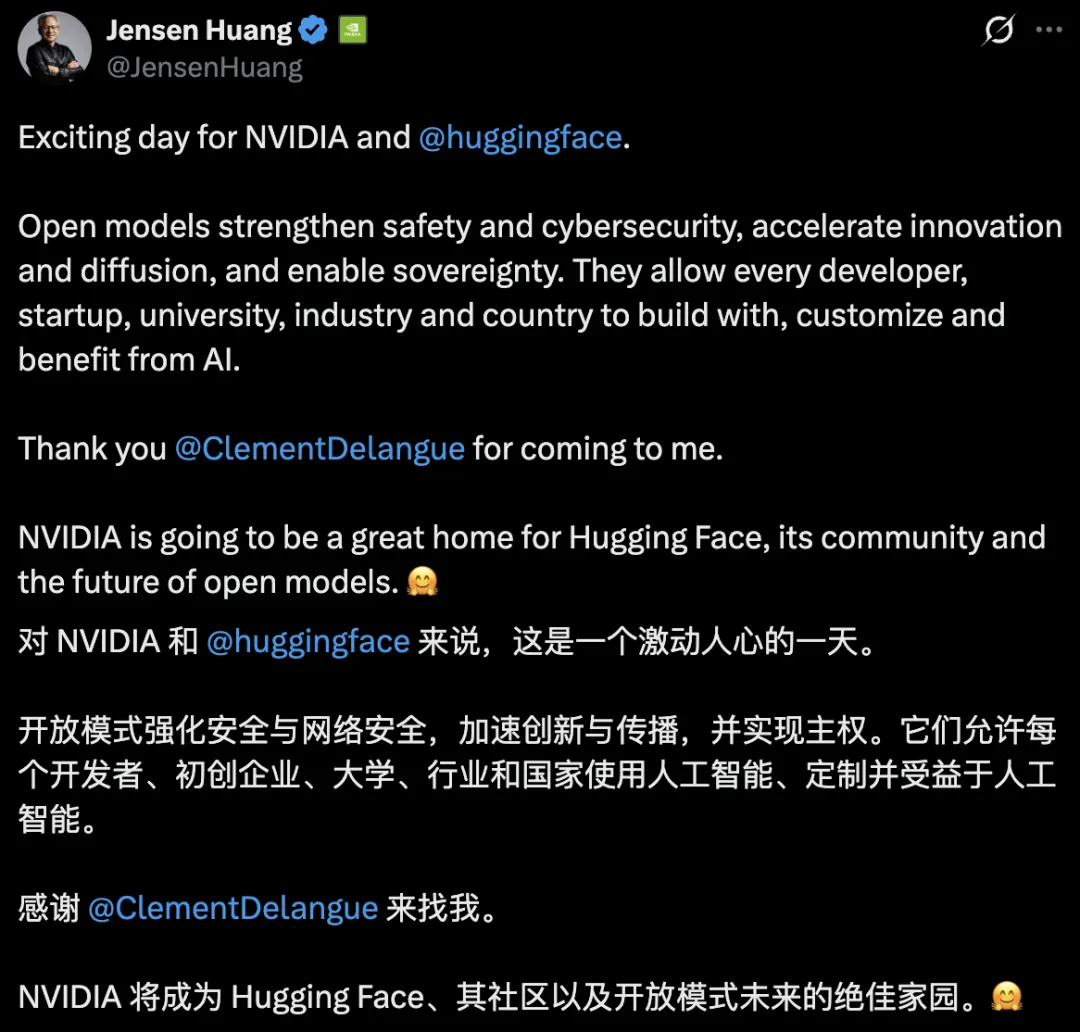
This is the largest overall acquisition in the history of British Airways.
The previous record was the $6.9 billion purchase of network equipment company Mellanox in 2020, which almost doubled the price this time.
Hugging Face co-founder and CEO Clément Delangue also posted on X, saying he was "very pleased" that Hugging Face would join United via this $129.303 billion acquisition.

As soon as the news broke, Musk appeared on both posts, leaving the same words: congratulations.

The transaction, therefore, opened the most dramatic scene:
At the end of last year, Clément, in an effort to "not let a single investor influence the platform's neutrality", turned down a US$500 million investment.
What happened in between?
The 18 million developers on Hugging Face are facing a bigger challenge:
When a chip giant becomes the owner of the world's largest open-source AI distributor and writes "calculative neutrality" into a file, what's the guarantee?
Rejection a year agoAnd this summer's "Planetary Pearl".Last year's rejection of 500 million was the reason why 12.9 billion were sold this year.
Time to go back to the end of 2025.
Invisalign proposed a valuation of $7 billion and invested $500 million in a minority stake.
Clément refused: partly because he didn't want a single giant in the shareholders' ranks.
That's only $500 million in exchange for about 7% of the shares, far from controlling, but for independence, Hugging Face chose to say no.
Why don't they give the whole company away in less than a year?
Clément explains:
In the 10 years since the founding of Hugging Face, open-source AI has come a long way. The community has proven that open models can be a complement to closed-source APIs, or even an alternative. But to do this on a larger scale requires more computing, more support, more collaboration, and more exposure.
Clément also said that the route had received a lot of investment and acquisition bids, which had been rejected in the past, but "this summer, the planet is pearling".
Hugging Face has a big ambition behind Planetary Pearls.
Their goal is to double the number of developers from 18 million to 100 million.
It's hard to get this huge infrastructure up and running with that kind of revenue from paid subscriptions and corporate services, from round-to-round financing.
The quickest shortcut is to find a host that can provide computing power, infrastructure, and global channels.
The company, which is not lacking in all three, happened to be the company that was rejected by it last year.
So Clément went to Huang Rin, and Huang Rin said the two could do it together.
Clément also mentioned that the transaction would make AI "more decentralized and avoid excessive concentration of power".
But when he said that, he was selling the company to a company with a market capitalization of $54 trillion.
How do you explain this magical turnaround?
Hugging Face wants to be big, but with limited resources, independence and to be big, it can only choose one.
What does Enida want?Why spend nearly $13 billion on a platform that doesn't sell GPUs?
According to SEC's 8-K filing, of the $129.303 billion, about $11.9 billion was paid to the original shareholders, with a maximum of about $1 billion in stock retention plans for employees who joined the company.
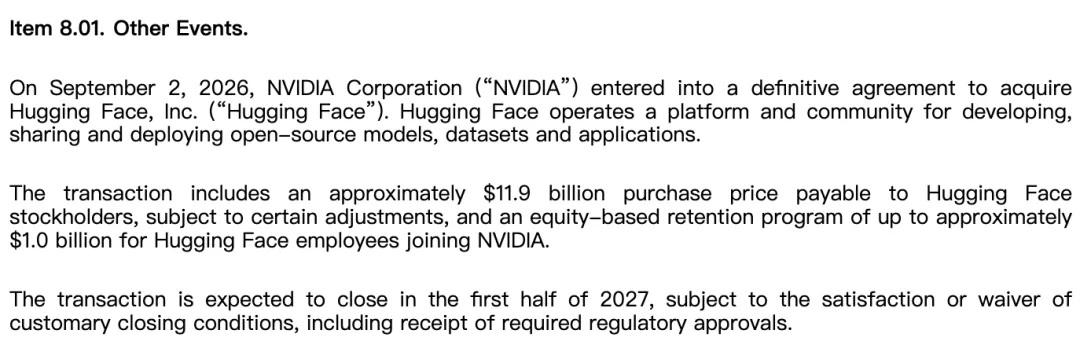
8K filed by INVIDA on 3 September: About $11.9 billion paid to shareholders, up to about $1 billion for employees remaining in office, and expected to be delivered in the first half of 2027.
The Hugging Face is supported by an amazing amount of ecology:
Over 18 million developers, over 3 million models, 500,000 datasets, 1 million applications, over 200,000 businesses have found and deployed AI here.
Inadequacy already holds GPUs, holds CUDA ecosystems and holds DGX Cloud.
From buying the card to running training, the developer doesn't get around it every step of the way. Only one link is missing: the discovery, evaluation, download and distribution of the model.
This ring is called the Hugging Face. Buying it is equivalent to buying an open-source AI super router.
As Reuters reviewed it: "England is buying strategic influence and has little to do with profits at the time".
There is a deeper reason for this, and that is hedging.
Meta, OpenAI, and Microsoft are all developing their own AI chips with only one goal in mind: to pay less money to Great Britain.
These are the biggest customers of Ingrid and the ones who want to get rid of it.
The flourishing of the open model is the second pipeline by which Great Britain has bypassed its major customers.
When hundreds of thousands of companies download their own models, their own tweaks, their own reasoning, the buyers will no longer be just a few giants, but a whole long-tail market.
Millions of open models run on cards that are less than a giant order.
In a SEC filing, Invisalign even wrote this logic as a risk disclosure:
Any regulatory measures that restrict the development, training, distribution or use of open source models may restrict models and datasets available on the Hugging Face platform, thereby having a substantial impact on Ingrid's own business.
This is equivalent to announcing that the demand for open-source ecology is directly focused on Intel's chip sales.
With the introduction of the Hugging Face revenue bag, INVEDA has also taken control of this lifeline in its hands.
Old Yellow pledged not to tie his N-cardBut for what?Mr. Huang also pledged to write in the SEC document:
Invisalign is committed to keeping the Hugging Face platform open and to continuing to support other chipmakers.
He also stressed in his blog that developers can choose any model, framework, cloud, and reasoning server they want, and that "British computing is not a prerequisite for developing or deploying on Hugging Face".
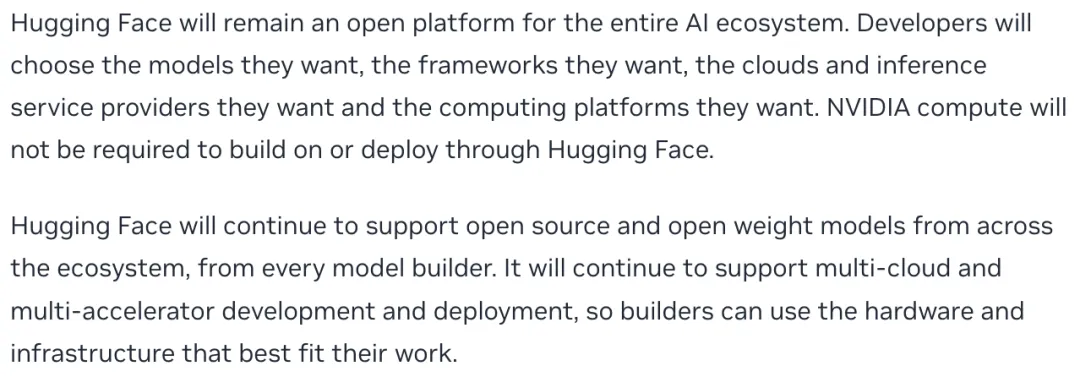
In a blog post, Huang Jin promised: to build or deploy on Hugging Face without the need for NVIDIA computing, multi-cloud, multi-accelerator support to continue.
Clément has repeatedly stressed the neutrality of arithmetic.
The three sides are highly consistent in quality.
But the devil is in the details: these commitments have no deadline, no independent governance mechanism, and no breach of the terms.
The deal is expected to be delivered in the first half of 2027, after which Hugging Face will be legally owned by Ingrid.
In Clément's words, "independence" can only be understood as relative independence at the level of operational and technological choice.
Harold Byun, CEO of BlueRock, said the following truthfully: "Although they claim, at least, technological means will be used to create a competitive advantage. Any rational company would do that".
It's not a conspiracy theory, it's business as usual.
So the real challenge is not a statement, but four default options for the future:
The default ordering of the recommended model will not lead to an improved version of Ingrid;
The hardware benchmark for assessing the list is whether the numbers in the H series and the B series continue to be staggered, or whether the numbers in the H series and the B series are slowly dropping.
The default goal of a key deployment is either to move to a multi-cloud environment or to slide to DGX Cloud;
Rationalise the priority of the service, and with the calculation of the UK, it will be cheaper, faster, and the queue shorter.
Each of the subtleties in these four places does not violate the pledge, but each of them can make "not tying Ncards" into a correct nonsense.
For developersIs that good or bad?In the short term, this is a good thing.
What has been the biggest headache for developers in Hugging Face in years?
The server scrolls, downloads are as slow as a buffalo, reasoning services line up endlessly...
The first thing Huang Jinping promises in his blog is to use Ingrid's infrastructure, engineering team and global network to fill in the gaps in reliability, security, evaluation and deployment.
The 18 million free open-source warehouse, which is finally home to a host that can make money, is likely to run faster and more steadily.
The real change doesn't happen overnight, it happens like a frog boiling in hot water, little by little, where you don't notice it.
There are two types of groups that are primarily affected.
The first category is for developers who don't use N-Cards.
Hugging Face has not only a website, but also an underlying open-source library of transformers.
In the past, these libraries were completely cross-hardware, and AMD and Google's TPUs could run fast.
What about the future?
With the release of the new model, NVIDIA's optimized version is likely to go live for the first time, while other hardware adaptations could take weeks.
This does not violate any "keep open" pledge, but developers will vote with their feet: which card will run the first day and which one will be purchased.
The first place where hardware neutrality collapses is often hidden in an update log in a code library.
The second category is the manufacturer that released the model.
Invisalign claims to be the largest open model and data contributor to Hugging Face, having released over 500 models and over 250 open datasets.
Invisalign is a player in its own right, and its Nemotron series has shipped over 500 models on the Hugging Face.
When a company is both the owner of the shelf and the brand on the shelf, the competitor's models of Meta, Mistral can still stand up, but it is up to the competitor to decide on which layer the label is not attached.
This is a variable that has never existed before this transaction.
For developers, the biggest attraction of the open-source world is the six words "you can move around anytime".
Clément had declared idealistically that the deal was to allow 100 million developers to own their own smartphones, rather than lease them.
In the future, there will certainly be more and more people with open-source intelligence.
However, Hugging Face, the widest avenue of open-source AI in the United States, will change its name to Yellow in a few months.
For 18 million developers, whether it's good or bad, the answer is not in the declaration, in the default options of Hugging Face.