Recently, Anthropic has launched a new generation of models such as Claude Fable 5.1 and Claude Mythos 5.1.
According to Anthropic, Claude Fable 5.1 is one of the most powerful open-source models currently available, designed for complex reasoning, long-cycle tasks, and Agent workflows, while Claude Mythos 5.1 represents the higher capability boundaries they explore.
It should be noted that while the two share the same basic modeling capabilities, different security measures are used for different use scenarios.
Fable 5.1 is open to ordinary users, developers and businesses, while Mythos 5.1 is open to audited high-risk partners with stricter access controls.
In other words, one is responsible for entering the real world and the other is left in a more rigorously controlled environment. This may be an Anthropic exploration of the shape of future AI products: the strongest models will not necessarily be available to everyone in the same form.
Officials said the two models represent important advances in the capabilities of the Claude series and show how they can continue to advance security deployments while improving model capabilities.
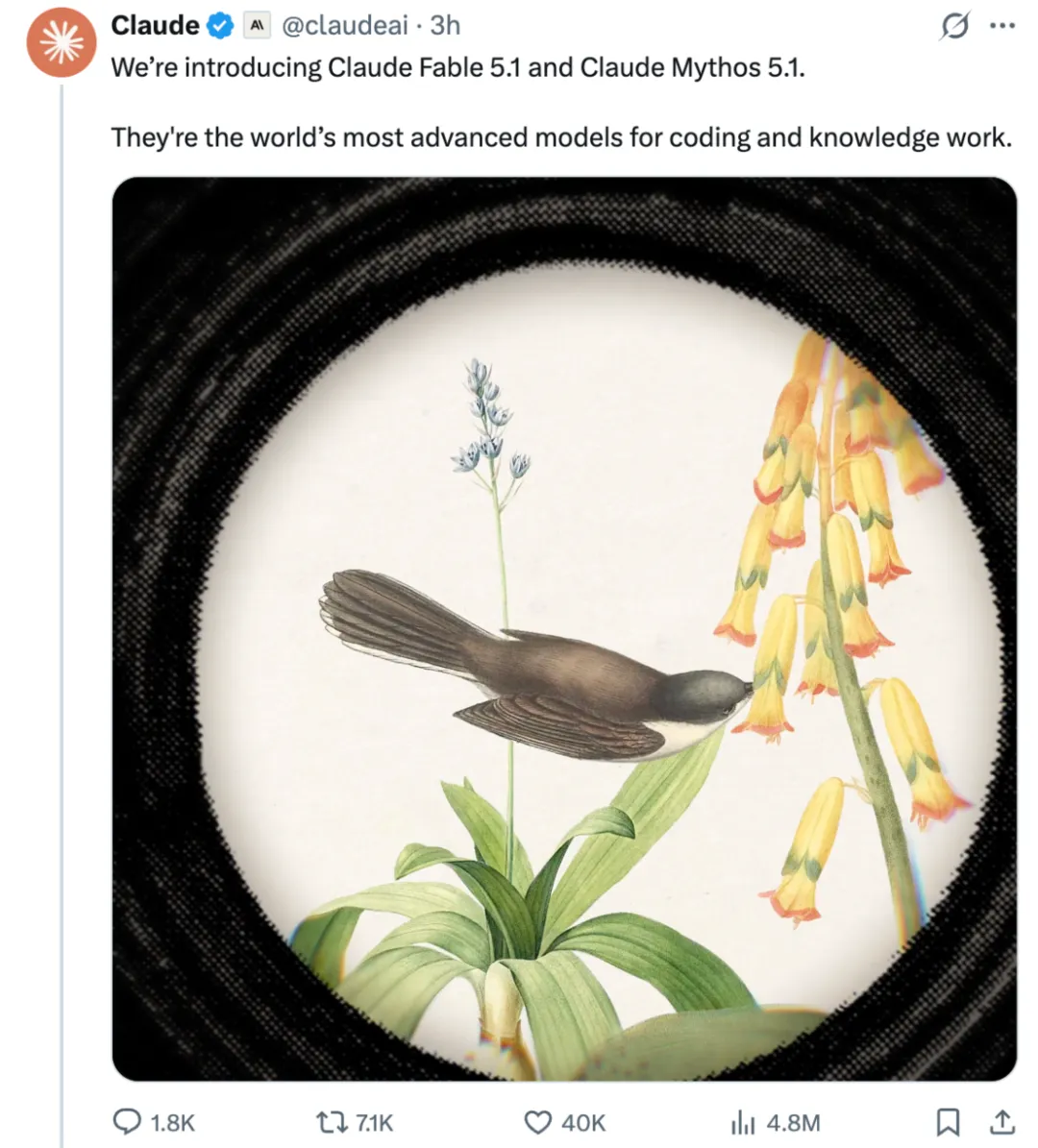
As the "strongest model on the surface", Fable 5.1's performance is still playable, and official data shows that Fable 5.1's performance in more benchmark tests is better than the previous generation Fable 5.
But the capability is stronger, and the price is cheaper. According to Anthropic, Fable 5.1 keeps the base price constant, reducing the cost of caching readings by 75% compared to Fable 5. In actual use, this reduces the overall cost of the model by about 25% for typical workloads; for highly Agented workloads, the cost can be as much as 45% lower.
It seems that even the most powerful models are considering sexuality.
We'll look at the details below.
Fable 5.1 is primarily about "sexuality".
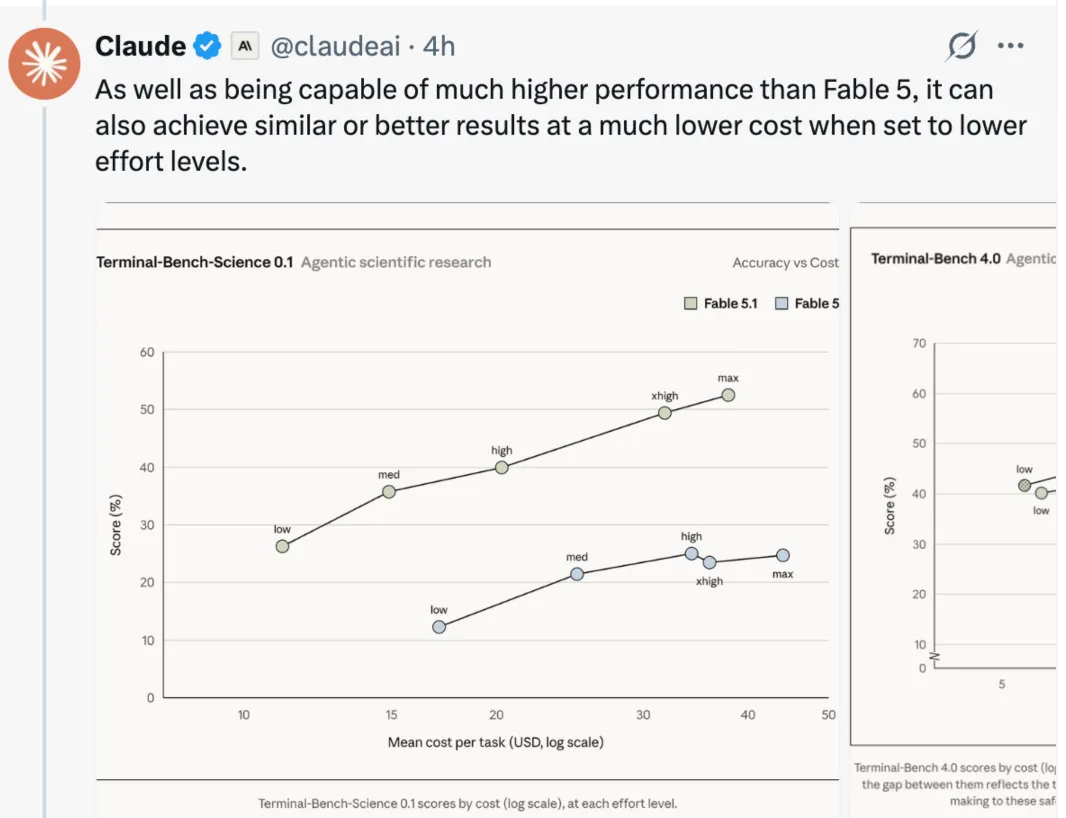
Instead of simply refreshing the list, Anthropic wants to emphasize this time around: Fable 5.1 can accomplish tasks that in the past required high ratings for Fable 5 at a lower cost of reasoning.
According to official tests, Fable 5.1 has been able to achieve performance close to or even higher than Fable 5 at low and medium reasoning intensities. Claude Code uses high reasoning intensity by default, Claude Cowork and Claude.ai use medium reasoning intensity by default, and users can adjust between speed, cost and effectiveness depending on the complexity of the task.
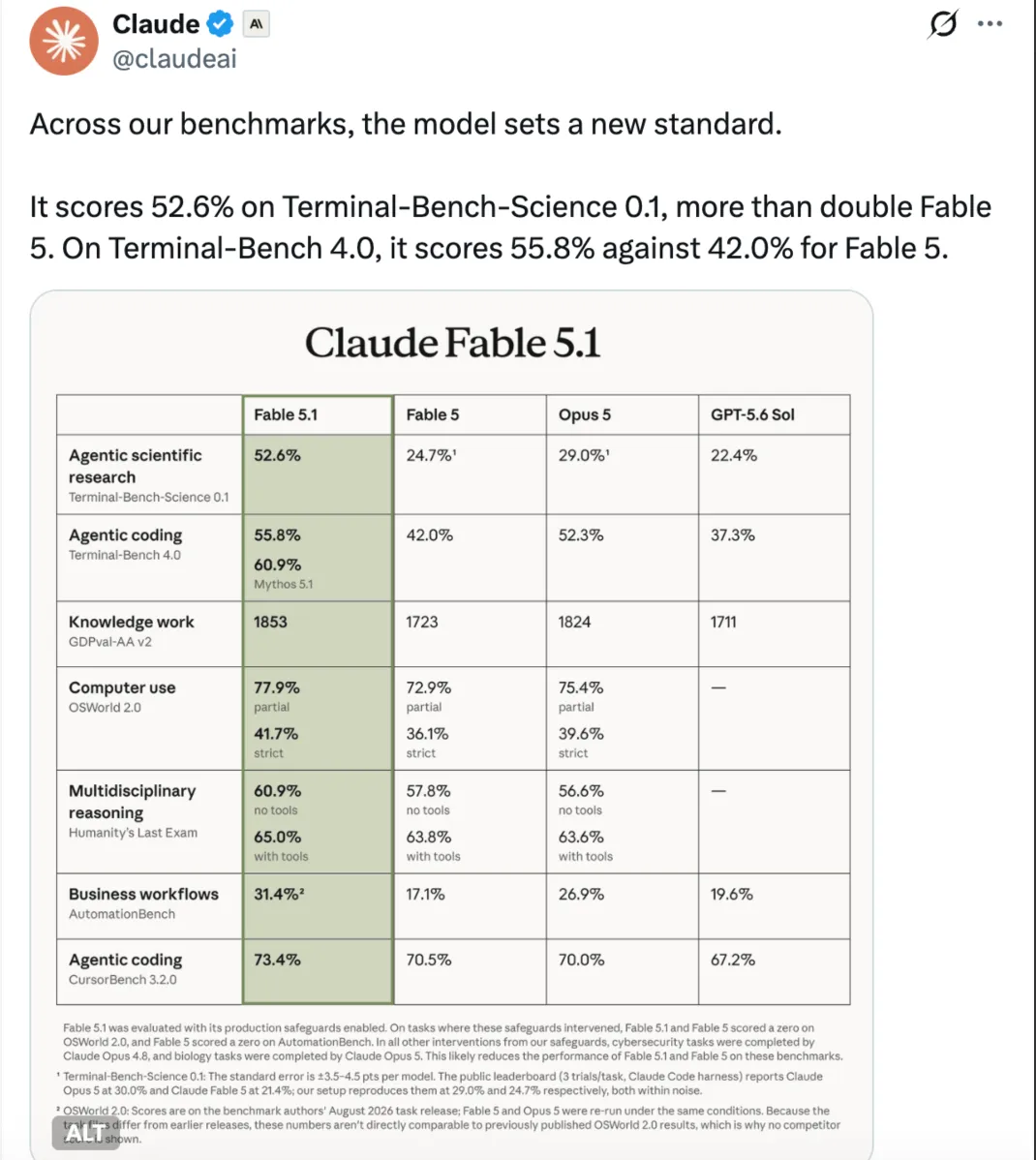
Specifically, Fable 5.1 achieved a score of 52.6% in the scientific research-type Agent benchmark Terminal-Bench-Science 0.1, up more than double from Fable 5 by 24.7%; in Terminal-Bench 4.0, Fable 5.1 reached 55.8%, and Mythos 5.1 with more open capabilities further increased to 60.9%.
In knowledge work, computer operations and business process testing, the new model also gained improvement. AutomationBench scores increased from 17.1% in Fable 5 to 31.4%, and CursorBench 3.2.0 from 70.5% to 73.4%.[3]
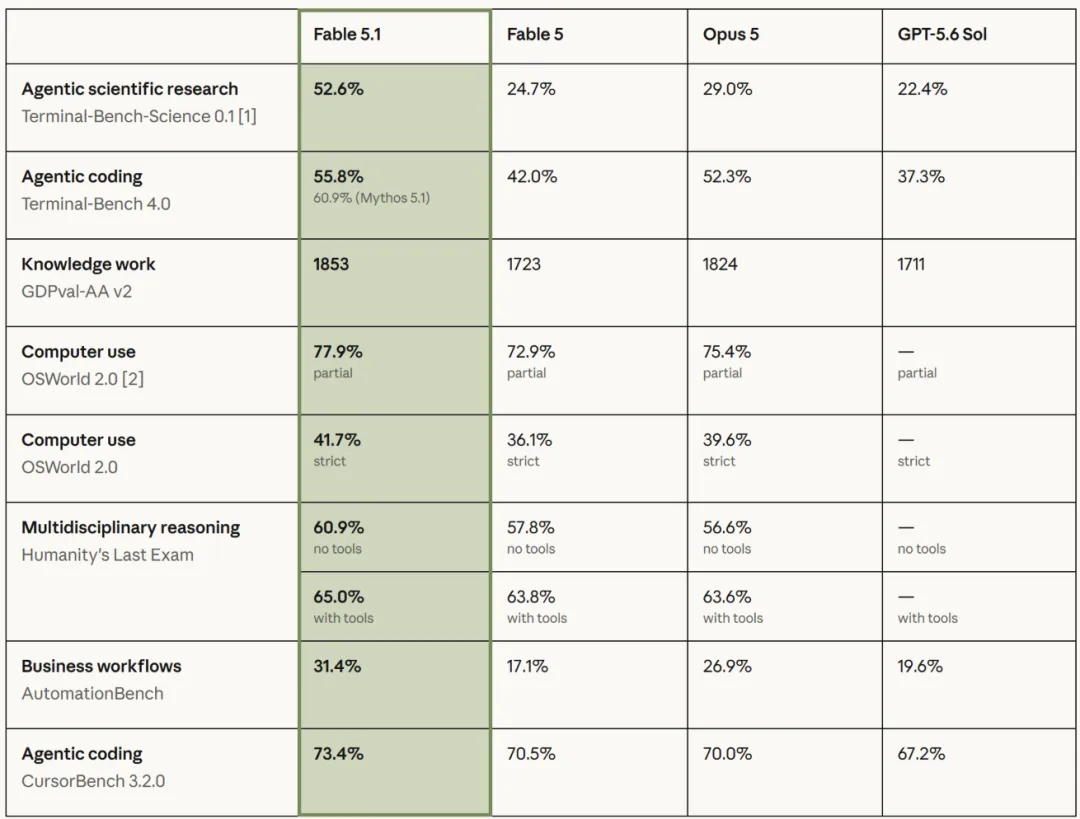
Among the many benchmark tests, Fable 5.1 outperformed Fable 5, with the most significant improvement in scientific research-based Agent and business workflow capabilities.
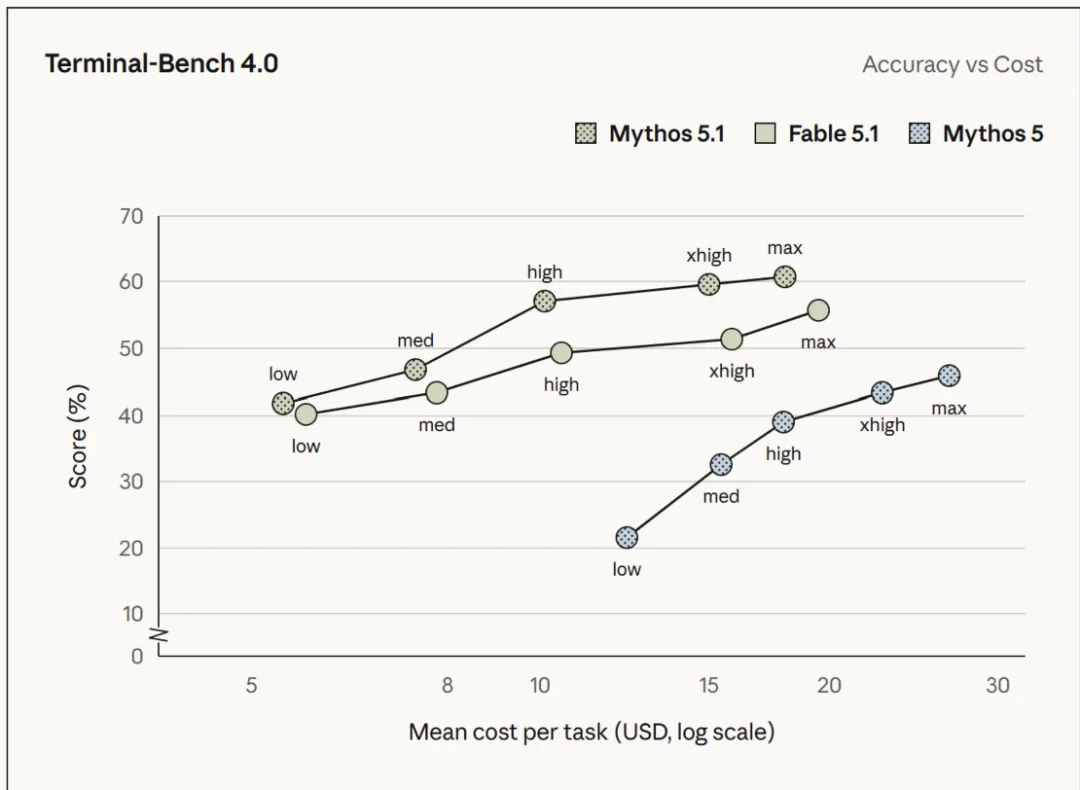
In the Terminal-Bench 4.0 test, Fable 5.1 and Mythos 5.1 outperformed the previous generation of Mythos 5 in different reasoning intensities.
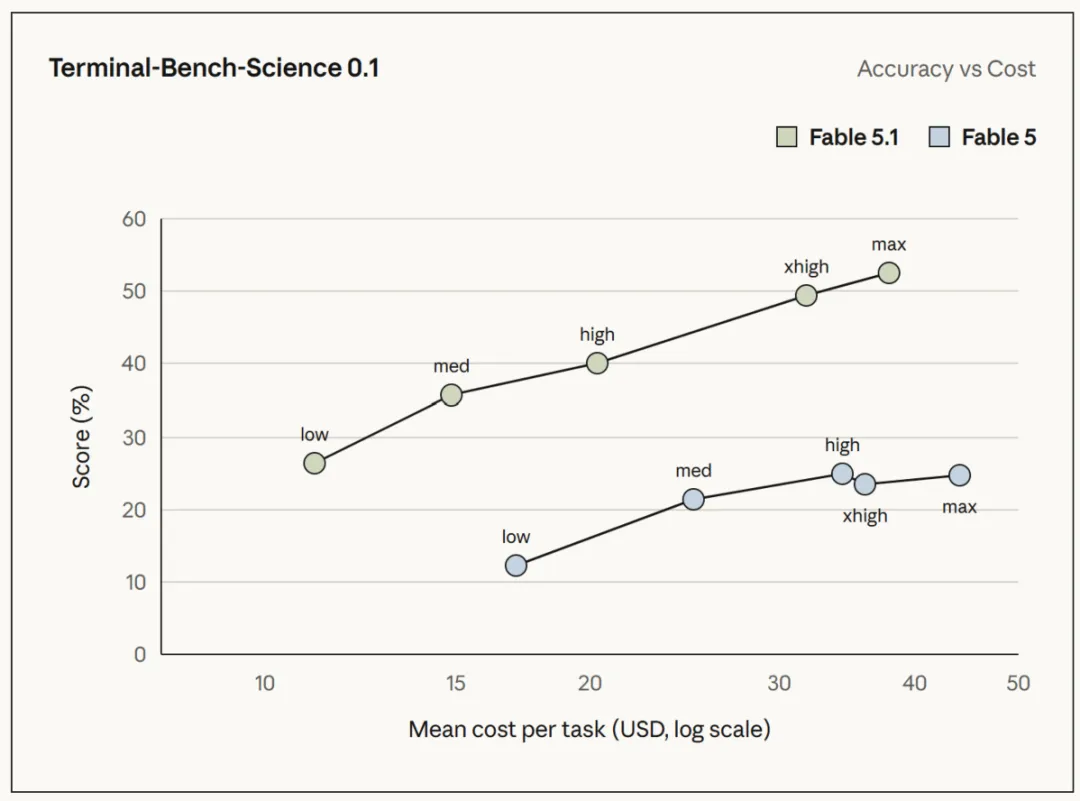
In the Terminal-Bench-Science 0.1 test, the highest score of Fable 5.1 was 52.6%, more than twice that of Fable 5.
Anthropic believes that an important change to Fable 5.1 is that it is more willing to track the root causes of the problem and is better suited to performing complex tasks that last for hours or even tens of hours.
In testing, the investment firm Millennium found that an internal code collapses about once every one million runs. The problem plagued the engineering team for four to five years, and other models failed to find out why. Fable 5.1 eventually localized the problem to a bug in a third-party database by reassembling the program libraries of external vendors rather than the core transfer files.
Ramp also allowed Fable 5.1 to run continuously for 38 hours. The model corrected the problem on its own after discovering that the original machine learning outcome was affected by a label error, and started six sets of experiments to finalize new results and follow-up recommendations.
From writing code to doing research
In this release, Anthropic introduced Fable 5.1 and Mythos 5.1 in scientific research with considerable detail.
In a protein design experiment, the researchers used Mythos 5.1 to call for open-source protein design and folding tools, and then handed the generated design over to two external bodies for experimental verification.
On the three target proteins, the binding affinity of the Mythos 5.1 design is 10 times greater than that of the Adaptyv Bio related protein design competition. For 12 target proteins, the effective binding affinity of the model design is close to 50 percent, while the industry standard given by Anthropic is 10 to 15 percent.
Fable 5.1 also uses radar images collected by NASA's Magellan spacecraft more than 30 years ago to generate a new high-resolution high-altitude map of about a third of Venus' surface.
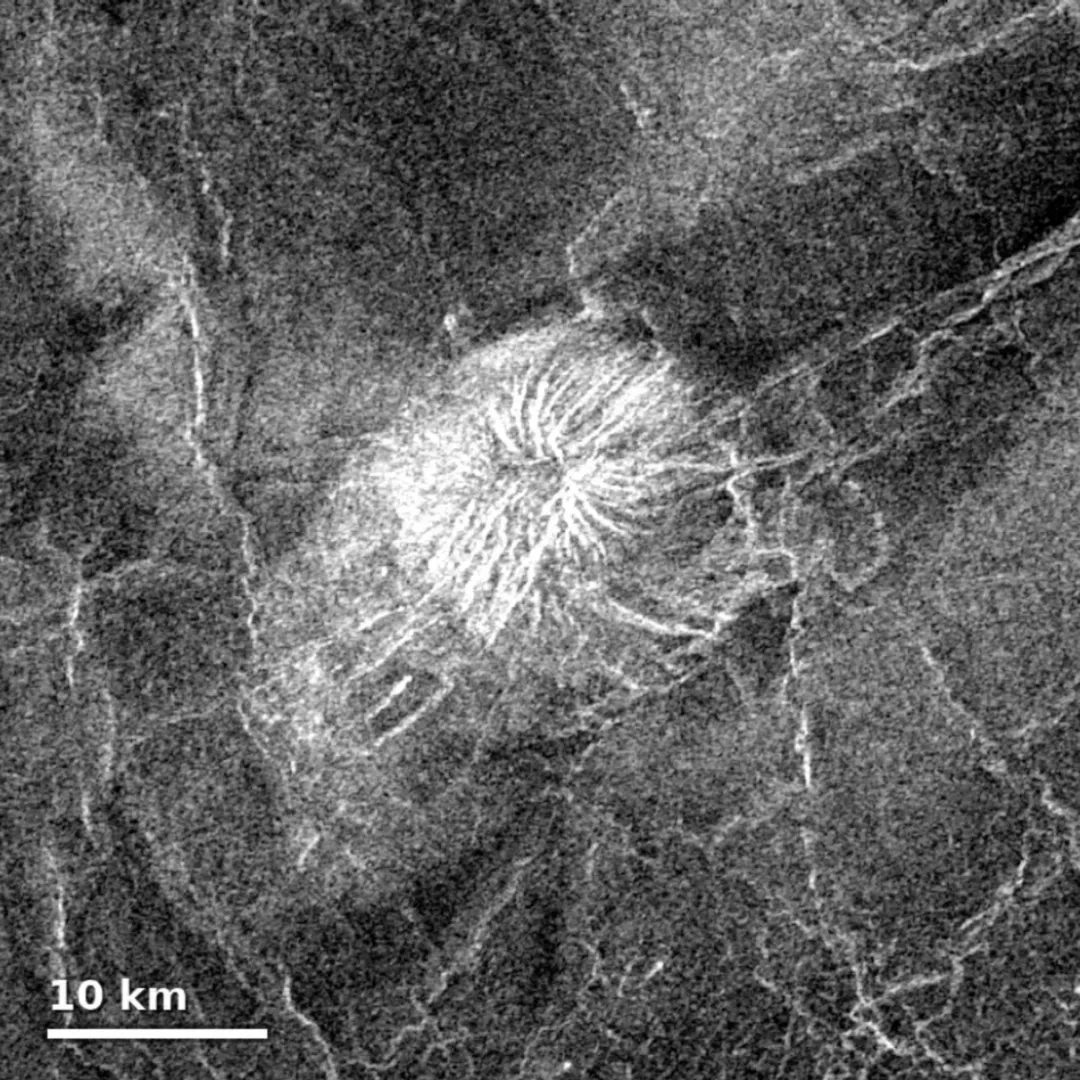
Venus radar image taken by NASA's Magellan spacecraft, centered on a small shielded volcano about 15 km in diameter.
The original map was designed to show only 10 to 20 km of detail, and the new map will increase the resolution to 2 to 3 km, with a maximum of 25 percent higher measurement accuracy. The Anthropic project has released the map with a knowledge-sharing license for subsequent missions such as NASA VERITAS and the European Space Agency's EnVision.
In computational biology, Mythos 5.1 improved the running speed of seven open-source proteins and genome deep learning models by up to 2.5 times, while keeping the output consistent. In some genome-wide analysis tasks, GPU costs are expected to be reduced by 30 to 60 percent.
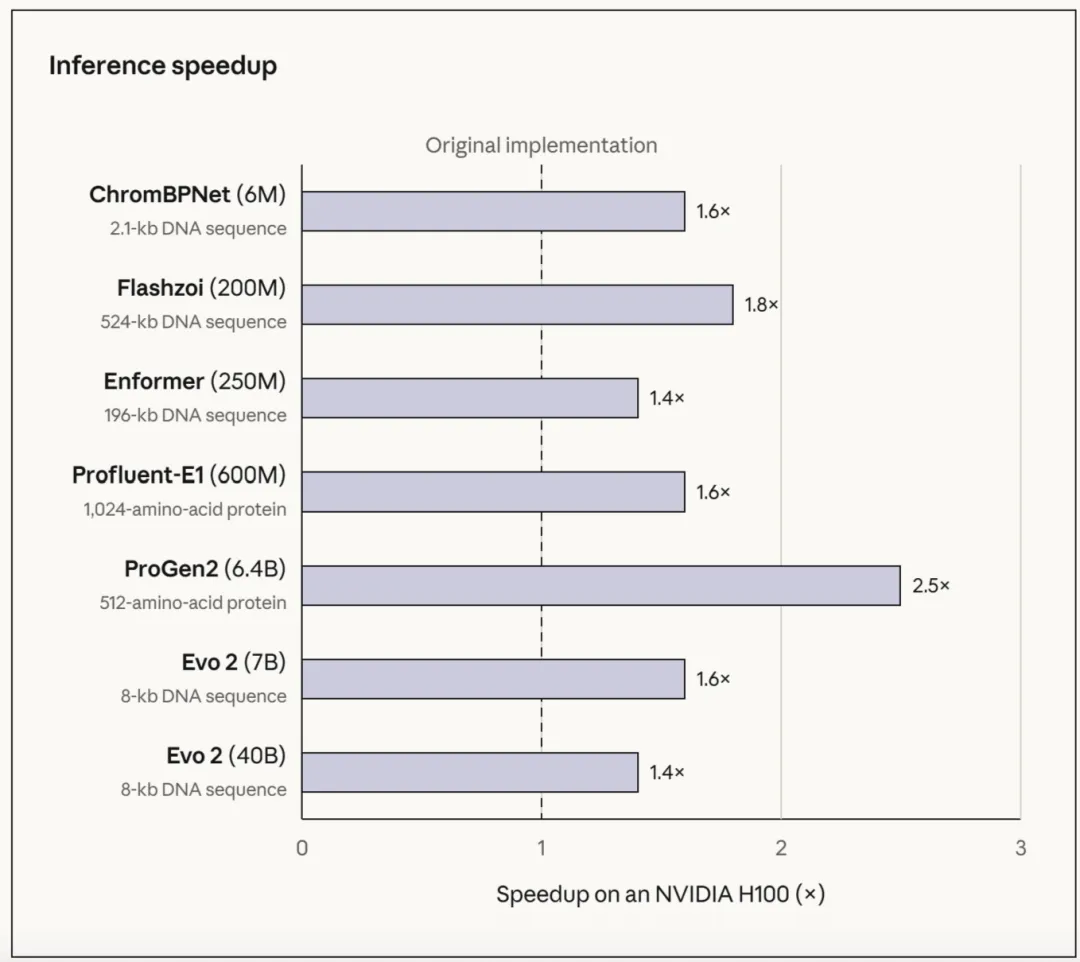
Mythos 5.1 optimises 7 open-source protein and genomic models to improve reasoning speeds by 1.4 to 2.5 times.
Anthropic wants to use these examples to demonstrate that the model is moving from compiling data, writing code, to proposing programs, running tools, and delivering scientific results that can be experimentally verified.
Cache prices are down 75% and Agent missions are 45% cheaper.
Aside from the performance, the price is one of the most direct changes to Fable 5.1.
Fable 5.1's input and output prices remained unadjusted at $10 and $50 per million tokens, but the caching read price dropped 75% from its original level to $0.25 per million tokens.
Cache reading refers to the replication of a model in a context that has already been processed. The share in common queries may be limited, but in Agent tasks requiring repeated reading of code libraries, historical conversations, and tool results, caching often constitutes the main cost.
According to Anthropic's measurements of actual usage data for August 2026, the overall cost of running a typical Fable 5.1 mission is about 25% lower than that of Fable 5; the maximum cost reduction can be about 45% for longer, frequently complex Agent tasks.
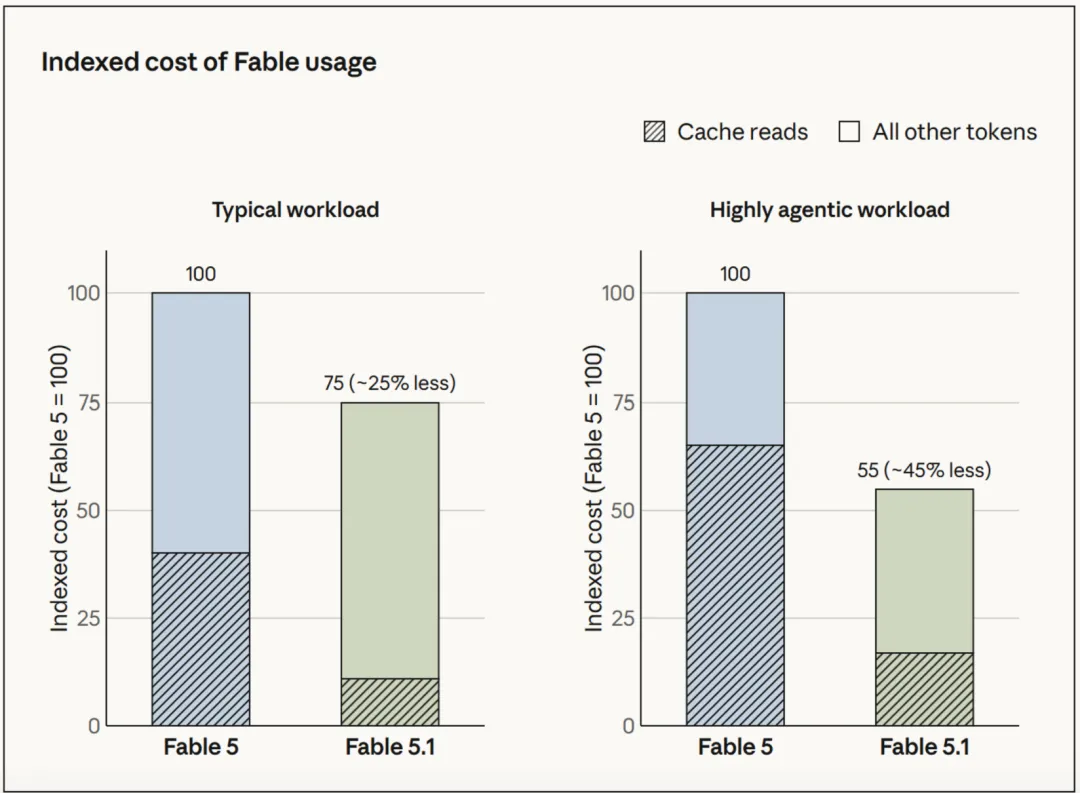
After the caching-reading price was lowered, the typical Fable 5.1 mission cost decreased by about 25%, and the cost of high-agent assignments decreased by about 45%.
Fable 5.1 is now available in the Claude.ai, Claude Code and Claude API, and is available via AWS, Google Cloud and Microsoft Azure. Developers can call on new models through claude-fable-5-1.
Stepping up the anti-distillation mechanism
Fable 5.1 and Mythos 5.1 actually use the same underlying model, the main difference between the two being security constraints.
Fable 5.1 is fully open to ordinary users and businesses; Mythos 5.1 has looser cybersecurity and life science restrictions and is currently only available to individuals and institutions that have been audited.
In the field of cybersecurity, Fable 5.1 can already help users detect software vulnerabilities, but still cannot directly generate vulnerability exploitation processes. Dual-use tasks such as penetration testing, vulnerability exploitation generation and vulnerability scanning based on binary files may still be transferred to more stringent model processing restrictions.
Following the adjustment, the new version of the cybersecurity protection mechanism reduced the number of misinterceptions by about 60% compared to Fable 5. The biosecurity mechanism also reduced the number of misinterceptions on basic biological and medical issues by 85%, while advanced capabilities in life sciences research and development were opened mainly through the Mythos 5.1 audit program.
Anthropic has also launched Enterprise Frontier Safeguards. Enterprises can store data in cloud infrastructures under their control and be censored by default by enterprises, while maintaining their security monitoring capabilities to achieve privacy effects that are close to "zero data retention". The mechanism is scheduled to go online in phases starting this fall.
For large-scale model distillation, Fable 5.1 also added new restrictions. API accounts created later that day will not be able to manually modify previous context in multiple rounds of dialogue while maintaining Claude's historical thinking record.
In addition, to meet the requirements of the EU's Fable A.I. Bill, the text output of Fable 5.1 will contain invisible watermarks. At the same time, Anthropic has begun small-scale testing of detecting APIs, the first of which is open to regulators, the media, fact-checking organizations and research institutions.
Finally, the netizens were right, early birds used 5.1 early.
The link is as follows: