In the past, the way AI rewrites software development has largely followed the same path. People say a word, models write code; code runs and turns into web pages, apps, and all sorts of clickable interfaces. From Copilot to Cursor, and then more and more Coding Agents, models have taken over a considerable amount of programming work.
Now, Runway wants to take this layer straight away.
Early this morning, Runway announced a new Solaris study and defined it as the first Interface World Model, the Interface World Model.
It poses a straightforward question: What happens if the apps and websites in the operating system are not written in advance, but generated in real time while you're using them?
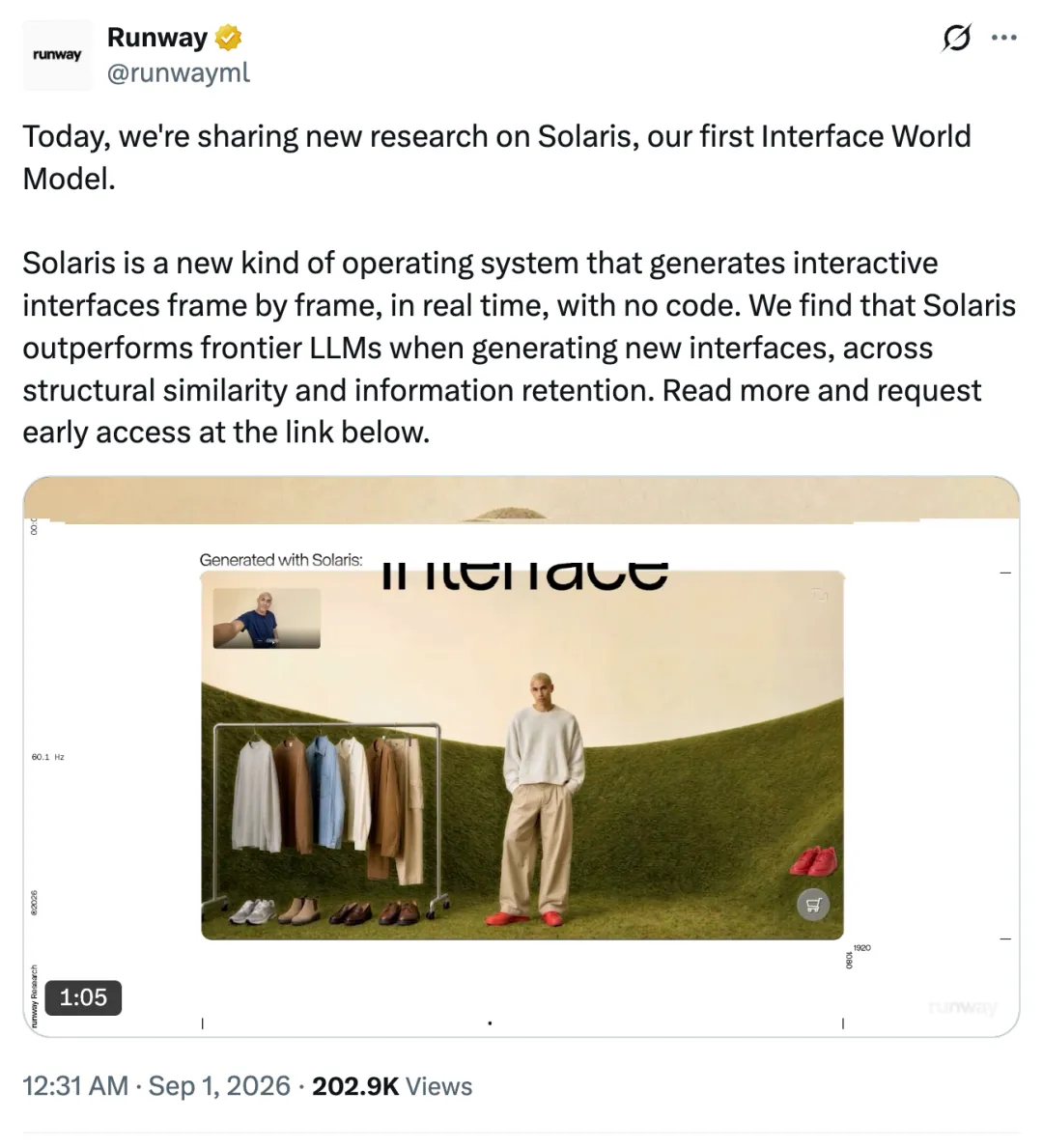
You click, drag, or enter a sentence, and the model continues to generate the next set according to the current state. The buttons, objects, scenes, and any changes that occur, do not have to be written in code by the developer in advance.
In other words, in Solaris's conception, the images you see before you can become software in their own right. This is another obvious expansion of the Runway from video generation to the world model.
Some people exclaimed, "You're too fast, you're still in the lead. I can't wait to see how much the world model will evolve in the next six months".

When a graph can really "run".
Today's AI is already drawing a lot of interfaces. Give the model a Prompt, it can generate a high-performance e-commerce page, product website, or even an entire set of App design drawings. The problem is that these drawings can only be viewed and can't really work.
You want the clothes in the picture to be dragged, you want the shopping cart to be able to calculate prices, you want the page to change based on clicks, you want the design to end up in HTML, CSS, JavaScript or other programming languages, and you want to convert it into a structure that a computer can execute.
Runway's views on the matter are quite radical. In his view, the transformation itself is a loss of information.
A complex visual design may contain materials, shadows, spatial relationships, and the state of a subtle object. But when it is re-expressed as a component, layout, and code, the program retains only part of the behavior that the developer decides to perform in advance.
Solaris tried a different path: no longer to translate images into code, but to let the code drive images; the model directly handles interfaces and interactions in visual space.
For example, in a virtual clothing store scene on Runway, the entire store itself is the interface. Users can take a dress off the shelf, drag it on themselves and try it on, or move it directly to the store's display.

Traditional webpages require a predefined developer: the area that can be clicked, the object that allows to drag, and what events are triggered after being dragged here. In Solaris, these changes are generated by the model based on current images and user actions.

It can be a row of buttons, or it can be a store, a table, a painting, or even a complete three-dimensional scene.

How does Runway turn video models into "software"?
Solaris is not a new system trained from scratch. It builds on the video generation model Gen-4.5 from Runway and follows the technical route of the previous GWM-1 world model.
The first step is to make the video model truly understand "interaction".
Solaris will also consider user input such as clicks, drag and drop as a condition for the next generation. The model sees not only continuous images, but also what people did before the images changed. After seeing enough of these interactions, it is able to learn the connection between a movement and a visual result.
So, when a user pulls an object, the system doesn't necessarily need a pre-written program to tell it "how much to add to the X coordinate after pulling", and the model can directly predict what the visual state should be after the move.
But it's not enough to understand the movement. An interface that only moves a few seconds after a click is basically unusable. Traditional video scattering models often require dozens of steps to make noise, and generating a video can take seconds or even longer. For video viewing, this speed is acceptable; replacing mouse interaction is quite another thing.
Runway made a three-step transformation for Solaris. First, it turned the generation process into a step-by-step regression, leaving the current frame only dependent on the content that has already appeared; then it distilled the original multi-step noise de-noise process into a few steps; and finally, let the accelerated model continue to train with its own generation results to reduce the image drift after a long continuous run.
According to Runway, this method ultimately allows Solaris to achieve the production speed of real-time interaction while maintaining the visual quality of the Gen-4.5 teacher model. One of the official goals set for Solaris is to maintain visual quality in long-term interaction at 720p.

Solaris also has a remarkable design. It is not a single video model that really drives the system. Next, Runway breaks the entire process into two parts: the language model is responsible for reasoning and the world model is responsible for rendering.
The language model first understands what the user wants to accomplish, determining whether the current scene should be changed locally, or switched to a new state, to be reproduced as a tip for guiding Solaris. Solaris is then responsible for actually drawing out the change and continuing to generate sequences. One decides what the next step of the application should do and the other decides how it should appear on the screen.
This distance Solaris from the mere "AI generating web pages".
The last important capability is continuous generation.
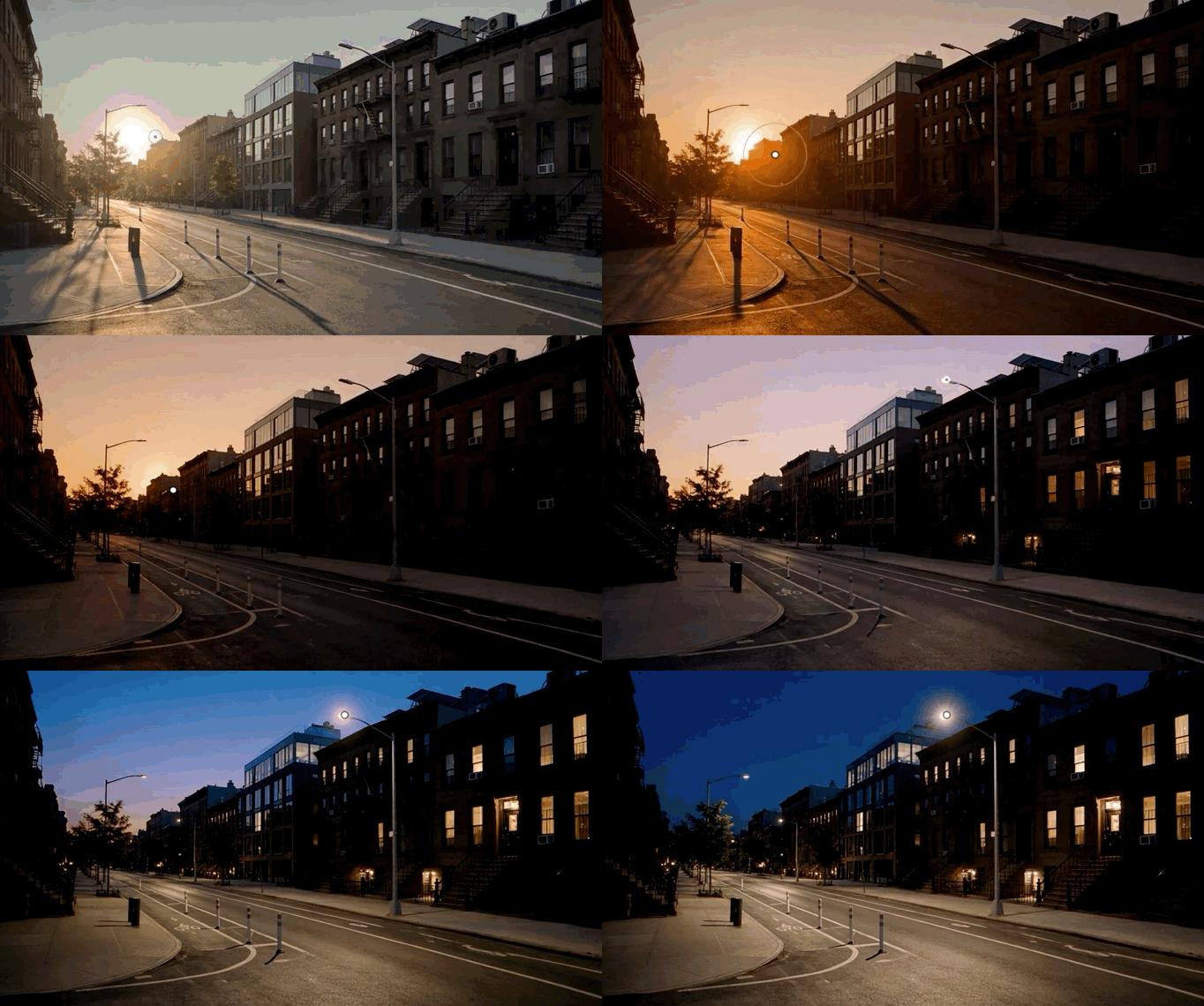
All you need to do is provide an initial state, such as a brand scene or a product demonstration scene, and the model continues to generate images in real time. When users click, drag, or input content, these interactions are incorporated into the process of generating subsequent images, and the scene responds in real time.
Throughout the process, there are no pre-defined pages, and no fixed templates can be invoked. Instead, text suggestions are used to define what clicks, drag, and other interactions mean in specific scenarios.
What is the performance of Solaris compared to the front-end model?
Runway has also designed a set of experiments to verify whether the route makes sense.
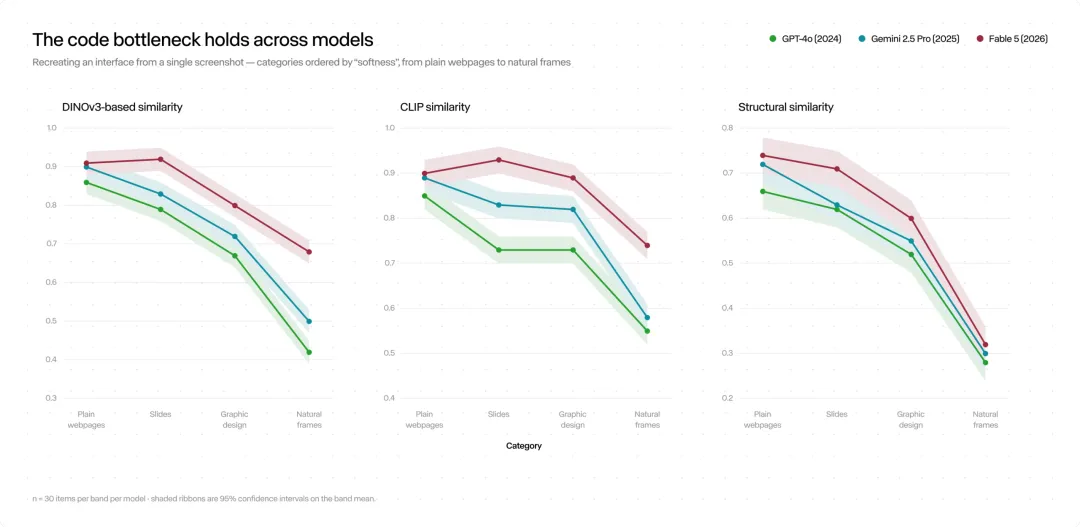
The first set of tests was aimed at "translational loss". Runway selected 30 interfaces of different complexities, including ordinary web pages, image-dense web pages, and natural images, to allow multi-modal models, including Claude Fable 5, to reconstruct interfaces on the basis of a single screenshot.
The evaluation uses two types of indicators. One is SSIM, structural similarity, which is used to measure the degree to which the reconstruction results are similar to the original image in position and visual structure. The other uses the DINOv3 characteristic to compare the different regions of the original image with the corresponding content in the reconstruction results, to observe how much original visual information is retained even if the layout changes.
The results released by Runway show that information loss is becoming increasingly apparent as the complexity of images increases and interfaces are reconstructed through language and code. Natural images are particularly affected.
The second set of experiments was more intuitive. Runway allowed Solaris and the code interface created using Claude Opus 5 to start with the same image and accept the same interaction requirements, and then let the real person judge which result was better. The experiment covered 30 interaction cases, invited 250 participants, and ultimately collected nearly 7,500 pairs of comparisons.
On "Is it better to follow the interactive instructions?" Solaris received a 61% preference, with code schemes at 24%; on "Is it more natural to behave?" Solaris received a 71% preference, with code schemes at 21%.
At least in these runway-designed tasks, it is easier to directly generate the entire visual state to keep the operation and surrounding environment consistent at a time rather than just modify the UI element that is required to change.
It's a larger use, perhaps not yet available to humans.
If Solaris were just to make the web more beautiful, it would not be enough to allow Runway to create a concept of an "Interface World Model" alone.
Computer Use Agent is faced with a very real problem. The Internet is designed for humans, and the Agent needs to learn how to button, fill out forms, and operate web pages. If the model is trained extensively on a fixed site, it is easy to learn a specific layout. Changing a hotel website, the location of the buttons, the page structure, and even the entire way of interaction, the operating experience the model previously learned can quickly fail.
Solaris offers a different training environment.
Because the interface itself can be continuously generated, the same task can respond to a large number of different layouts, visual elements and interaction paths. Agents can not only remember "There's a button in the upper right corner", but really understand: what they want to accomplish now, what things in the picture have a corresponding function, what changes in the environment after doing this move.
Runway believes that this could provide a continuous change - even an interface that has never existed before - to train Agent's generalization capabilities. This also shows the consistency of Runway's recent world model path.
GWM-1 has been used to explore environments, real-time characters, and robots; Runway also announced experiments this year to execute robot strategies using world-modeled simulations.
The common idea behind them is very close: to let the model face an environment that can act, that can observe results, that can continue to change. Video generation is just an underlying capability, and what Runway really wants to do is to let the video model take on the role of a "simulator".
The original address: