Late on August 24, Chevrolet released its 2026 half-year report: revenue of US$32.78 billion, down 3.8%; net loss of US$31.2 billion, expanding by 173.4%. The same night, its humanoid robot received $900 million in funding, valuing it at US$6.3 billion.
U.S. stocks fell 8.53 per cent on August 24 and Hong Kong stocks fell 9.19 per cent on August 25.
Three sets of numbers are like a mirror. The automotive industry is bleeding on one side of the mirror, and the robotics business is being redefined by capital on the other side.
Capital markets have already priced the robotics business at $6.3 billion, close to half of the total market value of the parent company. The flag counted another bill: minus the valuation of robots, the robotics business has an implicit value of only $6.5 billion, almost as much as robots.
This mirror reflects not "happily ever after", but two sets of pricing logics. One set of cars, which reads current profits; one set of robots, which looks at future possibilities.
What is the answer, only IRON can answer.
01.
$6.3 billion, bought as an option
The market structure of small business has changed. This valuation split is not unique to small business, but small business pushes it to the forefront.
According to Qianlong's 2026 Semiannual Report: revenue of 327.8 billion yuan in the first half of the year, a decrease of 3.8%; net loss of 312 billion yuan in the same period of the previous year, 1140 million yuan, an increase of 173.4%; car deliveries of 166,000 vehicles, a decrease of 15.8%.
At the same time, the loss of blood, at the same time, the betting, capital is not just a price for small robots.
On 27 August, at the Physical AI Sharing Day in Guangzhou, the company launched the first major upgrade of the second-generation VLA model, from 3D space understanding to 4D space understanding. On the same day, Turing AI's third chip announced the launch of the G9L.
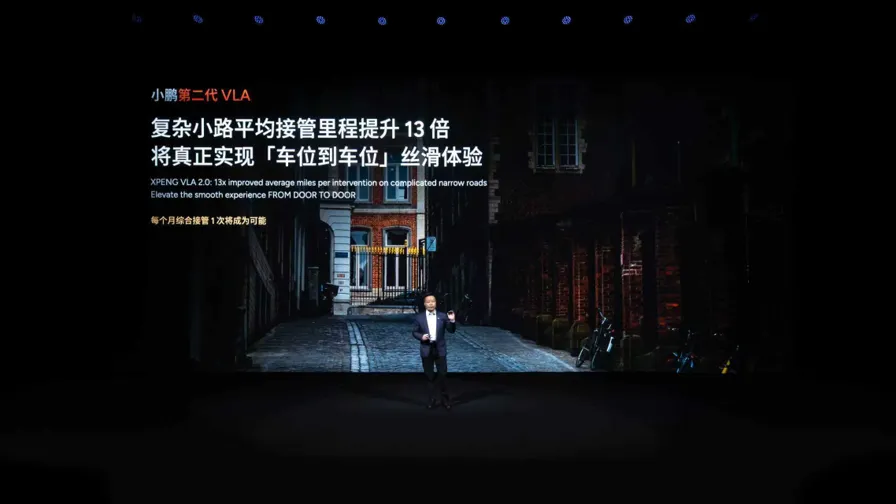
Chart: Physical AI Sharing Day on the scene, Ho Chi Minh is presenting major upgrades to the second-generation VLA model (Source: Web)
The conference is a summary of the story of small car technology. The Turing chips, large VLA models, intelligent driving data, which were originally the ability to prepare for cars, are being transferred to robots.
It's this recycling logic that's driving the capital boom. $900 million in funding, led by IDG, Tencent, and Ali War Investment, the largest single round of private equity financing in the field of physical intelligence in the country. $6.3 billion in post-investment valuation, making it one of China's highest-valued humanoid robot companies.
Financing is just ordering guns. The premium that the market pays to small-scale robots is essentially a vote of confidence in "running the full distance".
02.
They're under the control of IRON.
The mass production schedule for the miniature humanoid robot IRON is clear: mass production will begin at the end of 2016 and delivery to the market in 2027. This is the first and the hardest route.
In the last decade, the company has established two major production bases in Qingdao, Guangzhou. Full car manufacturing, supply chain management, and cost control capabilities can theoretically be transferred to the robotic production line.
In theory, this is not the same thing as automatic success. The supply chain for cars and the supply chain for robots is not the same thing. Cars have tens of thousands of parts, but the requirements of robots for precision parts such as handhelds, accelerators, torque sensors are lower.
By the end of 2026, mass production means less time left. If IRON fails to line up, the options offered by the market will quickly depreciate.
IRON is just a starting point. The real battle of the robot circuit is the battle of productivity. The bottom line of productivity is not a parametric table, but that these parameters can't run continuously in real life scenarios.
The little guy transferred some of the most valuable abilities on the car directly to IRON.
The first is arithmetic. IRON is equipped with three small, self-developed Turing AI chips, with an effective edge arithmetic of 2250 TOPS. Currently, the majority of human-robot mainstream programs are in the hundreds of TOPS levels, with 2250 TOPS being the first tier in edge arithmetic.
The second is the perception. IRON's 720-degree blinker vision system, directly derived from the Micro-Intelligent Driving System, contains laser radars, TOF sensors and 4D millimeter radars that can simultaneously track 10 dynamic targets. This is not a new system developed from scratch as a robot, but a quantum-verified perception architecture for cars.
The third model is the second-generation VLA large model, released on August 27, which upgrades from 3D space understanding to 4D space understanding, introduces the Infini-VLA long-time sequence architecture to remember the first 30 seconds of the scene, and uses flow-through regression reasoning to realize "side-by-side thinking side-by-side actions".
The fourth is data. The XNGP has covered 337 cities across the country, with fleet sizes reaching millions of levels, and accumulated billions of real-world traffic data. These driving data are trained vision and decision-making models that can theoretically migrate to robots.
This migration logic is the core support of the $6.3 billion worth of tiny robots. The problem is that migration is not equal to copying.
Cars and robots are two sets of physical tasks. The core of a car is mobility: perceiving the environment, planning the path, controlling the wheels. The core of a robot is operation: grabbing, moving, screwing, opening the doors, coordinating the precise movements with the eyes. Visual perception can be replicated, but the ability to operate must be re-learned.
Iron has taken part in P7+ assembly, hand drilling screws, and other tasks at its Guangzhou plant. However, high-frequency operation at an industrial level poses extremely high demands on the durability and maintenance costs of hand tools, which is what IRON has to go from demonstrating to mass production.
The other shortcut is data. More data on car intelligent driving can't replace the physical interaction data of the robot itself. Robots need a large number of human-handed demonstrations, force feedback, failures cases in order to learn steady grabbing and flexible contact.
See also competitions. Wu-Teng is stronger in motion control, Zhao is more aggressive in factory landing and data collection, and the Stereo chart emphasizes layered intelligence and explainability. The advantage of Zhaoyang is "car-level+ full-fledged self-development+ high computing ability", the disadvantage being "robot data and operational experience accumulation relatively late".
Therefore, the technical level of the small car is enough to give IRON a high point: computing, perception, chips, manufacturing systems are already in place. But whether these capabilities can be transformed into robotic productive power depends on whether it can fill three gaps: the reliability of sophisticated operations, the size of real physical interaction data, and the modeling ability to optimize for robot scenarios.
The 2250 TOPS is also a nice number.
03.
Money is omnipotent
The car industry continues to lose blood, which is the biggest external risk to the small robot business.
The mainstream industry is losing money, and robots are still burning money. $900 million in financing can be saved for how long, depending on the volume of production progress and the intensity of the investment. If IRON's volume of production is delayed, or the automotive business continues to bleed, the ability to transfuse blood will be under pressure.
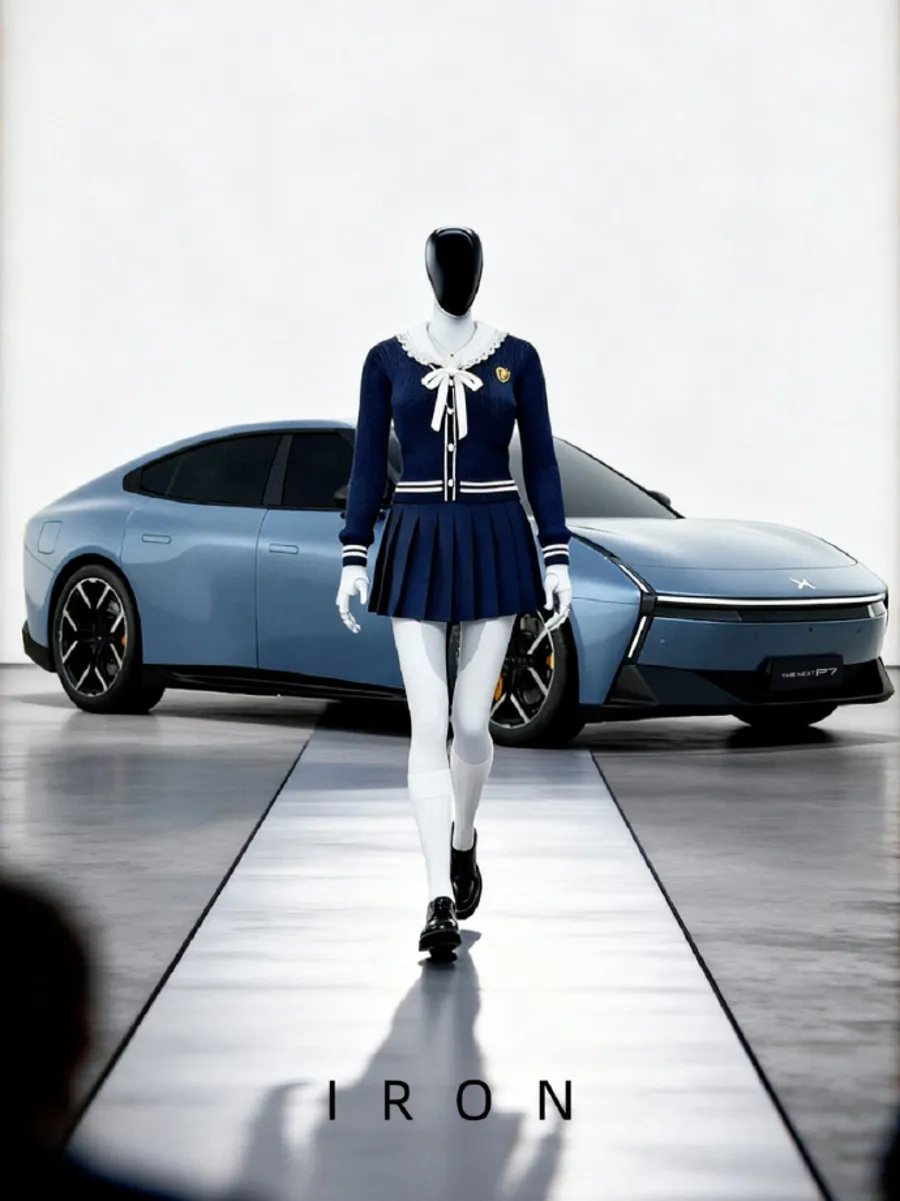
This is the first episode of the first season of Iron Maiden's T-Series.
Money can be sustained, not only if there is no cash on the books, but also if robots themselves can't reduce it to a scalable level.
A humanoid robot, more than 70% of the cost is in the hands of actuators, accelerators, motors, silks and sensors. In industry measurements, actuators account for about 35% of the total cost of the machine, silks about 18%, accelerators about 15%, motors about 12%, and sensor modules such as smart hands are up by 20%. The price of these parts has indeed fallen in the last three years: wavelength reducers decreased from 1280 yuan to 410 yuan, servo motors decreased from 2000 yuan to 500 yuan, and core parts domestic production increased from less than 50% in 2023 to 75% to 90% in 2026.
This means that it has the opportunity to lower costs. But it is not faced with a complete list of reductions, but with several specific arithmetic problems.
The first arithmetic is scale. The previous generation of IRON cost more than 1 million yuan, and the company wants to bring it down to the level of a mainstream smart car, i.e. between 100,000 and 200,000 yuan.
The path of reduction depends on two things: supply chain replication and scale mitigation. 85% of the supply chain is combined with robots, which is its advantage. But supply chain mitigation is not the same as automatic cost reduction, and fixed costs can only be mitigated when production climbs to 10,000 units. The monthly capacity target is 1,000 units by the end of 2026 and thousands by 2027.
The second method of calculation is parts. Joint modules account for 40 to 60 percent of the total cost of the machine, 15 to 30 percent of the total cost of the hand, and 10 to 20 percent of the total cost of the planetary roller silk. These three pieces together account for more than 70 percent.
It's been done, the Turing chip is self-developed, the Turing chip is self-developed, the Turing chip is self-developed, the Turing chip is self-developed, the Turing chip is self-developed, the Turing chip is self-developed, the Turing chip is self-developed, the Turing chip is self-developed, the Turing chip is self-developed, the Turing chip is self-developed, the Turing chip is self-developed, the Turing chip is self-developed, the Turing chip is self-developed, but the mass-production consistency of the reducers, the silk, and the micro-motors are still time-consuming.
The third arithmetic is the business model. In the early days of high-cost enterprises, small businesses were unlikely to sell hardware directly to earn money. What small companies plan to do is to get IRON into small stores to buy, explain, host, charge for services or lease models. This is equivalent to turning robots from "selling products" into "selling services" to cover hardware with operating cash flow.
The timeline is clear, and it also shows that the financial accounts of the domestic market are still unchanged.
He is obviously aware of these accounts. Since June, he has personally served as CEO of Small Business Robot, raising the robot business to the highest priority of the group. This is not a simple consolidation, but allowing the robot business to call on the group's resources, supply chains and cash flow.
Personal will is no substitute for financial reality. The $6.3 billion valuation is both market-approved and a bargain agreement. The market's patience with small-scale robots depends on how long the auto industry can survive and how quickly the robot business can bleed itself.
The abandonment of car insurance is the most appropriate description of the game at the moment. Small cars are using the resources and credit of the main industry in exchange for time and space for the robotics business.
He has a price tag and the market is waiting for his answer card.