In recent years, large-language models (LLM) have shown great potential in long-range tasks, but the existing frameworks still face significant challenges in how memory is used and altered.
The traditional method is to retrieve experience based on task retrieval memory before the start of the task or through context during the interaction. As the task progresses, the memory of one-time retrieval at the start of the task phase no longer reflects the current problem, and the expanding context of retrieval is mixed with outdated information and execution noise, making retrieval increasingly unreliable. The reason for retrieval is not because of a lack of useful experience, but because of a lack of a compact and reliable task state, to keep accumulated experience in line with current execution needs.
Recent recursive self-improvement (RSI) has faced similar challenges in long-range tasks, where memory iteration is almost exclusively determined by the scores of downstream tasks and cannot be accurately positioned to the specific components that generate the problem, so updates are often rough and untargeted, while the reasoning trajectory in long-range tasks and the increasing up-and-down lengths make it difficult for intelligent entities to analyze and find the most effective improvement strategies in them accurately.
In this context, Recuris, in collaboration with research teams from the National University of Singapore, Princeton University and Stanford and Oxford University, has been proposed as the first self-improving architecture within the memory control layer to achieve a complete upgrade from the 3B mini-model to the Claude Opus 5 without training through three core technologies.
Recursive Experiential Harnesses Working Memory Evolution for Long-Horizon Agent Harnesses
The code repository:https://github.com/Gen-Verse/Recuris
Link to the paper:https://arxiv.org/abs/2608.24876
The difference between Recuris and existing memory methods is reflected in two dimensions: how memory is used and how memory is substituted.
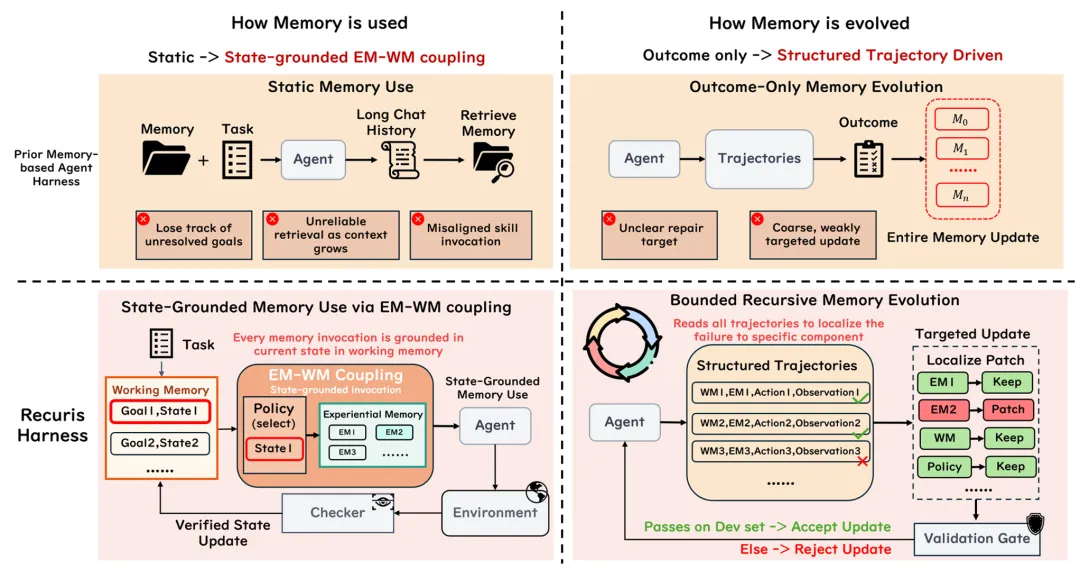
Recuris differs from the two paradigms of existing memory methods
How memory is used: existing frameworks inject or retrieve memories into the expanding history of conversations, easily generating hallucinations in long-range tasks, causing skills to be miscalculated; Recuris uses skills to execute events and is converted back into verified status updates by the controller, rather than hearing a phrase in the conversation "completed".
Performance performance:
From the 3B miniature to the Claude Opus 5, there's a whole riot going on.
The team evaluated ten models on four long-range benchmarks (τ2-Retail,τ2-Airline,SkillFlow,Terminal-Bench 2.1):
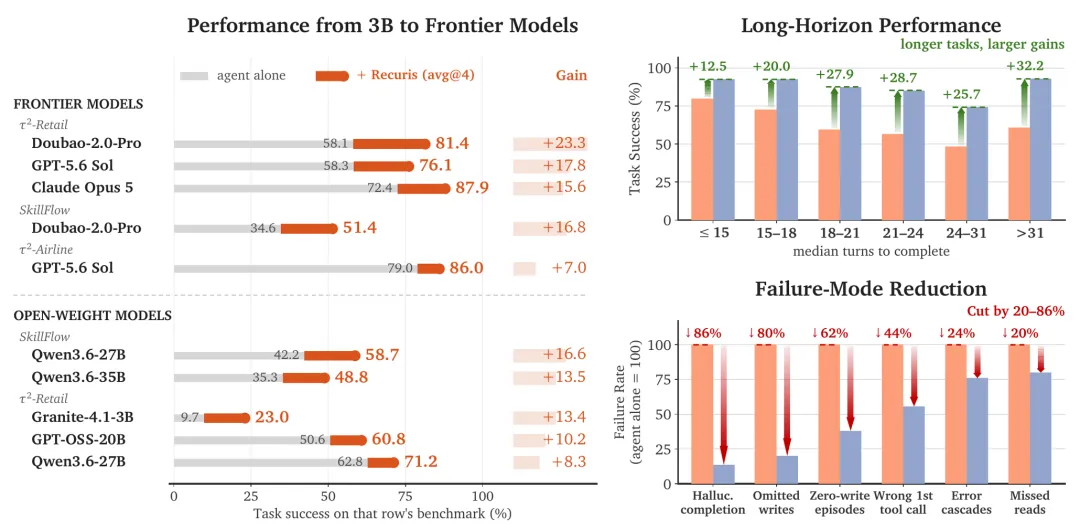
Recuris' performance on the 3B open-source model to the front-end model
From small models in 3B to front-end models such as Claude Opus 5 and GPT-5.6-Sol, Recuris demonstrated significant performance improvements. At the same time, this advantage decreased in long-range missions without increasing alternating turns and significantly reduced the frequency of frequent failures in long-range execution.
Long-term reliability:
The advantages do not increase or decrease with the task
The common difficulty in evaluating long-range capabilities is that "task evolution" and "intelligent early abandonment" are often confused. Thus, how many rounds per task are required by the research team to complete the τ2-Retail in four phases.
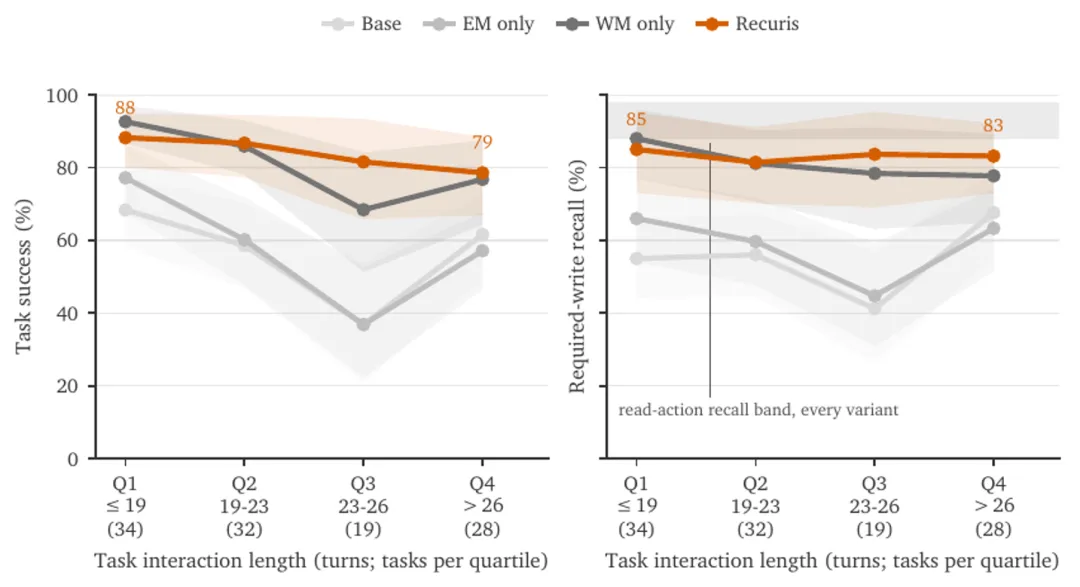
Long-range performance of assignment-specific length assignments
Recuris leads the baseline in all four positions, ranging from +17.0 to +44.7, without changing the length of the task.
Structured trajectories allow for failure to be positioned
The research team did not stop at observing the memory, but actively injected the known flaw into the memory, and then had a fixed referee judge which component was the problem from three pieces of evidence: just look at the final success, look at the original trajectory, or look at the structured trajectory that Recuris produced.

Only the successful positioning accuracy was 13.0%, lower than the baseline of the same answer; the original trajectory was 37.0%, less than four points higher than the baseline; and the structured trajectory was 64.8%, nearly twice as close to the baseline.
The evolution of memory can be transferred:
Cross-tasking and cross-modelling
Cross-mission: Memory distilled from 16 failed missions, resulting in an improvement of +9.01 to +17.44 on 86 missions that never participated. This result validates Recuris' core assumption: the information contained in structured failure trajectories is sufficient to support cross-mission migration.
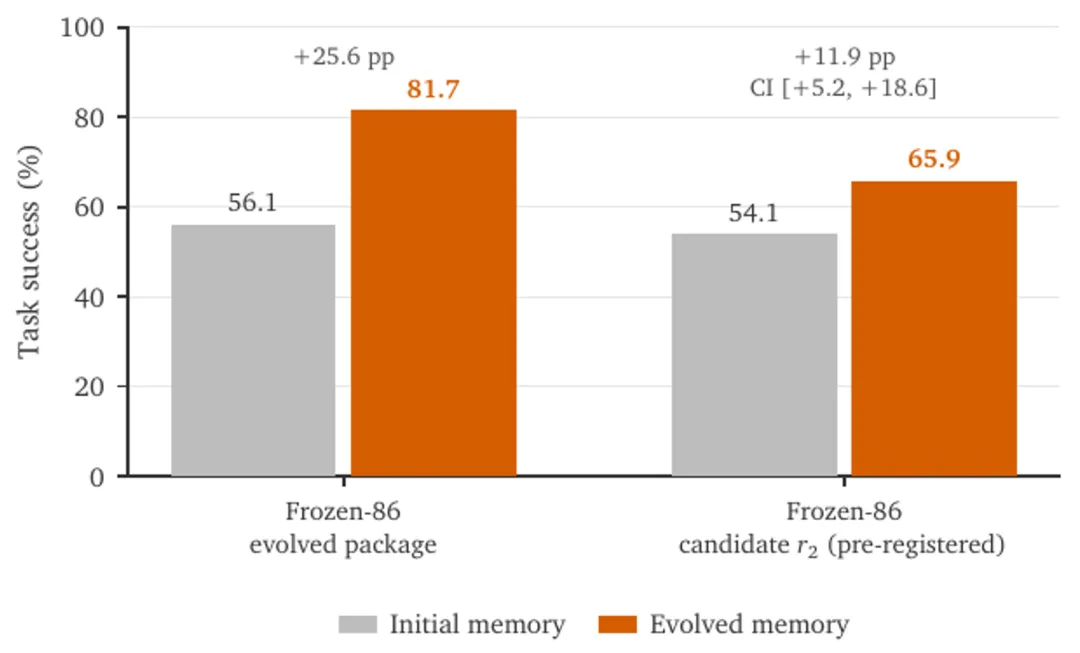
The memory evolved in response to tasks left behind.
Cross-model: A memory evolves only once on a deployment model, and is then passed to a front-end model that has never participated in the evolution, and can also produce a significant improvement, further demonstrating the generalization of the framework.

Key technical analysis
The paper concludes that the real bottleneck in a long-term scenario is not "no available experience", but a lack of a compact and reliable task state to continually align the accumulated experience with current execution needs.
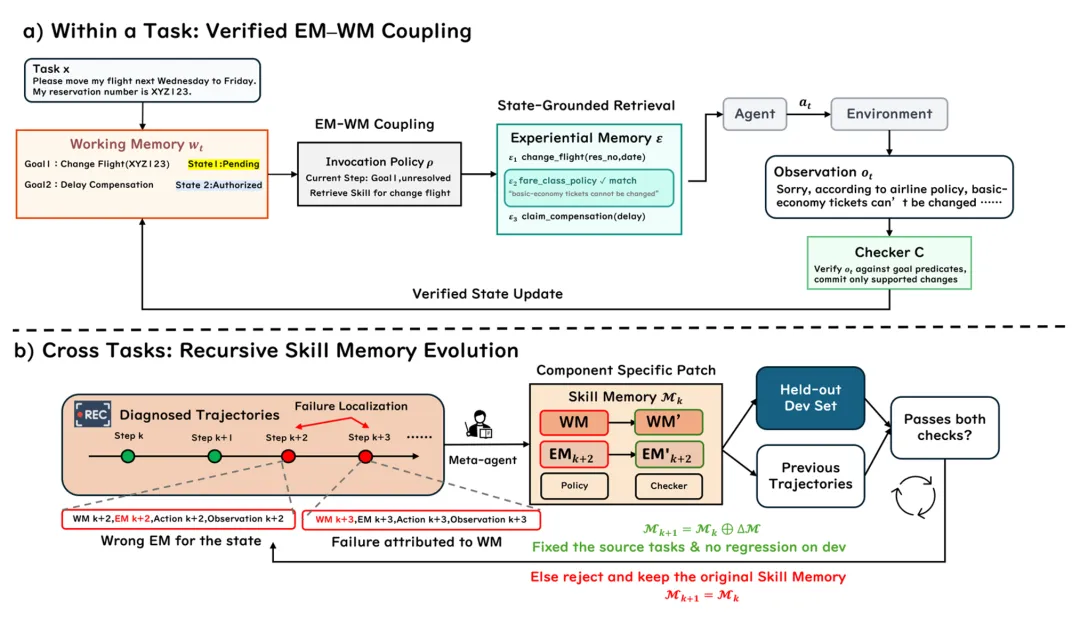
Recuris architectural overview
Experience memory, working memory coupling (EMWM Coupling)
Working memory (WM) represents that missing state. It continues to track the current progress and unresolved goals of the intelligent body, and accordingly selects the most appropriate skills from experiential memory (EM); once the skills are executed, environmental feedback verifies progress and updates the state, concluding a cycle:
Task Status → Skills Selection → Execute feedback → Updated task status
Specifically, skill calls occur in execution events: drafting a state-altering call, or reaching an interaction-turn boundary, rather than matching similarity to an expansive historical context. After an intelligent-body action, the tester re-evaluates the progress of tools based on environment returns, and only evidence-supported state changes are submitted: calling a skill or attempting a tool call are not actually completed.
Structured trajectory and component failure positioning
While there are many methods that can only be learned from the final success, these signals are "out of the question", but it is not possible to indicate that the correction is stored skills, tracking task status, skill calling mechanisms, or progress verifiers. EMWM combines task status, called skills, actions and observational manifestations to link the execution process itself into evidence about "how memory affects behavior":
EMWM Synthesis → Structured evidence → Failed positioning → Focused on memory evolution
It transforms "this mission failed" into "which component caused it to fail", thus making local correction possible without the need to write a whole body of memory.
The evolution of border controls has been verified
A fixed Meta-Agent reads structured trajectories, attributes each diagnosed failure to a particular memory component, and modifies only the component that triggered the problem; a fixed gate control is accessed only by patching the target task and not by leaving the cache. Accepted updates change future execution patterns, generate new optimization information, and thus support the next round of updates.
The dynamics of recurrent evolution
Introduction by the main author
Yu Shō: PhD student at the National University of Singapore, focusing on big language model reasoning, intelligent systems and self-improvement.
Ling: A postdoctoral researcher at Princeton University, his research focuses on large language models and reinforcement learning.
Wang Mondi: She is a lifelong professor in the Department of Electronics and Computer Engineering at Princeton University, and founded and is the founding director of the Center for AI for Accelerated Invention at Princeton University. Her research interests include reinforcement learning, controlled large models, machine learning theory, and AI for Science.
Professor at the National University of Singapore, IEEE/ACM/AAAI/IAPR Fellow, whose research areas include computer vision, machine learning and multimodal models.
Among the collaborators on this project are Stanford University's professor of journalism and Oxford University's professor of journalism, Dunphy, and others.