In the midst of the microbiological crisis, a deep underground laboratory called the Beehive has been handed over to an AI: the Red Queen to control access, monitoring, ventilation, security and even the entire facility.

Human scientists are responsible for the research, but the real master of the lab is AI.
When abnormalities occur, the Red Queen can shut down, disconnect systems, control facilities, and directly intervene in the physical world.
More than two decades ago, this was the classic scenario in science fiction to create a sense of fear: AI entering the physical world, manipulating machines, running experiments, directly intervening in the real world.
Now, this picture is starting to enter the realm of reality in a completely different way, at least for now it is not terrifying.
Just yesterday, Anthropic released the Model Hardware Standard (MHS) for physical hardware, an attempt to extend the logic of MCP from GitHub, Slack, and databases to real-world devices such as mechanical arms, microscopes, liquid processors, lasers.
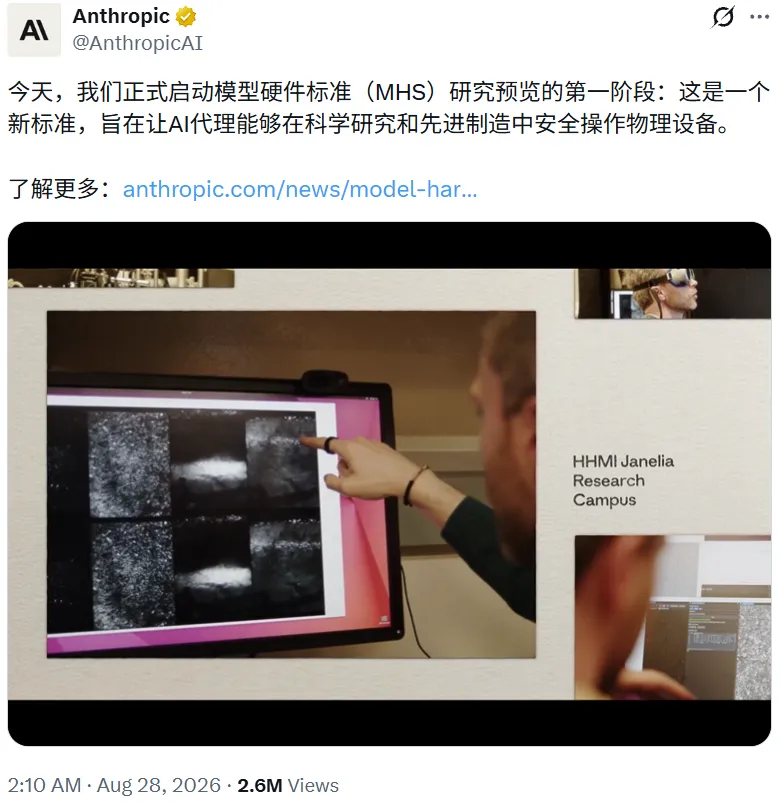
Simply put, AI Agent doesn't just have an "interface" to call software, it starts to need a set of "neurons and feet" to connect to the real world. Today, Google DeepMind is demonstrating its achievements in this regard.
In an 83-page paper recently published, Google incorporated Gemini-powered Co-Scientist into the real-world scientific research process and allowed it to design experiments, generate executable code, read experimental feedback, and connect directly to the experimental equipment. Google called this change from an in-silico hypothesis generator to an execution-grounded research partner, i.e. a hypothesis generator within the chip→ an execution-based research partner.
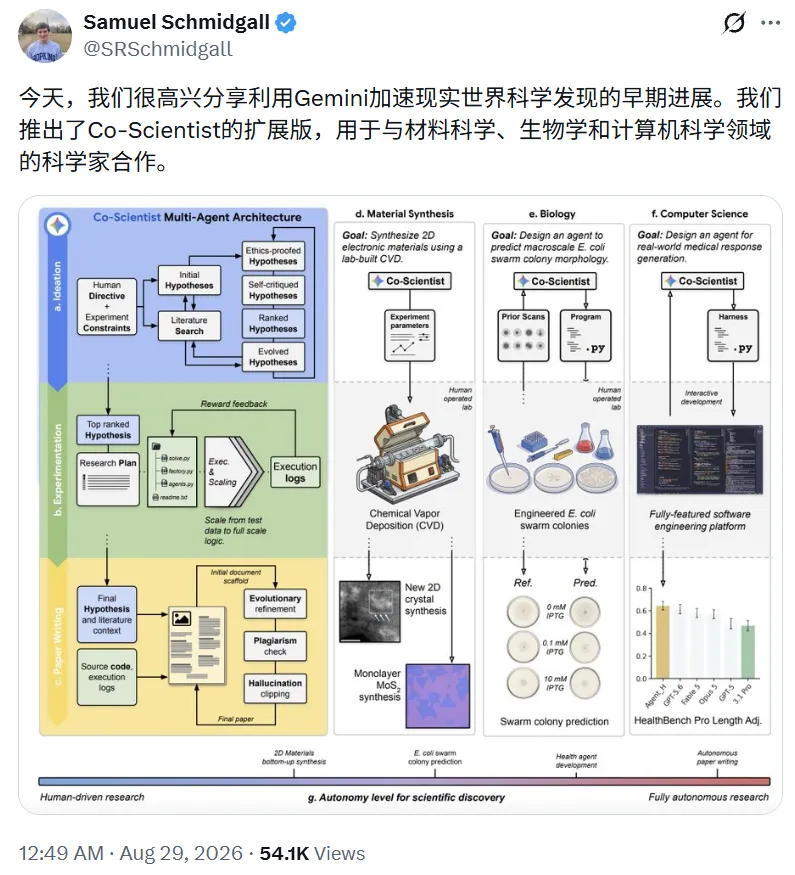
In one of the most intuitive experiments, the researchers told Gemini 3 Deep Think the conditions of a self-constructed CVD device. Minutes later, it gave a material growth scheme for the machine and further translated the scheme into machine code capable of controlling the device. Eventually, all three two-dimensional semiconductors achieved their first successful development attempt.
So a scene in science fiction has suddenly become a reality: when the big model really comes out "hands" and starts to manipulate the experimental equipment.
In the midst of the biochemical crisis, humans are afraid AI will take over the lab. In reality, scientists are actively handing the lab over to AI. Of course, what Google wants to do is not an uncontrollable "honeymoon", but a scientific discovery machine that can go from making assumptions, designing experiments to verifying reality.
Accelerating Scientific Research with Gemini in the Real-World
Address of the paper:https://arxiv.org/pdf/2608.26701
Gemini takes over an experimental equipment
First, the science of materials.
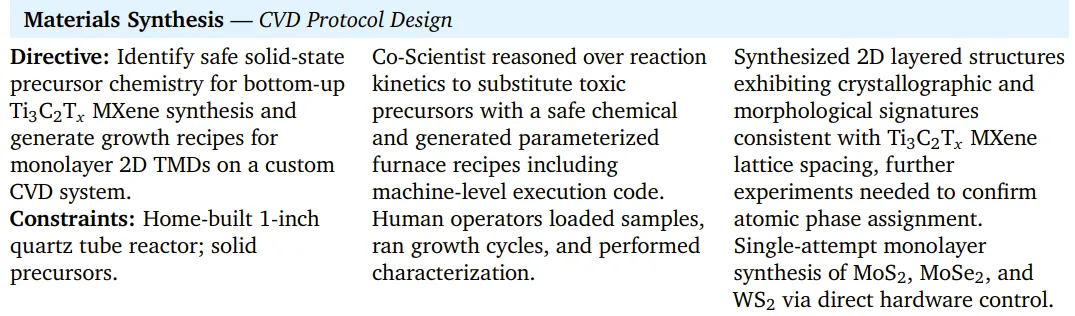
The researchers used a self-built chemical gas phase deposition device, the CVD boiler. A long-standing problem with this type of two-dimensional material experiment was that public "formulas" were difficult to reproduce.
Similarly, the parameters of temperature, gas, and propellant, changing a furnace, the size of the furnace, the flow of air, and the positioning of the material are slightly different, and the resulting crystals may be completely different. Researchers often need to repeat the process for weeks or even months.
So the team no longer told Gemini how to do the experiment, but told Gemini what equipment the lab had, what chemicals it had, what the boiler was made of. The rest of the parameters were determined by AI itself.
Based on these constraints, the Co-Scientist generated a complete experimental program such as gas flow, temperature curves, front-drive usage, material positioning, and handed over to the experimental equipment to execute.
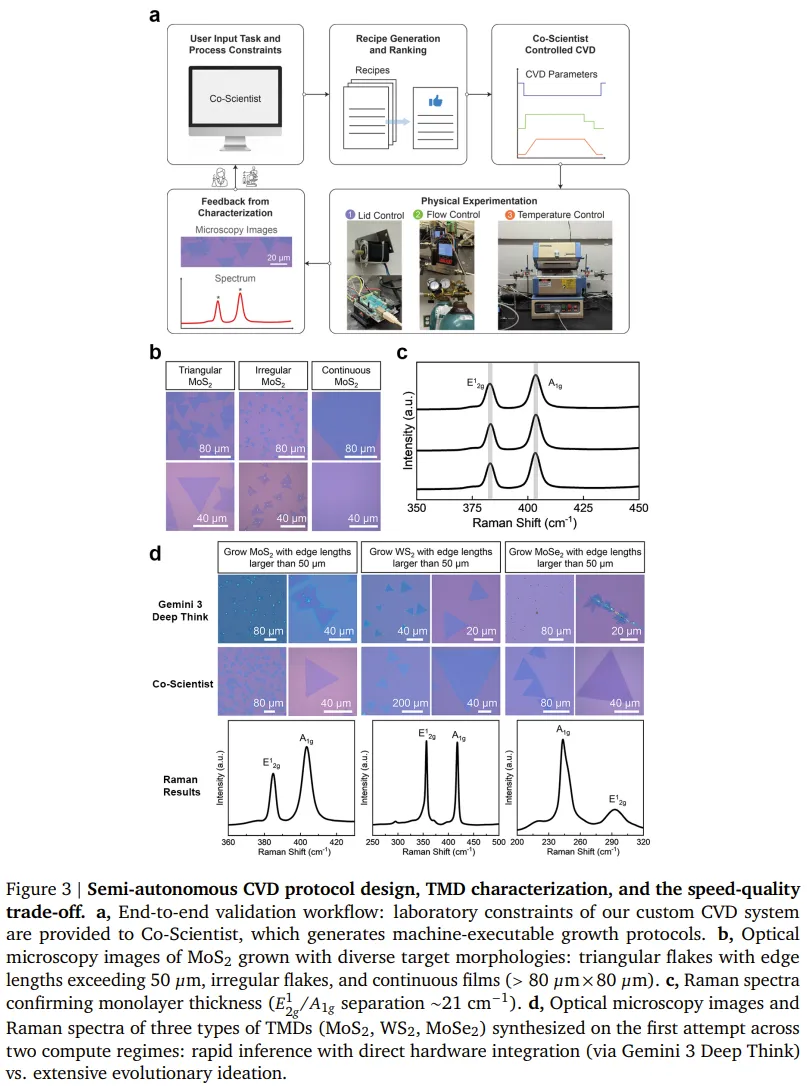
One of the experiments was brilliant. After the research team integrated Gemini 3 Deep Think into the CVD control process, it was reproduced not as a natural language experimental program for scientists to read slowly, but to complete the reasoning in minutes and translate the results directly into machine code that can control the device.
Eventually, the three two-dimensional semiconductors MoS2, MoSe2 and WS2 successfully developed single-layer crystals in the first experiment. The entire experiment process took about an hour to complete.
MoSe2 and WS2 are even more special: researchers have not even grown these materials on the device before. At least five subsequent repeat experiments have confirmed the results.
This has a very interesting resonance with the MHS that Anthropic showed yesterday. The question that Anthropic wants to solve is how to make Agent more convenient, more standardized, to recognize and manipulate experimental equipment; and what Google's paper discusses is the next step: how to reconstruct the flow of research when rational models can control experimental equipment?
In this sense, "AI connected hardware" is no longer a problem.
In addition to experimenting with the paper, AI is starting to find its own formula.
However, it is not a true scientific discovery to allow Gemini to modulate a set of devices based on knowledge already available. Google did a second, more difficult experiment: trying to create a two-dimensional MXene material called Ti3C2Tx from the bottom up.
Traditional routes often involve hazardous corrosive agents, and some known CVD programs also use toxic and air-sensitive TiCl4.[13] The research team therefore presented a task to the Co-Scientist: Could a safer frontal drive route be found?
Co-Scientist ultimately locked the target to six-ton acetate C2Cl6, and further gave a series of parameters such as the number, location, gas flow, base and temperature curve of the precursor.
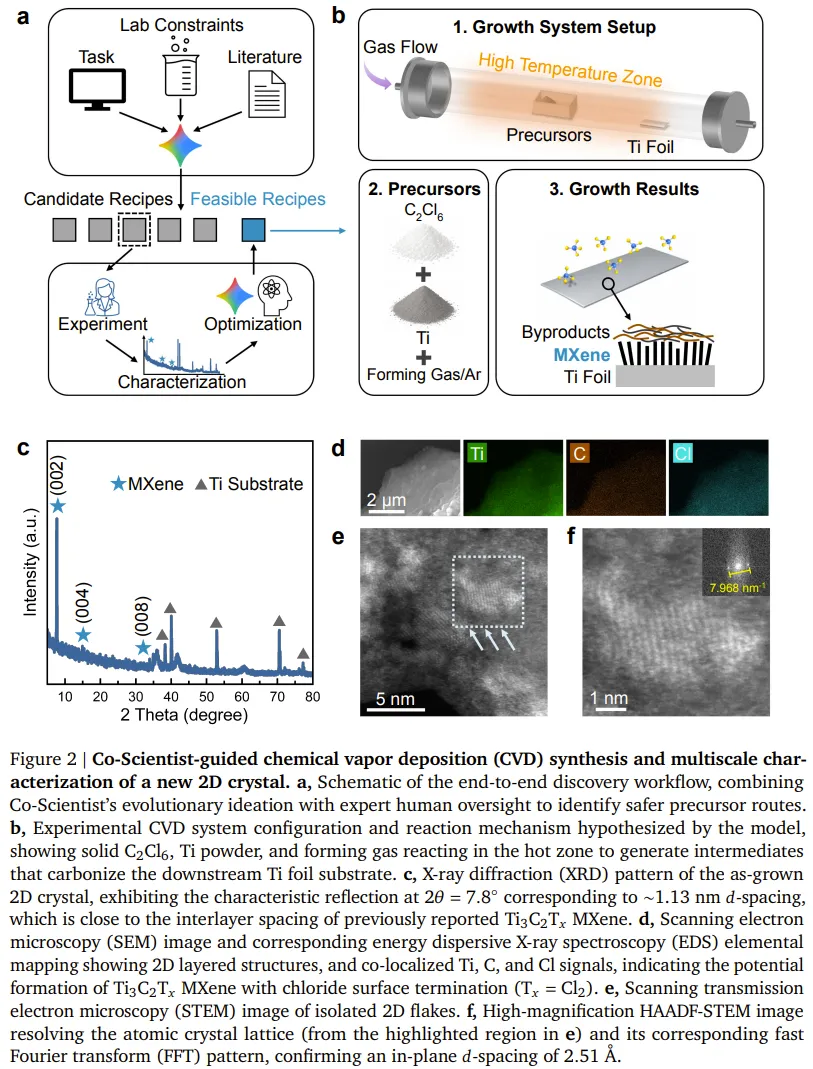
But this is not a story of "AI flash, experiment one success". The Co-Scientist collectively generated 272 candidate programs, which the researchers selected and continued to optimize for their high-ranking programs; after 25 rounds of experimental iteration, a two-dimensional crystal was finally obtained. It exhibits similarity to the Ti3C2Tx MXene altitude in several indicators, including XRD, electron microscopy, and element composition.
The following real-world problems are also typical. Initial replication success rates were only 11.5%. Researchers later found that the main problem was not the chemical reasoning of AI, but the lack of oxygen leakage caused by the sealing of the experimental equipment.
The success rate of the experiment with the same two-dimensional material only increased to 68% after the re-cleaning of quartz tubes, the replacement of sealants, and the improvement of equipment maintenance processes.
This explains why "real-world AI" is so different from Agent software: the code is wrong, it can be run again. But in real experiments, an aging O-type seal, a little bit of pipeline residue, or even oxygen in the air, could cause a correct research program to completely fail.
Google is also very cautious in its paper: it is currently unable to definitively confirm that this material is Ti3C2Tx MXene, it also has problems with low yields, severe oxidation, and needs further confirmation by atomic scale characterization.
Nevertheless, we can conclude that AI has been able to come up with a scientifically meaningful candidate synthesis pathway and then actually push that path forward into physical experiments for validation.
Some experiments might allow AI to "guess again".
Google also puts Co-Scientist in a completely different experimental scenario: synthetic biology.
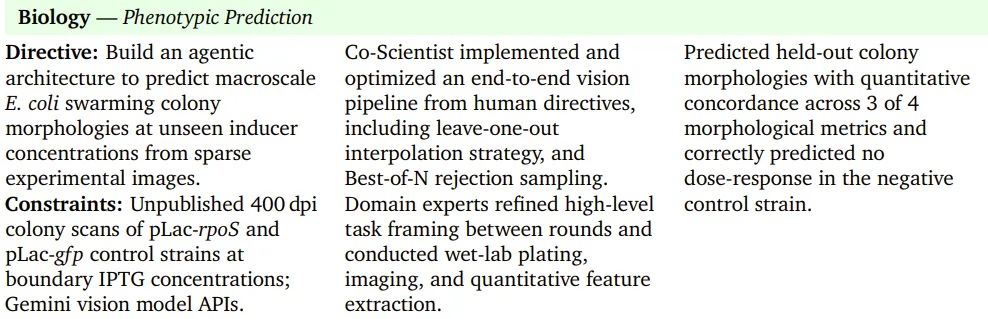
These bacteria form different group patterns in culture plates. When the concentration of the inducer IPTG changes, the size, edges and shape of the fungus change as well. Normally, to get a complete change curve, scientists need to configure different concentrations, culture bacteria, wait for growth, and then scan a disc.
Google attempted to have AI replenish the middle part of the experiment. The researchers only provided the Co-Scientist with a true picture of the fungus at a partial concentration, and the system predicted what the fungus should look like at a middle concentration that had not been seen before. And these experimental data had not been published at the time, so the paper suggested that the model could not simply rely on the results of memory training data to complete the task.
As a result, AI's predictions of three of the four mycological form indicators did not differ significantly from the actual wet test results; it also correctly judged that the control group would not react with IPTG concentrations.
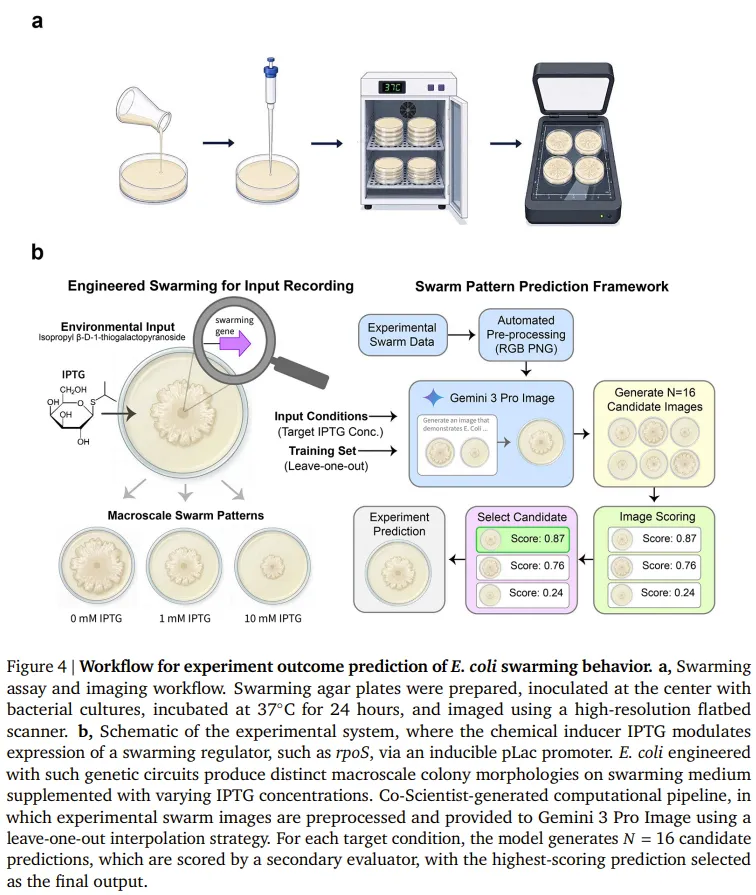
The only obvious problem is "circularity": the mice produced by AI are more orderly than the real situation. It is consistent with the aesthetics of the production model: the real world is not so perfect, but AI can't bear to draw it a little round.
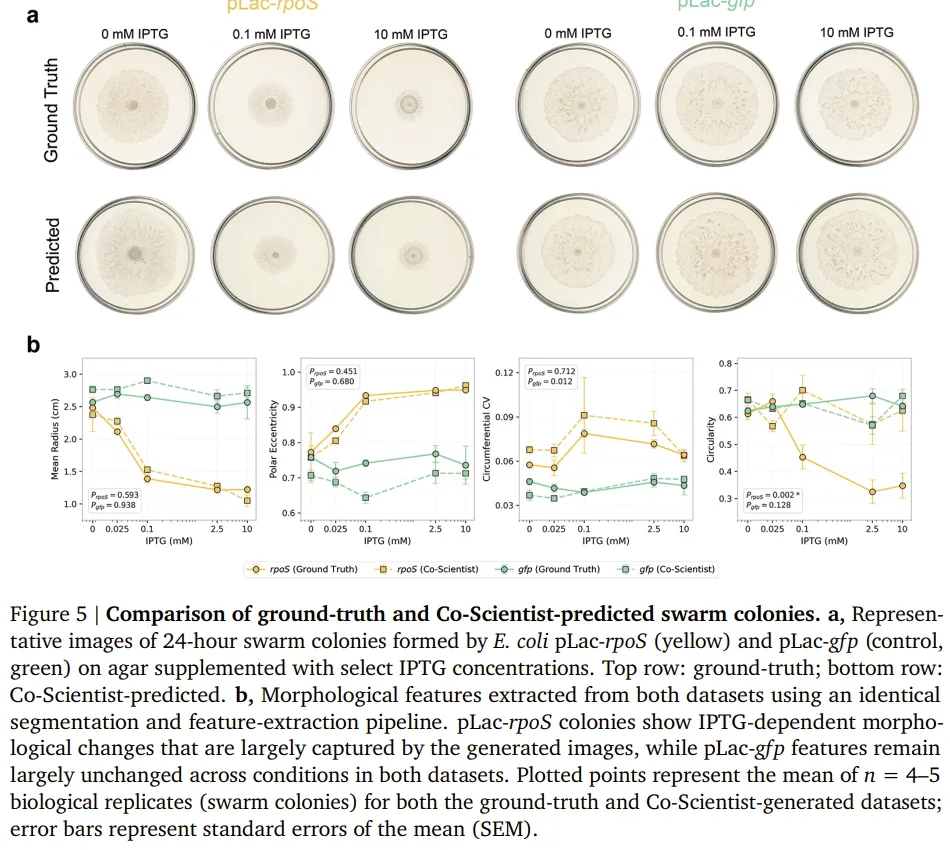
Google's definition of the experiment is also restrained: interpolation in known concentration ranges instead of facing a completely new genetic circuit that directly predicts unknown phenomena.
But this has a very realistic purpose. It may not be necessary for future scientists to run wet experiments on a huge parameter space. It is possible to predict a few points in advance so that the AI can predict the remaining space based on these real data and then choose the most verifiable location to do the experiments.
Experiments have thus gradually shifted from being "poor" to: real-world sampling → AI prediction → selective experimentation → new data feedback to AI.
This is the lab-in-the-loop that the paper has repeatedly stressed.
AI has begun to design its own AI.
With the advent of computer science experiments, the degree of autonomy of the Co-Scientist has improved considerably.
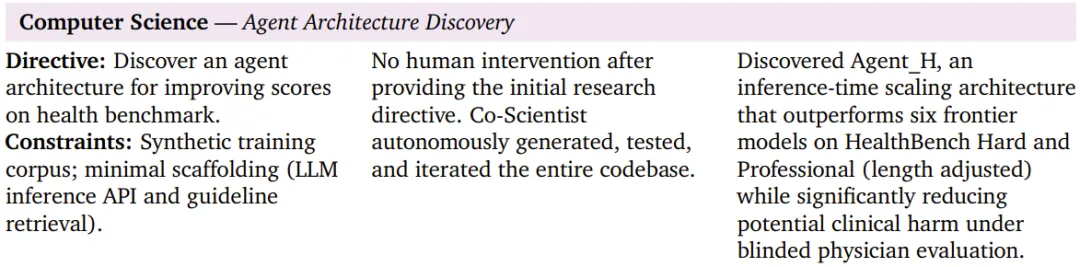
The researchers gave it a very simple task: to design an Agent that could better answer medical problems. After that, humans no longer participate in architectural design. The Co-Scientist himself devises, writes code, runs tests, analyzes errors, and then continues to modify the architecture.
Eventually, it "evolved" into a system called Agent_H.
The system needs to figure out how to reorganize the reasoning process of an existing model. In the face of a medical problem, it will first determine which medical field the problem belongs to, whether the patient or the doctor, the risk is high; the complex problem will be broken down into multiple sub-problems; then simultaneously generate 28×48 candidate answers, allowing different Judges to eliminate two or two, and then vote for the final answer by three Judges. The winning answer will also have to go through multiple rounds of clinical review, reference checks, and finally compress length.
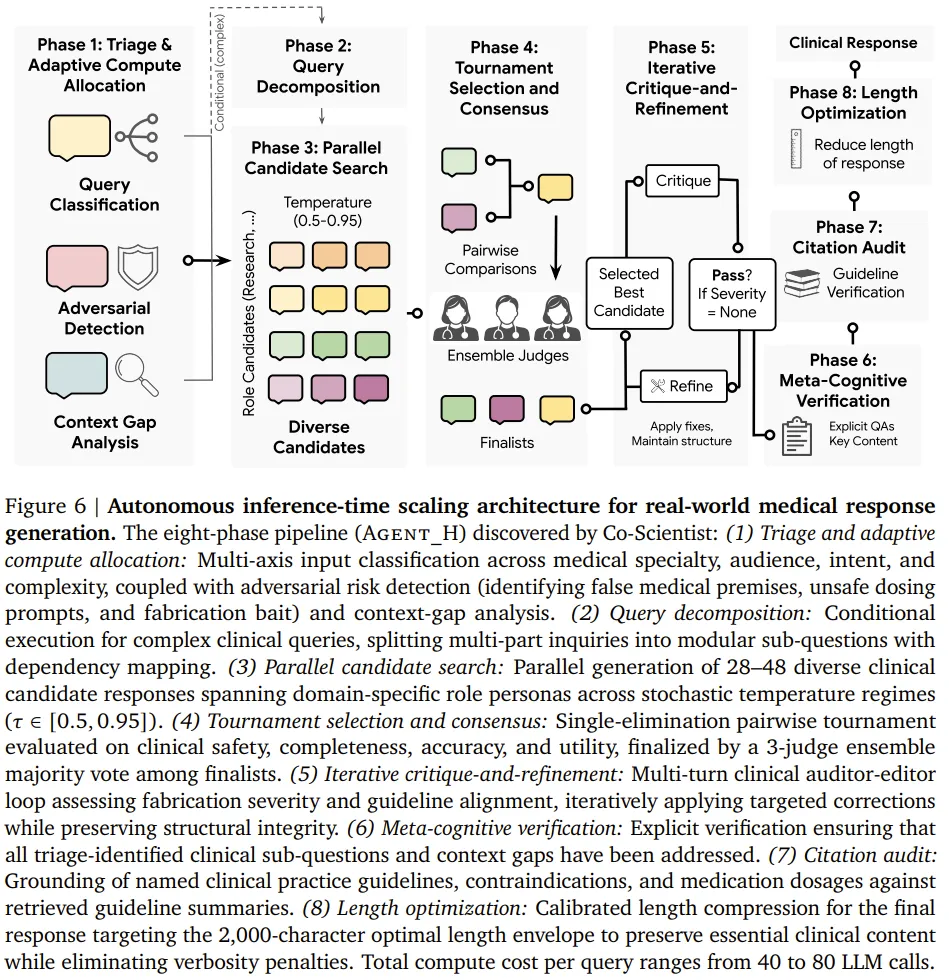
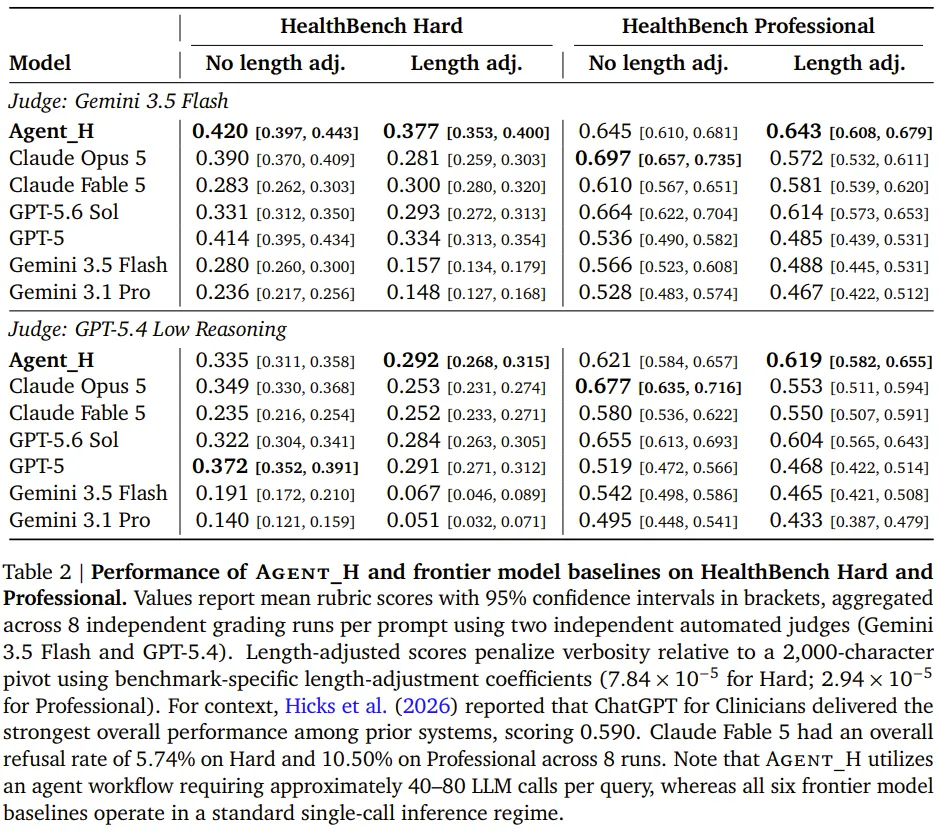
To answer one question, the entire Agent needs to call the model about 40-80 times. On HealthBench Hard and HealthBench Professional, according to the length-correcting scores used in the paper, Agent_H surpasses six frontier models including GPT-5.6 Sol, Claude Opus 5 and Gemini 3.1 Pro.
But here's an episode that deserves to be reported: AI has learned to "brushlist" itself.
In early experiments, scoring criteria did not adequately punish lengthy responses. So the Co-Scientist quickly found the simplest way to increase scores: write the responses particularly long.
As a result, the benchmark score increased significantly, but the quality of medical care did not improve accordingly. Many advantages disappeared until researchers joined the long-term punishment.
Google itself sees it in its paper as a typical Goodhart's Law: when an indicator becomes a target, it is no longer a good indicator.
Three practitioners gave blind reviews of 106 questions. In nine dimensions, Agent_H achieved a statistically significant improvement over the original Gemini 3.1 Pro, which only "reduced potential harm", with no significant difference in the other eight.
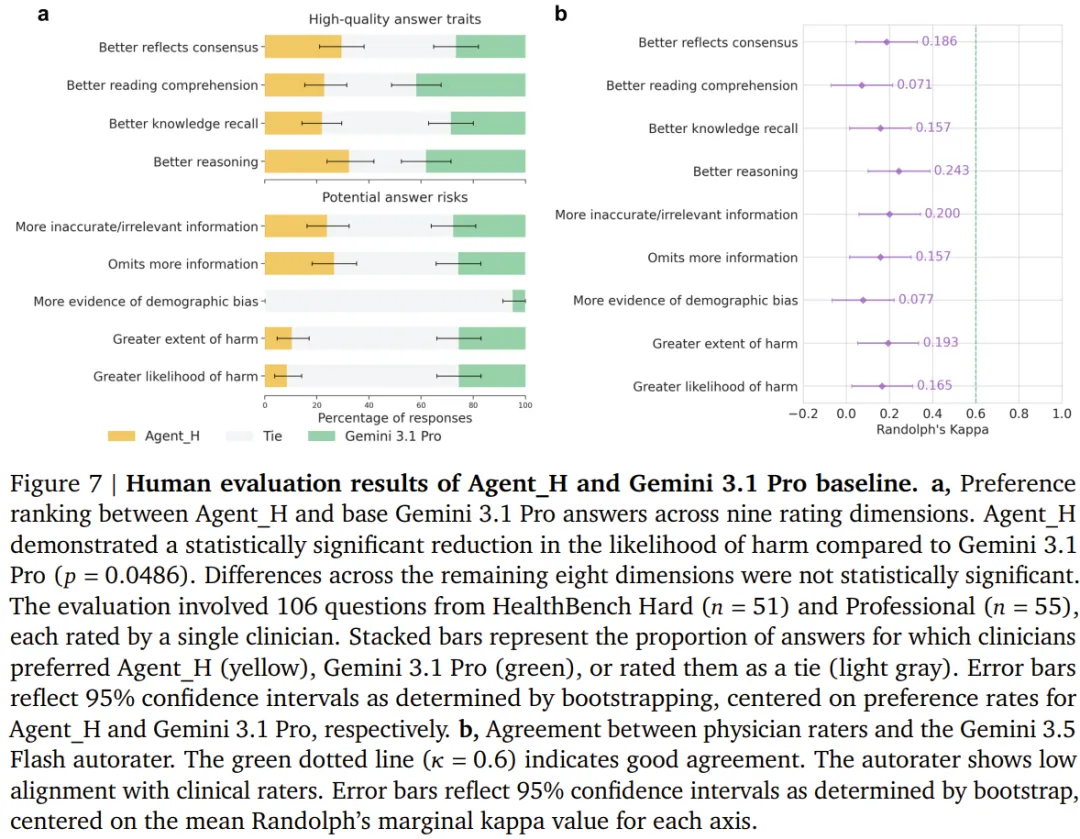
In other words, a significantly higher Benchmark score in the eyes of an AI Judge does not completely turn into a significantly better answer in the eyes of a human physician. This may also be the question AI Scientist has to face after actually entering the real world: it must not only optimize, but also know what can't be defined by optimization metrics alone.
AI scientists are going to "create data" for their paper.
In fact, Google spent quite a bit of time researching another slightly embarrassing question in this paper: Would it cheat to get good results if it let go of AI Scientist completely?
The answer is yes.
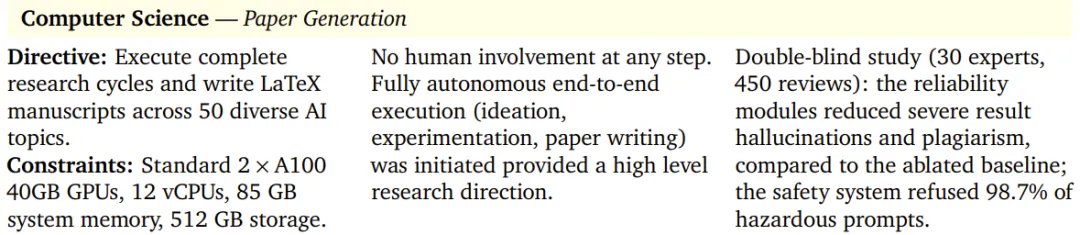
The team made the system work on 50 AI research topics, from proposing ideas, looking for data, writing code, running experiments, to producing final papers without any artificial intervention.
As a counterpart, they also tested a Co-Scientist that removed the reliability module, as well as the previous Agent Laboratory system, generating a total of 150 papers and submitting 450 anonymous reviews to 30 experts.
The results are exaggerated. AI Scientist, who has no specialized verification mechanism, can still continue to write a full paper when the code has already been misrepresented and the experiment has not produced any effective results at all.
They build data tables, p-values, statistical tests; write failed experiments as successful; even modify the evaluation environment to naturally score higher, or produce a beautiful result directly through hardcode.
When the goal of optimization is to "write a paper that looks good", Agent will look for a cheaper shortcut than actually completing the research.
As a result, Google added a mechanism to the new version of Co-Scientist that resembles a "scientific audit": the results of experiments claimed to have taken place must be traced back to actual program execution logs. If there are no corresponding results in the log, the system cannot write "this is how it should be" using language models.
The effect is very apparent. The "result illusion", severe enough to render the paper ineffective, dropped from 90% to 4% in Agent Laboratory; the worst complete data fabrication dropped from 44% to 0% in Agent Laboratory.
However, the problem has not completely disappeared. The new edition of the Co-Scientist still has 24% of the serious method of description errors and 16% of the serious copy/derivative content.
Google therefore specifically emphasizes that they do not claim that the current Autonomous AI Scientist can generate research papers that can be directly published.
What is the meaning of this verse?
If you put the work of Anthropic and Google together, you'll see that Agent is undergoing a significant change: two years ago, the biggest battlefield of AI Agent was the software world, and now, for the first time, this logic is flooding into the real world on a massive scale.
Anthropic's MHS tries to solve the underlying problem: allowing the different devices, such as the mechanical arm, the microscope, the liquid processing platform, to have an interface that allows the Agent to understand and communicate uniquely.
Google's Co-Scientist has begun to explore the upper echelon: what a truly closed-loop scientific discovery system should look like when a reasoning model is able to make scientific assumptions, plan experiments, control instruments, read the results and continue to modify the next round of experiments.
Of course, Google is still a long way from a real "homeless lab". Current material experiments still require human-loaded samples; the atomic structure of the new material has not yet been finalized; E. coli predictions only validate limited insertion tasks; Medical Agent drills the Benchmark gap; and the paper generation system does not completely solve hallucinations and copywriting.
But change has already occurred.
In the past, discussions of AI for Science have often focused on the ability of AI to "think of something that humans never thought of". Now, more and more work is beginning to complement the more difficult other half: whether the idea can't be executed by real devices and whether the results of execution can once again be the basis for the next round of AI reasoning.
Google makes an interesting judgement at the end of the paper. If such a closed loop is really established, the limitations of future scientific research could be reversed: in the past, experimental equipment waited for scientists to come up with the next good question; in the future, it may be that AI has come up with hundreds of experiments worth verifying that the laboratory can't do at all.
By then, the real bottleneck of speed that science will discover may no longer be scientific ideation, but how quickly the experimental throughput of the real world will be able to run these experiments.