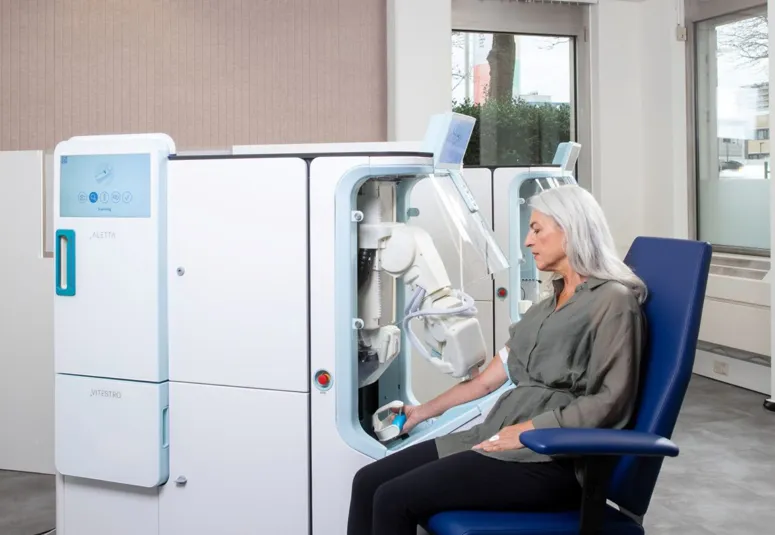
“ A Dutch company has created a robot that can use its own needles.
It's called Aletta, a medical technology company from Vitestro, Utrecht, Netherlands. Recently, the US Food and Drug Administration (FDA) formally approved the device to be marketed through De Novo for venous blood collection in adult patients. It's believed to be the world's first robotic device that can perform venous blood collection independently without any direct human intervention.
Prior to this, Aletta was CE certified by the European Union, entering the clinical and pre-commercial phase in some hospitals and laboratories in Europe. This FDA authorization means that the device has simultaneously gained access to two major medical device markets worldwide.
As the world's first commercially-approved autonomous blood collection device, it is unique in its ability to pump autonomously, which refers to the complete process from positioning the blood vessels, piercing the needle, to replacing the blood vessels, gluing the blood lining, all done by machines without touching the needle.
More importantly, the FDA has set up a regulatory framework for the brand-new class of devices called autonomous blood-collecting robotic pumps, which means that medical robots are becoming a specific, high-frequency, vital clinical tool that can do the job.
01.
Blood transfusion is the most frequent medical operation in the world.
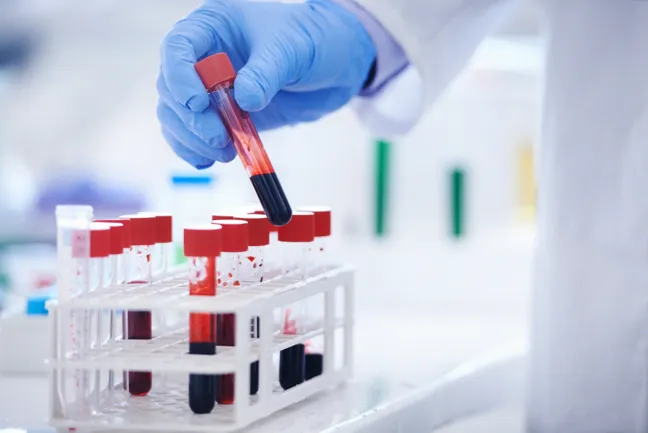
Why is it worth taking this matter seriously? Because it is the most frequently performed invasive medical operation in the world. According to industry statistics, billions of blood transfusions are performed globally every year, far more frequently than any surgery, any single imaging inspection.
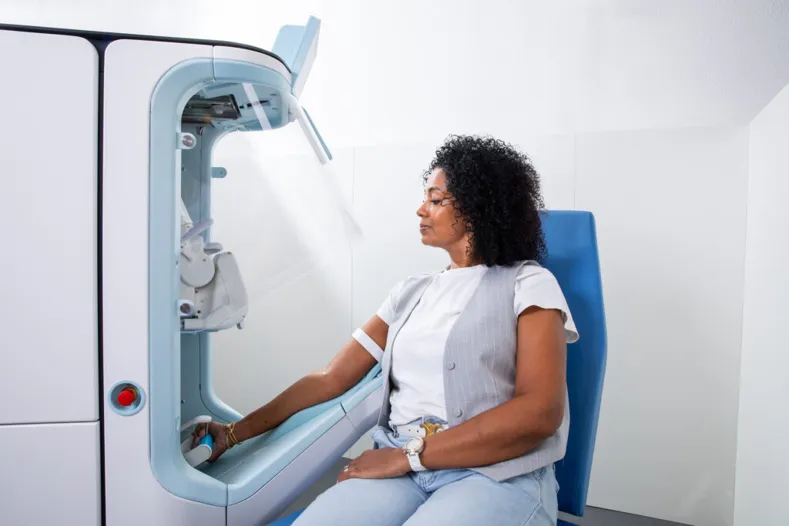
High frequency, however, never means simple. On the contrary, blood sampling is actually a technique that relies heavily on the sensitivity of the hands and the experience of the hands.
Blood vessels are rough, shallow, and tend to vary from person to person, depending on age, body type, and physical condition, as well as the condition of older people, children, obese people, and long-term chemotherapy patients.
It is not uncommon in clinical settings to not see blood from one needle to another. Different studies have shown that the first success rate of manual blood collection varies between 75% and 97%, depending on the patient group and the experience of the operator. Each struggle is painful and anxious for the patient, and time-consuming and psychological stress for the nurse.
In a larger context, there is a continuing shortage of nurses around the world. This repetitive, time-consuming, and technological threshold is precisely where nurses are most consumed. Michelle Tarver, director of the FDA's Center for Equipment and Radiation Health, said: "Blood sampling is one of the most commonly performed medical operations in the United States, but patients may face delays due to a growing shortage of trained blood collectors".
When the shortage of human hands continues, the demand continues to expand, and a robot that can be standardized, that can be copied, that can run 24 hours without stopping, it will no longer be a trick that is added to the jaw, but just the need to deliver coal in the snow.
This is exactly the problem that Aletta wants to solve and the real industry logic behind its approval.
02.
From the touch of a nurse to the precision of a vacuum cleaner
In order to turn a massage nurse's hand sensors into a massage machine, Aletta relies on a combination of fists.
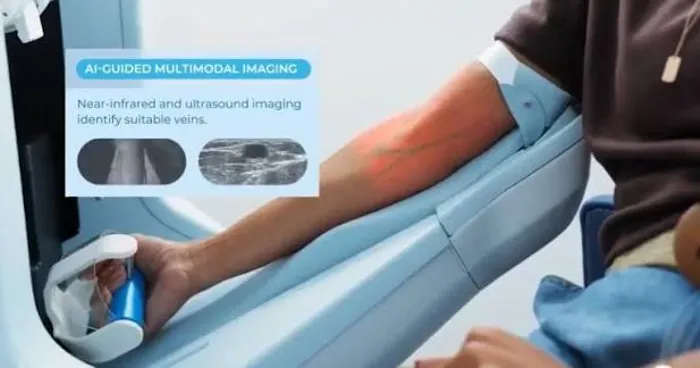
The first step is to look at the veins. Aletta uses a multi-mode imaging technique that combines near-infrared light and ultrasound imaging, so that the veins under the skin of the patient are penetrated in real time, showing the location, depth and direction of the vessels. This step solves the problem of where the needle should be pointed, not finding the right vein and the robot will not open the needle.
The second step is to calculate spin. The AI algorithm in the system, based on real-time imaging, calculates the optimal path of the needle. Whether at the angle, depth, or speed, the planning is completed in milliseconds.
The third step is to control the needle. The mechanical arm, with a needle, accurately points the needle along the computational path to complete the piercing with a sub-millimeter accuracy, while the on-board sensor senses the resistance feedback received by the needle in real time and stops exactly once it touches the vascular wall.
Vitestro published the results of a peer-reviewed multi-centered ADOPT clinical trial in Clinical Chemistry. The study included 1,633 clinical patients and showed a 94.5% success rate of first piercings when the device was identified to a suitable vein. In different patient groups, it was particularly relevant for patients with a high BMI of >30 kg/m2 at 97.4%, for elderly patients >65 years of age at 93.4%, and for those with difficulty penetrating the veins at 92.7%.
This data means that Aletta's success rate is comparable to, or even better than that of a senior blood collector. After all, robots don't get tired, stressed, or strained because of work-related fatigue, and its stability is the biggest killer killer of human beings.
03.
Blood transfusion, robot landing at the bridge head
If we put this into a larger coordinate system, it means much more than blood transfusion itself.
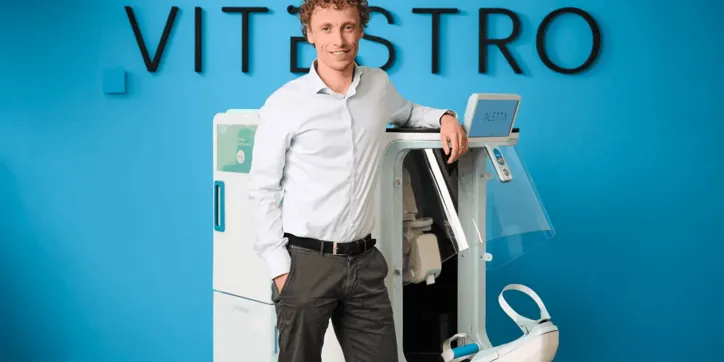
The robotics industry has been screaming for years about a downward spiral, but for now, the real downward spiral needs to be stepped on a high frequency, standardized, and the real scenario of three conditions being created at the same time.
The collection of blood takes place every day in the examination department, medical examination center, emergency room and sick room, and after the run-up, retrieval and scale is determined; the chain of action for finding blood vessels, injection needles, blood drawings, stop bleeding is relatively fixed, the more standardized the operation, the more suitable for robots; the shortage of medical care is a long-term trend, and the collection of blood is one of the most labor-intensive links, and the demand for technology is pushing back, which is precisely the healthiest form of business.
The three of them are ready for a scene that is rare in the entire robotics industry.
In March 2026, Vitestro completed a $70 million (over-the-counter) B round of financing, with investors including Labcorp Venture Fund, Mayo Clinic, Sutter Health, and other major healthcare institutions and industry capital. The list of investors included co-founder and former CEO of Fred Mollin, a legend in the field of surgical robotics, and former CEO of Intuitive Surgical (Da Vinci Surgical Robot). The flow of capital tends to be more descriptive than the parameters of technology.
Once it runs, it is verified not only that the link is drawn, but that the sewing machine replaces the entire path of repeated clinical operations. The sewing is only the first stop, and the vein infusion, the insertion of the conduit, and even more complex piercing operations are all on the same technological extension line.
04.
Link to the Future
Before Aletta actually opened the hospital, there were still three ways to do it. First, trusting patients to trust a robot, rather than issuing a certificate, and actually testing people's deepest sense of security. This requires long-term clinical data and patient reputation to be built more slowly than technological breakthroughs.
The second is the cost of buying, deploying, deploying and maintaining a blood robot, whether it can actually calculate the hospital's human bill, which is the real test of commercialization.
Finally, the boundaries and the ability of autonomous blood sampling to adapt to blood vessel conditions have yet to be further verified. Currently, Aletta is designed for adults aged 16 and over, and children and other groups are not included. However, the FDA disclosed that the verification group includes a list of people who have difficulty penetrating veins, indicating that it is not only difficult for struggling patients. It is only a more realistic image in the short term, that robots handle regular blood transfusions, that nurses handle with difficulty and emergency.
Vitestro's official website also makes it clear that Aletta's design concept is to work in collaboration with a team of blood collectors to get regular blood collections done by robots, so that blood collectors can focus on patients who need more time and care.
While there are many issues that need to be addressed, the moment when people begin to seriously discuss whether or not they dare to surrender their hands to robots actually means that medical robots have moved from a distant concept to the gates of everyday life.
The blood collection was the first stop on the landing and the first needle to verify the entire route.