
It's the first time in the history of the world.
This year, about one-third of the world's new computing power is finally working for the same two AI companies!
The two are Anthropic and OpenAI.
By next year, this figure could be cut in half.
According to this momentum, by the end of 2028, the two companies could control the majority of the world's efficient computing capabilities.
This was said by Dylan Patel, founder of SemiAnalysis.
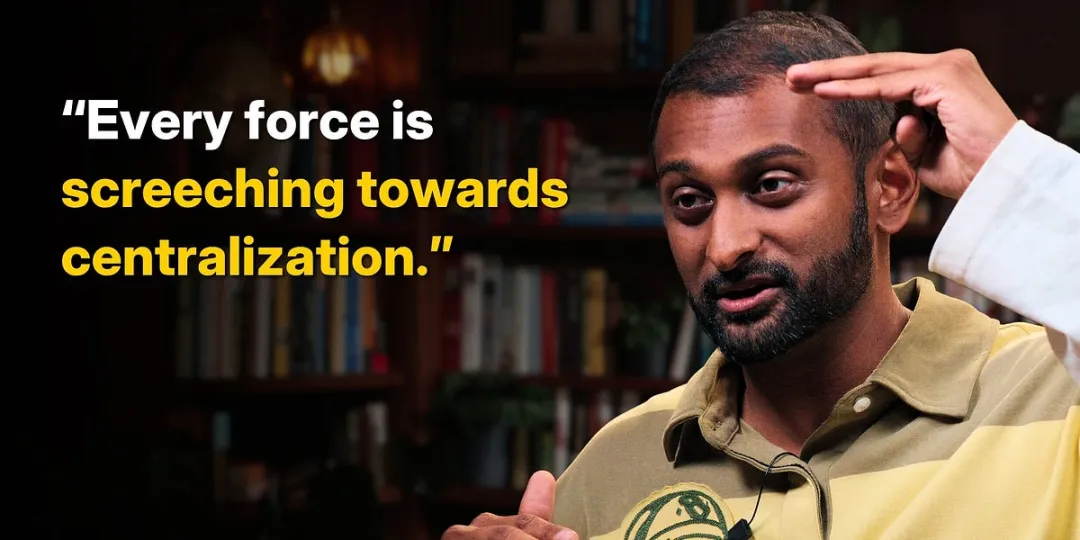
Dylan Patel hosts the Dwarkesh Podcast.
On August 25, he hosted the Dwarkesh Podcast, recounting the next three years.
In the last 10 minutes, the topic shifted from mathematics to a bigger question:
The power of AI will really fall into the hands of very few companies.
Seeing this, co-founder and chief scientist of Hugging Face, Thomas Wolf, was immediately taken aback.
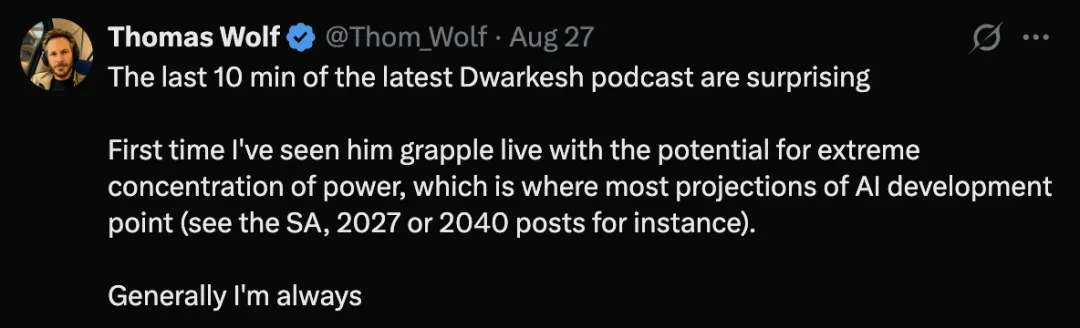
He turned around and said that this was the first time he had seen the issue being addressed in Dwarkesh.
This was not surprising to him.
Wolf holds the upper half of the hook open, which he sees as blocking the exit of the power center of the power plant.
Three nuclear power plants a yearLet's take a look at how fast these two companies are doing their calculations.
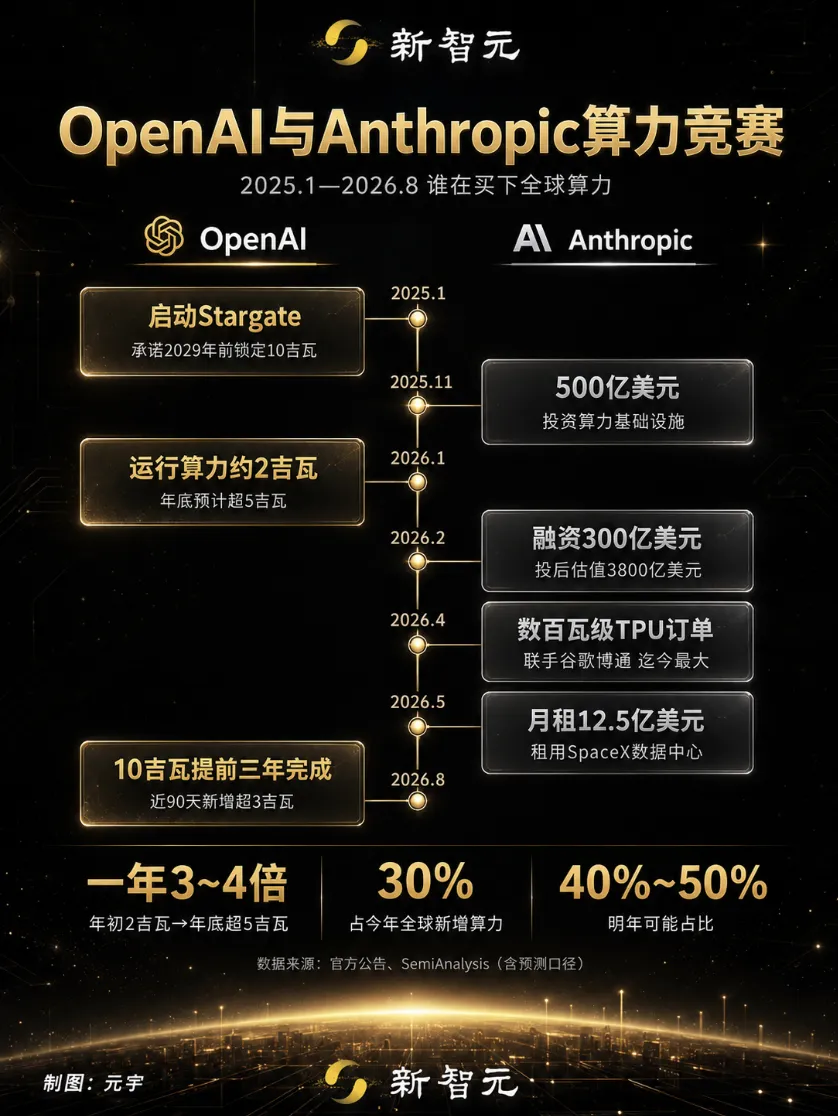
At the beginning of the year, OpenAI had about 2 GW, Anthropic less than 2 GW, and by the end of the year, both will exceed 5 GW.
The average person earns three to four times a year, and the unit is the jiva.
One gigawatt is the equivalent of power generated by a large nuclear power plant: the equivalent of three nuclear power plants consumed in a year!
This year, the new global computing capacity is about 30 gigawatt, next year 50 gigawatt, and around 70 gigawatt in 2028.
Not only is the volume increasing, but there is also a multiplier that is easily overlooked: a new watt added this year will hit a lot more than the one installed two years ago:
The GB300, TPUv7, and Trainium 3 generations of chips are 3 to 5 times more powerful per watt than the previous generation.
So, when Dylan says, "By the end of 2027, two people will take half of the new computing power", the amount of gold in that half will be much higher than the amount of gold in the next year.
These two multiples overlap to produce Dylan's phrase, "Most efficient computing available".
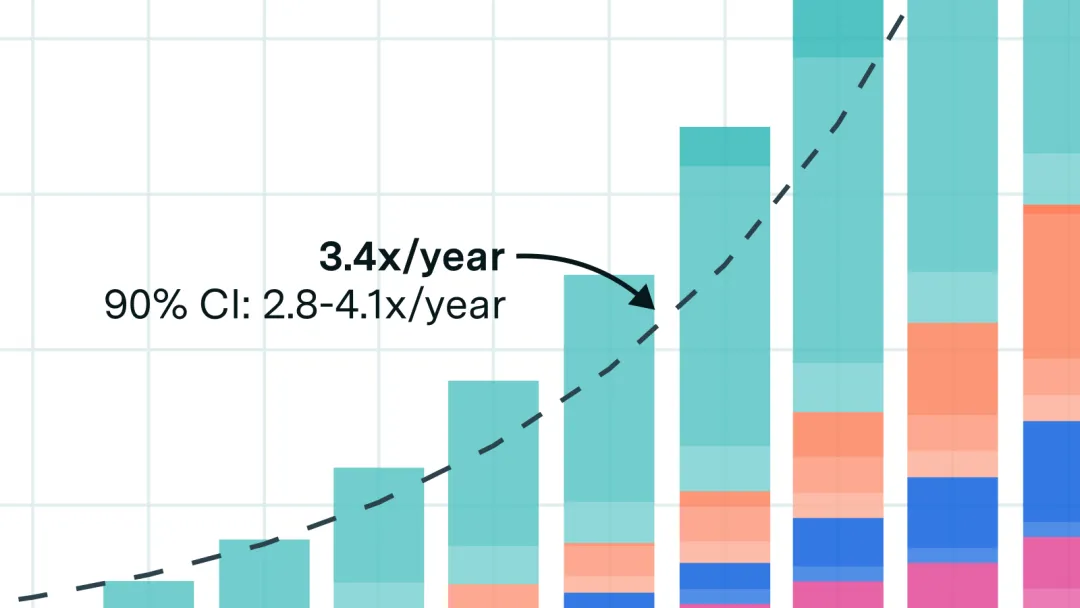
Worldwide, the total computing power of AI chips doubles every seven months. This year's new one-watt is much higher than the one-watt that was installed two years ago.
However, this statistic is the ultimate user of arithmetic, not the arithmetic property.
Someone called Claude on Amazon's Bedrock, and this algorithm was written into Anthropic's head.
Who makes money faster?Who eats more math?Why these two?
The answer lies in a rarely mentioned indicator: revenue per megawatt.
A year ago, the token business itself was losing money.
OpenAI runs GPT-4 on Hopper, with a negative gross profit for every token sold, and Anthropic is burning investors' money.
Now it's the other way around.
Anthropic started profitable in the second quarter of this year, and OpenAI is reportedly set to roll out in the third quarter.
After the GPT-5.6, Opus 5, and Fable 5 models went live, the two megawatts of revenue went well beyond the $10 million to $15 million line of computational costs.
The first runner up was Anthropic, which made a record $50 million per megawatt.
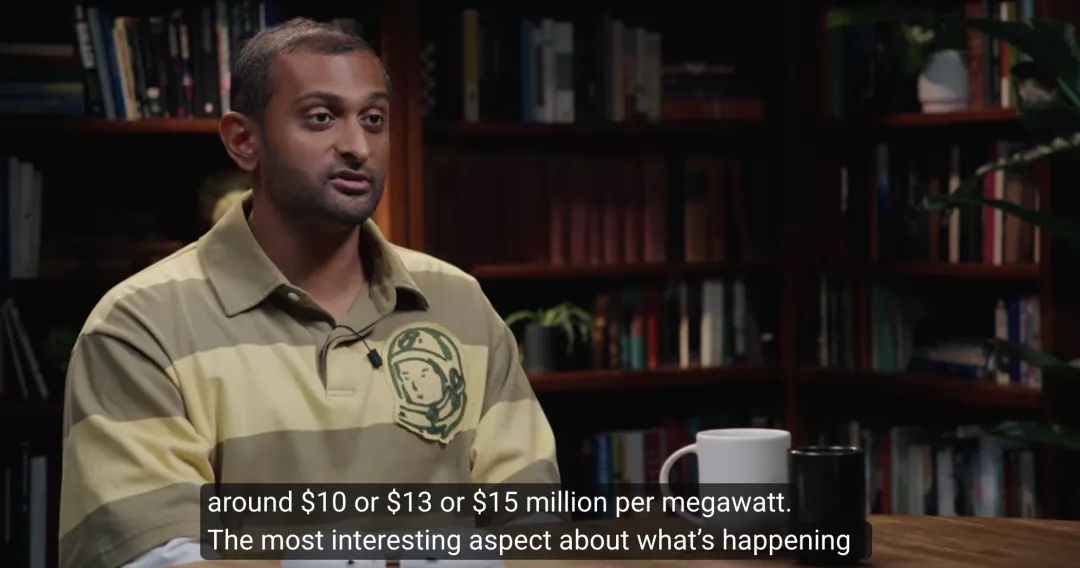
Dylan Patel gives an estimated import price of $10 million to $15 million per megawatt.
The competition is about how much money can be earned per megawatt, not how many cards can be earned.
If you earn more, you get a higher price; if you get a higher price, you get more math, and you can train a stronger model, and you keep earning more.
Three or four times a year, that's how it rolls out.
It is not difficult to cover that cost line.
An average person buys a GB300 cabinet, downloads an open-source reattachment to OpenRouter, and gets back more than he pays for it.
Because everyone got it, the line couldn't keep up, and the rent started to go up to 25 million megawatts, 40 million dollars.
Silicon Valley has only launched Anthropic and OpenAI at this price.
Dylan expects their earnings per megawatt to reach $70 million to $80 million by the end of 2027.
Cloud manufacturers buildingLaboratory rentalsAccording to Epoch AI, about 71% of global ownership of AI computing is still held by the top five cloud providers.
But the rights of use are being concentrated in two AI labs.
Cloud providers are the landlords, they buy skins and build data centers. OpenAI and Anthropic are like the two big tenants who rent most of the houses.
Now there's a third player: Build a house, then find a tenant.
Most cloud providers typically sign their customers first, take their contracts and go to the bank to borrow money.
Meta and SpaceX don't work: they're big enough to jump right out of the window to find customers and finance.
Musk even sold the calculator for $40 billion per gigawatt.
Dylan had a bill for him on the podcast: a gigawatt would have been worth $15 billion, he sold it for $40 billion and got it all back in a year.
If Anthropic can make more than $60 billion on this giant, why can't I sell more?
Next year, SpaceX will be a major add-on, renting most of its production to OpenAI and Anthropic.
According to WSJ, Anthropic has been leasing SpaceX's data center capacity for $1.25 billion per month.
In the case of the tenant, the appetite is greater than the landlord expected.
OpenAI launched Stargate in January last year, saying it would have shut down 10 GW in the U.S. by 2029. More than a year ago, the goal was reached ahead of schedule, with more than 3 GW in the last 90 days.
Anthropic announced in April that the next generation of TPUs in the Gigabyte class will be delivered by Google and Botone in 2027, officially calling it the company's largest computing order to date.
Not only that, but they also started building their own AI base: OpenAI as a self-developed chip, and Anthropic's TPU handed over to Fluidstack for deployment.
The tenant has been working for a long time and wants to build his own house.
Calculator purchasedYou're going to do it all?Currently, the laboratory's computational allocation is roughly 50% research, 10% development, and 40% reasoning.
The biggest part is research, not training.
Anthropic Training Mythos, a pre-training site with less than 200 megawatts of computing power, ran for about two months and less reinforcement training afterwards.
With a few gigawatt hands, the real pressure on "training a model" is only 200 megawatts.
It's not necessary, it's not really necessary.
These calculators are scattered in a machine room in the northern part of the country, transmitting data at an unpredictable speed, and working hard together is equivalent to each other.
So the rest of it burned to the ground trying new architectures, adjusting data comparisons, and validating ideas.
Dylan also has a more unconventional judgment: that the ratio of the piece to reason will continue to go back and forth.
A megawatt could sell for $30 million to $40 million today, take a quarter to reason, sell tokens, that's reasonable.
There are two options before the board: continue to sell the tokens, earn dividends, buy back, and all the shareholders are happy; or take all these calculations back and invest in R&D and create AGI.
Dylan believes there is no question about it.
According to the lab, the returns of AGI are much higher than before.
The signs are already there: Anthropic's monthly growth in computing is still on the rise, and the annual revenue growth has stabilized.
Investors will just stare at the question: If you could have made a hundred billion dollars a gigabyte, why would you go to Riga to train?
The problem is, both of them are going to the market.
The lab is paying AGI, investors are waiting for dividends, and the bill has been unfair from the beginning.
Who paid the $11 trillion bill?This year, global AI capital spending is just over $1 trillion, and by 2028, it will exceed $2 trillion.
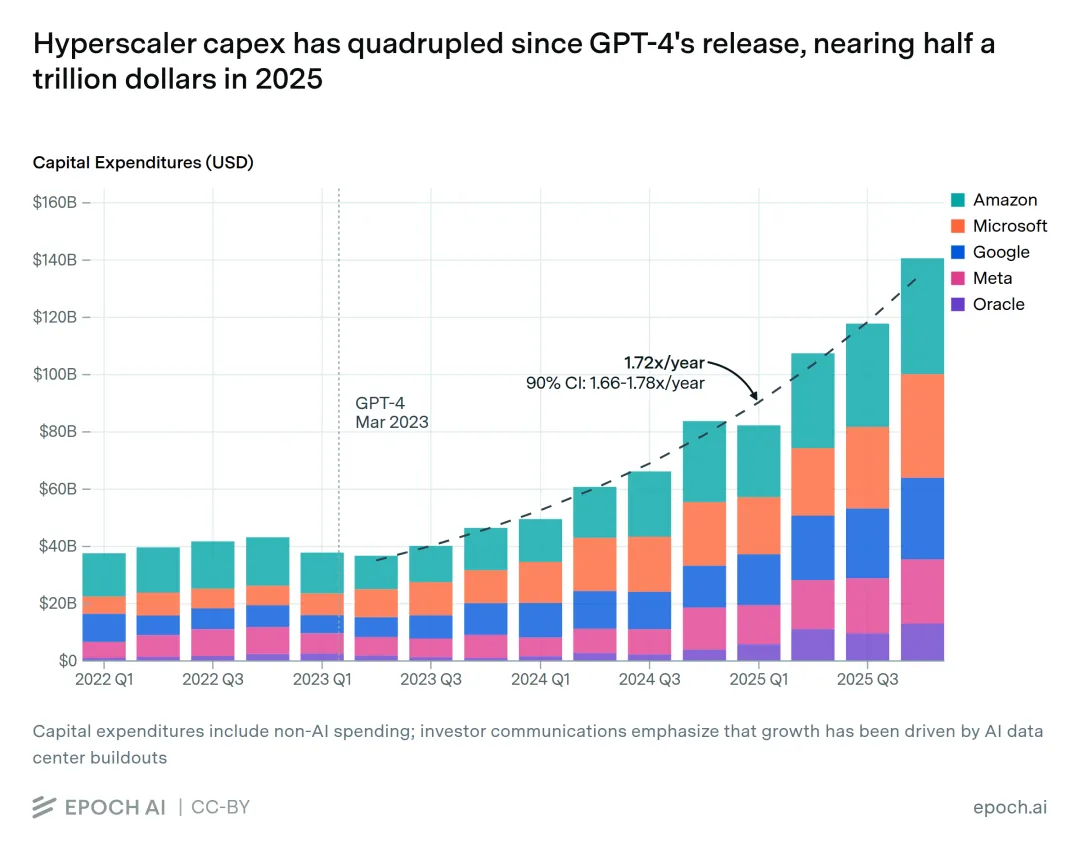
The top five cloud providers are projecting annual combined capital spending growth of 72% to nearly $500 billion in 2025. If the trend continues, it will reach $770 billion by 2026.
According to SemiAnalysis estimates, there will be a cumulative total of about $11 trillion between 2024 and 2029.
Five trillion dollars in debt, all in the same credit market, and money has become expensive.
Meta's current interest rate is 5 to 6 percent. Dylan says it's willing to pay up to 8 percent, and the calculated returns are too high.
The problem is that money is money in the same pool.
AI companies are willing to borrow at high prices, and the cost of financing the entire market is raised by these companies together.
In addition to money, there is no mention of government regulation.
New York is restricting data centers, Texas is suspending them, and the governor of Ohio just announced that the tax exemption for data centers is suspended.
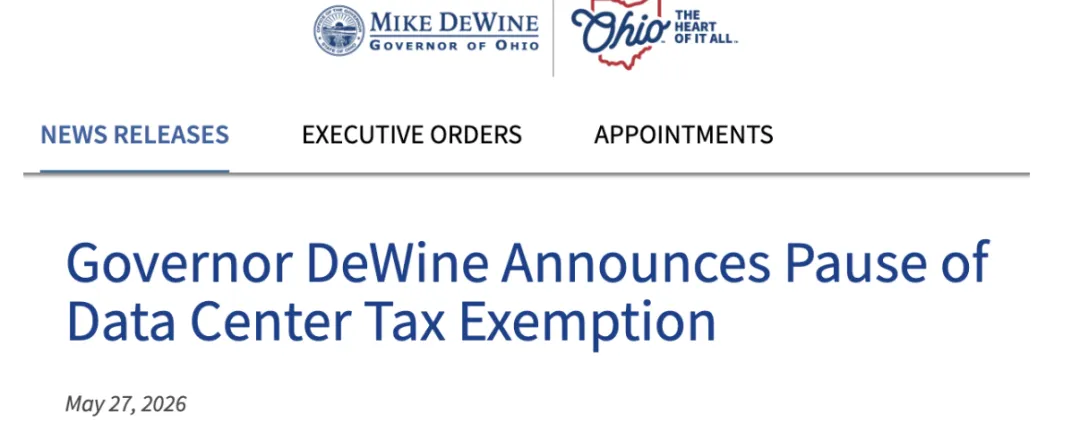
On May 27, 2026, Ohio Governor DeWine announced the suspension of the data center tax exemption.
What's more, it's not the best model.
OpenAI's Astra has not been released, and Anthropic has not released a model that is considered by the outside world to be the next generation of Mythos in its security assessment.
It's not just a waste of time for the lab.
According to Dylan, if all goes well, the two companies will buy 70% of the world's new computing power by 2028.
But the regulatory monopoly is the more you buy, the stronger you buy:
The best models don't come out, the revenue per megawatt stagnates; the revenue stagnates, it doesn't have the courage to raise the price of computing to a place where others can't; it can't buy more computing power, the next generation of models is slower, the revenue per megawatt stagnates.
The first step of Dylan's tour followed.
Megawatt installed todayThe AI workforce of tomorrowThe host, Dwarkesh, finally settled another bill.
Front-end computing power increases four to five times per year, while the computing power required to reach the same level of ability decreases by one-third per year.
The "effective AI workforce" in front-line laboratories is growing 10 times a year.
Push it at this rate: a lab holds 10 million AI workers this year, 100 million next year, and 1 billion next year.
"In a matter of years, the effective workforce of a company could exceed the total population of the planet!"
Dwarkesh says that this book is about the effect of scale:
Training costs will be scaled down to billions of sessions, the larger the budget; the scarcer the computing, the more premium the lead will receive; and models will learn from deployment, be used more widely, and have more data.
Each force flies towards the center, causing Dylan to shout "terrible death".
The AI competition is accelerating in a new direction, with more money being earned per megawatt than it was three years ago in terms of parameters, two years ago in terms of runs, and now in terms of revenue.
The real challenge is not who made the AGI first, but who called it after it was made.