It's the first time in the history of the world.
In the same model, the official price dropped only 20%, and your bills dropped by 80%.
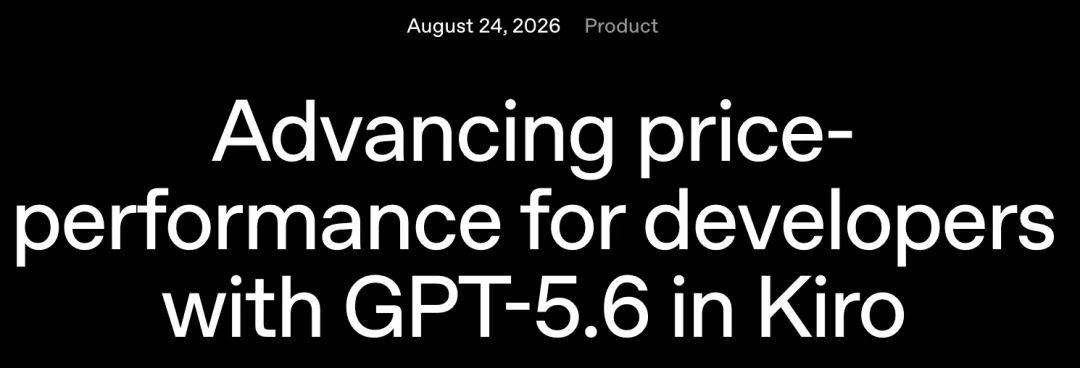
On August 24, OpenAI released a test result with AWS:
On Terminal-Bench 2.1, GPT-5.6 Terra reduced the cost of completing a successful mission at Kiro by about 82%.
Kiro is a software development platform for AWS that covers IDE, CLI, and Web.
Sol, Terra and Luna, three brothers in the GPT-5.6 family, have been running in it for more than a month.
This is not an official discount of 82%.
Terra was last priced at 20% on July 30.
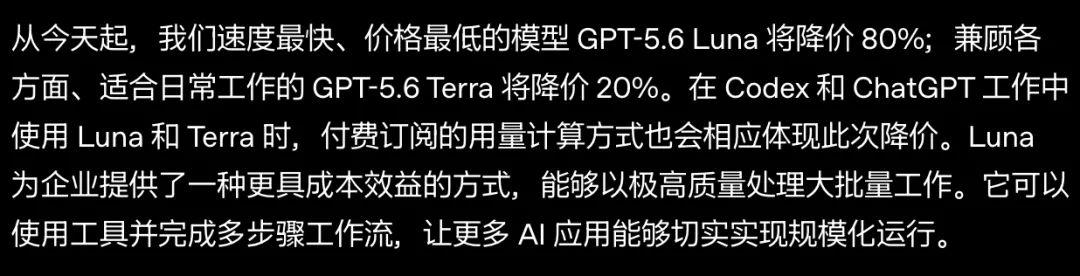
On July 30, OpenAI announced a 20% discount on Terra.
One-off prices are reduced by only 20%, but the bills can be cut by 8%.
The 60 percent difference in median is where it came from and it really deserves our attention.
The GPT-5.6 landing at Kiro was in July of this year.
On the 13th, AWS announced that GPT-5.6 Sol, Terra, Luna was officially available on Amazon Bedrock.
The following day, the blog of Kiro announced the launch of three models: IDE, CLI and Web.
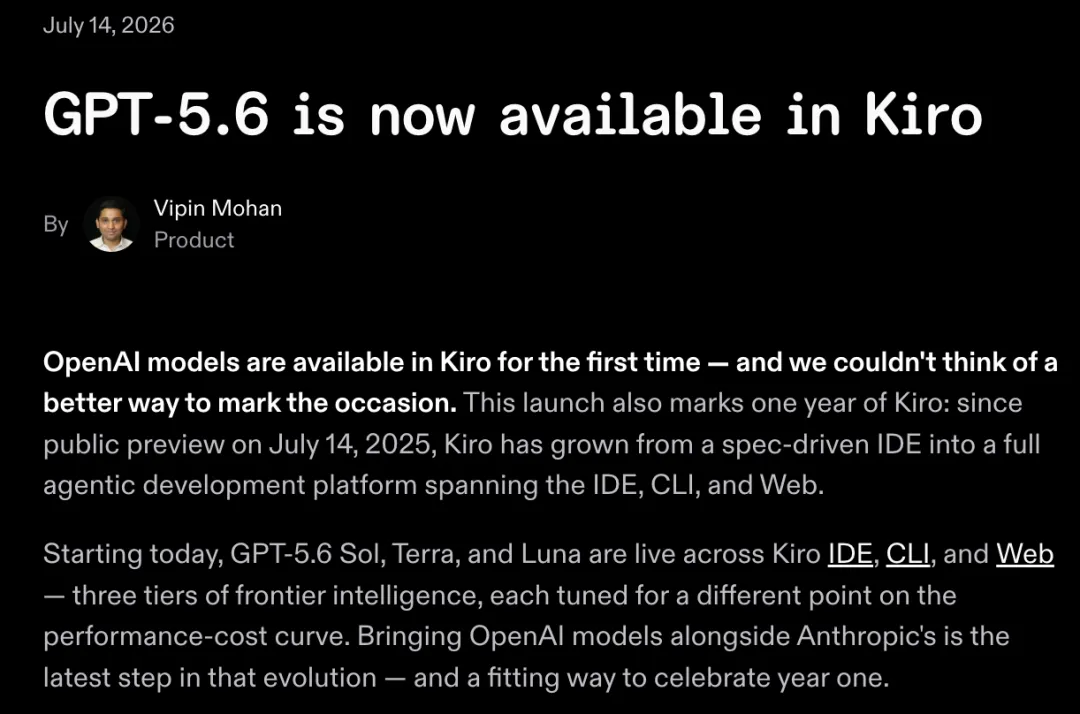
This is the first time that the OpenAI model has entered Kiro, just in time for the one-year anniversary of Kiro's public preview.
First, the model was put on the shelf, then pulled to work, and more than a month later, OpenAI returned to work:
Combining the Kiro environment and the OpenAI model, Terra's cost of completing a successful mission was reduced by about 82%.
Save the moneyIt's money for walking around.On 30 July, Terra's price was lowered by 20%, while the cost of a single mission was lowered by 82% in Kiro's tests.
Where did all that 60% come from?
The directions are as follows:
Less tokens are thrown by the model, fewer calls are made by the tool, fewer re-tests and long-distance trips are made after a failure.
So this large amount of money saved was not used for every call, but for those calls that would have made the flowers white.
The method is simple: an AI-smart body performs the task once, taking notes. It chooses the wrong path in the middle, runs three rounds back and forth, and these tokens are taken care of.
In real development, that's how money often goes missing.
OpenAI has also cited the same logic in its official blog, with efficiency coming from three levels:
The process of generating requests, organizing contextual frameworks, the intermediate scheduling system for requests, and finally the model running on the GPU itself.
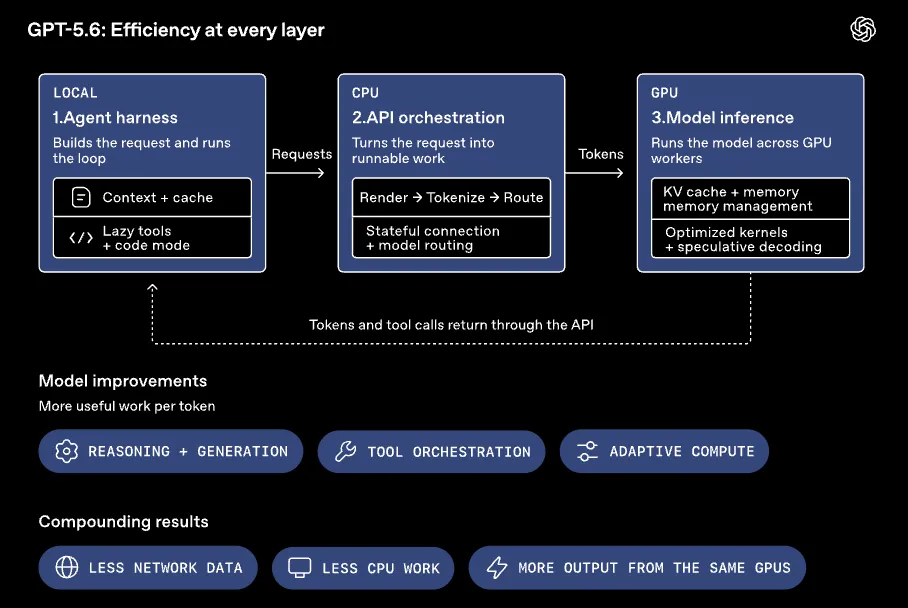
OpenAI dismantles GPT-5.6's source of efficiency: requests start from a smart body framework, sort through system scheduling, and finally to a GPU running model, each layer being saved.
It's also possible to save money on model division work.
OpenAI also uses a method: coding workflows can be used by Sol to clarify problems, plan ahead, and then replace Luna to implement changes that have already been clearly defined, write tests, and run evaluations.
The same flow of water, different links with different grades of intelligence.
Models account for only half of the billChange the framework and change the price.Terminal-Bench 2.1 is not a set of questions for the model to answer alone.
It throws the model into a terminal environment, gives it a blurred target, lets it plan its own path, tweak tools, write scripts, handle bugs, and iterate.
So the result that came out was a combination of the "Smart Body+ Model".
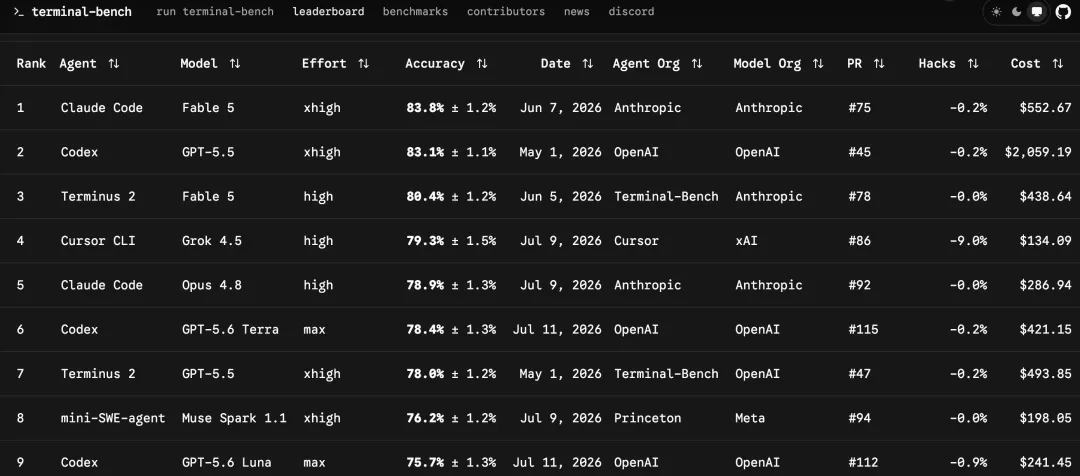
Terminal-Bench 2.1 opens the list and the accuracy rate on the right costs a bit more.
The four digits on the list illustrate the problem best:
Claude Code with Fable 5,83.8%, and $552.67;
Codex with GPT-5.5, 83.1%, $2059.19;
Codex with GPT-5.6 Terra, 78.4% and $421.15;
Codex along with GPT-5.6 Luna, 75.7%, and $241.45.
The first two lines scored only 0.7 percentage points, and the bills were nearly four times worse.
The same model, embedded in different frameworks, with different contexts and tool strategies, is not at all the same price.
According to official data from Kiro, Terra scored 77.4 points on the Coding Agent Index, only slightly higher than Claude Fable 5's 77.2.
The point of sale is not the score, but the price that corresponds to the score.
Kiro's spec-driven power point is also here, and the core gameplay is this: don't come up and write the code.
It first dismantles the user's vague goals, breaks them down into the correct requirements documentation, technical design and executable task lists, and then delivers them to the model.
In this way, the model is no longer a vague word, but a vivid one.
People familiar with Agent will react immediately, which is the most expensive part of the province.
The model runs off, returns to work, pushes back, and burns more tokens than it actually does.
Kiro also left two gaps in the process: before the code is actually modified, stop and take a look at it; and after it's done, run a test run automatically to verify that it's wrong.
Every time you go back to work, you can save real gold and silver.
Claude on the Amazon floorThe GPT split in half.
A year ago, Kiro was just a spec-driven IDE, and the model selector was the home of Anthropic.
A year later, AWS developed its own smartphone platform and launched a three-tiered OpenAI model.
Sol, Terra, Luna and Claude were all on the same drop-down menu, a picture that was hard to imagine a year ago.
Although GPT-5.6 is a "full house stay", it is not "full open".
The three models are progressive, experimental open, aimed at Pro+, Pro+, Pro Max and Power users, with only two regions, northern Virginia in the United States and Frankfurt in Europe, supporting cross-regional reasoning.
There's another thing that a lot of people don't fit in with: these models run around in Kiro with a hidden chain of thought, you don't see the reasoning steps, you only see the end result.
Those who are accustomed to looking at Agent's step-by-step reasoning will feel like throwing their life into an opaque box.
The official statement is that this is the expected behaviour and does not affect the output quality.
The three-door model is priced in Kiro.
On July 14, the same mission was launched, Sol clocking 2.4 times, Terra clocking 1.2 times, Luna clocking 0.6 times.
On July 30, OpenAI's round of price cuts fell, followed by Kiro the next day: Luna fell from 0.6 to 0.1 times, Terra fell from 1.2 to 1.0 times, with only Sol not moving.
The attitude of AWS is clear: a development platform cannot be tied to a single model.
In the same selector, the two front-end models began to price each other.
The model's rating criteria have also changed: high scores are no longer the default winner, and spending less money is the same winner.
For developers, choosing a model used to ask, "How much is this model worth a million tokens?" and now to ask, "How much will it cost me to get this done?"