For a long time, continuous learning has been the main study of how model parameters are updated along the task sequence, and how systems avoid catastrophic forgetting when learning new tasks. Methods such as experience playback, normalization, optimization constraints and architectural expansion share the same basic premise: continuous learning mainly occurs within the model.
However, in the age of Agentic AI, this model parameters-centered premise is changing. A deployed intelligent body is not only determined by the basic model, but also relies on an entire set of Harnesses that run around the model, including system prompts, interactive memory, reusable skills, external tools, workflows and routing strategies. Even without fine-tuning models, intelligent agents can continue to change behavior by updating these states. In other words, when the basic model stays frozen, objects of continuous learning and evolution can no longer be limited to the model parameters, but extend to the Harness, as shown in Figure 1.
Based on this context, the Harness Continual Learning study group at Nanjing University and researchers at the University of Wollongong in Australia proposed Harness Continual Learning as a starting point for the first time on the fundamental questions of traditional continuous learning, expanding learning objects from model parameters to Harness, system-defining and studying how Harness acquires new capabilities along a continuous sequence of tasks, retains existing behaviors, and responds to the forgetting that occurs during the update process.
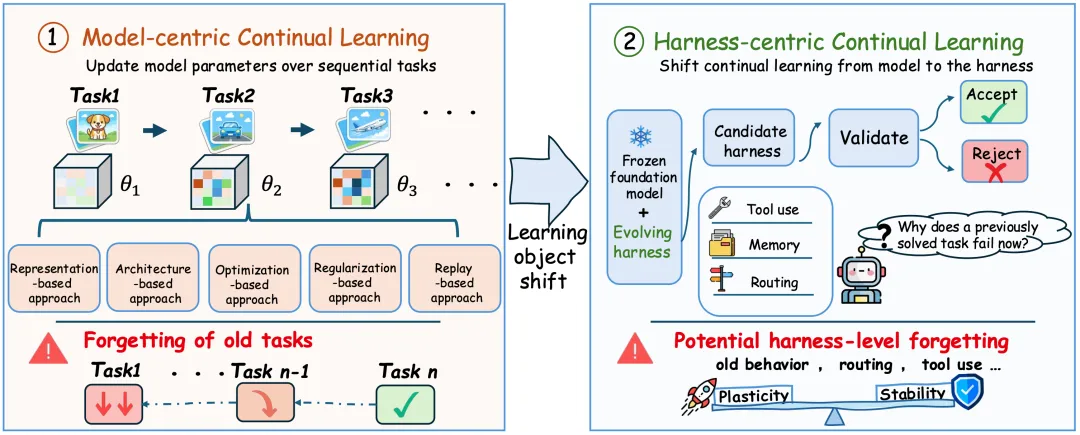
Figure 1 - Transition of continuous learning objects: From updating model parameters to the continuous evolution of the frozen basic model Harness
The topic of the paper is Harness Continual Learning: Continual Adaptation Beyond Model Parameters.
Link to the paper:https://arxiv.org/pdf/2608.19013
Affiliated institutions: The Research Group on Reasoning and Learning at Nanjing University, University of Wollongong, Australia
01 Harness as an object of continuous learning
On the premise of the transformation of continuous learning objects, the authors propose and formalize Harness Continual Learning (HCL): HCL focuses not on an isolated Prompt、Memory or Workflow optimization, but on a series of continuously deployed Harness states:
 Each update not only answers the question of whether or not the current task has been improved, but also raises further questions: Is this improvement at the expense of disrupting previously learned behaviour? HCL will therefore extend continuous study subjects from model parameters to Harness states and integrate the acquisition and maintenance capabilities of the entire evolutionary trajectory into a unified study.
But in order for this process to become a continuous learning problem that can be studied, it is first necessary to clarify: exactly what state is being updated and which parts of it determine the follow-up behavior of the Agent.
02 How can HCL achieve continuous learning?
The HCL framework states the state of Harness in phase n as:
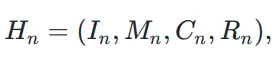
A continuous learning Harness requires simultaneous understanding of new tasks, accumulation of experience, formation and organizational execution capabilities. HCL therefore divides Harness into four classes of co-evolutionary states:
Task Interface: Analyze and standardize tasks to determine how the Agent understands input;
Experience Memory: Preserves interactive experiences and rules from which they can be abstracted and migrated;
Capability Map: managing external tools, perception models and internal reusable skills;
Adaptive Router: Select relevant memory and capabilities based on tasks and organize execution processes.
This is not the only rule for all Agent architectures, but rather a reference breakdown that covers common Harness functions. Its role is to clarify exactly what the HCL is learning from: when the base model stays frozen, the continuous change is in the systemic state that these jointly determine Agent behavior outside the model.
However, having the ability to continue learning does not necessarily mean that Harness evolves in a better direction.
What will be forgotten?
Because updates to Harness do not always lead to accumulation. These forgetting may stem from the evolutionary processes of the four components that have just been introduced, such as: new memory may interfere with the retrieval of old knowledge, skill modifications may disrupt the original legitimate tool calls, routing or workflow adjustments may also cause previously accomplished tasks to fail again. Even if the base model is completely frozen, a Harness update that helps the current task may still damage the reliability that the Agent already has.
These degradations, while occurring in different components of the Harness, ultimately affect the same core question: Will the agent be able to retain previously reliable behavior while gaining new capabilities?
The present article defines this degradation of existing reliable behavior caused by Harness updates as Harness-level Forgetting. It not only represents an old problem from right to wrong, but may also represent a tool to call a failure or an action trajectory that fails to accomplish its original goal. Formalisation, measurement and control of this forgetting is the core problem that HCL hopes to solve.
What updates are worth keeping for the long term?
Therefore, the key to Harness continuous learning is not to keep the system producing changes, but to build an evolutionary mechanism that can judge changes in value.
HCL proposes Guarded Harness Evolution, which separates hydrogen generating modified hydrogen from hydrogen deploying modified hydrogen, forming the Proposal hydrogen Evaluation hydrogen Commitment Closed Circuit. It seeks to prevent the system from falling into local remediation when updated: current problems are solved, but previously reliable behavior may not work.
Proposal: Candidates are proposed.
Continual Optimizer, based on current Harness, original interactions, execution results and feedback, is more likely to judge issues from interfaces, memory, capabilities, or routing, which correspond to the four types of Harness states in the preceding paragraph: Task Interface, Experience Memory, Capability Map, and Adaptive Router, and generate candidate modifications to the respective components. The current deployment status is:
 ) remain isolated and do not affect the actual system until the evaluation is completed.
Evaluation: Evaluation of the candidates.
Continual Evaluator examines candidates from three points of view:
1. Whether to improve the current mission;
2. Whether historically reliable behaviour is preserved;
3. Whether it meets the effectiveness requirements of output formats, tool calls and environmental actions.
Historical focus points are used only for evaluation and are not open to Optimizer to avoid adapting the candidate generation process to focus points. In a controlled experiment, the authors used a fixed scale (b) to regulate this constraint.
Commitment: Deciding to deploy.
Only candidates who meet the current improvement, historical maintenance and system effectiveness requirements at the same time are eligible to become the next version (); otherwise, the system continues to deploy the original ().
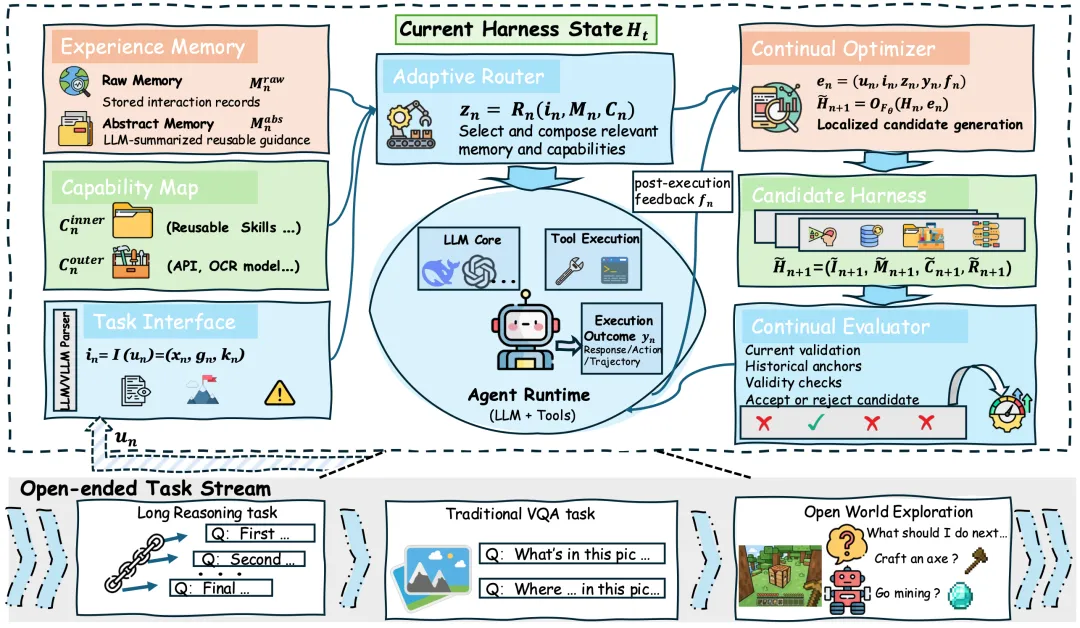
Figure 2 - The overall framework for Harness Continual Learning
03 Relationship between HCL and Traditional Continuing Learning
HCL continues the core goal of continuing learning: retaining existing capabilities while acquiring new capabilities, but extending this goal from model parameters to the experience, capabilities and execution strategies Harness carries out.
From a functional point of view, HCL will organize the multifaceted ideas that form in continuous learning over the long term into a single system: Experience Memory is responsible for preserving historical experiences; Abstract memory supports knowledge migration and capability replication with Capability Map; Continual Optimizer provides flexibility for new tasks; and Continual Evaluator protects already reliable behavior through historical constraints.
Experience recycling, knowledge migration, capacity expansion, optimization and stability control in traditional continuous learning are often distributed across different technological routes; HCL unifies these goals into a closed loop of continuous Harness evolution, allowing different mechanisms to work together to achieve new capabilities while maintaining the long-term goal of existing behaviour.
HCL, therefore, does not simply transfer some kind of continuous learning algorithm, but extends the basic idea of continuous learning further to the level of the Agent system, so that experience, capabilities and execution strategies beyond the model are also objects that need to be acquired, combined and protected in the continuous learning process.
04 Can HCL continue to gain access under the freeze model?
If Harness can indeed become a new object of continuous learning, the natural question is: can this evolution bring about an enhanced ability in real-world tasks, or can it control long-term forgetting?
This paper validates HCL in open-world interaction, text reasoning and multimodal perception tri-task flows, and uses different base models. In all experiments, model parameters are constantly frozen, so performance changes are entirely due to the continuous evolution of Harness.
At ALFWorld, the final average success rate for Static Harness was 47.12%, with Stability-HCL and Plasticity-HCL rising to 61.74% and 62.98%, respectively. Despite the closeness of the two final performances, the average neglect was 2.64 and 10.94 percentage points, indicating that different update constraints would result in significantly different historical losses.
The difference is more intuitive in Figure 3: In the longer, more complex Minecraft environment testing, Static Harness stopped advancing after the 15th mission, while HCL completed all 50 missions. HCL combined 83 environmental movements, down from 88 for MemRL and 91 for MemP, indicating that Harness evolution not only supports long-term mission advancement but also leads to higher execution efficiency.
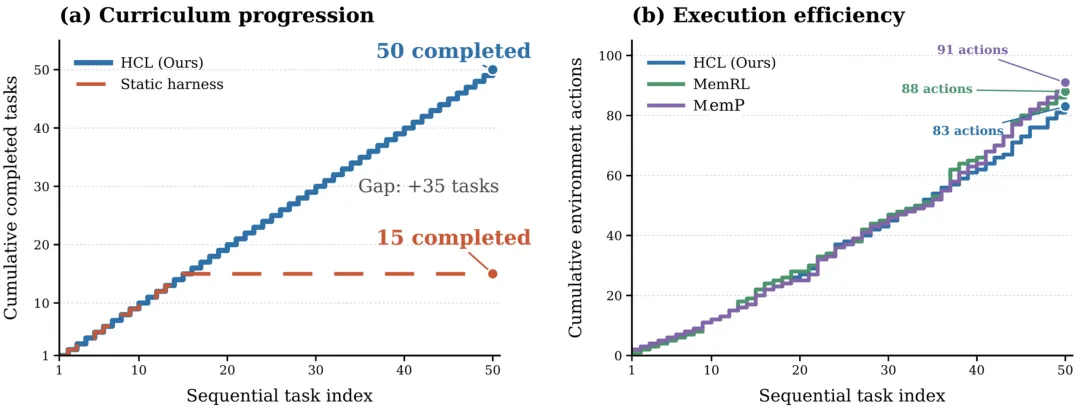
Figure 3 - Course progression and execution efficiency in Minecraft: HCL completes all 50 tasks, Static Harness stops at 15
In the text reasoning task stream, the final average performance of frozen DeepSeek-V4-Flash zero samples was 45.50%, with Plasticity-HCL upgrading it to 64.70%, and the average forgetfulness to only 0.07; of these, GSM8K was upgraded from 49.40% to 92.00%.
In the multi-mode perception mission stream, the final average performance of frozen Qwen 3.6-27B zero samples was 39.40%, the continuous multi-mission baseline DGG was 42.73%, and the Stability-HCL reached 68.92%, and the average forgetfulness was only 0.22 percentage points.
These results give two direct answers: even if the model parameters remain completely unchanged, Agent can continue to accumulate through Harness evolution; but different Harness update strategies can also lead to varying degrees of historical behavior degradation. The ability of HCL to study acquisition and forgetting thus becomes a systemic phenomenon that can be observed and quantified.
05 Stability and plasticity weights in HCL
As previous experiments have shown, Harness evolution brings with it both enhanced capabilities and historical losses. Thus, a natural question arises: how should the system choose between stability and plasticity?
To study this relationship, this article only changes the tolerance for historical loss b, with the remaining conditions remaining the same. As shown in Table 1, as constraints are gradually relaxed, forgetting continues to increase, and the final performance changes non-uniformly, with the best results occurring instead under moderate tolerance.

1 Explain the performance of historical loss tolerance. Forget the balance. Looser constraints increase the forgetting, but not necessarily improve the final performance.
Forgetting trajectories under the tolerance of different historical losses. More stringent historical constraints can generally suppress the forgetting of old tasks.
Figure 4 further shows how forgetting gradually accumulates along a sequence of tasks: Overall, more stringent historical constraints can continue to suppress performance degradation on older tasks. This result reveals a key phenomenon in Harness evolution: higher frequency updates do not mean better long-term outcomes.
Component melting also exhibits the same stability and plastical balance: the full HCL achieves the highest final average performance, while the freezing part of the Harness component, although sometimes reduced in forgetfulness, also limits the availability of new capabilities.
This result moves the question from how to modify Harness faster to how to choose a better long-term evolutionary trajectory. The value of an update cannot be determined only by its contribution to the current task, but also by how much memory, ability and selection space it retains for later learning.
06: Continuous learning leads to the Agent system
From the perspective of HCL, many of the problems that originally belonged to the design of the Agent system can also be reinterpreted as continuous learning problems, such as how to retain expanding historical behavior, how to attribute interference to different Harness components, and how to control the cost of evaluation and update in long-term evolution.
More importantly, HCL hopes to push the continuing learning community to reconsider a more fundamental question: where does continuing learning actually occur? As Agent's capabilities are increasingly distributed across the Prompt, Memory, Skill, Tool, Workflow and Router, continuing learning research subjects should no longer be limited to model parameters, but need to be further extended to support the entire system that the Agent operates in the long run.
As a result, continuing learning needs to answer three questions: what is being learned, what needs to be preserved, and how can current updates serve long-term learning?
HCL is attempting to integrate these issues into a unified framework that allows Harness evolution to formally define, measure and study the ability to access, maintain and forget behaviors, and provide a new research perspective for continuous learning from model-level learning to Agent system-level learning.