There is an unusual phenomenon in the body-smart industry:
While models are becoming more and more common, robots are not necessarily easier to access in factories.
A VLA model can see graphics, listen to instructions, understand the environment, and generate motion. But when it really gets to the production line, it has to re-identify how long the robot's arms are, how many joints it can rotate, how to grab things; and it has to re-adapt to materials, places, processes, and rhythms.
The more the model learns, the longer the distance from the factory may still be.
The group recently launched KUAVO-VLA 1.0, cutting through this neglected distance.

It did not continue to make models more general, but instead added a layer of industrial vertical models between the general base model and specific skills, first mastered the KUAVO robot, then absorbed the basic capabilities that repeatedly appear on the industrial scene, and finally learned new tasks for specific jobs.
The real cost of being physically intelligent is not to let a robot learn the first thing, but to let it learn without having to re-pay the tuition fee every time it switches a task.
01.
Every time robots change jobs, they're re-aware of themselves.
The most hidden cost of industrial robots is not necessarily hardware, but re-learning.
Sorting, moving, loading, and assembling seem to be four types of tasks, but after disassembly, they are repeated after identification, positioning, seizing, moving, placing. For people who have learned to seizure, one part only needs to be adapted to new materials.

This is an invisible gateway to the entry of VLAs into the industrial landscape.
The general model needs to cover more robots and scenarios, thus having a wider boundary of capability. But different robots have different operating spaces, laws of motion and controls. After the model enters a specific entity, it is still necessary to reestablish correspondence.
The second layer of complexity will be superimposed on the industrial scene. Parts change, jobs change, processes change, but the basic movements that robots repeat every day do not change. If each new skill needs to be re-exercised and upgraded, it is equivalent to every new recruitment in the factory, the ability to train again, the learning cycle grows, and the synthesis book continues to overlap.
The way to celebrate is by completing the basic functions of this part of the meal in advance.
KUAVO-VLA 1.0 uses 600+ hours of high-quality machine data, covering 100 industrial tasks such as sorting, transporting, loading, and assembly, and data from a single KUAVO configuration. The model can therefore continue to learn the same body's operating space and control laws while absorbing replicable operational capabilities from a large number of industrial tasks.
It's not just about teaching robots what to do, it's more like giving them a set of basic roles.
02.
General basic model university education courses, vertical model as a specialized curriculum curriculum
This is also where the vertical model is really interesting. The general base model pursues capacity breadth. It requires that any robot, any scenario can be understood. The vertical model pursues capacity replication. The focus is on what can be learned after entering a specific robot and industry.
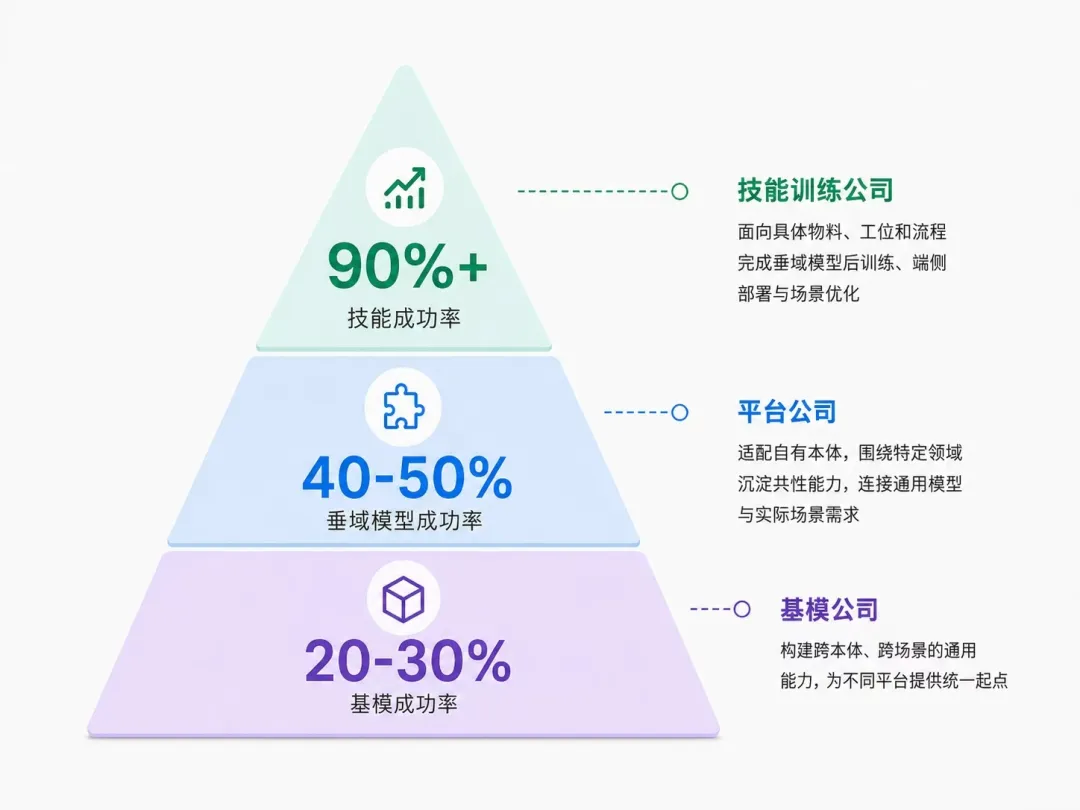
It can be understood as a system of education in which the basic model is responsible for comprehensive education, the vertical model is responsible for professional training and the skill model is responsible for upliftment.
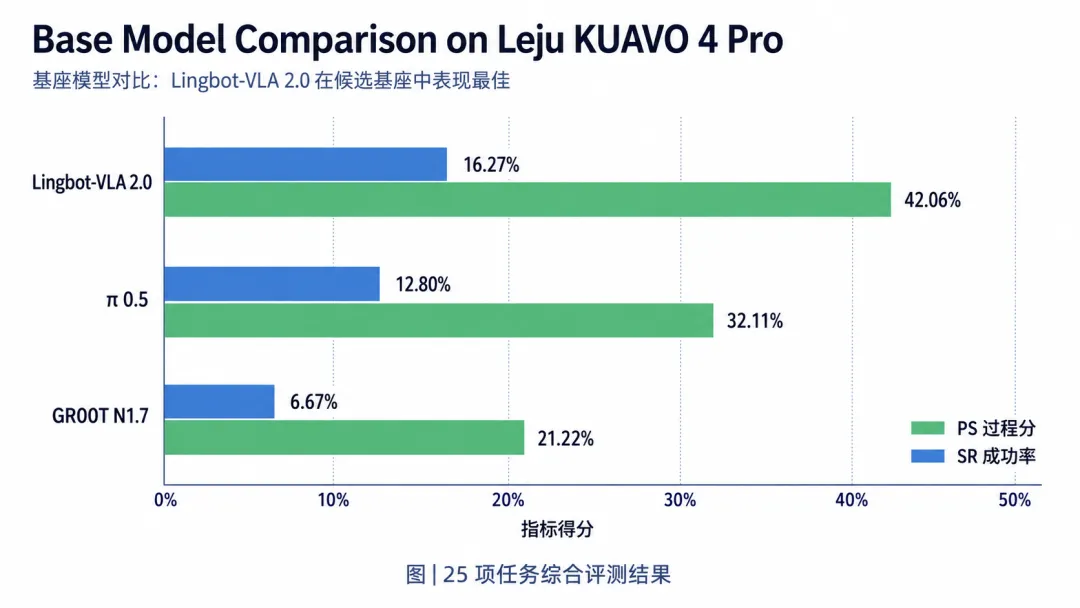
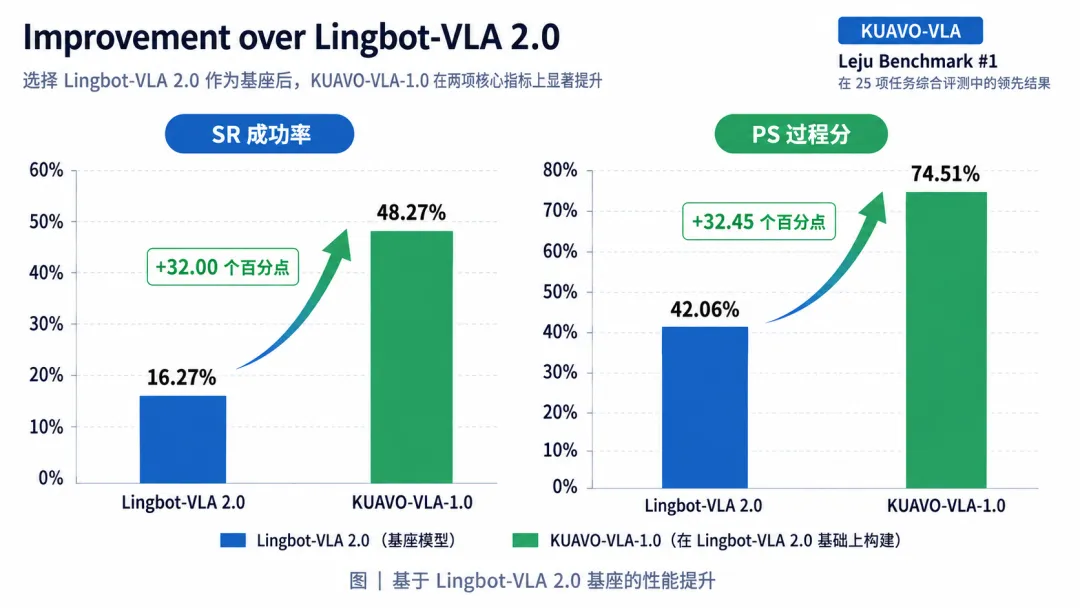
By benchmark comparison, LingBot-VLA 2.0 performed the best overall performance in the sensing model and was therefore chosen as the basis for the capabilities of KUAVO-VLA, providing a starting point for higher generic capabilities.
KUAVO-VLA 1.0 is based on the capabilities of Lingbot-VLA 2.0, followed by a second training with 600+ hours of KUAVO machine data.
The model first mastered the capabilities of the body and industrial communal operations, and the new task focused on learning the differences in materials, jobs and processes.
Thus, the chain of R&D with physical intelligence has also shifted from past modeling skills to modeling skills in the base modeling domain.
In this layer of multiplication, the compression is not a model parameter, it is essentially repetitive labor.
03.
In addition to 48.27%, what is really worth seeing is that development costs are being squeezed.
The performance of KUAVO-VLA 1.0 is remarkable enough if you look at the Benchmark alone. In 25 missions, it achieved an overall mission success rate of 48.27% and a process score of 74.51%, both of which ranked first. Compared to the test baseline of the Lingbot VLA 2.0 root network, the mission success rate was 16.27% and the process 42.06% respectively.
But for industrial customers, it's more interesting to see another set of numbers.
Developing a new industrial skill in the past often means going through a whole process again: collecting large amounts of data, retraining models, repeated on-site debugging, and then pulling robots back to the production line to verify. The entire cycle can be calculated on a monthly basis, and data volumes often require hundreds or even thousands.
The problem is not whether or not robotics is going to work, but if you learn a new skill, you have to re-pay your tuition.
This is exactly the bill that changed the vertical model.
In the past, the path was to make the general base model directly confront specific skills. The model had to be both re-adapted to the robot itself, and re-learn basic industrial operations before finally entering specific tasks.
It has now become: general base model → industrial vertical model → specific skills.
Physical capabilities and industrial commonality have been trained in advance, and new tasks only need to learn a portion of the changes that actually occur. If the development cycle of traditional paths is calculated in months, the path of a vertical model can be compressed to about a week; hundreds or even thousands of data are required, new tasks can be shortened to about 150, and the corresponding development costs can be reduced by more than three times.

More importantly, this compression has not reversed the effect.
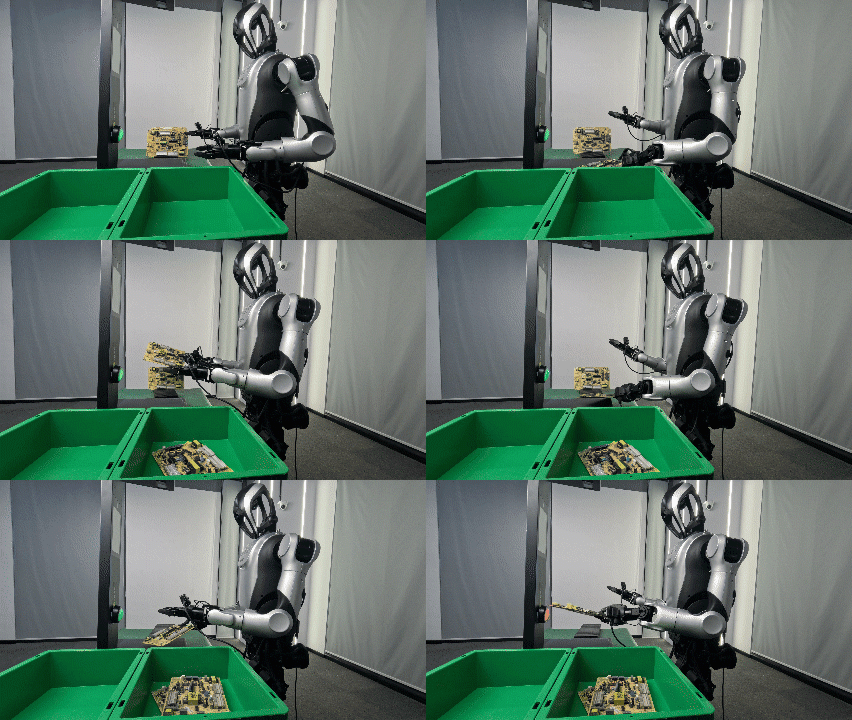
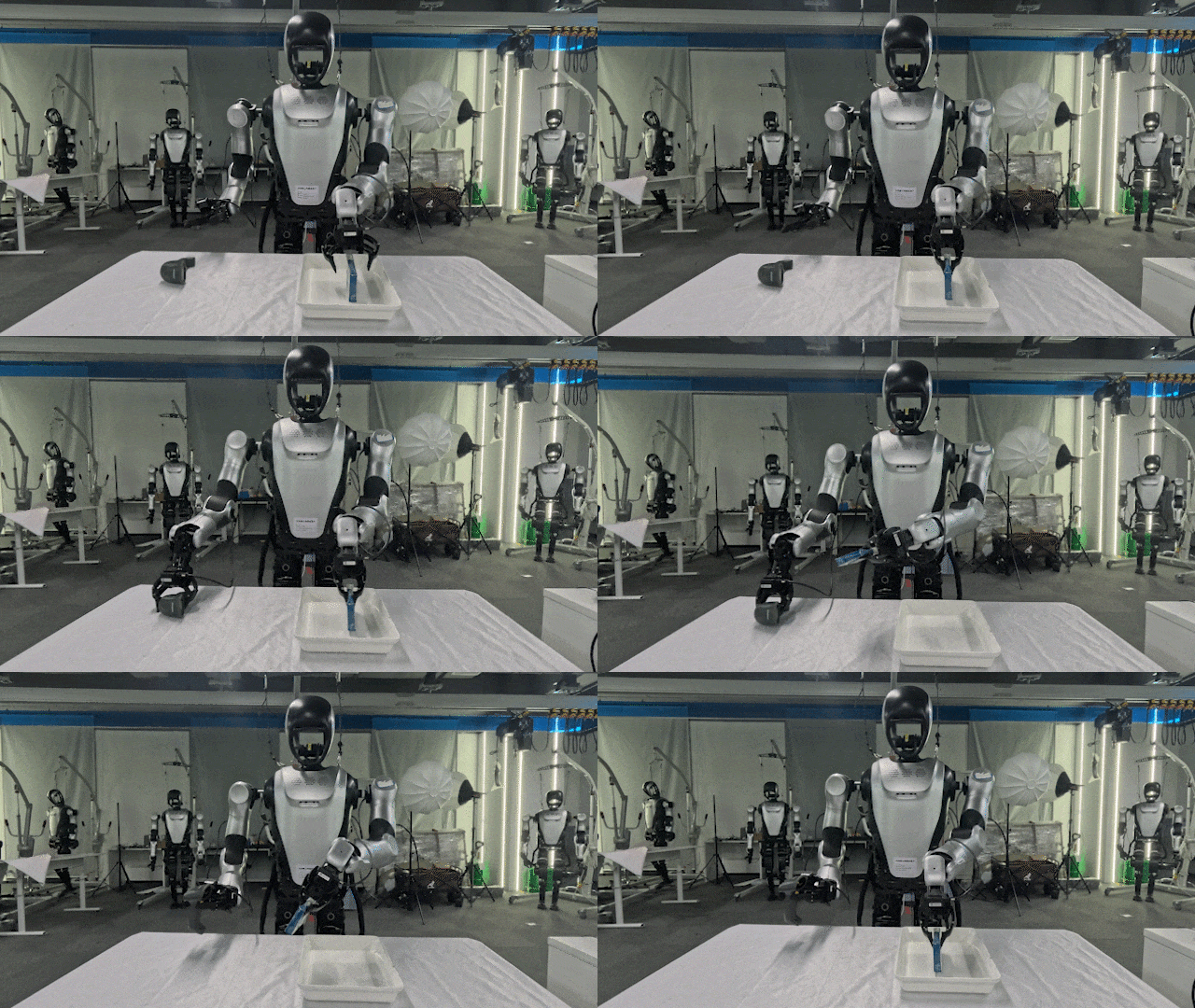
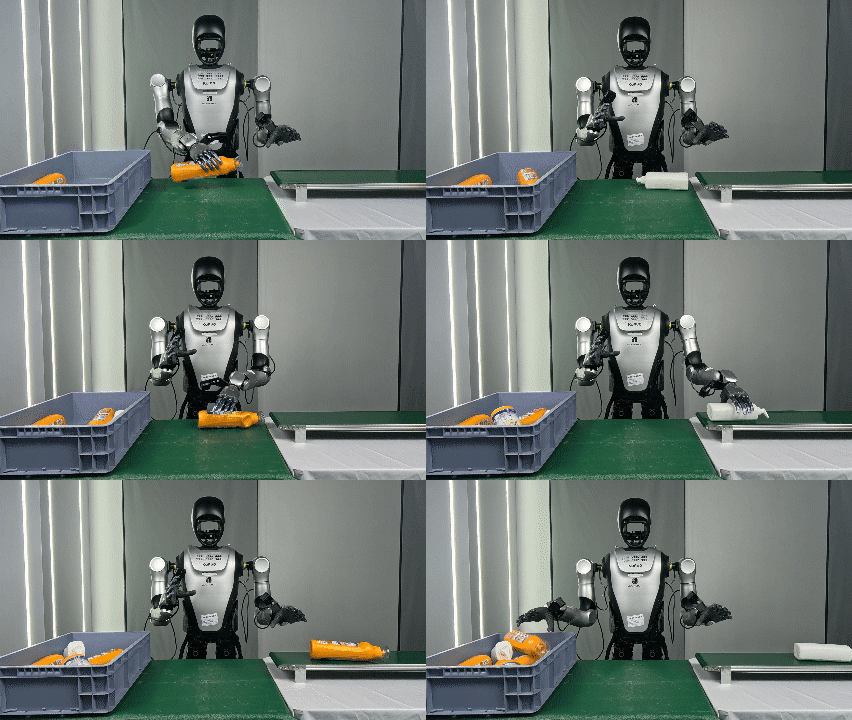
In specific tasks, the flow line switching sorting task used 5 hours of demonstration data after training adaptation, with a success rate of 80%; GM100's BM-45 snack sorting task used 150 demonstration data, with a success rate of 73.33%.

This is the kind of change that industry customers would really care about -- not just getting robots to learn a little bit more, but less time and less data to get the same results.
These two things seem to be just efficiency improvements, behind which is a change in model development logic.
In the past, each addition of a skill was like redrawing a robot on a white paper. Now, the white paper has become a map that completes most of the engineering work, with new tasks requiring only a small part of it to be modified.

For the laboratory, months and weeks may be just two numbers on the project progress table. For the factory, it's quite another matter. A skill is more like a custom project if it takes months to get online; if it can be adapted in a week or so, it can only begin to have the potential to be copied to more jobs.
The real scale-up of artificial intelligence is not to make a robot smarter, but to reduce the marginal cost of learning how to make a robot work.

04.
The next competition is the Efficiency War.
If an industrial skill is broken down, there are three levels: the lowest is the general base model, responsible for cross-robot, cross-scenario basic capabilities; the middle is the vertical model of the robotic platform, responsible for intrinsic adaptation and industrial commonality capabilities; the highest is the specific skills, to solve a certain material, a certain job, a certain set of processes.
In the past, it was easier to compare model capabilities, focusing on who had more data, who was bigger, who was more widespread. But after industrialization, it was really expensive to collect, train, and deploy the data behind each new task.
If each task is re-learned, the more robots sell, the higher the development costs.

If the capacity of the body and the capacity for industrial commonality have sunk, then every time a task is completed, the next time less is learned.
Eventually, a directional cycle was formed, mission landings→ real-machine data accumulation→ vertical capability enhancement→ new tasks coming online faster.
A robot that has done 100 industrial tasks and only three tasks, the hardware may be exactly the same, but the capacity density of the model is different.
This is perhaps the key to a truly scalable approach to physical intelligence - not to make a model do anything, but to make it learn one thing every time and be the starting point for the next.
In the end, the general model determines how far a robot can go, the vertical model determines how fast it can get into a factory; and skill training determines whether it can actually get started today.