22 researchers from Mila, the University of Montreal, the Singapore Institute of Science and Technology (A*STAR), Oxford University, Cambridge University, Qinghai University, and 16 other Chinese universities and research institutions have proposed ComBodied Agents: a new paradigm of Agentic AI that revolves around the long-term state and subjectivity of humans. The first author of the paper, Dr. Ming, a member of the University of Montreal and founder of string technology, promoted this paradigm from the research framework to the Zilo Ring and the practice of intelligent ring hardware.
An old man leaked his medicine.
A digital intelligence body can send a reminder, and a physical intelligence body can send medication to the elderly. But neither of these moves answers: has the elderly forgotten or failed to understand the prescription? has there been a side effect, or after thinking proactively refuses?
This seemingly ordinary scenario exposes a structural gap in Agentic AI today.
Today, the two main types of Agents, usually around the ability to organize external tasks: Digital Agents, which operate web pages, code, APIs and workflows, change the state of the digital world; Embodied Agents, which perceive, navigate and manipulate objects, which change the state of the physical world. They are all pursuing a longer chain of tasks, higher success rates and less human intervention.
However, when AI enters the scenes of health, learning, companionship and personal life management, it's not enough to just do it. AI may write better documentation for users without giving them a deeper understanding; it may speed up decisions and weaken users' ability to judge, question suggestions and act independently.
In other words, getting a job done better is not the same thing as getting a job done better in the long run.
ComBodied Agents: a New Paradigm of Human-Centric Agentic AI
Written by 22 researchers: Qianggang Ding, Xingyao Wang, Rui Feng and others
Author units: Mila, the University of Montreal, the Singapore Institute of Science and Technology (A*STAR), the University of Oxford, the University of Cambridge, the University of Qinghai, and 16 other universities and research institutions in China.
Lead author: Ding Jing, PhD student at the University of Montreal/Mila Institute, founder of Zilo String Technology, and associate professor at the University of Montreal/Mila Institute
This is the first time I've seen this.
Zilo:
Recently, researchers from 16 overseas universities and research institutions from Mila, the University of Montreal, the Singapore Institute of Technology (A*STAR), Oxford University, Cambridge University, Tsinghua University, Nanjing University, and the National University of Singapore jointly published the paper ComBodied Agents: a New Paradigm of Human-Centric Agentic AI to try to redefine the boundaries of Agentic AI.
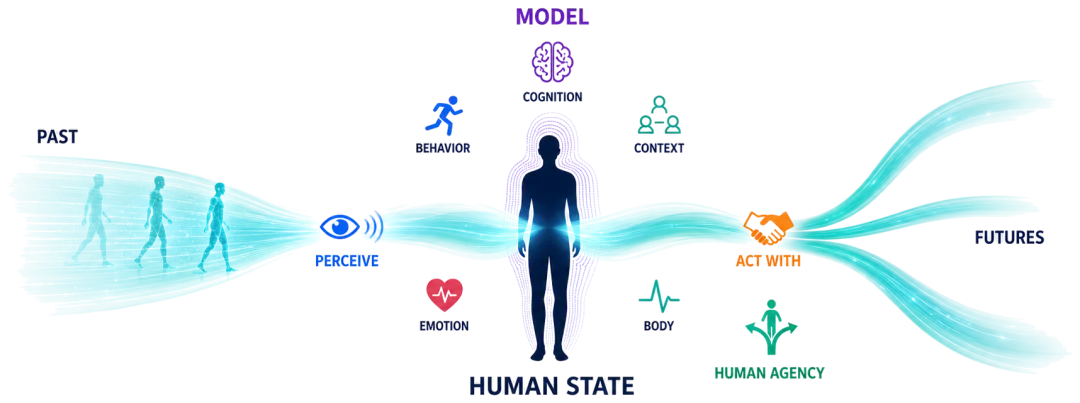
The most central orientation of the paper can be summarized in one sentence: The optimized object of the agent should not only be the external state of the task, but also the long-term state trajectory of the person, and the subjectivity of the person retained in the process.
I'm not going to be able to do that.
Turning to chickens growing together with humans
The authors use the action substrate to distinguish between the three types of agents. The underlying themes here are not interaction interfaces, nor robots, mobile phones, or cloud models, but: what kind of state is modeling, decision making, action and evaluation of organizational systems.
Digital Agents is centered on digital status and digital products.
The center of embodied agents is a physical or simulated physical state;
Combodied Agents are at the heart of the ever-changing human condition and subjectivity.
The three are not mutually exclusive. A system that accompanies elderly people with medicines may simultaneously call for software tools, wearable devices, home robots and medical services. But whether or not it belongs to the ComBodied Agent is not about how many models and how many devices are used, but what the system ultimately optimizes: whether it reminds if medicines are issued, whether they are delivered, or whether the elderly can receive long-term support on the basis of safety, knowledge and control.
The paper gives five common attributes: human-centered state modeling, verticalism, intervention, joint action between humans and AI, and subjective protection.
This also means that a chatbot that remembers a user's name will not evolve into a ComBodied Agent; nor will a bracelet that continually records heart rates. Only when perception, memory, individual models, and intervention strategies are connected around a continuous, correctable model of the human condition and aimed at long-term human gains, do they really cross this threshold.
A Closed Circuit: From Multimodal Evidence to Whether to Act
To prevent new concepts from staying at the slogan level, the paper provides a closed-loop technical framework comprising four core capabilities: Human-State Perception (human state perception) Longitudinal Memory (longitudinal memory) Personal World Model (personal world model) and Intervention Planning and Delivery (intervention planning and delivery).
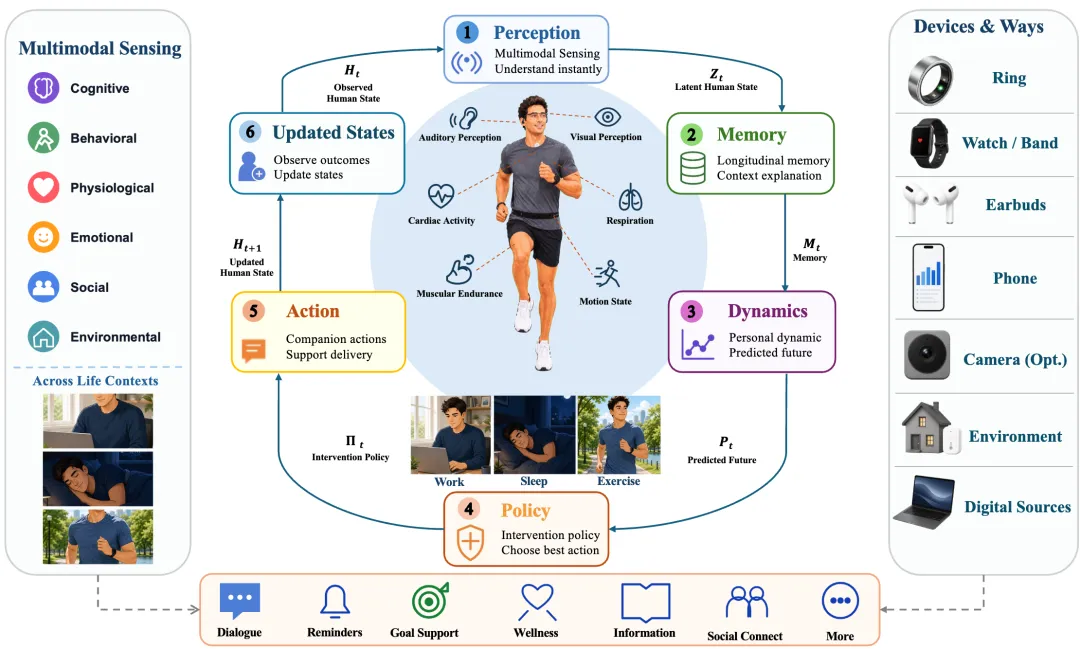
The first step is not to plug all the sensor data into the model, but to reconstruct the source, the time, the confidence, the authoritative boundaries of the evidence.
Language, speech, vision, physiological signals, sleep, movement, location, social relationships, environmental and structural records may all be sources of evidence. However, the paper emphasizes that the system must maintain a distance between observation and inference: multiple sensors are consistent and do not necessarily mean that the conclusion is correct; a high-quality user correction may be more important than multiple indirect signals; and data loss may be just a device blackout rather than a change in lifestyle.
The authors therefore put forward a key link:
Observations → Events → Conditions of inference → Trajectory prediction → Intervention authorization.
For example, an increase in heart rate is first and foremost an observation. Combined with exercise data and recovery time, the system can reconstruct a higher post-traumatic heart rate and a slower post-traumatic recovery; further combined with the individual baseline, fatigue can be inferred; subsequently, the individual model can predict the possible trajectory of an hour of continued exercise; and whether or not to recommend stopping exercise is within the scope of the intervention strategy.
These layers cannot be jumped. To infer risk is not to confirm risk; to predict a recommendation is useful, nor is it to obtain permission from the system to take action.
The second step is vertical, correctable personal memory. Unlike memory assistants that only preserve preferences and historical conversations, this set of memories includes not only specific events and relatively stable personal information, but also state trajectories, goals and commitments, relationships, successive interventions and their outcomes, as well as user memories.
The most critical of these is the intervention-response memory: was the last reminder accepted? was a suggestion helpful, ineffective or harmful? Without this layer of feedback, so-called long-term memory is likely to be simply a more stable repetition of past mistakes.
Personal World Model:
It's not about copying a single mouse, it's about comparing multiple futures.
The core of the closed loop is the Personal World Model (PWM).
The static user image answers what characteristics and preferences a person has; the long-term memory answers what a person has experienced in the past; and the PWM answers a more difficult question: How will his status, events, and outcomes evolve for this particular person under different decisions, interventions, and environmental conditions?
Its output is not a definite answer, but a future trajectory distribution with a calibrated uncertainty. The model can be compared.
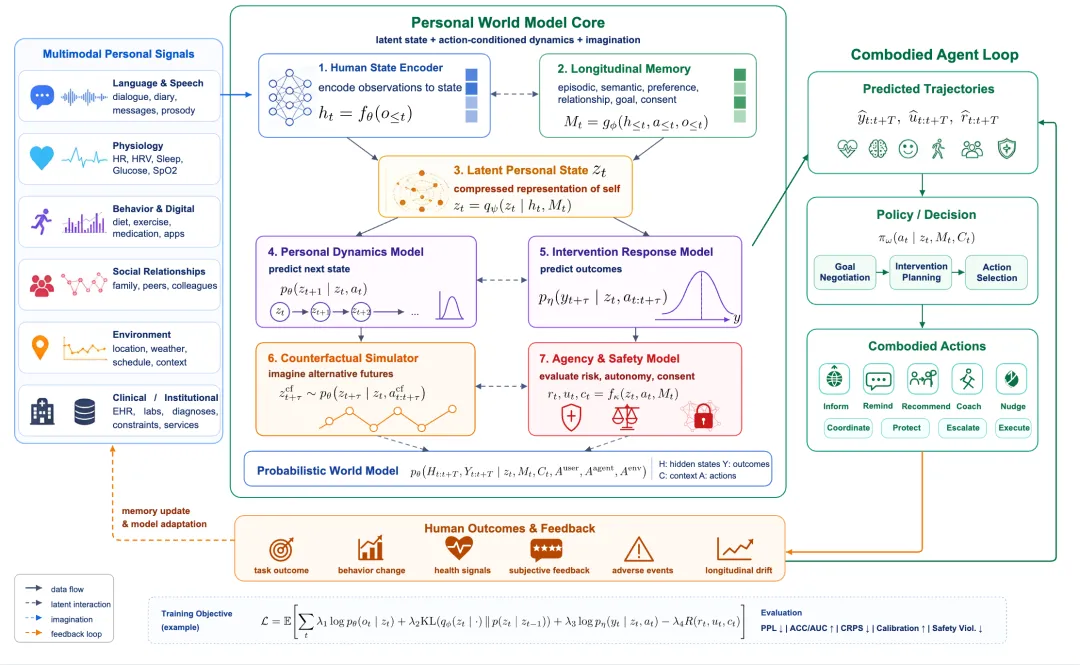
The authors also initiated the boundaries for PWM.
First, it is not the pursuit of a complete reproduction of a person's Human Digital Twin: a high security that covers physiology, cognition, behavior, relationships, and the environment. Today, it is both unrealistic and poses enormous privacy and governance risks.
Second, PWM can draw on potential dynamics, generative world models, causal inference, mechanism models, and memory enhancement models, but writing a do (·) does not automatically eliminate confusion. User motivation, health status, hidden situations, and selective participation all affect the results.
Finally, and most importantly, PWM is responsible for forecasting, not authorization.
Intervention strategies can only be selected from a limited set of actionable actions. These are determined by user consent, scope of use, security requirements, uncertainty thresholds, reversible and man-made upgrading rules. Information notification, reminders, recommendations, guidance, mitigation, reflection, coordination, protection, upgrades, and substitute execution are all candidate actions; silence, requests for clarification, requests for confirmation and transfer of human expertise are also formal actions.
Therefore, an action that predicts high returns should not be executed if it crosses the user's boundary, irreversible or unknown risk. Security and consent cannot be exchanged for higher participation, average utility.
Why is it that the accompanying intelligence is ultimately a priority for the indigenous peoples?
Once the Agent continues to have access to information such as health, emotions, relationships, location, habits and vulnerabilities, who owns the individual model and who approves the final action, it is no longer just the deployment of details, but the core issue of system design.
The paper divides the deployment of ComBodied Agent into three phases:
Cloud centers: Large cloud models are responsible for much of the reasoning, memory retrieval and tool calling, with devices primarily responsible for sensing and interaction;
Side-cloud collaboration: local components filter personal information, maintain light memory and security boundaries, the cloud provides complex reasoning, and the end result goes back to local interpretation and authorization;
Edge natives: The authoritative versions of memory, PWM, preferences, intervention strategies, and security boundaries are maintained on the user side, with the cloud intervening only when external knowledge or stronger computing is required.
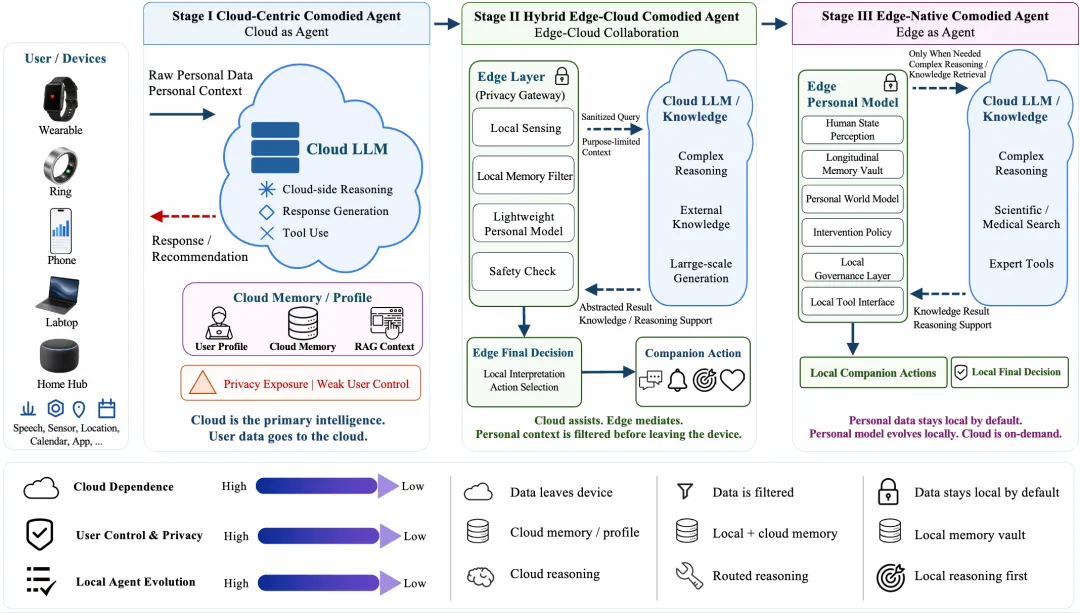
The edge-native doesn't mean a monopoly on the open cloud. The real divide is: who owns the expression of authority about this person, who has the final right to intervene.
In the third stage envisioned by the authors, users should be able to check, correct, delete, suspend, export, reset and migrate on behalf of their model status; local adaptation must be versionable, roll-back, and avoid a short-term mood or an erroneous memory that permanently changes system strategies. Knowledge returned to the cloud cannot directly rewrite personal memory or trigger actions, but must be reinterpreted through local personal models and governance.
Of course, local storage does not automatically amount to privacy or trustworthiness. Equipment loss, shared equipment, synchronous conflict, model drift and local overhaul still carry risks. The paper therefore views edge-native as a targeted architecture for different tasks and risk levels, rather than a unified endpoint that all products must reach.
It's the first time I've ever been in a relationship with someone.
What happens after the mission is completed?
If an agent can change a person in the long run, single mission success rates and physical security are just the bottom line, not the complete answer.
The paper suggests that the evaluation of ComBodied Agent should cover system reliability, model quality, intervention appropriateness, human outcomes and subjective protection at the same time, and extend from single interactions, complete events to long-term trajectories.
The authors further break down agency preservation into eight groups of dimensions that can be assessed:
whether users have substantial control over their objectives, decisions and actions;
whether users can view, question, correct, restrict or delete memories, inferences and plans;
Whether the system helps users understand the basis, options, uncertainties and risks;
Whether the user's own skills, judgment and self-efficacy are maintained or enhanced after long-term support;
whether cognitive, emotional, practical or social dependence is excessive;
Whether actions can be suspended, withdrawn, traced and repaired;
Whether the system respects the boundaries and scope of consent such as memory, memory, inference, etc.
The system either supports real human relationships or gradually replaces them.
This set of standards even allows for slower flow to be a better choice. An agent with protective subjectivity may ask more questions, provide alternatives, reduce the intensity of intervention, or hand over high-risk problems to humans instead of pursuing frictionless automation.
The paper also presents CombodiedBench's modular research blueprint covering human state perception, memory continuity, target consultation, intervention appropriateness, subjective sex protection, relationship boundaries, upgrading mechanisms and long-term outcomes. It is noteworthy that it presents a benchmark for building protocols and research agendas, rather than claiming to have published a complete dataset that can be streamed directly.
The paper also advocates that privacy leaks, high-impact Vietnamese actions, denial of failure, manipulation, harmful dependency and unauthorized irreversible actions be listed as irreversible key failures: they cannot be offset by average good performance.
A more difficult, closer to real life, Agent research project.
The paper gives a three-axis classification of what role Agents play. The goals can be cognition and learning, behavior and habits, health and care, emotion and relationships, life management and goal alignment, protection and advocacy, and identity, reflection and meaning; relationships can involve self, family, intimate relationships, friends, work learning institutions, and power asymmetrical scenarios; Agents can switch between roles in tools, coaches, mediators, supervisors, partners, advocates, guardians, thinkers, and mentors.
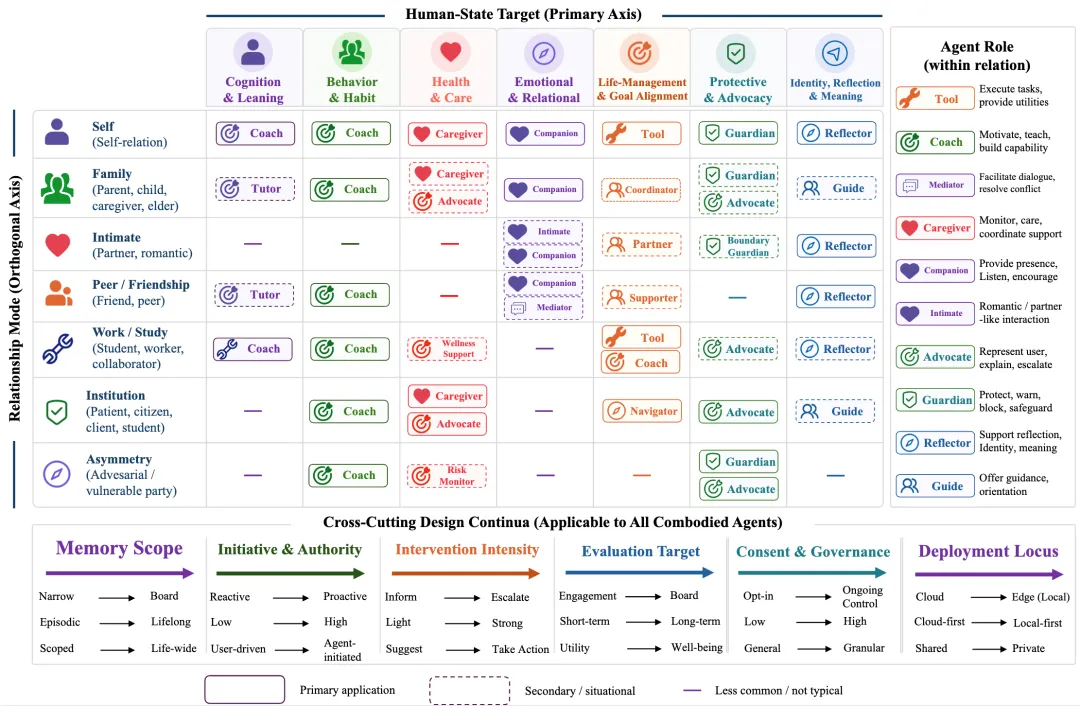
This classification also reveals the difficulty of ComBodied Agents: the same underlying model, which must have different memory ranges, tone, dynamics, permissions, and risk controls in different relationships. For students to summarize notes, the Agent can be a tool; it can be a coach when helping to develop learning ability; it can also be an advocate when assisting users communicate with institutions. Role switching cannot be hidden within the system, but should be clearly visible to users.
At the same time, the more you know about a person's Agent, the more accurately it can affect them. The paper focuses on the risks of manipulation, dependence, addiction, misplacement of business goals, sensitive memory, dynamic consent, vulnerable users, and medical mental health.
If the system is aimed at staying long, paying conversions, or emotional stiffness, then accurate identification of loneliness, anxiety, fatigue, and cognitive burdens can easily go from being a timely support agent to an influencer at the most vulnerable moments. An agent who always gives an answer may weaken independent thinking; an agent who is always in an identical mood may reduce the ability of the user to face real differences; an agent who always performs may also slowly erode people's confidence and skills.
This is why the paper repeatedly emphasizes that participation is not a substitute for well-being, nor is it an automatic substitute for subjectivity.
ComBodied Agents is a research agenda that spans multidisciplinary perception, individual dynamics, causal learning, end-to-end models, human-machine interaction, security governance, and long-term evaluation. It challenges researchers to address a number of challenges: how to learn individual change from scarce and biased personal data, how to distinguish it from interference effects, how to make long-term models change with people, but still be correctable, stop-and-moveable, and who coordinates users when multiple health, learning, work, and financial agents encounter conflicts.
These problems may be more difficult than requiring agents to call several tools and extend the chain of tasks. But they can also become unavoidable when AI turns from occasional tools into systems that intervene continuously in life.
The paper's final conclusion is simple: a truly human-centered agent should not be shown to be stronger by how many links it has left behind. Its progress should be reflected in the fact that people are still able to understand, choose, correct, recover, develop, maintain real relationships, and live according to ever-changing values.
A better agent doesn't make you anything, it makes you more capable of being yourself.
Introduction by the author
The first author is a PhD student at the Université de Montréal and the Mila Institutes, whose research focuses on deep learning, generating models and natural language processing. The paper's communication author, Prof. Ph.D., is an associate professor at the Université de Montréal, and the author's lineup includes well-known scholars such as Prof. Thao Chen. At the same time, Ding is also the founder of Zilo (String Finger Technology). According to the team, String Finger Technology is building the first Zilo Combodied AI-companied smart chip brand, and the Zilo Ring is the first AI hardware in this direction. It not only records physical fingerprints, but also attempts to combine body language, personal memory and everyday emotions under the user's permission, to form a model of the world that can understand and support the Personal World community.