The most valuable time for scientists, which should have been spent asking bolder questions, understanding deeper mechanisms, and making more important discoveries, is often spent searching, organizing, verifying, reproducing, and communicating.
Today, Shenzhen Technology officially released the Boolean Science Space (public test version), which provides a unified desktop work environment for researchers and AI scientists to complete their research tasks together. It connects local to cloud scientific data, computing and experimental resources, and will integrate AI scientists from different disciplines into the scientific research process.
Researchers, all they need to do is ask questions and confirm.
1. Starting from scientific questions
Implementing the entire process of research missions
1.1 Research phase: not only gathering information, but also providing high-quality judgments, and a starting point for executable hypotheses
In the face of a new research topic, the hardest thing is not to search for more papers, but to find out from the vast amount of information: which have become consensus? which are still controversial? where no one has yet answered?
In the Bohr scientific space, researchers can present research questions through dialogue. The Bohr scientific space's all-scientific research expert, Liu SciMaster, revolves around research questions, automatically retrieves literature and patents, understands the text, graphs, molecules and formulas in the paper, and forms structured research results.

On this basis, the system further refines the study of consensus, contradictions and gaps to help researchers come up with valid and verifiable research assumptions.
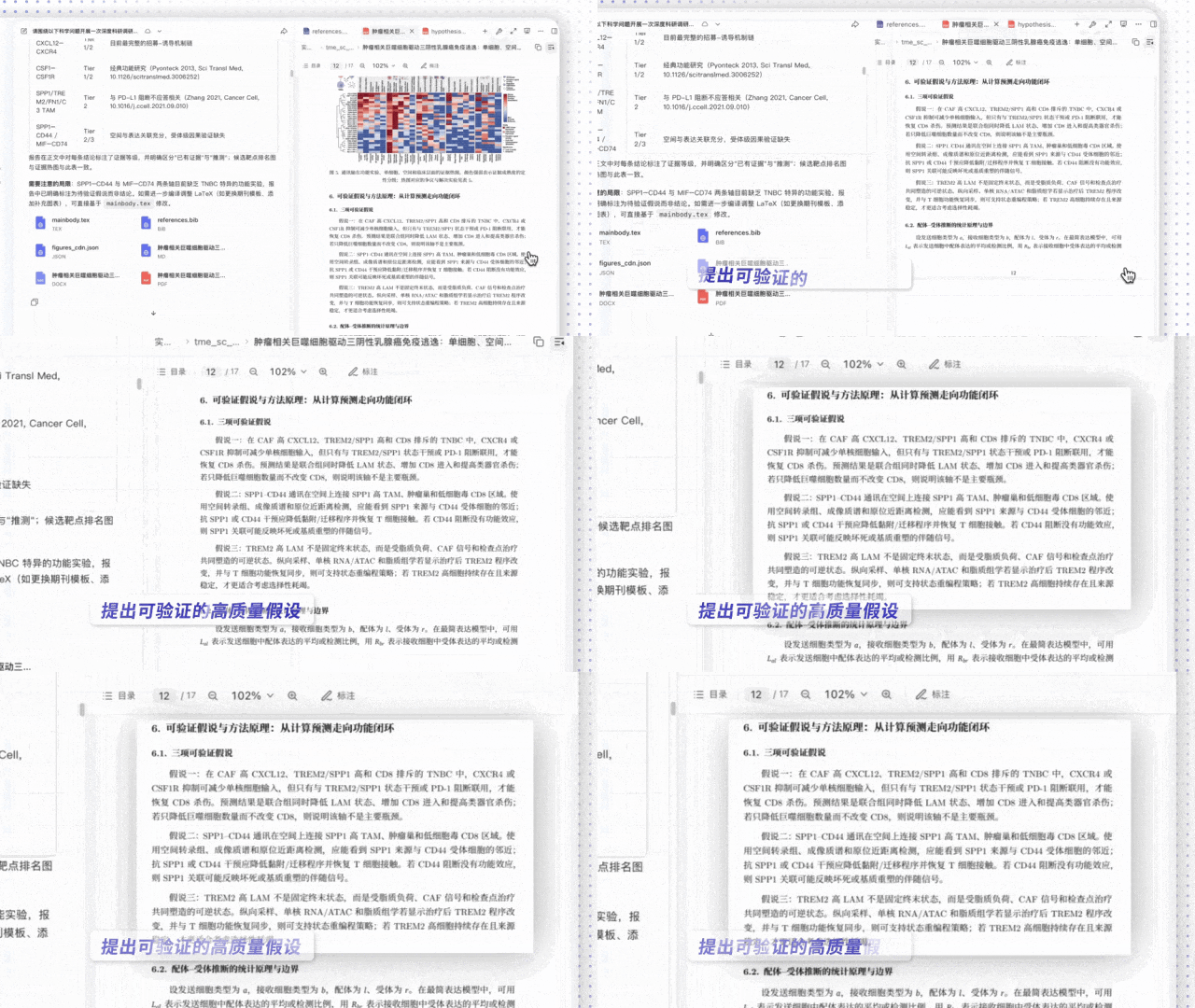
When a hypothesis has advancing value, AI scientists can also combine existing research, available data and experimental conditions to generate executable experimental design schemes, clarify the study of variables, technical routes, critical steps, and how to determine outcomes.

As a result, scientific research is no longer confined to the collection of information, but is the starting point for high-quality judgments and subsequent scientific research activities.
1.2 Research execution phase: Assuming that the discussion does not stop, the click is verifiable
From hypothesis to verification, the real time-consuming process is often just beginning.
Researchers not only need to select the right models and methods, but also to complete data acquisition, software installation, environmental configuration, parameter setting, task running, fault handling and result analysis. Failed, they also need to replace a set of parameters.
In the Bohr scientific space, AI scientists can automatically dismantle tasks based on their research goals, call on corresponding data, models, software and computational resources, perform computations, simulations and data analysis, and check results at key nodes.
Researchers can continue to make demands for the next step around scientific issues without having to switch back and forth between multiple tools and working environments.
In areas such as biology, medicine, pharmaceutical research and materials science, Boolean Science Space has built-in AI experts such as BioMaster, PharmMaster, MatMaster to support different types of real-world research tasks.
Researchers are only responsible for asking questions, and AI scientists run the verification.
BioMaster: Making biomedical analysis process executable, traceable and reusable
Bioinformatics research often requires constant switching between papers, public databases, code repositories, and analytical software. The real time-consuming thing is not just running the code, but finding the right data, restoring analytical methods, processing version dependencies, verifying parameters, and judging whether the results are credible to biological significance.
The three typical tasks are as follows:
Paper Reproduction Analysis: BioMaster can understand paper methods, associate public data such as GEO with author codes, complete data acquisition, environmental execution, code debugging and result verification, and convert public papers into research assets that can be actually run and continue to be used.

Single-cell data analysis: analyzes processes and scientific mappings around the same scientific problem organizing data processing, RNA velocity, preserving pre-order results, and supporting researchers to continue with additional analysis based on the results.

Genetic variation interpretation: around genetic variations such as TP53, across data sources such as ClinVar, UniProt, PDB, AlphaFold, complete entity alignment, evidence verification, statistical analysis and visualization to form structured results with source and evidence levels.

BioMaster will organize decentralized data queries and computational steps into verifiable analytical links, enabling researchers to devote more effort to judging outcomes, understanding mechanisms, and designing next steps in research.
PharmMaster: R&D links from focal point research to molecular design
Pharmaceutical research involves a number of areas, such as focus-point research and logic, patent patterns, mechanisms of action, efficacy relationships, structural analysis, molecular design and pharmaceutical evaluation. The information, models and tools required for each area are different, and research conclusions need to be passed on continuously between upstream and downstream tasks.
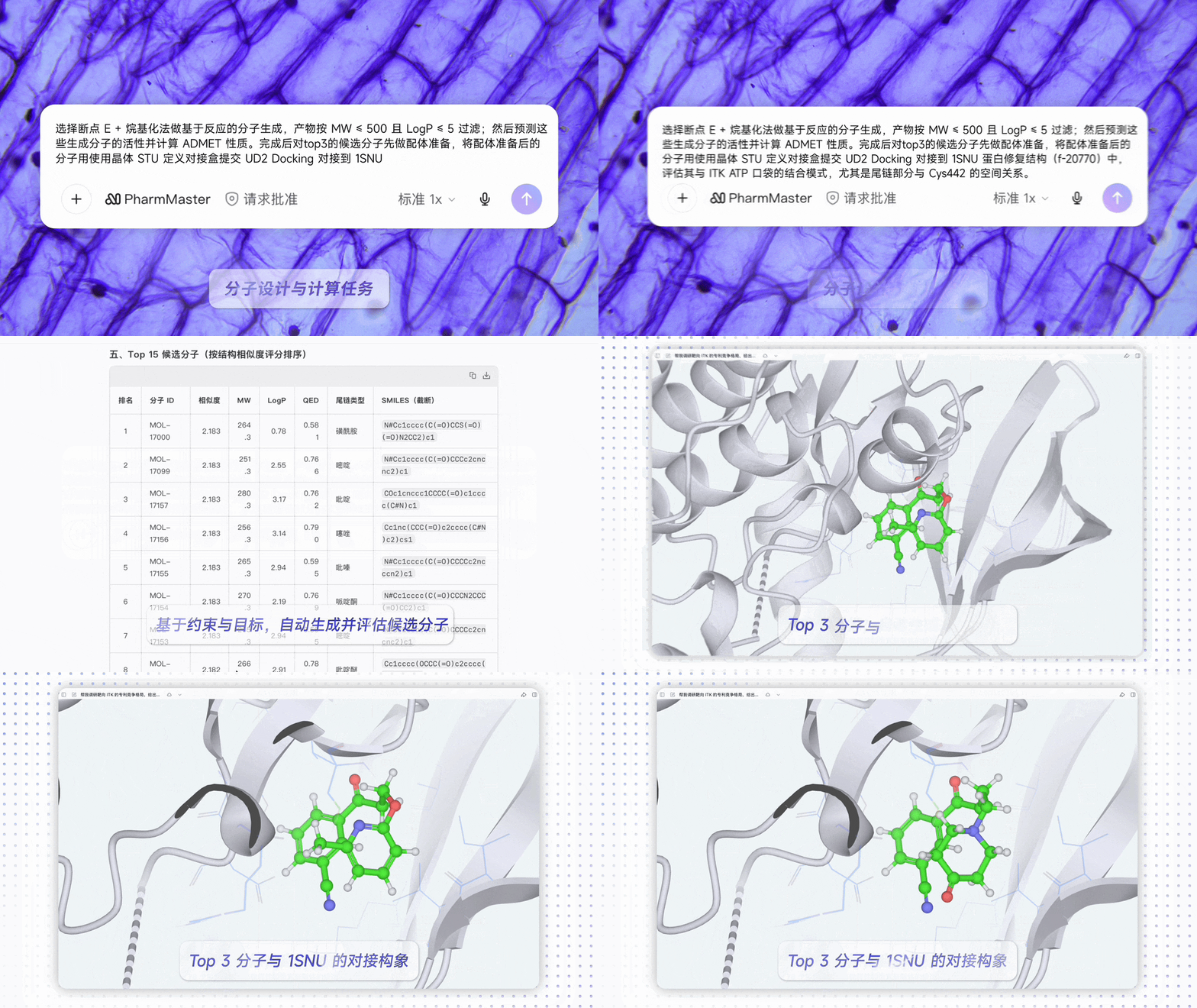
As an example of the metrics and development of ITK focus-point inhibitors, PharmMaster can gather extensive data around research objectives, accurately implement patent and competitive pattern analysis, accelerate metrics research and decision-making; complete SAR analysis interpretations through molecular identification and contextual correlation; automatically initiate computational tasks, complete start-point molecular screening, and further carry out crystalline structure analysis, reverse synthesis breakdown, new molecular recommendations, and activities with ADMET qualitative assessments; and provide researchers with comprehensive intelligence support in molecular discovery and optimization processes.
The different steps are no longer a combination of one-point tasks and complex tools that intersect each other, but are driven by the same research objectives and a continuous flow of R&D work. Researchers can examine the basis and results of each step and adjust the design direction accordingly to optimize candidates for the next round.
MatMaster
Design and simulation of organizational materials based on performance objectives
Material research needs to link documentary evidence, structural design, performance prediction, and mechanical verification. For example, in high-temperature intermediate electrophoresis, researchers need to systematically analyze related systems, understand structure and performance relationships, and verify the stability and mechanism of action of candidate materials using methods such as DFT, molecular dynamics, and others.
Researchers can describe the target performance, working temperature and material constraints in the Boolean space. The MatMaster thus completes field research, designs candidate systems, calculates simulation and results analysis, and gives further experimental verifiable material directions and bases.

From the search for a material pump that meets the requirements, we move further to which systems of pumps are worthy of priority verification and why.
1.3 Output phase: Written reliably, reviewed to be credible
After completing the study, there is a final link:
How can the results be written clearly? Is the citation reliable? Is the data consistent with the conclusions? Is the evidence stable in the face of the reviewer's questioning?
In the Bol Science space, writing assistants can assist researchers in developing ideas, organizing paper structures, rigorous wording, and producing content that can be further edited, such as LaTeX, based on research data and analysis.

Writing based on existing research data
The review assistant verifies the paper's logic, reference sources, chart data and supporting material, suggesting further confirmation or reinforcement of the position.
The results of research are based on the scientific knowledge accumulated all over the world and need to be re-introduced into the human knowledge system to be tested, discussed and verified.
By writing and reviewing the workflow, Bohr Space helps researchers translate computational and experimental results into structured, evidence-based, and continuing professional reviews of scientific results.
2. Why is AI capable of performing real scientific research tasks in Bol scientific space?
For AI to truly enter the scientific research process, the key is not merely to increase model parameters or conversational capabilities, but to provide it with a complete environment for understanding science, organizing tasks, calling tools and accepting validation.
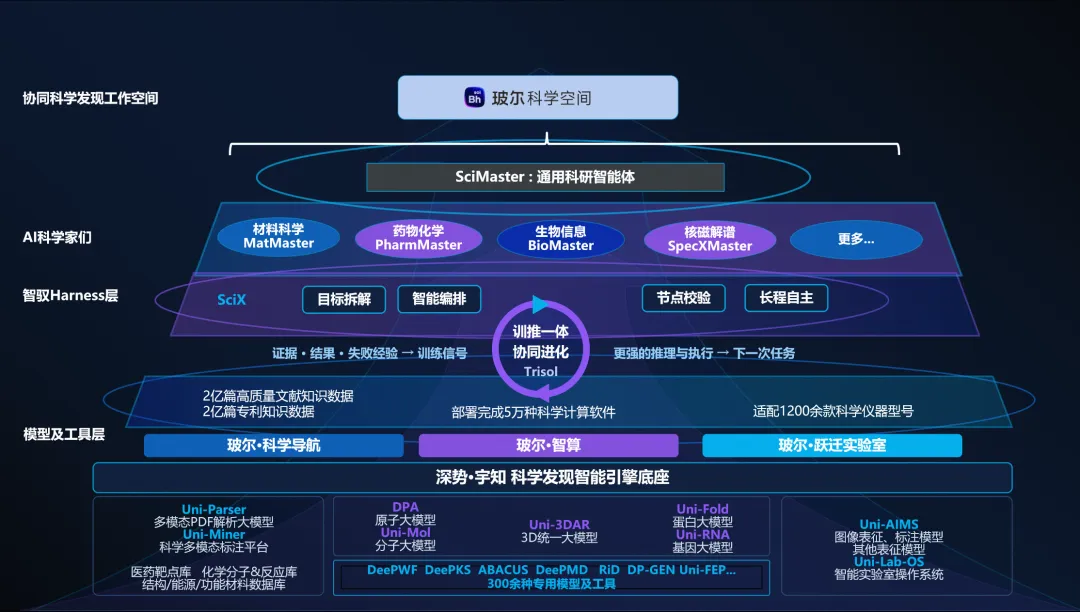
Scalable elements of science: connecting knowledge, computing and experimental resources
Science Navigator connects more than 200 million documents and patents, enabling AI to retrieve evidence from continuously updated scientific knowledge; deploys more than 50,000 classical scientific computing tools, deploys deployments of deployments of deployments of deployments of deployments of deployments of deployments of deployments of deployments of deployments of deployments of deployments of deployments of deployments of deployments of deployments of deployments of deployments of deployments of deployments of deployments of deployments of deployments of deployments of deployments of deployments of deployments of deployments of deployments of deployments of deployments of deployments of deployments of deployments of deployments of deployments of deployments of deployments of deployments of deployments of deployments of deployments of deployments of deployments of deployments of deployments of deployments of deployments of deployments of deployments of deployments of deployments of deployments of deployments of deployments of deployments of deployments of deployments of deployments of deployments of deployments of deployments of more than 50,000 classical to deployments of deployments of deployments of deployments of deployments of deployments of deployments of deployments of deployments of deployments of deployments of deployments of deployments of deployments of deployments of deployments of deployments of deployments of deployments of deployments of deployments of deployments of deployments of deployments of deployments of deployments of deployments of deployments of deployments of deploym
These rich, Agent-ready elements provide the foundation for real AI research tasks.
Multimodal knowledge understanding and organization: accurate extraction of evidence, mastery of knowledge relations systems
Uni-Parser is able to efficiently process multimodal scientific information such as papers, charts, molecular structures, formulas, tables, and experimental records. It has a resolution accuracy of more than 98% for text, mathematical formulas, and structured content in three types of tables. At the same time, the system is able to effectively identify complex visual information such as charts, process charts, molecular and chemical reactions, to achieve the unification of decentralized data, traceability and machine-readable conversion.
Scientific navigation and the big-knowledge model LKM further organize the physical relationship between literature, patents, data and research records, sources of evidence, and research connections to enable AI to understand consensus, critical differences, and research gaps around a scientific problem.
Intelligent organization and long-range execution: strong planning and high error rate SciX frameworks
The SciX smart body framework breaks down research objectives into executable steps, coordinates knowledge, models, software, computing and experimental resources, and checks and calibrations at key nodes; is able to automatically diagnose and correct during task-phase constraints, has extremely high task capacity. The Sandbox provides a batch, isolate, and recoverable operating environment for tasks, and supports scheduling between asymmetric computing resources, with a 98.8% success rate of creation in a cumulative start-up window of about 185,000 statistical portals.
As a result, AI is able to go from a research conversation to a complete scientific workflow, continuously performing research, hypothesized projections, computational simulations, results analysis and output.
Synchronous evolution: tools, intelligences and humans evolving in response to real-world missions
Every retrieval, reading, computational call and experiment execution constitutes the process of dealing with current problems; scientists' corrections, computational results, experimental data and failures together constitute the backbone of scientific training, providing long-term nutrients for the accumulation and training of tools, intelligent agents and human experience to provide important feedback for the subsequent better completion of scientific tasks.
As more processes are executed, tested and replicated, verified methods can be embedded in replicable capabilities and workflows, with the help of EvoMaster's self-learning and self-evolution mechanisms, the platform will also become increasingly knowledgeable, helping research organizations to fully integrate task experience into the entire work system, reducing repetitive configuring and repetitive testing errors.
We will continue to see more progress in technological achievements beyond the Boolean scientific space in the near future.
3. Addressing researchers as well as research organizations
The Boll Science Space can serve both as a unified workstation for researchers to call on knowledge, data and tools, and as a collaborative environment for research teams to organize AI scientists, recycling research processes, and immersive scientific research experiences.
For researchers, it reduces the time spent on cross-database retrieval, environmental configuration, tool switching, and result sorting, making the research process more science-driven than tool-driven.
For subject groups and R&D teams, it helps to create a traceable record of critical methods, parameters, processes, and outcomes, enabling verified analytical processes to be checked, reused, and iterated.
For research institutions and corporate R&D organizations, it provides a unified environment for connecting internal data, computing resources, professional tools and field experiences, supporting collaboration between human and AI scientists in real-world tasks.
4. Bol 107 Project: Finding the most valuable scientific problems in the AI era
As the efficiency of scientific research increases, a more fundamental question becomes increasingly important: When more research processes can be done with AI assistance, which scientific problems deserve to be explored as a priority?
Based on this, Deep Power Technologies is launching the Hubble 107 project, which aims to engage global researchers in issues of significant scientific value and exploratory potential, and rely on the ability of Hubble scientists and AI scientists to provide scientific support for the selection of questions ranging from scientific research, hypothesis projections, computational simulations to verification of results, and to advance valuable scientific questions from proposing to ongoing exploration.
Shenzhen wants to unite global researchers to continue discovering important issues worth investing in in the long term, and to explore new avenues for scientific discovery in collaboration with human scientists and AI scientists.
Making important problems visible, validating valuable ideas, and involving AI scientists in solving scientific problems that are truly worth solving.
5. Giving scientists time to return to scientific creation
AI scientists who are able to continue to carry out scientific research missions are developing rapidly. Future scientific discoveries will also include deeper collaboration between human scientists and AI scientists.
The curiosity, judgment and creativity of human scientists will not be replaced by AI. AI is better suited to carry out the arduous, repetitive but essential tasks, giving more time to scientists to ask more important questions, understand deeper mechanisms, and explore unexplained phenomena.
Let every piece of evidence not be overlooked, let every idea have a chance to be verified, let every exploration be closer to discovery.
Bohr Science Space is committed to creating a scientific environment in which human scientists and AI scientists work together to create a space for scientific research to continuously think, act, verify and evolve.