The end-to-end strategy model fails frequently in the physical world, and the researchers turn to Big Model Intelligences + Tools to call for self-help, trying to continue learning in the dynamic physical world. However, this online learning path in the physical world has not really gone through. The challenge is that, as the real physical environment changes rapidly, existing physical intelligences can only reconstruct entire trajectories after missions fail, making it difficult to correct errors and learn in real-time on-site, based on state changes.
In conjunction with Zetta ζ, which was developed by critics with high-frequency execution, China AIR launched online learning of closed-loop physical intelligences: robots no longer simply succinctly fail, but continuously observe the environment during execution, trigger recovery, and immerse the rollout experience into reusable skills.
Experiments have shown that Zetta ζ's mission success rate will continue to improve as the exploration experience continues, with LIBERO PRO and RoboCasa achieving 90.8% and 93.6% respectively under limited rollout budgets, well above other methods. More surprisingly, researchers have captured the robot's Aha Moment cube, which gives researchers a fresh start in physical intelligence scaling intelligence.
Project information
Project name: Zetta ζ
Publisher: China AIR, domain switching Z-Trans
Zetta ζ: An Efficient Closed Loop Embodied Harness for Self-Evolving Physical Intelligence
The main page of the project:https://AIR-embodied-brain.github.io/zetta/
01 A common robot failure scene
Imagine a very daily robot task: to get a glass of water.
Physical and intelligent systems understood this instruction and made seemingly reasonable grab-and-go moves. But when it was actually executed, the problem arose:
It's too strong to grab, and the glass of water breaks directly.
When the target is approached, the gesture is distorted and there is no way to let it in.
Smart bodies lack online feedback and cannot be adjusted.
Why not?
Because most of the existing physically intelligent systems are still static, open-circuit. They can perform fixed skills, but it is difficult to perceive abnormalities in real time during physical execution, actively repair and transform failed experiences into the next repeatable ability.
The physical world is dynamically changing, and the reflection of large models often occurs after the end of an episode. Smart entities are unable to test alternate movements online to verify whether the reflection results are correct; credit assignment of the entire trajectory is more difficult, while back-to-back analysis often fails to obtain the precise state of the moment the failure occurs.
This is exactly the problem that Zetta has to solve.
Zetta ζ: Closed-loop physical intelligence online learning
Zetta ζ is a closed-loop online learning physical intelligence system developed jointly by China and Domain Change. Zetta ζ is able to monitor the execution of every robot's action, generate the next step of execution based on feedback, and gradually learn the supervision and recovery skills, refine the generalizability and replicability of successful experiences, so that the intelligent body performs better.
In order to accelerate evolution, the research team also developed Z-Infra, the first rollout system designed for a physical intelligent body, for Zetta Z, which manages the need for resources such as scheduling environments, models, tools, and other resources on a variety of heterogeneous devices by unlocking the intelligent body and underlying hardware to make the process of evolution faster, more economical, and more scalable.
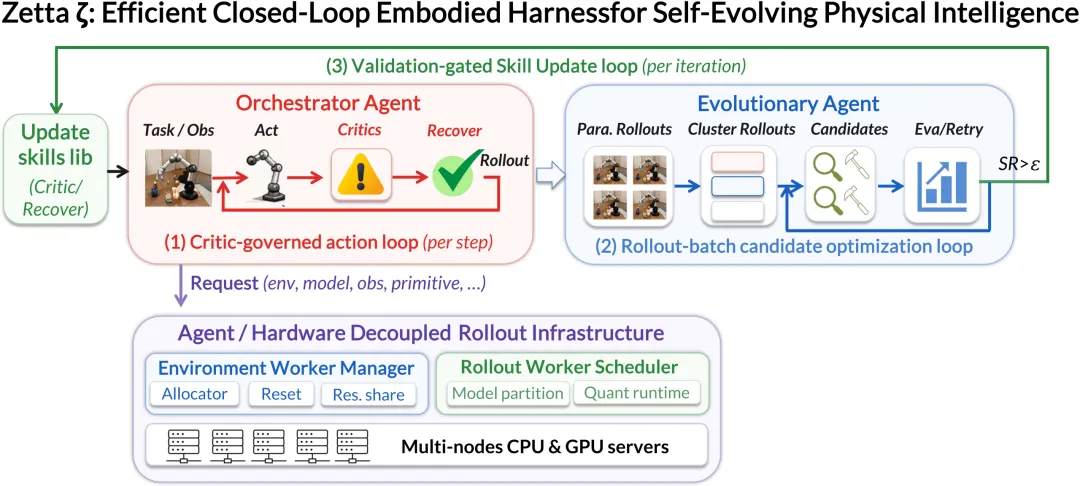
Zetta ζ learns to evolve independently online and solves the puzzle of intelligent landing:
03 Zetta Z evolving three closed rings
The core of the Zetta Z is composed of three different time-scale locks, which together form a self-evolutionary flywheel.
The first round: Critical-Governed Action Loop
At the action execution frequency, critics continue to monitor the physical state of the robot when Zetta ζ is running. Once abnormalities such as clutching, contact loss, transport stagnation are detected, the system immediately triggers the reset action, rather than waiting for the entire episode to fail. Once the reset is complete, there is a strict VLA Re-entry Contract: only confirm that the failure has been cleared, the physical state is restored to stability, and control security returns the original VLA model.
Second round: Rollout-Batch Candidate Optimization Loop
After the robot completes a set of tasks, Zetta ζ clusters and causes the failure trajectory to be diagnosed. It not only looks at whether the task has been successful at the end, but also locates the time points that deviate from the normal state at the earliest, and progressively moves along the level of the task evaluation → Critic → Status representation → Planning control → Recovery → Parameter array to find the root causes that really need to be corrected.
The third round: Validation-Gated Skill Update Loop
Candidate updates cannot be directly online. Zetta ζ will first perform a historical regression test and then verify on strictly isolated held-out data. Only those that really improve success rates and can be generalized to new scenarios updates will be written into the skill memory library. This ensures that robots do not over-fit to cling to a failed sample box.
This is the first time I've ever seen a robot.
During the evolution of the Zetta Z, researchers observed a very interesting phenomenon: the success rate did not rise smoothly, but went through a period of platforming and then jumped.
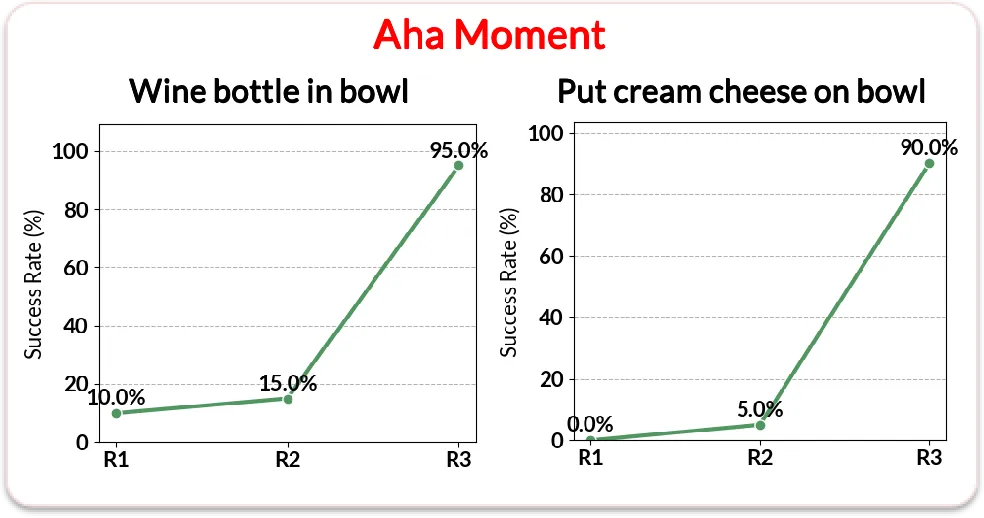
The following are two examples:
Put the bottle in the bowl: success rate from 15% → 95%;
Put the cream cheese in the bowl: success rate from 5% → 90%;
Similar jump ups have been made at RoboCasa, including the task of turning on the water pump, pushing the dishwasher drawer, closing the oven door, and placing the coffee cup.
Round0: The tactical model is able to correctly identify the coffee cup and the coffee machine and begin transportation; however, due to the lack of continuous checks on the grip hold and the collision gap when approaching the coffee machine, the mechanical arm collides and loses the coffee cup. The tactical model fails to identify this local physical anomaly in time, ultimately causing the mission to fail.
Round1: Zetta ζ evolved from failure to a touch-perceived operating skill. Its critic constantly monitors grip, object drift and collision risk; after triggering, recovery transports the coffee cup under safe spacing conditions and ends the takeover after confirming a stable placement.
On another Libero-Pro benchmark, the same phenomenon occurs, for example, in the task of pushing the plate to the front of the stove.
Round 0: Encounters with failure 0 and fails to keep grabbing after grabbing the plate.
Round 1: Critic1 (retained-grasp) is presented to identify whether the disk has been steadily grabbing the grain and to take over the transport with Recovery1 (retained-object transport) to resolve the failure0; it subsequently encounters failure1 in the process of grabbing the lost grain and fails to do so.
Round 2: Based on the effectiveness of Critic1 and Recovery1, Critic2 (carry-retention) is proposed to identify the crawling crawling crawling crawling crawling crawling crawling crawling crawling crawling crawling crawling crawling crawling crawling crawling crawling crawling crawling crawling crawling crawling crawling crawling crawling crawling crawling crawling crawling crawling crawling crawling crawling crawling crawling crawling crawling crawling crawling crawling crawling crawling crawling crawling crawling crawling crawling crawling crawling crawling crawling crawling crawling crawling crawling crawling crawling crawling crawling crawling crawling crawling crawling crawling crawling crawling crawling crawling crawling crawling crawling crawling crawling crawling crawling crawling crawling crawling crawling crawling crawling crawling crawling crawling crawling crawling crawling crawling crawling crawling crawling crawling crawling crawling crawling crawling crawling crawling cling cling cling cling cling cling cling cling cling cling cling cling cling cling cling cling cling c cling c c c c cling cling c cling cling cling c c c c c c cling cling cling c cling c c cling c cling c c c c c cling c c c c cling c cling c c c c c c c c cling c c c c cling c c c c cling c cling c c c c cling c c c c cling c c c c c cling c c c c c cling c c c c c c c c c c c c cling c c c c c c c c c c c cling c c c c c c c c c c c c c c c c c c
More importantly, these leaps were not realized by training models, increasing parameters or man-made modeling. Zetta Z helped the robot find the key physical state variables that determined its success. For example: whether to confirm that the crawler crawler holds steady steam before transport; whether to establish a sufficiently stable physical contact with the crawler when touching the target; and whether the end executor is within the geometry of the crawler's VLA model before approaching the target.
These findings may seem simple, but the question is whether a robot can move from an occasional successful pump to a stable and reliable pump.
05 Continued evolution and thriving
Aha Moment is not an isolated one-time breakthrough. More remarkably, Zetta ζ's success rate shows a continuous, reproducible scaling trend as evolutionary cycles continue to increase. On LIBERO-Pro, the pure VLA baseline has an average success rate of only 34.5%, with Zetta ζ continuously accumulating Critic Acid Recovery, eventually reaching 90.8%. On RoboCasa, the success rate increased from 73.6% to 93.6%.
Each round of evolution involves identifying and correcting the most important physical execution bottlenecks currently in place, which may be errors of approximation to geometry, unstable grab hold, premature release, stagnation of execution, or unfinished mission relationships. As these tiny mechanisms accumulate, the robot's control over the physical world increases, and the success rate of the mission moves one step closer to freezing the VLA itself.
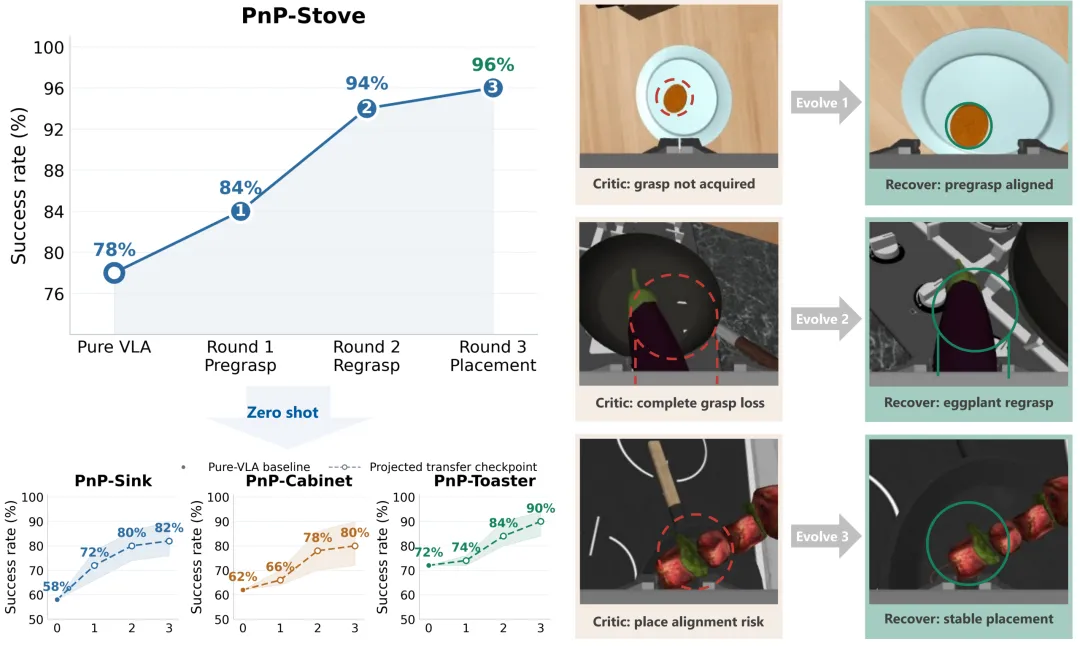
In the PnP-Stove mission, three rounds of evolution repaired the pre-crawling, recrawling, and placement phases for missions respectively, gradually increasing the success rate from 78% of pure VLAs to 84%, 94% and 96%; the same harness does not need to be re-optimized for targeted missions to improve the zero-sample performance gained on missions such as PnP-Sink, PnP-Cabinet, and PnP-Toaster.
06 Real performance: Zetta ζ's performance on the simulation benchmark far exceeds existing methods
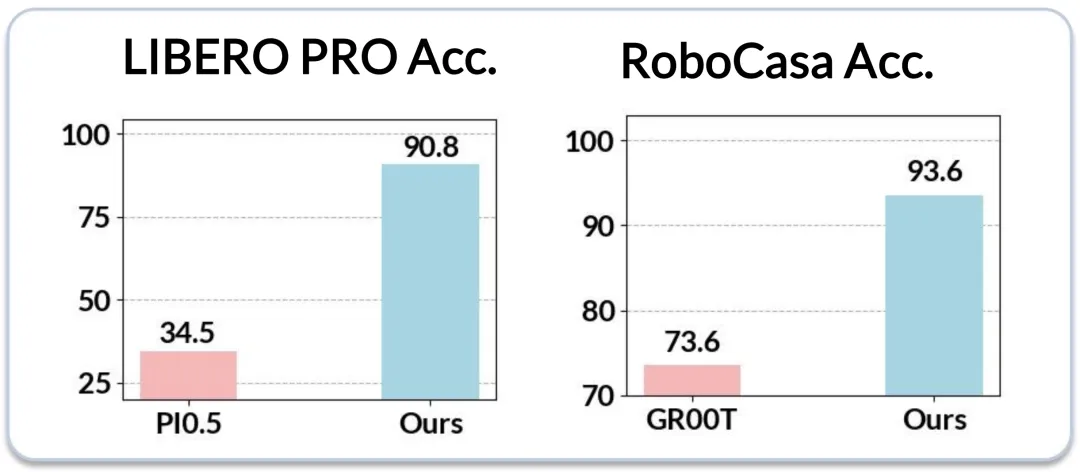
The Zetta ζ average success rate at LIBERO-Pro Goal: 34.5% → 90.8%; the average success rate at RoboCasa's 18 Atomic-Seen missions: 73.56% → 93.56%; absolute improvement of 20 percentage points, and improvement particularly evident on extensive, long-range missions. These improvements are all due to the continuous evolution of the execution system.
07 Z-Infra: Zetta ζ High-efficiency self-development infrastructure
The environment is the source of learning data, and the faster the rollout, the faster the evolution. Z-Infra, backed by Zetta ζ, was the first rollout infrastructure aimed at an autonomous intelligent body. Its design idea was clear: to completely dismantle the logic of intelligent agents and the complexity of hardware resources.
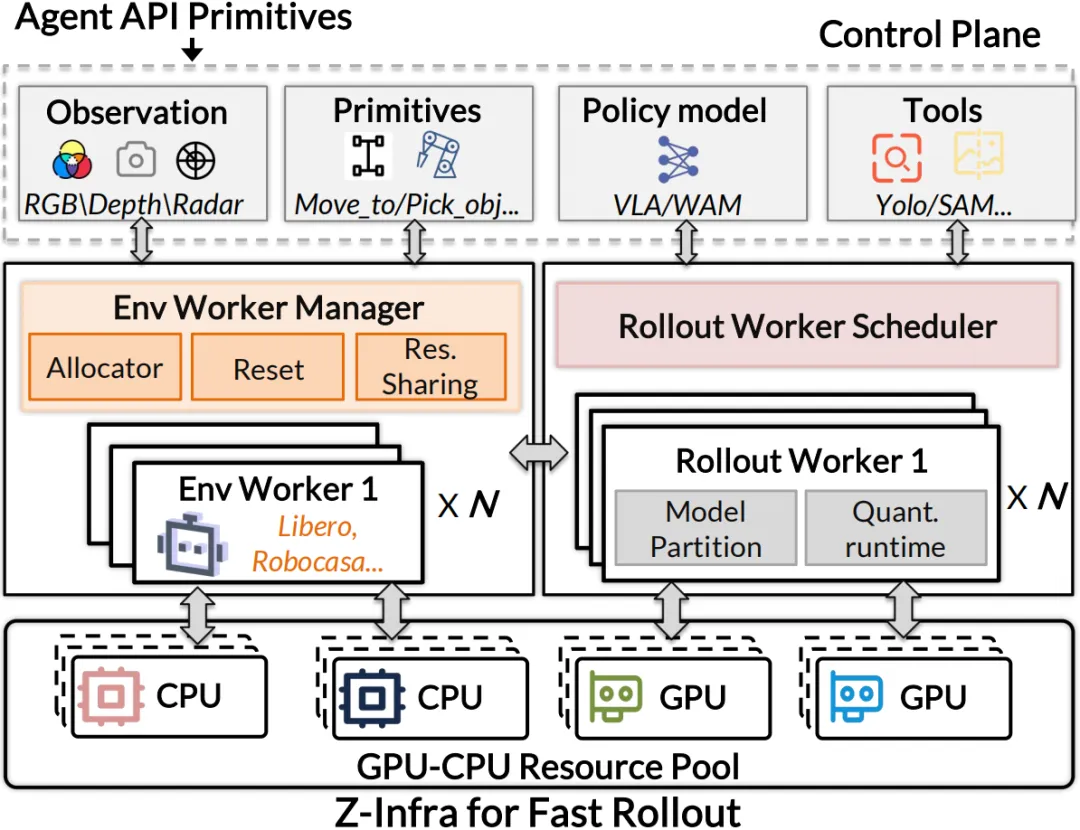
The architecture is divided into three layers:
Control Plane: Unified scheduling, routing, and lifecycle management;
Environment Worker: Manage the simulated environment, sessions, and physical states of a heterogeneous worker;
Rollout Worker: responsible for VLA/WAM model reasoning, dynamic batching, asynchronous scheduling.
Z-Infra has also implemented:
Model partition deployment: dismantle VLM and Action Expert into separate processes, along with CUDA IPC transmission;
Quantitative plugins: Select W8A8 / W4A16 / W4A8 by module, balancing speed and success rate;
Resource sharing groups: Multiple simulation sessions share model compilation and rendering on context, significantly reducing repeat costs.
Effective rollout throughput increased from 1.7 episodes/min to 35.1 episodes/min, up 20.6x; throughput increased 12.8x compared to HarnessVLA; single-episode delay decreased by 11.9x; and after deployment of π0.5 model segments, average reasoning delay decreased by 53% and goodput increased by 2.4x.
Why is this worthy of attention?
For a long time, the idea of scaling with physical intelligence was primarily to build stacks of data, stacks of parameters, and stacks of arithmetic to train larger models. Zetta ζ proposed another path: not to change the underlying strategic model, but to continue to evolve the executive system around it.
The value of this route is:
Lower cost: no need for repetitive training/modelling;
Deployment is more user-friendly: reliability can be directly enhanced based on existing models;
Continuous evolution: Robots can use real environmental data to become more and more powerful after deployment;
Movable: Physical skills accumulated in a task can be replicated for related tasks.
Of course, this does not mean that end-to-end VLA/WAM is no longer important. On the contrary, Zetta ζ supplements the most needed closed-loop governance capabilities of the physical world on top of existing model capabilities. The research team also said that future plans are to scale up Zetta ζ to real robots: allowing real robots to also perform large-scale parallel rollouts; bridging the sim-to-real gap; and using real robots as the first-class citizen rollout nodes in Z-Infra.
What's wrong with you?
Zetta ζ shows us that the evolution of physically intelligent people does not necessarily depend on larger model models, but also on smarter intelligent body systems.
There's also the Aha Moment, and what Zetta Z has to do is keep this realization and evolution going.