The disease of big companies is almost an inevitable product of corporate growth.
As the scale expands, processes change, approvals change, decisions slow down, and friction builds up, ultimately dragging on overall efficiency.
OpenAI is expanding rapidly, with a workforce expected to exceed 8,000 by the end of the year.
In a recent report, Richmond cited a set of friction mechanisms.
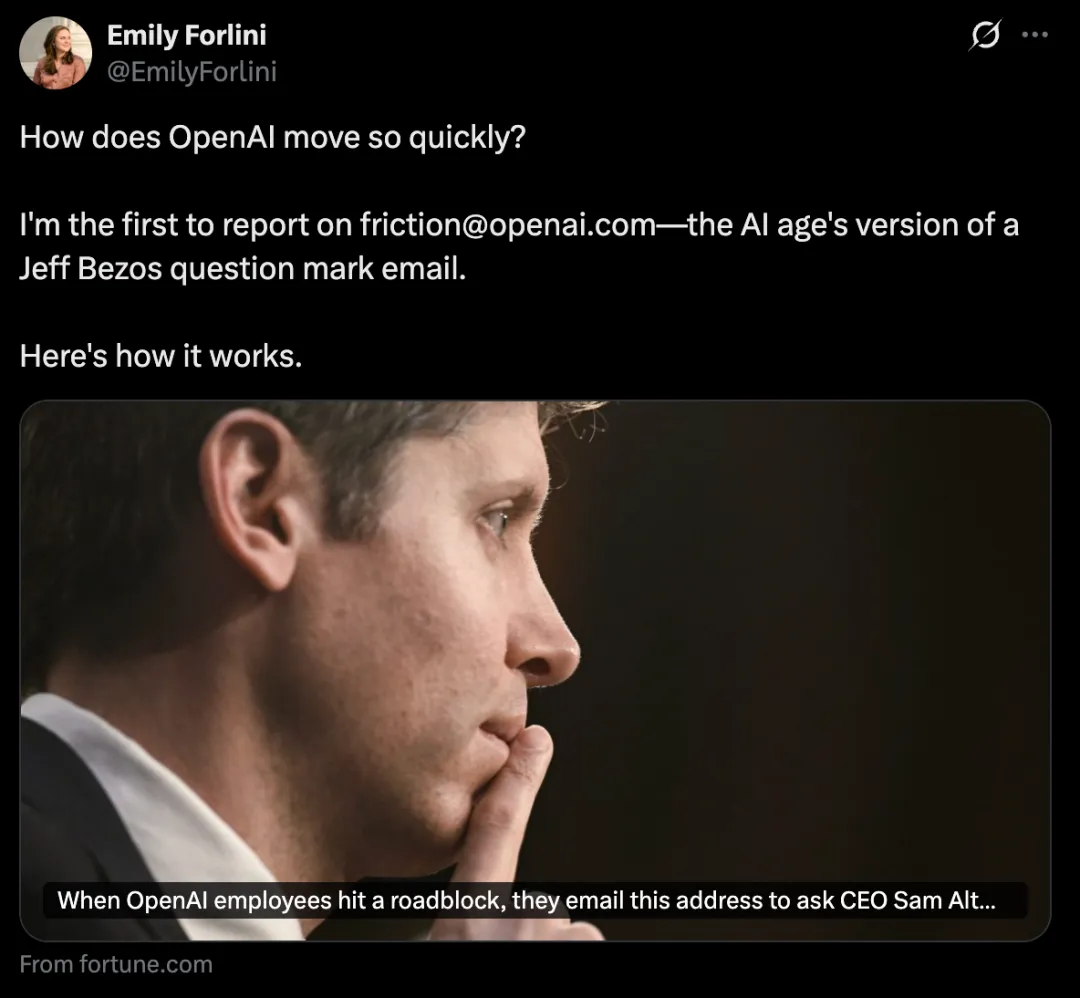
In OpenAI, an email can directly change the priorities of a team's work.
This email address is friction@openai.com. friction, which means "resistance" or "friction".
OpenAI's leadership team will screen for these issues, and once they are determined to be worth solving, they will enter the fast-track corridor, with important issues that could shock CEO Sam Ottman or President Greg Brockman.
OpenAI has little to do with email, and internal communication is largely dependent on Slack, but this friction@ is an exception.
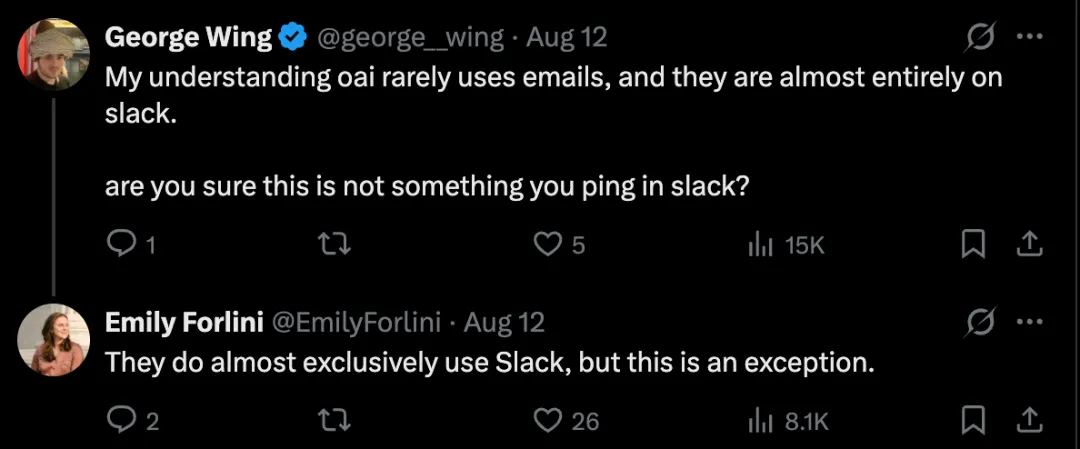
Any employee can send a question to the CEO
According to Bloomberg, the problem with friction@ varies in size.
In order to alleviate parking space tensions, OpenAI has launched a pilot to prioritize the provision of parking spaces for employees over long commuting distances. Employees have suggested that the company needs to improve API allocation processes to ensure that allocations are stable and distributed on a large scale.
A former OpenAI employee believes that this mechanism allows management to directly get first-line feedback, issues that do not need layered reporting, and can be addressed before they accumulate into more trouble.
"Anyone can tell Sam the crap about big companies, and they'll take action", said the former employee, "if you want to get rid of bureaucracy ruthlessly, you have to calm down".
As OpenAI expands rapidly, this channel becomes even more important. The company expects to have more than 8,000 employees by the end of the year, with offices throughout the United States and other countries. The larger the organization, the more friction associated with approval, collaboration and resource allocation.
The new CEO is institutionalizing this mailbox.
The friction@ mailbox has been around for a long time within OpenAI and was initially not widely used.
In the fall of 2025, Fidji Simo joined OpenAI as the CEO of the application business. She spent three months inside the company doing "listening tours", talking to employees at all levels, focusing on issues within the company.
Fidji Simo believes that bureaucracy usually doesn't come out of nowhere. An unnecessary meeting, multiple approvals, and small setbacks can only make it 1% or 2% more difficult to work each time. These problems can be easily overlooked, but overlapping over the long term will ultimately significantly slow down the entire organization.
She subsequently built a clearer processing process for the friction@ system, arranging the OpenAI strategic plan with Irina Kofman, vice president of operations, who was responsible for monitoring mailbox and tracking progress. The company also began to report progress to all employees on a monthly basis via Slack.
In early July, Fidji Simo left OpenAI for health reasons to focus on his own medical startup company.
Some call for good, some call for misery.
Not all employees like friction.
A former OpenAI team leader said he had received "dozens" of friction emails during his tenure. For a team with a long-term shortage of people and overloaded with tasks, each level rise could disrupt the original arrangements.
OpenAI's work culture has always been known for its high intensity. Employees work long hours, often overtime and even late at night. In this environment, a friction email can suddenly trigger an unpopular "firefighting operation".
"As long as Sam and Greg feel something is worth dealing with, as long as the problem is solved, a friction task will start immediately. The person responsible for causing the blockage can almost be told to shut up and take care of it, which is absolutely not a joke, and you have to put your hands down".
Speed is the only priority
In the fierce competition to build and release the latest AI models, other costs seem to be temporary as long as they eliminate any factor that slows down.
In December 2025, OpenAI internally sounded a "red alert" requiring employees to concentrate resources on developing strategic products to counter competitors such as Google and Anthropic. In this environment, any internal blockage could affect product progress.
The friction mechanism is also reminiscent of Amazon's "question number email". In the past, when customers complained to Jeff Bezos, if the problem was worth investigating, he would forward the email to the relevant team, literally with only one question number. The team that received the email must investigate and solve the problem immediately.
Amazon primarily handles complaints from external customers, with OpenAI focusing on internal blocks, both using a similar management approach, with direct intervention from top management to compress the communication chain.
Other AI companies have different solutions
OpenAI's competitors are also looking for their own management methods.
Anthropic opts to improve the transparency of internal information. Employees have an open Slack Notebook for sharing ideas and work progress, which others can view at any time and can directly challenge management's judgments.
CEO Dario Amodei regularly posts on Slack explaining company strategies and important decisions and open discussions with employees. This allows for long-term retention of decision-making context and reduces the loss of information in level transmission.
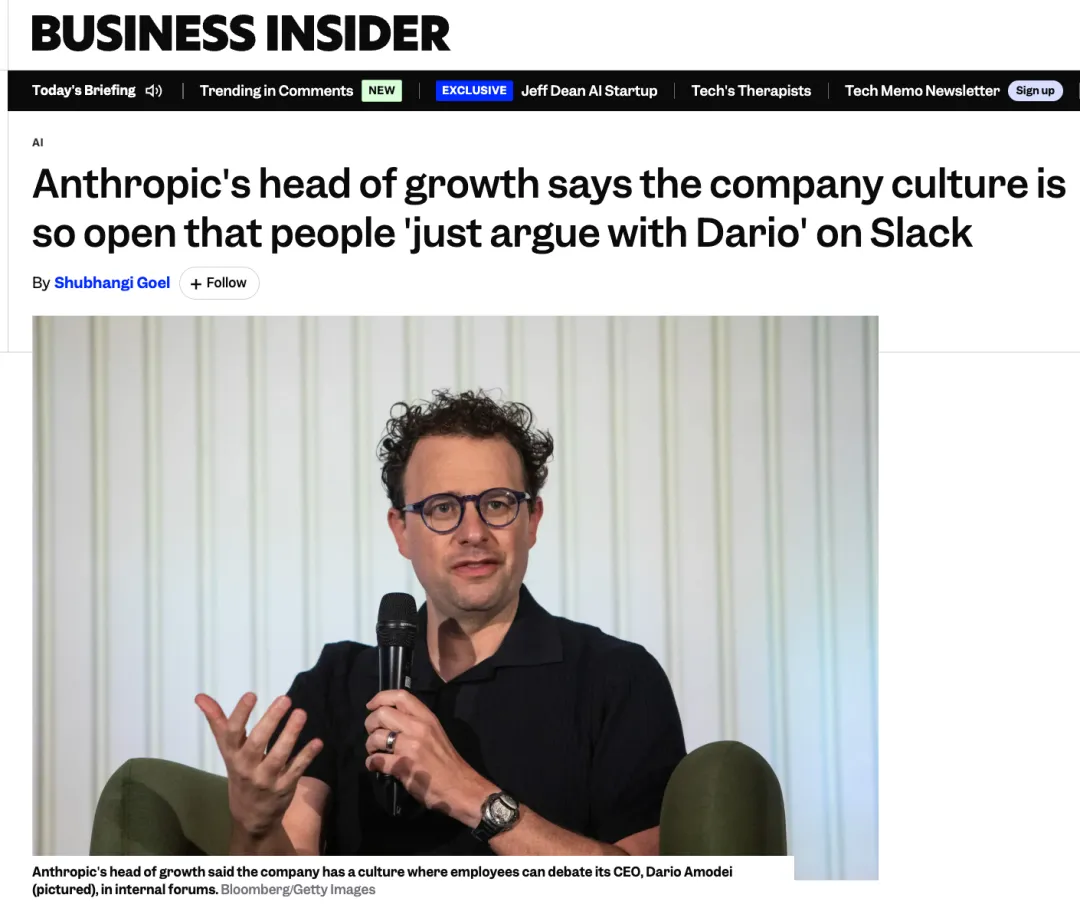
Anthropic also emphasizes a high-confidence, low-self-esteem organizational culture. Employees need to communicate directly, take action on urgent tasks, and prioritize finding simple, feasible solutions.
Google is directly compressing the management level. By the end of 2024, the company has cut about 10% of the positions of managers, directors and vice presidents; in 2025, the number of managers managing three or smaller teams is down 35% from a year earlier.
friction reflects the real-world challenges of OpenAI expansion. The company wants to maintain the response rate of its startup team while also managing a global organization of thousands of people. Whether this mechanism works in the long run will ultimately depend on whether senior management can accurately determine priorities and whether the executive team has enough resources.
The link is as follows: