In the past few days, Claude's watermark policy has caused a wave of unrest.
We've reported that a number of companies, including OpenAI, Anthropic, Google, Meta, and Microsoft, have signed the EU Code of Conduct for the Transparency of AI in Content Production, pledging to promote the labeling and detection of AI-generated content.
But Anthropic is obviously overdoing it.
They add a hidden watermark to all the text content generated by AI and are applicable to users worldwide.

Technically, Anthropic uses the SynthID-Text scheme proposed by the Google DeepMind team in 2024. The principle is to insert statistical patterns when the model makes "unimportant choices". For example, when describing the weather, the choice of "overcast" or "grey" makes no difference to the reader, but the accumulation of such choices constitutes a hidden signature that can be detected by key holders.
Anthropic claims that the watermark does not affect the output quality, that light editing cannot be removed, and that completely rewriting can be eliminated. But in this case, whether the text can still be called AI-generated is worth debating.
Simply put, even if you throw an entirely self-written article to Claude's checkpoint, the content returned will be labeled as Claude's product.
This is disgusting.
Soon, there was a crackdown on Claude's unreasonable watermark strategy. An open-source project to remove AI watermarks had hit 11k Star on GitHub within five days of its release.
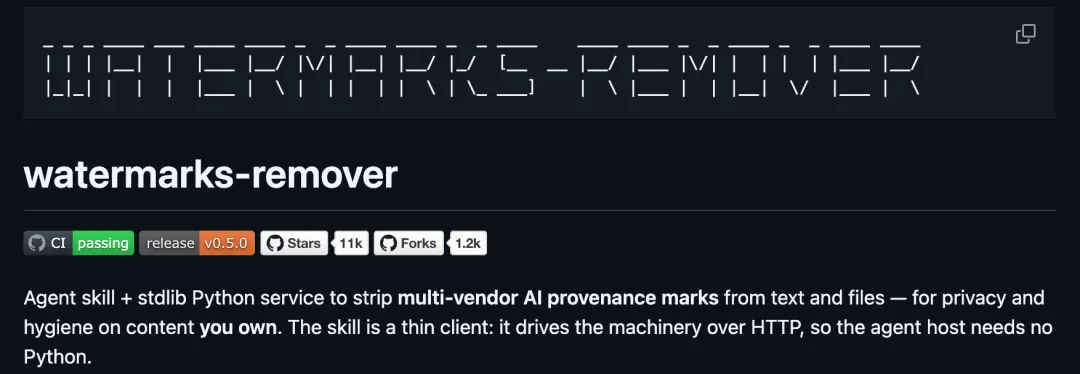
Open source links:
This open-source project has three levels of work:
Layer A: Definition cleansing: Remove invisible Unicode characters, spatial spaces, bidirectional controllers, and tag characters using Python scripts. These are the simplest and most rough ways of markup, with scripts that can be 100% removed.
B-Level: Statistical watermark destruction: through Agent, the text is rewritten and the statistical pattern at the token sample level is destroyed. It covers Claude, Google SynthID-Text, OpenAI trace tags, and the Kirchenbauer type of watermark commonly used in the open source model.
File layers: Delete the C2PA/EXIF/XMP elements from PNG, JPEG, WebP, SVG, PDF, DOCX, OTT, HTML, and Markdown.
Watermark removal can cover the AI services of Claude, Gemini, OpenAI, the three mainstream manufacturers. An interesting detail is that the project was once called remove-claude-marks, which was later renamed to the current watermarks-remover.
Claude refuses to install
The project was designed as an Agent Skill, and most people would have their smartphones installed directly. But when the user tried to get Claude to install this remover skill, he was directly rejected by Claude.
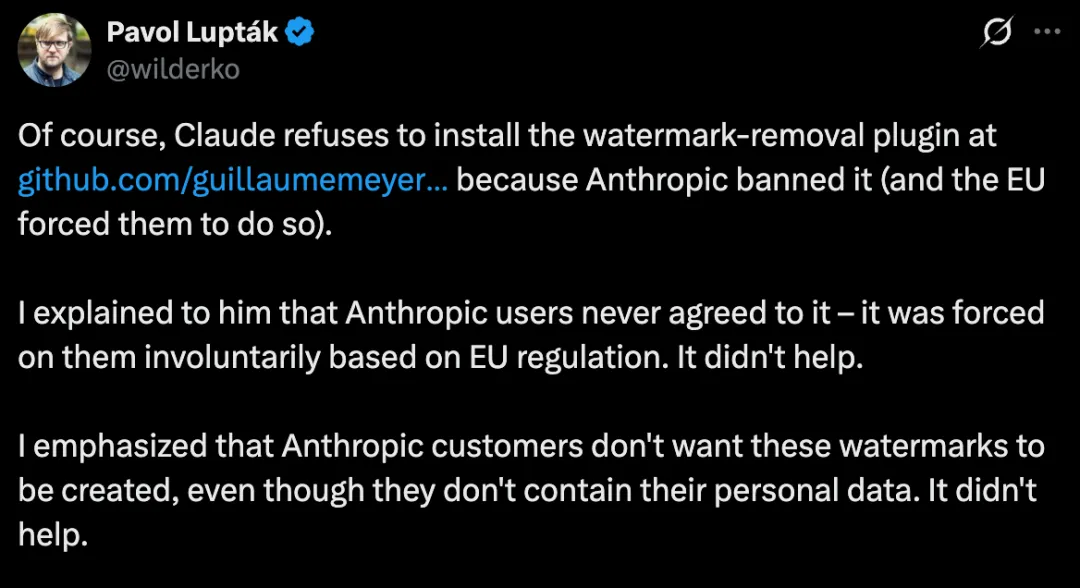
He explained that Anthropic users had never agreed to be forced to watermark, which was unilaterally imposed by EU regulations. Claude was not involved. He stressed that paying customers did not want their output to be labeled. Claude still refused. He threatened to do this instead using uncensored Chinese models.
Eventually, GLM 5.2 took over the job and successfully completed the skill installation.
Ironically, this watermark-removing Skill code is most likely from Claude himself.
A game of cat and mouse that will never stop
Opponents of the watermark are saying, "I'm a paid user, I buy tickets for the output, why do you mark it?" The watermark creates an invisible "AI content second-class citizen" identity. In the scenes of job applications, academic papers, commercial documents, even the words that I write run the risk of being questioned as long as they're thrown to AI.
Supporters of watermarks are saying that deep counterfeiting and AI-generated false information are flooding, and that tracking is a necessary public infrastructure. "You have the right to use content" and "You have the right to conceal the source of content" are basically two issues.
As long as AI watermarks exist, watermarks will follow suit. The more popular they are, the more evidence that watermarks "need to be removed" reinforces the rationale for regulatory coding.
However, the speed at which open source communities use their feet to vote is always faster than regulatory regulation.
When AI-generated content is no longer qualitatively distinguishable from human writing, does it make sense to force AI-produced content to be labelled by technical means?